
That sharp, blue-white zap—a tiny flash and snap as you brush past your decorated tree or reach for a bulb—is startling enough to make you pause mid-holiday cheer. It’s not imagination. Real micro-sparks occur in homes across North America every December, especially around live-cut evergreens. But is it just static electricity dancing harmlessly in the dry winter air—or a warning sign of something more serious? The answer lies at the intersection of botany, physics, and household electrical safety. Understanding what’s happening—and distinguishing between benign static discharge and genuine fire risk—is essential for protecting your home, your family, and your peace of mind during the holidays.
The Science Behind the Spark: Why Trees Become Tiny Lightning Rods
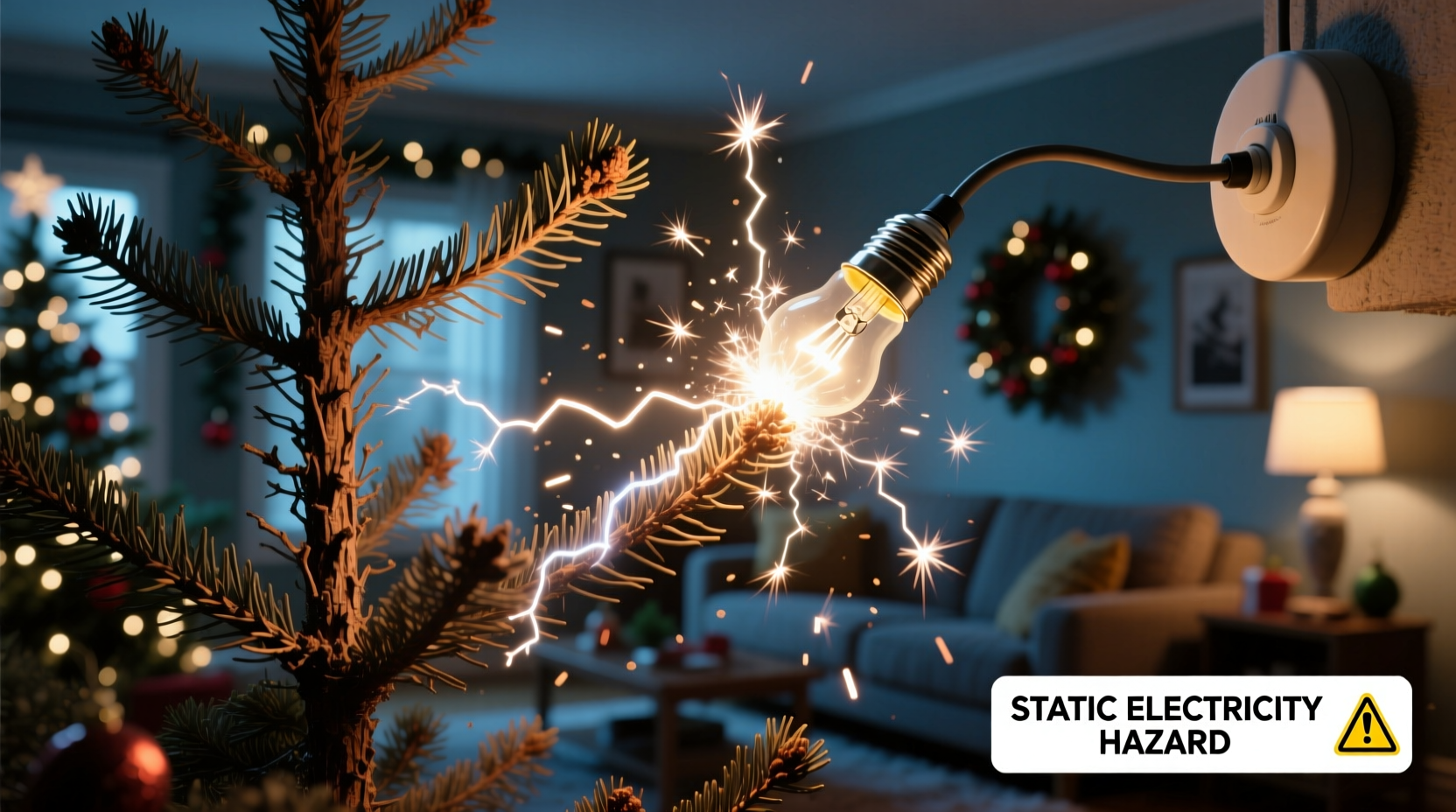
A live-cut Christmas tree—whether Fraser fir, Balsam fir, or Douglas fir—isn’t just wood and needles. It’s a complex, porous, water-rich organism that begins drying out the moment it’s cut. Over 7–10 days indoors, moisture loss accelerates dramatically: a healthy 7-foot tree can lose up to 1 gallon of water per day in heated, low-humidity environments (often below 20% RH). As internal moisture drops, the tree’s electrical resistance increases. Its surface becomes increasingly insulating—ideal for accumulating static charge.
Static electricity builds through triboelectric charging: when two dissimilar materials rub together (e.g., wool sweater and tree needles, or even air currents moving across dry branches), electrons transfer. The tree acts like a capacitor—storing charge until it finds a path to ground. That path might be your finger, a metal ornament hanger, or a nearby light string. When the voltage difference exceeds the breakdown threshold of the air gap (typically 3,000 volts per millimeter), electrons jump across—creating visible plasma, audible crackle, and localized heat. This is *not* current flowing through wiring—it’s electrostatic discharge (ESD), identical in nature to shocks from doorknobs or car doors.
Crucially, this phenomenon is far more common with natural trees than artificial ones—not because plastic is inherently “safer,” but because fresh-cut trees have higher surface resistivity *and* emit volatile organic compounds (terpenes) that subtly alter local air ionization. Artificial trees, especially older PVC models, can also generate static—but usually only when rubbed vigorously with synthetic fabrics.
When Sparking Is Harmless—And When It’s Not
Most holiday sparks are electrostatic and pose no fire hazard. They’re brief (<1 nanosecond), low-energy (<10 millijoules), and localized. A true electrical fault—like frayed insulation, overloaded circuits, or faulty sockets—produces fundamentally different behavior: sustained buzzing, warm cords, flickering lights, burning smells, or repeated sparking *at the same point* on a wire or plug. That kind of spark draws continuous current, generates measurable heat, and can ignite nearby flammable material—including dry tree needles.
Here’s how to tell the difference:
| Characteristic | Static Spark (Typically Safe) | Electrical Fault Spark (Potentially Dangerous) |
|---|---|---|
| Timing | Occurs only upon contact or proximity; never when tree is undisturbed | Occurs spontaneously—even when no one is near; may happen repeatedly in same spot |
| Location | At tips of branches, ornaments, or where clothing brushes foliage | At cord connections, socket housings, plug ends, or damaged wire sections |
| Sensory Clues | Single sharp pop; cool sensation; no odor | Warm/hot components; ozone or burning plastic smell; visible melting or discoloration |
| Consistency | Worsens in dry air; improves with humidification or anti-static spray | Unaffected by humidity; persists or worsens over time |
| Risk Level | Minimal fire risk; primarily startling | High fire risk; requires immediate disconnection and inspection |
Real-World Scenario: The Anderson Family Tree Incident
In December 2022, the Andersons in suburban Minneapolis noticed frequent sparks near the top of their 7.5-foot Balsam fir—especially when their toddler reached for a glass ball ornament. Assuming it was “just static,” they added a humidifier and wiped branches with diluted fabric softener (a common DIY anti-static hack). The sparks lessened but didn’t disappear. On Christmas Eve, while adjusting a strand of vintage mini-lights, Sarah Anderson saw a sustained orange arc—about ½ inch long—jump from a socket to a metal star topper. She immediately unplugged everything. An electrician later found cracked insulation on a 15-year-old light string where wires had been bent repeatedly at the same junction box. The tree’s dryness hadn’t caused the fault—but it had lowered the air’s dielectric strength, making arcing easier once the wiring failed. The tree itself was fine. The lights were condemned. Their quick response likely prevented ignition.
This case underscores a critical nuance: static doesn’t *cause* wiring failures—but it can expose or accelerate them. A dry tree won’t spark dangerously unless there’s already a latent electrical vulnerability nearby.
Proven Prevention Strategies: From Physics to Practice
Preventing nuisance sparks—and eliminating real hazards—requires a layered approach. Start with environmental control, then address tree care, lighting safety, and grounding practices.
Step-by-Step Holiday Static & Safety Protocol
- Hydrate early and often: Make a fresh ½-inch cut at the base before placing in stand. Use a reservoir-style stand holding at least 1 gallon. Check water level twice daily—never let the base go dry. A well-hydrated tree holds 30–50% more moisture, reducing surface resistivity.
- Raise indoor humidity: Target 35–45% relative humidity using a console or whole-house humidifier. Below 30%, static generation increases exponentially. Place hygrometers near the tree and living areas.
- Choose lights wisely: Use only UL-listed LED strings (cooler operation, lower voltage). Avoid incandescent bulbs near dry branches. Replace any string with cracked insulation, bent pins, or corroded sockets—even if it “still works.”
- Ground potential differences: Run a bare copper wire (14-gauge) from a grounded outlet screw or cold water pipe to a small metal plate screwed into the tree stand. This equalizes charge without creating a shock path. Do *not* attach directly to lights or outlets.
- Anti-static treatment (optional): Lightly mist branches with a solution of 1 part liquid fabric softener to 10 parts water using a clean spray bottle. Test on a hidden branch first. Avoid oversaturation—it can promote mold or attract dust.
“People conflate ‘sparking’ with ‘electrocution risk.’ In reality, 95% of tree sparks are static—and completely separable from electrical safety. But that 5% matters profoundly. Always rule out wiring faults first—before reaching for the humidifier.” — Dr. Lena Torres, Electrical Safety Researcher, National Fire Protection Association (NFPA)
Essential Safety Checklist Before Lighting Up
- ✅ Inspect every light string for exposed wires, cracked sockets, bent prongs, or darkened connectors
- ✅ Verify all extension cords are rated for indoor use and have polarized (one wide/one narrow) plugs
- ✅ Confirm total wattage of connected lights stays under 80% of circuit capacity (e.g., max 1,440W on a 15-amp circuit)
- ✅ Place tree at least 3 feet from heat sources (fireplaces, radiators, vents, candles)
- ✅ Install working smoke alarms on every level—and test them now, not on Christmas morning
- ✅ Keep pets and children from chewing cords or pulling ornaments with wires
- ✅ Set a calendar reminder to check water level daily for the first 14 days
FAQ: Your Top Questions Answered
Can static sparks from my tree ignite a fire?
Under normal circumstances, no. Electrostatic discharges from dry trees rarely exceed 25 millijoules—well below the 40+ mJ minimum typically needed to ignite dry pine needles in lab conditions. However, if the spark occurs *simultaneously* with an existing electrical fault (e.g., a hot short circuit), it can act as an ignition catalyst. That’s why eliminating wiring defects is non-negotiable.
Why do some trees spark more than others?
Species matter. Firs (Balsam, Fraser, Noble) retain moisture longer and spark less than spruces (Blue, Norway) or pines (Scotch, White), which dry faster and develop higher surface resistance. Cut date is equally critical: a tree cut more than 72 hours before display loses up to 40% of its water-absorbing capacity at the base. Always buy local, ask when it was cut, and get it in water within 2 hours.
Is it safe to use a “static guard” spray on my tree?
Commercial anti-static sprays designed for fabrics or electronics are *not* tested or approved for use on live plants. Many contain flammable propellants or alcohol-based solvents that could increase fire load. Stick to the proven, low-risk fabric softener dilution (1:10) or prioritize hydration and humidity instead.
Conclusion: Spark Smart, Celebrate Safely
Your Christmas tree shouldn’t be a source of anxiety—or a physics experiment gone awry. That sudden zap is usually just nature reminding you how dry your house has become, not a portent of disaster. But dismissing *all* sparks as harmless ignores the very real, preventable risks posed by aging lights, overloaded circuits, and neglected maintenance. The most thoughtful holiday preparation isn’t about perfection—it’s about informed vigilance. Hydrate your tree like it’s precious (it is). Treat your lights like the electrical devices they are (they are). And remember: the safest tree isn’t the one that never sparks—it’s the one you’ve prepared with quiet attention, grounded in both science and care.
This season, choose presence over panic. Check your outlets. Refill the stand. Adjust the humidifier. Then step back, breathe, and enjoy the quiet glow—knowing you’ve done more than decorate. You’ve protected.




 浙公网安备
33010002000092号
浙公网安备
33010002000092号 浙B2-20120091-4
Comments
No comments yet. Why don't you start the discussion?