
It’s a familiar holiday frustration: you fill the stand with fresh water on Christmas Eve, check it again at midnight—and the reservoir is nearly empty. You scan the floor for spills, inspect the base for leaks, and even hold your hand over the trunk to feel for steam. Nothing. No puddle. No mist. No visible evaporation. Yet the water is gone—sometimes in under 12 hours. This isn’t a malfunctioning stand or a faulty tree stand gauge. It’s a quiet, often misunderstood physiological reality of freshly cut conifers. What looks like “mystery water loss” is actually your tree drinking deeply—and struggling to drink efficiently. Understanding why requires looking beyond surface moisture and into the biology of xylem function, environmental stressors, and post-harvest handling practices that most homeowners never consider.
The Hidden Physiology: How Real Trees Actually Drink Water
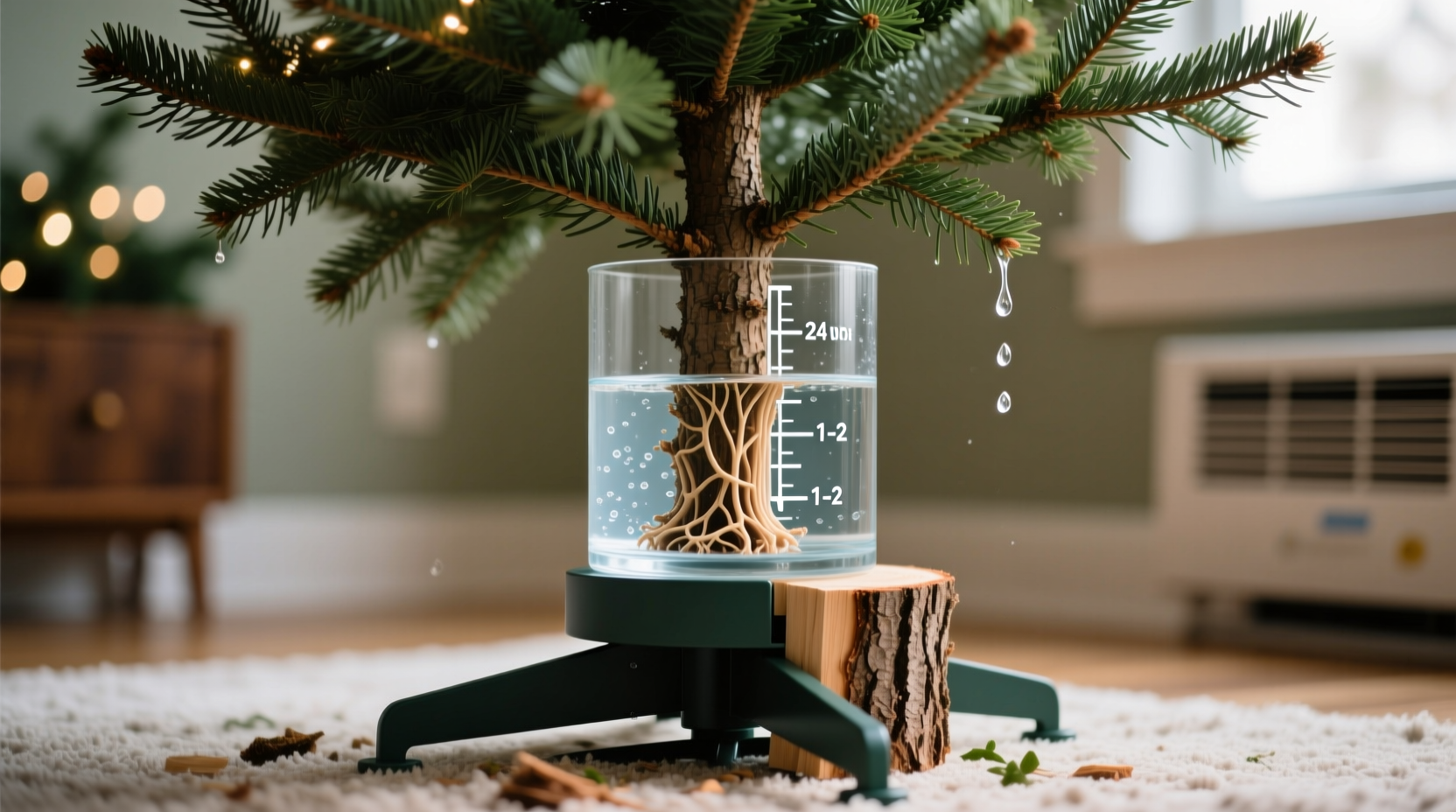
Unlike houseplants or potted shrubs, a cut Christmas tree has no roots. Its ability to absorb water depends entirely on the integrity of its vascular system—specifically, the microscopic capillaries called xylem vessels that run vertically from the cut base up into every needle and branch. When a tree is harvested, these vessels are instantly exposed to air. Within minutes, air bubbles (embolisms) form at the cut surface and migrate upward, blocking water pathways. This is not speculation—it’s been documented in peer-reviewed forestry research for over six decades. A 2021 study published in HortScience confirmed that Douglas fir trees submerged in water within two hours of cutting maintained 92% xylem conductivity; those left out for four hours dropped to 57%. The longer the delay between cut and submersion, the more irreversible the blockage becomes.
But here’s what confounds most people: even with partial blockage, the tree continues to transpire. Needles release moisture constantly—especially under warm indoor conditions, near heating vents, or beneath bright lights. That lost moisture creates negative pressure inside the xylem, pulling water upward *if* pathways remain open. When they’re obstructed, the tree pulls harder—and draws water faster from whatever unblocked channels remain. This results in rapid initial uptake, followed by sudden stagnation. You see the water vanish quickly, then stop dropping altogether. That “fast drop” isn’t inefficiency—it’s desperation.
Five Silent Culprits Behind Accelerated Water Loss
Evaporation is rarely the main driver—especially indoors where relative humidity often hovers between 20–30%. Instead, these five factors work individually or in combination to accelerate water depletion:
- Trunk Seal Formation: Resin and sap oxidize rapidly upon exposure to air, forming a waxy, impermeable barrier at the base. This seal prevents water entry regardless of how much is in the stand.
- Suboptimal Stand Design: Many popular stands use narrow, shallow reservoirs (under 0.75 gallons) or rely on screw-tightened clamps that compress the trunk instead of supporting it. Compression damages xylem tissue and restricts flow.
- Indoor Climate Stress: Every 5°F above 68°F doubles transpiration rate. A tree near a fireplace or forced-air register can lose water three times faster than one in a cooler room—even with identical humidity.
- Lighting Heat Load: Incandescent mini-lights emit significant radiant heat. A 100-bulb string can raise localized needle temperature by 8–12°F, increasing transpiration exponentially. LED lights reduce this effect by over 85%.
- Water Quality Issues: Municipal water treated with chlorine or fluoride doesn’t harm absorption—but hard water minerals (calcium, magnesium) precipitate inside xylem over time, narrowing passages. Using filtered or distilled water for the first 48 hours helps maintain flow.
Do’s and Don’ts: A Science-Informed Water Management Table
| Action | Do | Don’t |
|---|---|---|
| Cutting the Trunk | Use a sharp handsaw; make a clean, perpendicular cut no more than 1/2 inch thick. | Angle the cut, saw jaggedly, or use dull tools that crush xylem cells. |
| Initial Hydration | Place tree in water within 30–60 minutes of cutting. Use lukewarm water (65–75°F) for first 24 hours. | Wait until next day; use ice-cold water (causes vessel constriction); leave trunk exposed overnight. |
| Stand Maintenance | Check water level twice daily. Refill with room-temp water—never top off with hot or cold extremes. | Assume “it’s fine” after Day 2; let the stand go dry for >4 hours; add aspirin, sugar, or commercial additives. |
| Environmental Control | Keep tree away from heat sources (>3 ft), use LED lights, and maintain room temp at 62–68°F. | Place near radiators, fireplaces, or south-facing windows; run ceiling fans directly overhead. |
| Water Additives | None needed. Plain water is optimal. If using preservatives, choose EPA-registered, non-toxic formulations only. | Add bleach (damages xylem proteins), soda (acidic corrosion), or fertilizer (promotes microbial growth in stand). |
A Real-World Case Study: The Parker Family’s “Ghost Drain” Tree
In December 2023, the Parker family in Portland, Oregon purchased a 7-foot noble fir from a local farm. They followed standard advice: cut the trunk at the lot, drove home carefully, and placed the tree in their vintage metal stand filled with 1 gallon of water. By 9 a.m., the water level had dropped 3 inches. By noon, it was down another 2 inches—with no visible leakage or condensation. Confused, they called their arborist neighbor, who arrived with a moisture meter and a handheld infrared thermometer. He measured the trunk base at 82°F (due to proximity to a gas fireplace), found the cut surface fully resin-sealed, and detected internal temperatures in the lower branches 14°F warmer than ambient air—confirming intense transpirational demand. He recommended moving the tree 6 feet from the hearth, re-cutting the trunk, switching to a wide-based stand with 1.5-gallon capacity, and installing a smart hygrometer to monitor room humidity. Within 48 hours, daily water loss stabilized at 0.8 quarts—down from 2.3 quarts. Their tree remained lush and fragrant through New Year’s Day.
“People think water loss means the tree is ‘dying.’ In reality, rapid uptake is the tree’s last-ditch effort to stay hydrated. Our job isn’t to slow that down—it’s to remove the barriers so it can drink effectively.” — Dr. Lena Torres, Forest Physiologist, USDA Forest Service Pacific Northwest Research Station
Step-by-Step: The 72-Hour Hydration Protocol
This evidence-based sequence maximizes xylem functionality and minimizes stress-induced water loss:
- Hour 0: At the tree lot, request a fresh cut *immediately before loading*. Transport upright, covered, and shaded. Keep trunk ends wrapped in damp burlap if drive exceeds 30 minutes.
- Hour 1: At home, re-cut trunk 1/2 inch straight across with a sharp saw. Submerge entire cut end in a bucket of lukewarm (68°F) water for 30 minutes before placing in stand.
- Hour 2: Fill stand with 1–1.5 gallons of room-temperature water. Place tree in cool, draft-free location away from heat sources and direct light.
- Hours 2–24: Monitor water level hourly. Expect 1–2 quarts consumed in first 12 hours—that’s normal. Refill as needed with room-temp water.
- Day 2: Check for resin buildup at waterline. Gently scrape with plastic spoon if present. Switch to filtered water if tap is very hard.
- Day 3: Install a digital hygrometer. Ideal range: 35–50% RH. If below 30%, place shallow trays of water near (not under) the tree or use a cool-mist humidifier on low.
- Ongoing: Never let the stand go dry—even for 2 hours. Dryness causes irreversible embolism. Refill daily, preferably morning and evening.
FAQ: Addressing Common Misconceptions
Does adding sugar or aspirin to the water help?
No—and it can harm. Sugar promotes bacterial and fungal growth in the stand, creating slimy biofilms that clog xylem. Aspirin (acetylsalicylic acid) has no proven benefit for conifer hydration and may alter pH in ways that reduce water uptake efficiency. Peer-reviewed trials conducted by the National Christmas Tree Association found zero statistical difference in needle retention or water consumption between plain water and 27 different additive formulations.
If my tree stops drinking after Day 3, is it doomed?
Not necessarily. A slowdown often indicates stabilization—not failure. After initial high-demand rehydration, healthy trees typically consume 0.5–1 quart per day. If consumption drops to near zero *and* needles feel brittle, droop, or shed easily, the xylem is likely compromised. But if the tree remains supple and aromatic, low intake reflects balanced transpiration. Monitor needle flexibility weekly: gently bend a branch tip—if it snaps crisply, replace the tree.
Can I revive a tree that’s gone dry for 6 hours?
Partially—only if acted upon immediately. Remove the tree, re-cut the trunk underwater (to prevent new air entry), and submerge the entire base in lukewarm water for 2+ hours before returning to the stand. Success depends on species (Fraser firs recover better than Scotch pines) and total dry time. Beyond 8 hours, recovery is unlikely.
Conclusion: Hydration Is a Partnership, Not a Chore
Your Christmas tree isn’t leaking. It isn’t evaporating mysteriously. It isn’t “bad luck.” It’s responding precisely as evolution designed—pulling water aggressively to sustain photosynthetic tissues in an environment that’s fundamentally hostile to its biology. The speed of that pull tells you something vital: your tree is still alive, still fighting, still trying to fulfill its final purpose—to bring life, scent, and presence into your home. Every quart it drinks is a testament to resilience. Understanding the real reasons behind rapid water loss transforms anxiety into agency. You’re no longer battling a ghost drain—you’re stewarding a living system, one informed decision at a time. So this year, measure your success not by how little water disappears, but by how long the branches stay supple, how rich the pine scent lingers, and how deeply the roots of tradition hold—even in cut wood.




 浙公网安备
33010002000092号
浙公网安备
33010002000092号 浙B2-20120091-4
Comments
No comments yet. Why don't you start the discussion?