
It’s a familiar holiday frustration: you’ve arranged your miniature houses with care, strung delicate garlands across cobblestone paths, and placed tiny lamplights just so—only for the entire village to dim, pulse, or flicker violently the moment you flip the switch on your 300-bulb LED tree. This isn’t faulty craftsmanship or a defective transformer—it’s physics in action. Voltage sag, circuit overload, and impedance mismatches between lighting systems are silently disrupting your festive display. And while it may seem like a minor nuisance, persistent flickering can shorten the lifespan of delicate village components, cause transformer overheating, and even signal underlying wiring hazards that extend beyond seasonal decor.
This issue sits at the intersection of household electrical infrastructure and modern low-voltage electronics. Most Christmas villages operate on 12–24V AC or DC power supplies (often labeled “village transformers” or “village adapters”), while tree lights typically draw from standard 120V AC household circuits. When both systems share the same branch circuit—or worse, the same outlet strip—the sudden inrush current from tree lights can momentarily depress voltage across the entire circuit, starving the village’s power supply of stable input. The result? A visible, rhythmic flicker as the village’s internal regulators struggle to compensate.
The Root Cause: Voltage Sag and Shared Circuit Loading
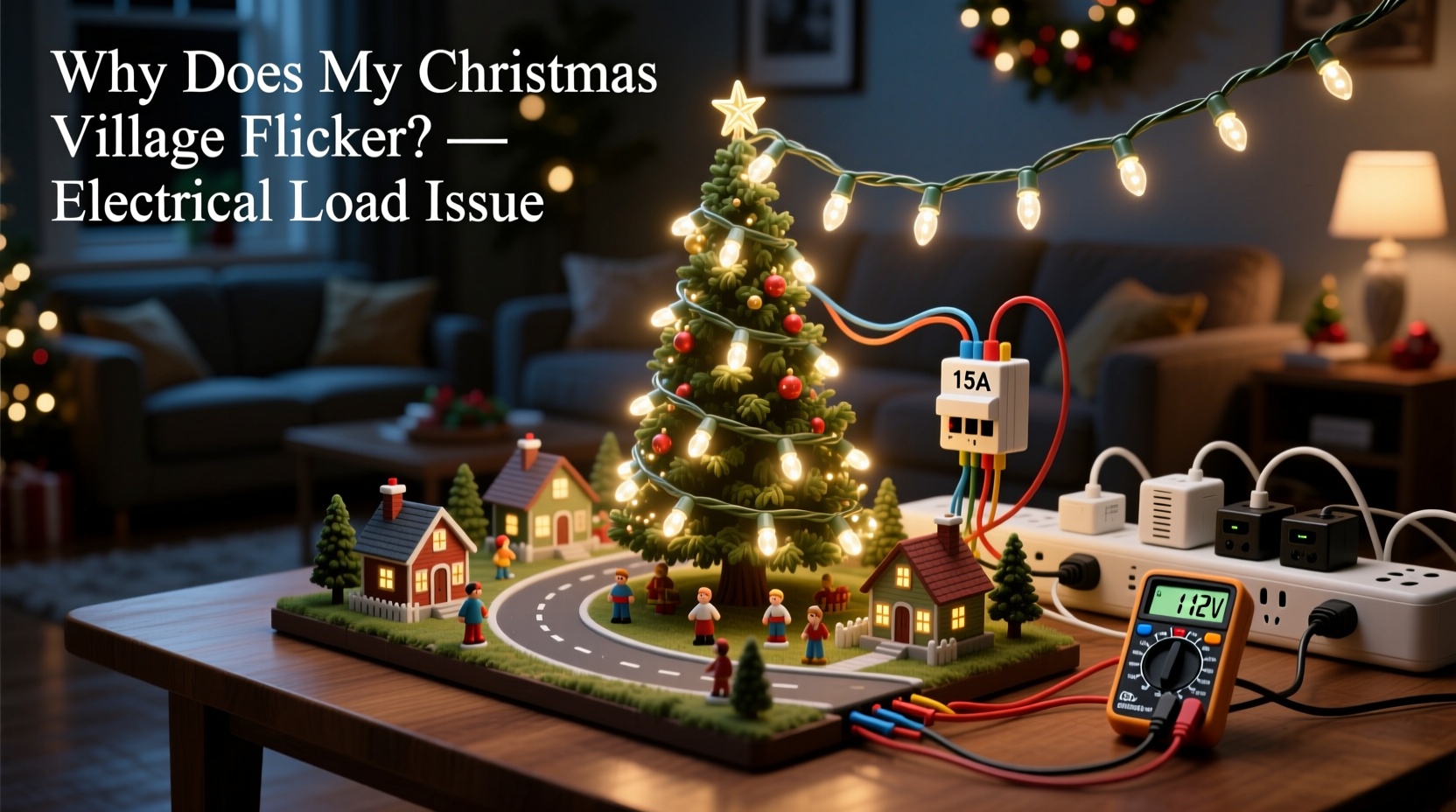
Every standard U.S. residential circuit is rated for 15 or 20 amps at 120 volts—translating to 1,800 or 2,400 watts maximum. While individual LED tree lights consume far less than older incandescent strings (typically 5–25W per 100 bulbs), cumulative loads add up quickly: a 7-foot pre-lit tree may use 60–90W; add a 50-light animated wreath (12W), two garlands (8W each), and a 12-piece village set drawing 20–35W via its transformer, and you’re already approaching 150W on a single outlet. That seems modest—until you consider inrush current.
When LEDs power on, their drivers draw 2–5× their rated wattage for the first 100–500 milliseconds. A 75W tree string might surge to 300W momentarily. That brief but intense demand pulls voltage down across the circuit—sometimes by 5–12 volts. If your village transformer requires a minimum of 105V input to maintain stable 12V output (and most do), even a 7V dip can trigger brownout protection or cause ripple in the regulated output. The flicker you see is the village’s lights cycling on/off as its power supply drops below operational threshold and recovers.
How to Diagnose the Real Culprit (Not Just the Symptom)
Flickering isn’t always about raw wattage. It’s often about where the load is applied and how devices interact electrically. Start with these diagnostic steps:
- Unplug everything except the village. Observe operation for 5 minutes. Does it run steadily? If yes, the issue is external loading.
- Add one light string at a time. Plug in your tree lights *alone*—no other decorations. Does flickering begin? If yes, the tree is the primary offender.
- Check outlet voltage under load. Using a multimeter, measure voltage at the outlet powering the village transformer *before* and *immediately after* turning on the tree. A drop exceeding 4V confirms significant voltage sag.
- Listen and smell. A faint buzzing from the village transformer or warm-to-hot casing after 10 minutes signals overloading or poor regulation—not just flickering.
- Test with a known-clean source. Power the village from a different circuit (e.g., kitchen counter outlet) while running the tree on its original circuit. If flickering stops, circuit sharing is confirmed.
Crucially, don’t assume “LED = low impact.” Many budget LED strings use cheap capacitive dropper drivers that introduce harmonic distortion and reactive power—making them especially disruptive to sensitive low-voltage supplies. Higher-end strings with active PFC (power factor correction) drivers behave more cleanly.
Do’s and Don’ts: Electrical Safety & Village Stability
| Action | Do | Don’t |
|---|---|---|
| Circuit Management | Assign village + tree to separate 15A circuits. Verify breaker labels or use a circuit tracer. | Plug both into the same outlet strip—even one rated for 15A. |
| Transformer Selection | Use a regulated, switching-mode transformer with wide-input range (e.g., 90–130V) and ≥25% headroom above village’s rated wattage. | Reuse an old unregulated “wall-wart” transformer rated exactly at village wattage. |
| Wiring Practice | Run village power directly from outlet—no extension cords longer than 6 feet. Use 14-gauge cord if extending. | Chain multiple 50-foot extension cords to reach the village. |
| Load Timing | Turn on village first, wait 30 seconds for stabilization, then power tree lights. | Flip all switches simultaneously with a smart plug timer. |
| Grounding & Filtering | Add a line noise filter (e.g., Tripp Lite ISOBAR) between wall outlet and village transformer. | Assume surge protectors alone will solve flickering. |
A Real-World Case Study: The Elm Street Display
In December 2023, Sarah M., a longtime collector in suburban Ohio, experienced severe flickering across her 18-piece Department 56 village whenever her 9-foot pre-lit Balsam Hill tree powered on. She’d upgraded to “energy-efficient” LED lights and assumed the problem was resolved—yet flickering worsened. Her initial fix was replacing the village transformer ($42), which helped briefly but failed within days. She then measured outlet voltage: 122V at rest, dropping to 109V at tree startup—a 13V sag.
Her home’s 1970s wiring revealed the real issue: the living room outlets were daisy-chained on a single 15A circuit shared with hallway lights, a ceiling fan, and the furnace thermostat. When the tree’s inrush hit, voltage dipped enough to reset the thermostat’s digital board—causing HVAC cycling that further destabilized the circuit.
Sarah’s solution wasn’t bigger hardware—it was smarter distribution. She installed a dedicated 20A circuit (per NEC 210.11(C)(3) for holiday displays) running directly from the panel to a new outlet behind her display cabinet. She also added a $28 Mean Well LRS-100-12 regulated 12V/8.3A power supply (derated to 6.5A continuous) for the village, with a ferrite choke on the DC output line. Flickering vanished. As she noted in her online forum post: “I spent $42 on a band-aid. The real fix cost $220—but it’s been rock-solid for three seasons, and I no longer worry about tripping breakers during holiday gatherings.”
Expert Insight: What Electrical Engineers See
“Flickering villages are rarely about the village itself—they’re a diagnostic red flag for circuit stress. Modern LED loads create complex waveforms that interact poorly with legacy transformers. A 5% voltage dip shouldn’t crash a well-designed system. If it does, either the transformer lacks sufficient hold-up capacitance, the circuit impedance is too high due to long wire runs or corroded connections, or there’s undetected neutral-ground bonding elsewhere on the circuit.”
— Dr. Lena Torres, PE, Senior Applications Engineer at Belkin Power Solutions & IEEE Power Electronics Society Member
Dr. Torres emphasizes that flickering is often the *first observable symptom* of deeper issues: undersized neutral wires in multi-wire branch circuits, loose terminal screws in outlet boxes (a leading cause of arcing and fire risk), or even utility-side voltage regulation problems exacerbated by neighborhood-wide holiday lighting surges.
Step-by-Step: Stabilizing Your Village in Under 30 Minutes
- Unplug all decorations. Turn off tree, village, and any ancillary lights.
- Identify your village’s power requirements. Check label on transformer: input voltage (e.g., “120V AC”), output voltage (e.g., “12V DC”), and output current (e.g., “2.0A”). Multiply V × A to get wattage (12V × 2.0A = 24W).
- Select a robust replacement transformer. Choose one rated for at least 1.5× your calculated wattage (e.g., 36W+), with wide-input range (90–130V) and regulated output. Look for models with “constant voltage” or “CV” designation.
- Map your circuits. Turn off breakers one by one and test which outlets go dark. Identify two physically separate circuits—one for village, one for tree.
- Install isolation. Plug village transformer into Outlet A (Circuit 1). Plug tree lights into Outlet B (Circuit 2)—even if they’re across the room. Avoid power strips entirely for this step.
- Add filtering (optional but recommended). Insert a line noise filter (e.g., Furman PL-8 II) between Circuit 1’s outlet and the village transformer. This suppresses high-frequency transients from the tree’s driver.
- Test sequentially. Power village first. Wait 45 seconds. Then power tree. Observe for 3 minutes. No flicker? You’ve solved it.
FAQ: Addressing Common Concerns
Can I use a UPS (uninterruptible power supply) to stop flickering?
Yes—but only specific types. A line-interactive UPS with AVR (automatic voltage regulation) can correct moderate sags. Avoid basic standby UPS units; they switch too slowly (4–8ms) and won’t prevent flicker. Look for models like CyberPower CP1500AVRLCD with “pure sine wave output” and ≥10ms hold-up time. Note: This treats the symptom, not the root cause of circuit overload.
Why do some villages flicker only at night, not during daytime testing?
Because household baseline load changes. At night, refrigerators cycle, HVAC compressors engage, and laundry appliances may run—raising overall circuit impedance. A marginal setup that works at noon may fail at 7 p.m. when total load peaks. Always test under worst-case conditions: evening hours with major appliances active.
Is flickering dangerous—or just annoying?
It’s potentially hazardous. Repeated voltage cycling stresses transformer insulation, electrolytic capacitors, and LED driver ICs. Overheating can lead to capacitor venting or thermal shutdown failure. More critically, if flickering coincides with buzzing, burning smells, or warm outlets, it may indicate arcing faults requiring immediate electrician inspection per NFPA 70E guidelines.
Conclusion: Stability Is Part of the Season’s Spirit
Your Christmas village isn’t just decoration—it’s memory, tradition, and intention made tangible. Every hand-placed figurine, every snow-dusted roofline, reflects care that deserves reliable, quiet operation. Flickering disrupts that reverence. But understanding the electrical reality behind it transforms frustration into empowerment. You now know that flickering isn’t magic failing—it’s physics signaling a need for thoughtful infrastructure. With the right transformer, intelligent circuit separation, and awareness of inrush behavior, you can reclaim stability without sacrificing scale or sparkle.
Start tonight. Pull out your multimeter. Trace one circuit. Swap one transformer. That small act honors not just your display—but the safety and serenity of your home during the season that matters most. Because true holiday magic isn’t in flawless perfection—it’s in the quiet confidence that your lights will shine, steady and sure, for every carol sung and every story told.




 浙公网安备
33010002000092号
浙公网安备
33010002000092号 浙B2-20120091-4
Comments
No comments yet. Why don't you start the discussion?