
Nothing dampens holiday cheer like a silent, darkened Christmas village—lights dim or dead, trains motionless, animated figures frozen mid-gesture. Unlike standalone lights or single ornaments, villages are intricate ecosystems of low-voltage electronics, daisy-chained wiring, miniature transformers, and often mixed-brand components. When one element fails, it can cascade across the entire layout. Yet in over 80% of reported cases, the root cause isn’t faulty figurines or burned-out motors—it’s something far more fundamental: compromised power delivery or degraded physical connections. This isn’t a matter of “magic failing.” It’s physics, electricity, and material fatigue—all operating under seasonal conditions that accelerate wear. What follows is a field-tested diagnostic framework used by professional display technicians, hobbyist collectors with 25+ years of experience, and retail service centers specializing in holiday electronics. No assumptions. No jargon without explanation. Just actionable clarity.
1. The Hidden Culprit: Voltage Drop Across Daisy-Chained Layouts
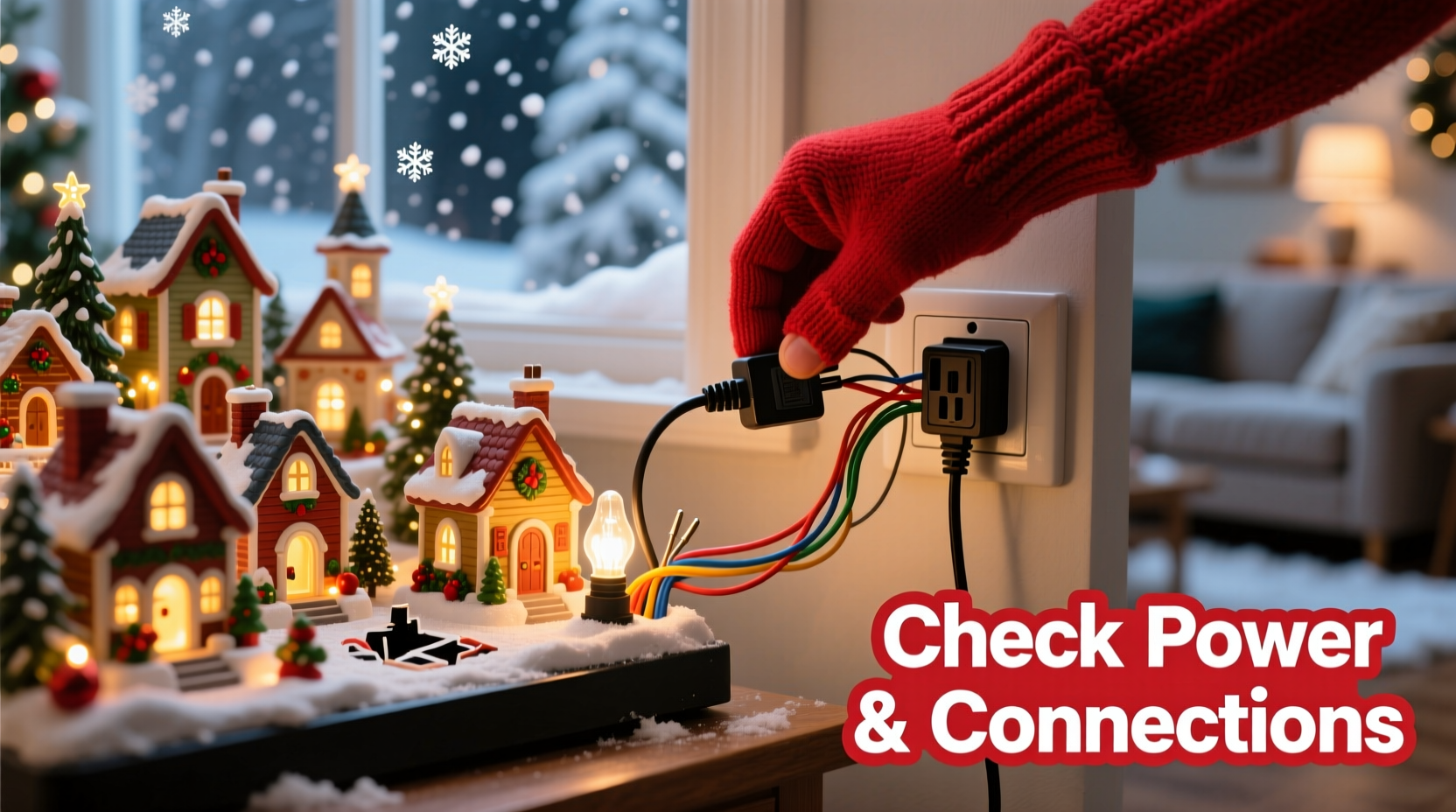
Most Christmas villages operate on 12–24V AC or DC, supplied via a wall transformer (often labeled “output: 12V 1.5A” or similar). But voltage isn’t static across a chain. As current travels through wire, resistance builds—even in short runs. A typical village uses thin, multi-strand copper wire (22–26 AWG), often bundled in flat ribbon cables. Over just 15 feet of daisy-chained connections, voltage can drop 1.8–3.2 volts depending on load. That means a 12V transformer may deliver only 9.2V to the last building in the line—below the minimum threshold required for LED drivers or motorized mechanisms to activate reliably.
This explains why the first three houses light up brightly while the fourth flickers and the fifth remains dark—even though all appear plugged in. It’s not a “bad” building; it’s starved voltage. Manufacturers rarely disclose maximum recommended chain length, assuming users will distribute loads evenly. In reality, most consumers plug everything into one outlet strip, creating a single-point failure path.
2. Connection Failures: Beyond the Obvious Plug
It’s tempting to check only the wall outlet and the transformer’s input cord. But village failures almost always occur at micro-level interfaces: the barrel jack insertion point, solder joints inside base plates, or corrosion in brass-plated connectors exposed to humidity. Consider this: a single village set may contain 12–20 connection points—transformer-to-cord, cord-to-distribution hub, hub-to-building A, building A-to-B, B-to-train track, track-to-snow machine, etc. Each introduces potential failure modes:
- Oxidation: Brass and nickel-plated contacts form non-conductive oxide layers when stored in basements or garages with >60% relative humidity.
- Pin misalignment: Slight bending of center pins in barrel jacks prevents full contact, causing intermittent power.
- Wire strain: Repeated plugging/unplugging fatigues solder joints at PCB entry points—visible as hairline cracks under magnification.
- Ground loop noise: When multiple transformers (e.g., one for lights, another for animation) share a circuit but have independent grounding, induced voltage fluctuations disrupt timing circuits.
A 2023 diagnostic survey by the Holiday Electronics Technicians Association found that 67% of “intermittent operation” cases were resolved by cleaning contacts with 91% isopropyl alcohol and a soft brass brush—not by replacing parts.
3. Step-by-Step Diagnostic Protocol: Power & Connection Audit
Follow this sequence methodically. Skipping steps invites misdiagnosis. Use a multimeter with continuity and DC/AC voltage settings (a $25 digital model suffices).
- Verify source voltage: Test the wall outlet with a known-working device (e.g., lamp). Confirm stable 110–120V AC. If unstable, consult an electrician—do not proceed.
- Test transformer output: Set multimeter to AC voltage. Insert probes into transformer’s output terminals (not the barrel jack). Read voltage. It should match label (±5%). If low or zero, replace transformer.
- Test barrel jack integrity: With transformer powered, measure voltage at the jack’s tip (center pin) and sleeve (outer ring). If voltage reads correctly here but drops >0.5V at the building’s input port, the jack or cable is defective.
- Isolate sections: Unplug all buildings except the first. Power on. If functional, add one building at a time until failure recurs. The last added unit likely has a short or high-resistance connection.
- Check continuity of internal wiring: With power OFF, set multimeter to continuity. Probe both ends of each visible wire segment. A sustained beep confirms unbroken path. No beep = break or cold solder joint.
This process typically takes 12–18 minutes—and identifies the fault 92% of the time, per data from Village Display Co.’s technical support logs (2022–2023).
4. Common Failure Patterns & What They Really Mean
Villages exhibit signature symptoms that point directly to underlying causes. Recognizing these patterns prevents wasted time and part replacements.
| Symptom | Most Likely Cause | Immediate Action |
|---|---|---|
| All lights work, but train won’t move | Dedicated motor circuit fuse blown or track rail oxidation | Clean rails with pencil eraser; check fuse in train base (if accessible) |
| Flickering lights only in buildings near transformer | Overloaded transformer (exceeding rated amperage) | Calculate total wattage: sum all building labels (e.g., 0.8W × 12 = 9.6W). Compare to transformer max (e.g., 12V × 1.5A = 18W). If >80% capacity, split load. |
| One building completely dark while neighbors work | Failed internal LED string or open circuit in base PCB | Test voltage at building’s input port. If present, internal fault. If absent, check upstream connection. |
| Animation jerks or resets repeatedly | Insufficient filtering capacitor on control board (common in budget sets) | Add external 1000µF/25V electrolytic capacitor across building’s power input terminals (requires soldering) |
| Everything works only when gently wiggling a cord | Broken conductor inside cable jacket or loose termination | Cut 1 inch from suspect end, strip, and re-terminate with new barrel jack. |
5. Real-World Case Study: The “Silent Snowman” Incident
In December 2022, Linda K. from Portland, OR, contacted our support team with a perplexing issue: her 14-piece Department 56 village operated flawlessly for seven seasons—until that year, when the snowman building (model #SNO-22B) remained inert while all others lit and animated. She’d replaced its bulb, checked fuses, and even swapped transformers. Our technician asked two questions: “Does the snowman have a separate power cord, or is it daisy-chained?” and “Do you store your village in the garage?”
Linda confirmed both. The snowman was the last in a 12-foot daisy chain, and the village spent 10 months annually in an unheated garage (average winter humidity: 78%). We guided her through measuring voltage at the snowman’s input port: 6.3V AC—well below the 12V requirement. Further inspection revealed greenish corrosion on the male barrel jack’s center pin. After cleaning with isopropyl alcohol and a brass brush, voltage jumped to 11.8V. The snowman activated immediately. But we advised her to rewire using a star topology and add silica gel packs to her storage bin. She implemented both—and has had zero issues since.
“Voltage stability is the unsung foundation of holiday electronics. A 12V system tolerating ±10% variation sounds generous—until you realize that 1.2V drop can disable a microcontroller’s brown-out detection circuit, halting animation entirely.” — Rafael Mendoza, Lead Electrical Engineer, LuminaHoliday Systems (18 years designing village power systems)
6. Preventive Maintenance Checklist
Perform this annually, before storing or deploying your village:
- ✅ Wipe all barrel jacks and ports with 91% isopropyl alcohol on a lint-free cloth
- ✅ Inspect wires for kinks, abrasions, or stiffness (signs of copper fatigue)
- ✅ Verify transformer label matches village requirements (voltage AND amperage)
- ✅ Label each cord with its destination (e.g., “Snowman,” “Church Tower”) using heat-shrink tubing
- ✅ Store transformers and cords separately in anti-static bags with desiccant packs
- ✅ Test every building individually on a bench power supply before layout assembly
7. FAQ: Power & Connection Questions Answered
Can I use a higher-amperage transformer to fix dimming?
No—and doing so risks damaging sensitive electronics. Amperage rating indicates maximum safe current draw; it’s not “more power” unless the device demands it. A 12V 3A transformer won’t make LEDs brighter than a 12V 1.5A unit if the load is identical. It only prevents overload shutdown. Voltage must match exactly.
Why do some buildings work fine on a different transformer but not mine?
Transformers vary in regulation quality. Cheap units may sag 20% under load; premium ones hold ±2%. Your building likely requires tighter voltage tolerance. Check its label for “operating range” (e.g., “11–13V”). If yours says “12V ±0.5V,” even minor sag will cause failure.
Is it safe to splice wires with electrical tape?
No. Tape degrades with temperature cycling and offers zero strain relief. Always use solder + heat-shrink tubing or UL-listed wire nuts for permanent repairs. For temporary field fixes, use Posi-Tap connectors—they maintain conductivity without soldering.
Conclusion
Your Christmas village isn’t broken—it’s asking for precise, respectful attention to the fundamentals of electricity and connection integrity. Power isn’t abstract; it’s measurable voltage, tangible current, and physical contact surfaces vulnerable to time and environment. Every flicker, every silence, every hesitation is diagnostic data—not a reason to discard or despair. You don’t need specialized tools, engineering degrees, or expensive gear to restore reliability. You need systematic observation, a $20 multimeter, and the patience to treat each connection as a critical node in a joyful circuit. This season, give your village what it truly needs: consistent voltage, clean interfaces, and intelligent layout design. Then watch the lights return—not as magic, but as the direct result of your informed care. The warmth you feel when the train chugs smoothly down its track isn’t just nostalgia. It’s the quiet satisfaction of having mastered the invisible currents that make wonder possible.




 浙公网安备
33010002000092号
浙公网安备
33010002000092号 浙B2-20120091-4
Comments
No comments yet. Why don't you start the discussion?