
If your morning coffee carries a bitter, acrid aftertaste reminiscent of ash or overcooked toast, you're not imagining things — something in your brewing process is off. While many assume the issue lies with the beans or the roast level, the real culprit often hides in plain sight: your grinder settings. Poorly calibrated grinds disrupt extraction, leading to underdeveloped or scorched flavors that mimic burning. Understanding the relationship between grind size, brew time, and water temperature can transform your cup from harsh to harmonious.
Coffee isn't just about boiling water and pouring it over grounds. It's a precise chemical reaction where hot water extracts soluble compounds from ground coffee. When this extraction goes wrong — too fast, too slow, too uneven — bitterness dominates. And while dark roasts do carry natural smoky notes, true \"burnt\" flavor is rarely a feature; it’s a flaw. The grinder, often overlooked, plays a starring role in this imbalance.
The Science Behind Burnt-Tasting Coffee
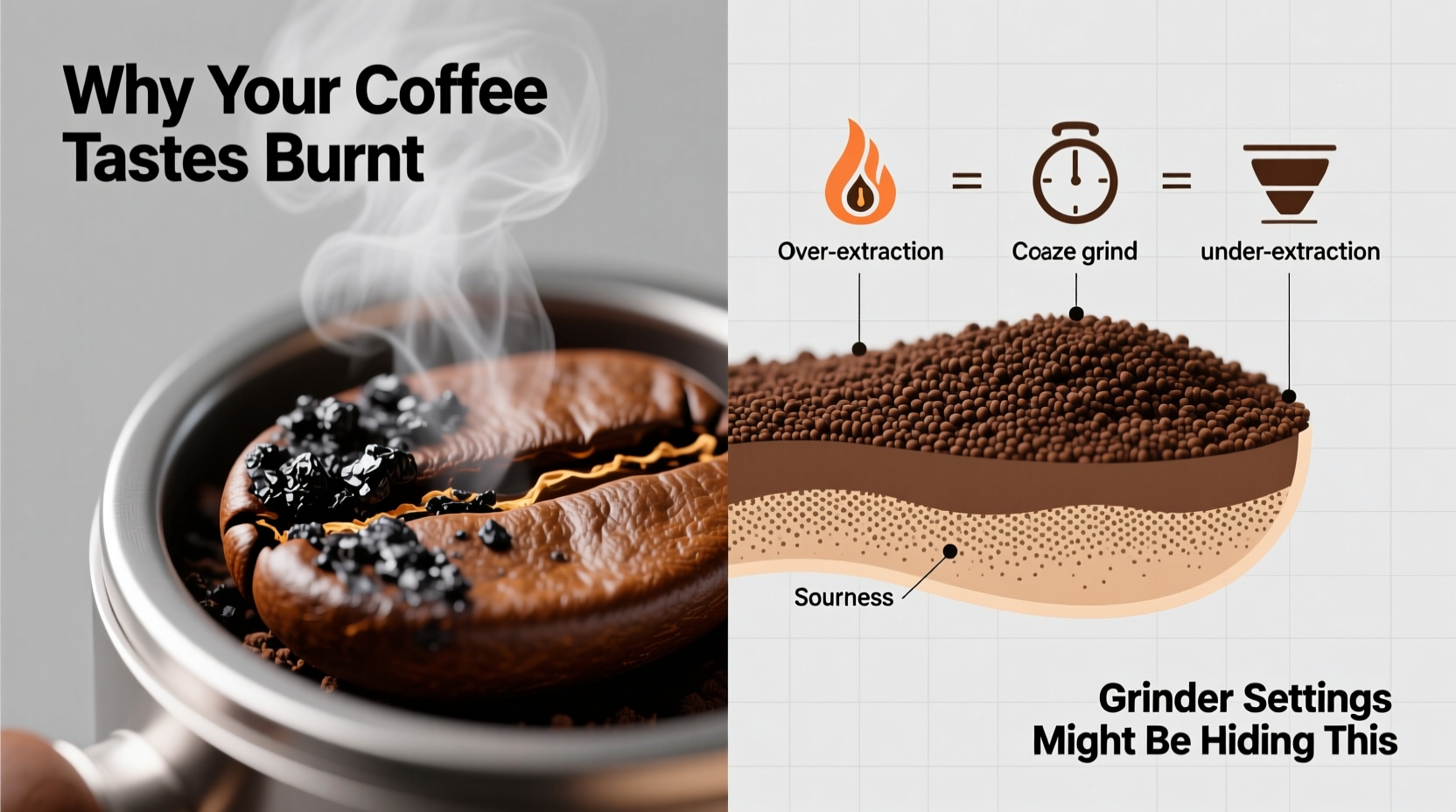
Burnt flavor in coffee doesn’t usually mean the beans were physically burned during roasting — though that can happen. More commonly, it results from over-extraction or thermal degradation during brewing. Over-extraction occurs when water pulls out too many compounds from the coffee, including undesirable bitter ones like lignin and tannins. Under-extraction, paradoxically, can also create sharp, ashy notes because sour and acidic compounds dominate before sweetness develops.
The key factor influencing extraction? Particle size consistency and distribution. A blade grinder chops beans inconsistently, producing a mix of fine dust and coarse chunks. The fines over-extract instantly, contributing harshness, while the coarse bits under-extract, adding sourness. This chaotic profile masks balance and amplifies perceived bitterness.
“Grind quality is the single most impactful variable home brewers overlook. It’s not just size — it’s uniformity.” — Dr. Sarah Nguyen, Coffee Extraction Researcher, Oregon State University
Burr grinders solve this by crushing beans between two abrasive surfaces, yielding far more consistent particles. But even with a burr grinder, incorrect settings can sabotage your brew. Too fine, and water struggles to pass through, extracting bitter compounds. Too coarse, and water rushes through, pulling only sour elements. The sweet spot depends on your brewing method — but misalignment here is likely why your coffee tastes burnt.
How Grinder Settings Influence Flavor Profiles
Different brewing methods demand different grind sizes. Espresso requires a fine grind to withstand high pressure and short contact time. Pour-over needs medium-fine for balanced flow. French press uses coarse to prevent sludge and over-extraction. Using the wrong setting for your method distorts extraction and introduces off-flavors.
For example, using an espresso grind in a drip machine forces water through compacted fines too slowly. This extended dwell time leads to over-extraction, especially if your machine runs hot. Conversely, a coarse grind in a Moka pot produces weak, sour coffee — but some users compensate by turning up the heat, which can literally scorch the brew.
Another hidden issue: static and clumping. Low-quality grinders generate heat and static electricity, causing grounds to stick together. These clumps act like oversized particles, creating channeling — where water finds paths of least resistance, bypassing much of the coffee. The result? Inconsistent extraction, with some parts over-extracted (bitter) and others under-extracted (sour), combining into a flat, burnt-like aftertaste.
Common Grinder Mistakes That Mimic Burnt Flavor
- Using pre-ground coffee: Oxidation begins immediately after grinding. By the time you brew, volatile aromatics are gone, leaving behind flat, stale notes that resemble staleness or burning.
- Not cleaning the grinder: Old oil residues from dark roasts can rancidify, imparting smoky, acrid flavors indistinguishable from burnt coffee.
- Blade grinders: Their inconsistent particle size creates extraction chaos, making balanced brewing nearly impossible.
- Ignoring burr wear: Over time, metal burrs dull, producing more fines and heat, skewing extraction toward bitterness.
- Adjusting by time instead of feel: Many grinders lack precise calibration. Turning the dial “two clicks finer” means nothing if the mechanism is imprecise.
Step-by-Step Guide to Diagnosing and Fixing Burnt Taste
Follow this timeline to isolate and correct the root cause of burnt-tasting coffee:
- Day 1: Reset your grinder. Clean all bean hopper, burrs, and grounds bin. Remove old residue with a brush or compressed air. Reassemble and set to factory default.
- Day 2: Match grind size to brew method. Use the reference table below to select a starting point.
- Day 3: Brew and evaluate. Use fresh, light-to-medium roast beans. Note flavor: Is it bitter? Sour? Flat?
- Day 4: Adjust incrementally. If bitter, coarsen grind slightly. If sour, go finer. Repeat every 24 hours until balanced.
- Day 5: Check water temperature. Ideal range is 195°F–205°F (90°C–96°C). Boiling water (212°F) can scald coffee, especially with fine grinds.
- Day 6: Evaluate machine cleanliness. Descale your brewer. Mineral buildup alters flow rate and heat distribution.
- Day 7: Test with a new bean batch. Rule out poor storage or over-roasted beans.
Grind Size Reference Table by Brewing Method
| Brew Method | Recommended Grind Size | Signs of Being Too Fine | Signs of Being Too Coarse |
|---|---|---|---|
| Espresso | Fine (table salt) | Bitter, dry, slow shot time (>30 sec) | Sour, thin, fast shot (<18 sec) |
| Pour-Over (V60) | Medium-Fine (sand) | Ashy finish, clogged filter | Weak, sour, fast drain (<2:30) |
| French Press | Coarse (breadcrumbs) | Muddy, overly strong, hard to plunge | Watery, sour, gritty sediment |
| AeroPress | Medium (regular sand) | Bitter, difficult plunger action | Sharp acidity, lacks body |
| Drip Machine | Medium (beach sand) | Bitter, lingering aftertaste | Flat, quick brew cycle |
This table serves as a baseline. Individual machines and grinders vary, so use it as a launchpad, not a rigid rule.
Mini Case Study: From Bitter Brew to Balanced Clarity
Mark, a remote worker in Denver, complained his daily pour-over tasted like “campfire leftovers.” He used a popular supermarket dark roast and a $30 blade grinder. His routine: grind beans the night before, store in a jar, brew each morning with boiling water.
After switching to a conical burr grinder and adjusting to a medium-fine setting, he began grinding fresh each morning. He lowered his kettle temperature to 200°F and timed his brew at 2:45. The change was immediate: the sharp bitterness vanished, replaced by chocolatey sweetness and a hint of red fruit — notes he never knew his beans had.
The transformation wasn’t due to better beans alone. It was the combination of consistent grind size and proper extraction timing. His old blade grinder produced extreme fines that extracted instantly, overwhelming the cup with bitterness. The burr grinder eliminated that chaos, allowing balanced flavor development.
Do’s and Don’ts: Avoiding Burnt-Tasting Coffee
| Do | Don’t |
|---|---|
| Grind fresh for each brew | Use pre-ground coffee stored for days |
| Use a burr grinder with adjustable settings | Rely on a blade grinder for precision brewing |
| Store beans in an opaque, airtight container away from light and heat | Keep beans near the stove or in the fridge |
| Brew with water between 195°F and 205°F | Pour boiling water directly onto delicate light roasts |
| Clean your grinder monthly | Ignore oily buildup in the burr chamber |
FAQ: Common Questions About Burnt Coffee and Grinders
Can dark roast coffee taste burnt even when brewed correctly?
Dark roasts naturally have deeper, smoky, and sometimes charred characteristics due to prolonged roasting. However, they shouldn’t taste acrid or ashy. If your dark roast overwhelms with bitterness, check your grind size — too fine will amplify negative traits. Try coarsening the grind slightly and lowering brew temperature to preserve balance.
Does grinder material matter for flavor?
Yes. Conical burrs (usually steel or ceramic) produce less heat and noise than flat burrs, reducing the risk of scorching grounds during grinding. Ceramic burrs resist heat buildup better but may wear faster. High-end grinders also minimize static, ensuring even distribution and preventing clumping that leads to channeling.
Why does my coffee taste worse in the afternoon than in the morning?
This often points to grinder heat retention. Budget grinders heat up after repeated use, altering particle size and potentially scorching the first few seconds of grounds. Let your grinder rest between uses, or consider a model with better heat dissipation. Also, check if you’re reusing old grounds or storing them improperly.
Checklist: Eliminate Burnt Taste in 7 Steps
- Switch to a quality burr grinder if still using blades.
- Always grind immediately before brewing.
- Select the correct grind size for your brewing method.
- Use water between 195°F and 205°F — never boiling.
- Clean your grinder monthly to remove rancid oils.
- Use fresh, well-stored beans (roasted within the past 3 weeks).
- Adjust grind size incrementally based on taste — coarser for bitterness, finer for sourness.
Conclusion: Reclaim Your Coffee’s True Flavor
That burnt taste in your coffee isn’t inevitable — it’s a signal. Your palate is detecting imbalance, and your grinder is likely the source. By treating grind size as a dynamic variable rather than a fixed setting, you unlock control over extraction, flavor, and enjoyment. Small adjustments yield dramatic improvements: a smoother mouthfeel, nuanced sweetness, and aromatic clarity that mass-produced coffee rarely delivers.
You don’t need expensive gear to start. Begin with clean equipment, fresh beans, and mindful experimentation. Track your changes. Taste deliberately. The difference between a harsh, lifeless cup and a vibrant, balanced one often comes down to a half-turn of the grind dial. Take that step today — your perfect brew is closer than you think.




 浙公网安备
33010002000092号
浙公网安备
33010002000092号 浙B2-20120091-4
Comments
No comments yet. Why don't you start the discussion?