
It’s a familiar holiday scene: the cheerful glow of string lights, the scent of pine, and—suddenly—the sharp, insistent barking of your dog, locked in tense vigilance toward a bobbing snowman or a grinning inflatable reindeer that just blinked its LED eyes. What seems like festive whimsy to us can register as deeply unsettling—or even threatening—to a canine nervous system. Animated inflatables combine unpredictable motion, sudden sound effects, reflective surfaces, and unfamiliar silhouettes—all within a context where your dog’s usual environmental cues are disrupted by seasonal decorations. This isn’t “bad behavior.” It’s a biologically grounded stress response rooted in sensory processing, evolutionary vigilance, and learned associations. Understanding *why* the barking happens is the essential first step—not to suppress it, but to compassionately address its source.
The Canine Sensory Reality Behind the Barking
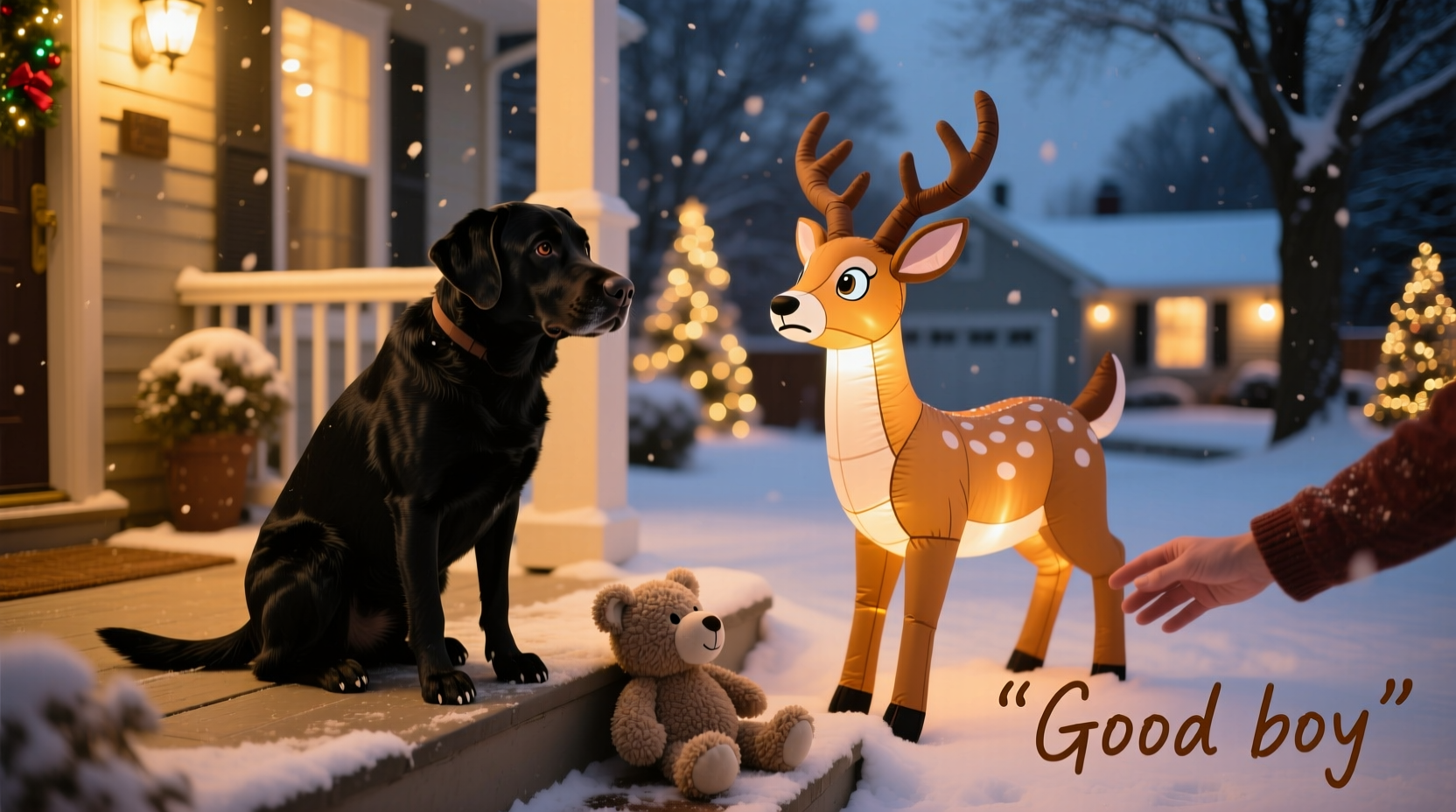
Dogs perceive the world through a sensory lens vastly different from ours. Their hearing range extends up to 65 kHz (nearly double humans’ 20 kHz ceiling), making them acutely sensitive to the high-frequency whine of inflation motors, intermittent compressor pulses, and even ultrasonic components in some LED controllers. Their vision prioritizes motion detection over fine detail—so a slow, swaying inflatable appears as a series of startling, disjointed movements rather than a cohesive object. Add to this the fact that many inflatables emit low-level infrared heat signatures (from internal bulbs or electronics), which dogs can detect via their highly sensitive facial thermoreceptors, and you have a multi-sensory anomaly: something that moves without biological rhythm, emits faint heat without body warmth, makes erratic sounds, and reflects light unpredictably.
This sensory mismatch triggers the amygdala—the brain’s threat-assessment center—before the prefrontal cortex can contextualize it as “just decoration.” For dogs with limited exposure to novel stimuli (especially those raised indoors or with minimal outdoor socialization), the inflatable becomes a persistent, unexplained stimulus. Repeated exposure without positive association doesn’t lead to habituation; it often leads to sensitization—where the reaction intensifies over time, manifesting as sharper barking, pacing, or even displacement behaviors like frantic licking or digging.
Why “Ignoring It” or “Letting Them Get Used To It” Rarely Works
A common misconception is that dogs will “get over” the inflatable if left alone with it. In reality, unguided exposure often reinforces fear-based responses. Each time your dog barks and the inflatable remains (or worse, moves or lights up in response), their brain logs: *Barking = I prevented threat.* This strengthens both the vigilance and the vocal response. Worse, if the dog retreats to a safe space (like under the bed) while barking, they learn that avoidance + vocalizing = relief—a powerful negative reinforcement loop.
True habituation requires three conditions: predictability, control, and positive emotional association. Animated inflatables offer none of these. Their movement is jerky and irregular. Their sounds occur without warning. And because they’re typically placed outdoors—beyond the dog’s ability to investigate or interact safely—they remain an unresolved mystery. As veterinary behaviorist Dr. Sarah Wilson explains:
“Dogs don’t habituate to ambiguity. They habituate to safety. If an object moves erratically and you never let them approach, sniff, and discover it’s harmless, their nervous system stays on alert—not out of stubbornness, but survival instinct.”
Evidence-Based Calming Strategies (Not Quick Fixes)
Effective intervention focuses on lowering physiological arousal, rebuilding confidence, and reshaping perception—not silencing the bark. These strategies require consistency over days or weeks, but yield durable results.
Step-by-Step Desensitization & Counterconditioning Protocol
- Baseline Observation (Day 1–2): Note exact distance, time of day, and your dog’s threshold—where they notice the inflatable but remain relaxed (no lip licking, no stiffening). Mark this spot with tape or a cone.
- Positive Pairing (Days 3–5): At the threshold distance, feed high-value treats (e.g., boiled chicken, cheese) every 3–5 seconds—regardless of whether your dog looks at the inflatable. The goal is to create a subconscious link: *That thing = delicious food arriving.*
- Gradual Proximity Shift (Days 6–12): Only after your dog consistently looks at you expectantly for treats when the inflatable is in view, move 1 foot closer. If any stress signs appear, retreat to the previous successful distance and repeat for two sessions before advancing again.
- Introduce Motion Safely (Days 13–18): With your dog at a comfortable distance, briefly activate the inflatable’s motion function (e.g., press the “swing” button for 2 seconds), then immediately feed 3 treats. Repeat only once per session. Never force proximity during activation.
- Transfer Control (Day 19+): Teach a “look away” cue using a hand target or clicker. When your dog glances at the inflatable, mark and reward *immediately* for looking back at you. This builds an alternative, confident response.
Practical Environmental Adjustments
While behavioral work unfolds, immediate changes reduce daily stress. These aren’t substitutes for training—but critical supports that prevent your dog from rehearsing anxiety.
| Strategy | How to Implement | Why It Helps |
|---|---|---|
| Visual Barrier | Install semi-opaque window film on lower panes, or use sheer curtains weighted at the bottom. Avoid complete blackouts—dogs need ambient light cues for circadian regulation. | Removes the triggering visual stimulus without isolating your dog indoors. Reduces constant low-grade vigilance. |
| Sound Dampening | Place white noise machines near windows facing the inflatable. Use nature sounds (gentle rain, forest breeze) at low volume—not jarring tones. Test decibel levels with a free phone app (aim for ≤45 dB). | Masks compressor hum and start-up clicks—the most common auditory triggers for sound-sensitive dogs. |
| Controlled Access Points | Block access to doors/windows with baby gates or furniture rearrangement. Ensure your dog has an alternate “view zone” with calming visuals (e.g., a bird feeder visible from their bed). | Eliminates opportunity for sustained fixation and prevents rehearsing reactive barking at the source. |
| Preemptive Enrichment | Before dusk (when inflatables activate), engage your dog in 10 minutes of nosework (sniffing game in grass or indoor mat) or chewing on a frozen KONG. | Lowers baseline arousal and redirects focus toward species-appropriate, calming activities. |
Mini Case Study: Luna, a 4-Year-Old German Shepherd Mix
Luna began barking obsessively at a new inflatable Santa that rotated slowly and emitted a soft “ho ho ho” every 90 seconds. Her owner initially tried covering the window, but Luna paced and whined instead. After consulting a certified behavior consultant, they implemented the step-by-step protocol above. Key turning points included: (1) realizing Luna’s true threshold was 42 feet—not the 15 feet assumed; (2) discovering she’d only accept treats near the inflatable when fed *by hand*, not tossed; and (3) adding a white noise machine, which reduced her baseline stress enough that she could finally engage in the look-away cue. By Day 17, Luna would walk past the window, glance at Santa, and immediately look to her owner for a treat—then settle on her mat. No barking. No tension. Just quiet coexistence.
What Not to Do: A Critical Don’ts Checklist
- ❌ Don’t punish barking—yelling, spraying water, or using bark collars increases fear and erodes trust.
- ❌ Don’t force interaction—dragging your dog closer or holding them still creates trauma, not familiarity.
- ❌ Don’t use “calming” products as standalone solutions—CBD oils, thunder shirts, or pheromone diffusers may support behavioral work but won’t rewire neural pathways alone.
- ❌ Don’t assume breed stereotypes—a “watchdog” breed isn’t destined to bark at inflatables; individual temperament and history matter more than genetics.
- ❌ Don’t skip veterinary screening—sudden reactivity can signal underlying pain (e.g., arthritis worsened by cold weather) or hearing loss causing misinterpretation of sounds.
Frequently Asked Questions
Can I leave the inflatable running all night to speed up habituation?
No. Continuous exposure without positive association fuels sensitization. Limit active exposure to 5–10 minute sessions, twice daily, aligned with your desensitization plan. Overnight operation removes your ability to monitor stress signals and reinforce calm behavior.
My dog only barks when the inflatable moves—but ignores stationary ones. Is that normal?
Yes—and highly informative. This confirms motion is the primary trigger, not the object itself. Focus desensitization on *gradual, predictable movement*: start with a handheld fan blowing gently toward a still inflatable (to simulate wind-induced sway), then progress to brief, controlled activations.
Will neutering/spaying reduce this behavior?
No. Reactivity to environmental stimuli is not hormonally driven. While sterilization may influence certain aggression-related behaviors, fear-based reactivity to novel objects stems from neurology and learning history—not testosterone or estrogen levels.
Conclusion: Reclaiming Holiday Calm, One Calm Moment at a Time
Your dog’s barking at animated Christmas inflatables isn’t defiance—it’s communication. It’s their way of saying, *This feels unsafe. I don’t understand it. I need help feeling grounded.* Every time you respond with patience instead of frustration, with observation instead of assumption, and with science-backed strategy instead of quick fixes, you deepen the trust that makes your relationship resilient. These calming strategies do more than quiet barking; they strengthen your dog’s confidence in navigating an unpredictable world. Start small: choose one tip from the Tips Box, implement one item from the Don’ts Checklist, and observe what shifts in your dog’s body language over the next 48 hours. Progress isn’t measured in silence—but in softer eyes, relaxed shoulders, and the quiet moment when your dog chooses to rest beside you instead of guarding the window. That’s the real gift of the season: shared peace, built not with tinsel or timers, but with empathy, consistency, and unwavering presence.




 浙公网安备
33010002000092号
浙公网安备
33010002000092号 浙B2-20120091-4
Comments
No comments yet. Why don't you start the discussion?