
It starts subtly: a low whine as the first string of lights flickers on the porch. Then, a sharp, insistent bark—repeated, urgent, almost frantic—each time the LEDs pulse or strobe. Your dog isn’t being “naughty.” They’re reacting to sensory input their nervous system interprets as unpredictable, threatening, or even painful. Blinking Christmas lights—especially modern LED strings with rapid on-off cycles, inconsistent timing, or high-frequency flicker—can overwhelm a dog’s visual processing and trigger anxiety, startle responses, or compulsive vigilance. This behavior is more common than most owners realize, yet rarely discussed with nuance. It’s not about “spoiling” your dog or “giving in”—it’s about recognizing neurobiological reality and responding with empathy and evidence-based support.
The Science Behind the Startle: Why Lights Trigger Barking
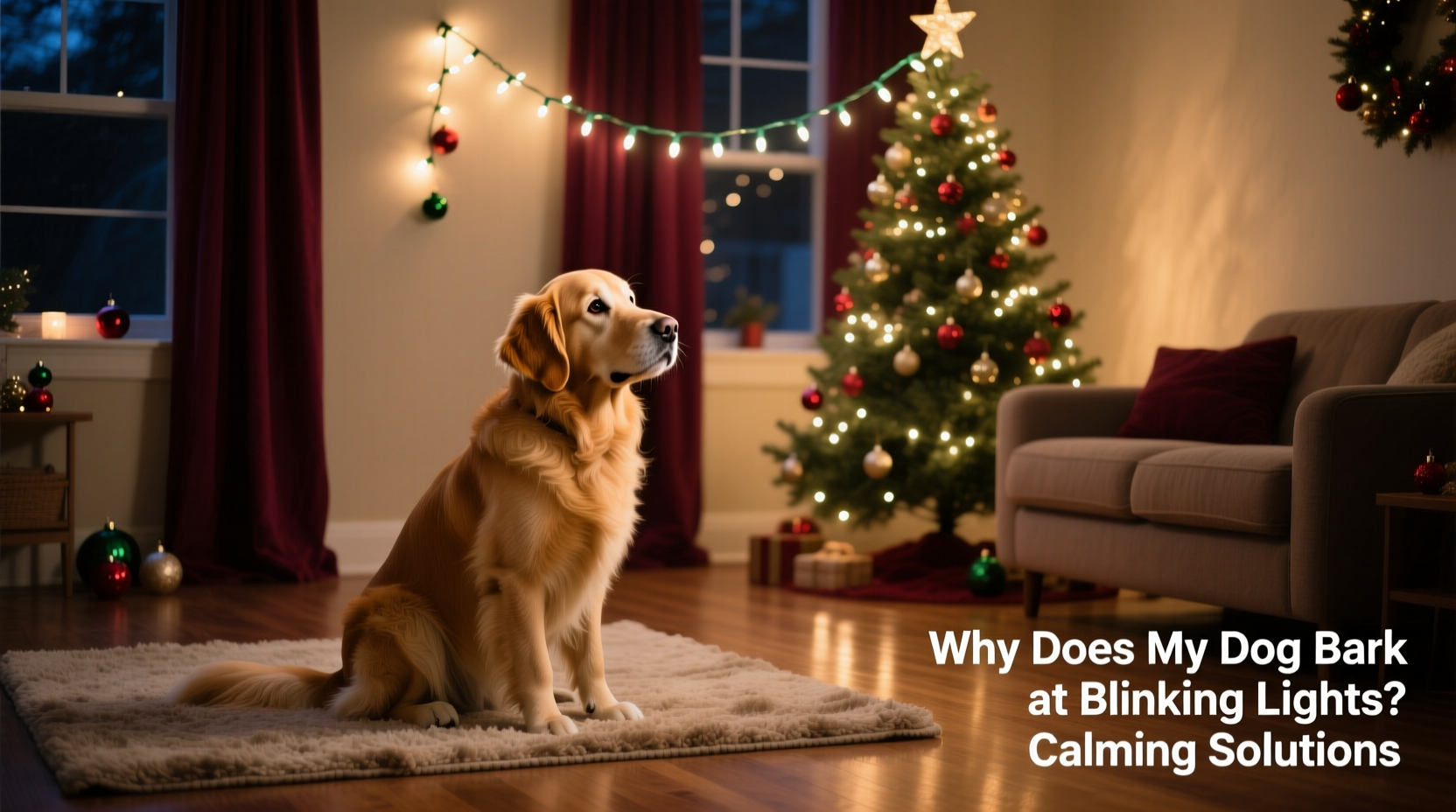
Dogs perceive light differently than humans. Their retinas contain a higher density of rod photoreceptors—cells optimized for motion detection and low-light vision—but they also process visual information at a higher “flicker fusion rate.” While humans typically fuse discrete light pulses into continuous perception at around 50–60 Hz, many dogs require 70–80 Hz or more. That means LED lights operating at 50–100 Hz (common in budget or older holiday strings) may appear to dogs as erratic, stuttering flashes—not steady illumination. To a canine brain wired for predator-prey awareness, this mimics the movement of small, skittering creatures—or worse, the unpredictable flash of danger: fire, lightning, or an approaching threat.
Compounding this is the lack of contextual cues. Unlike humans who understand lights are decorative and harmless, dogs rely on pattern recognition and environmental consistency. A light that blinks irregularly—say, a “twinkling” mode with random intervals—defies predictability. Neurologically, unpredictability activates the amygdala and triggers the hypothalamic-pituitary-adrenal (HPA) axis, releasing cortisol and adrenaline. The bark becomes both an alarm signal (“Something’s wrong here!”) and a displacement behavior—a way to discharge mounting tension when no clear threat is identifiable.
Age, breed predisposition, and prior experience matter too. Senior dogs may develop flicker sensitivity due to age-related changes in lens clarity or retinal function. Herding breeds (Border Collies, Australian Shepherds) often exhibit heightened visual reactivity. Dogs with prior trauma—such as exposure to fireworks, thunderstorms, or flashing emergency vehicles—may generalize that distress to similar stimuli.
Immediate Calming Strategies You Can Apply Tonight
When barking erupts, your first priority is safety and de-escalation—not correction. Punishment or shouting increases sympathetic arousal and reinforces the association between lights and fear. Instead, use these proven, low-stress interventions:
- Interrupt & Redirect: Use a neutral, cheerful cue like “This way!” while offering a high-value chew (e.g., frozen KONG with peanut butter) or puzzle toy. Avoid treats that require intense focus if your dog is already over-aroused—opt for slow-lapping options like lick mats.
- Dim the Source: Cover blinking strings with sheer white fabric (like a thin muslin curtain) to diffuse intensity and soften contrast. Avoid black or dark fabrics—they increase perceived contrast and can worsen the effect.
- Introduce White Noise: Play consistent ambient sound (e.g., rain sounds, gentle piano, or brown noise) at low volume to mask the subtle electrical hum some LEDs emit—a frequency dogs hear but humans often miss.
- Block Line of Sight Temporarily: Close blinds or curtains in rooms where your dog spends time—but only if your dog doesn’t associate closed blinds with isolation or punishment. Never use physical barriers as confinement without positive conditioning first.
Long-Term Solutions: Retraining Perception and Building Resilience
Sustained relief requires shifting your dog’s emotional response—not just suppressing barking. Desensitization and counterconditioning (DS/CC) are gold-standard behavioral tools validated by veterinary behaviorists. The goal isn’t to eliminate all reaction, but to build tolerance and replace anxiety with calm curiosity.
- Assess Baseline Threshold: Observe your dog from a distance. Note the exact distance and lighting condition (e.g., “barks when lights are visible from hallway, 12 feet away, on ‘twinkle’ mode”). This is your starting point.
- Reduce Intensity: Switch lights to “steady-on” mode, or unplug blinking strings entirely for now. If you must use blinking lights, choose models labeled “low-flicker” or “flicker-free” (look for specifications mentioning <1% flicker percentage at 100 Hz).
- Pair with Positive Association: At a distance *below* threshold (where your dog notices lights but shows zero stress), offer one irresistible treat every 5 seconds for 2 minutes. Repeat daily for 5 days.
- Gradual Proximity Increase: Only after 3 consecutive calm sessions, move 2 feet closer. If barking or lip-licking resumes, step back one distance and repeat.
- Introduce Controlled Blinking: Once steady lights evoke zero reaction, add a single low-intensity blinking bulb (e.g., a warm-white mini LED on a battery pack) placed far away. Follow same DS/CC protocol.
This process takes consistency—not speed. Rushing triggers setbacks. Most dogs show measurable improvement within 2–4 weeks of daily 5-minute sessions. Patience isn’t passive; it’s strategic neurological rewiring.
What to Avoid: Common Mistakes That Worsen the Problem
Well-intentioned actions can unintentionally reinforce fear or escalate distress. Here’s what veterinary behaviorists consistently advise against:
| Action | Why It Backfires | Better Alternative |
|---|---|---|
| Yelling “No!” or using a spray bottle | Increases fear and links lights with punishment—deepening negative association | Redirect calmly; reward stillness near dimmed lights |
| Forcing proximity (“Look, it’s fine!”) | Triggers learned helplessness or panic; erodes trust in your leadership | Let your dog choose to approach; reward voluntary glances |
| Using red/green blinking lights exclusively | Dogs see red as dark gray/brown and green as yellowish—high-contrast combinations create visual “noise” | Opt for warm-white or amber steady lights; avoid multicolor blink patterns |
| Leaving lights on overnight near sleeping areas | Prevents full REM sleep recovery; chronic low-grade stress impairs resilience | Use timers—lights off by 9 p.m.; keep bedrooms completely dark |
Real-World Success: How Maya’s Rescue Dog Found Calm
Maya adopted Leo, a 3-year-old mixed breed, in early November. He’d spent his first two years in a high-traffic shelter where strobe lights were used during fire drills. By December, he barked nonstop at her outdoor light display—even covering the windows didn’t help. His vet ruled out pain or vision issues, and referred her to a certified behavior consultant.
They began with environmental control: switching all lights to warm-white steady mode, installing blackout shades in Leo’s favorite napping spot, and playing classical harp music during evening light hours. For DS/CC, they started at 30 feet—outside the house—with a single unplugged light string held by Maya. Leo received chicken slivers for looking at it without tension. After 12 days, he’d walk past it sniffing calmly. They then introduced a battery-powered flicker-free LED candle indoors, gradually moving it closer over 18 days. By Christmas Eve, Leo rested beside the tree—curious, relaxed, tail thumping softly—as the steady-warm lights glowed. No barking. No pacing. Just peace.
“It wasn’t about making him ‘ignore’ the lights,” Maya shared. “It was about helping him feel safe enough to stop scanning for danger. The change wasn’t in the lights—it was in his nervous system.”
Expert Insight: What Veterinary Behaviorists Emphasize
“Barking at blinking lights is rarely ‘attention-seeking.’ It’s a physiological stress response rooted in sensory processing differences. The most effective solutions honor that biology—not human assumptions about motivation.”
— Dr. Lena Torres, DACVB, Board-Certified Veterinary Behaviorist, author of Canine Sensory Wellness
“If your dog’s reaction includes panting, trembling, hiding, or refusal to eat near lights, consult a veterinarian *before* starting behavioral work. Underlying conditions like canine cognitive dysfunction, ocular disease, or generalized anxiety disorder can mimic or exacerbate light sensitivity.”
— Dr. Arjun Patel, DVM, Behavioral Medicine Director, Midwest Animal Wellness Center
Practical Holiday Light Checklist
Before decorating, run through this actionable checklist to minimize sensory strain:
- ✅ Test all strings with your phone camera—point it at the lights and watch the screen. If you see rolling bars, flickering, or pulsing on video, your dog perceives it far more intensely.
- ✅ Choose warm-white LEDs (2700K–3000K color temperature) over cool-white or multicolor—lower blue light reduces glare and visual fatigue.
- ✅ Use mechanical timers, not app-controlled smart lights—unpredictable remote activation adds another layer of uncertainty.
- ✅ Install lights away from primary paths—keep strings at least 6 feet from dog beds, crates, and food/water stations.
- ✅ Designate one “light-free zone”—a quiet room with no decorations, used consistently for rest and decompression.
Frequently Asked Questions
Can I use CBD oil or calming supplements to help?
Evidence remains limited and regulation is minimal. Some dogs respond positively to CBD isolates (zero THC) under veterinary guidance, but quality varies widely. Never combine with sedatives or SSRIs without explicit vet approval. Supplements like L-theanine or alpha-casozepine may support baseline calm but won’t override acute light-triggered reactivity. Always prioritize behavioral strategies first.
Will my dog outgrow this behavior?
Unlikely without intervention. Neural pathways strengthen with repetition—so repeated barking at lights reinforces the habit loop. However, with consistent DS/CC, most dogs *can* develop lasting tolerance. Early intervention yields the best outcomes, but dogs of any age can learn new associations.
Are solar-powered lights safer?
Not necessarily. Many solar lights use low-quality capacitors that cause inconsistent, erratic blinking—exactly the type most likely to trigger dogs. Stick to AC-powered, high-CRI (Color Rendering Index >90), flicker-free LEDs rated for indoor/outdoor use.
Conclusion: Creating a Holiday Season Your Dog Can Truly Enjoy
Your dog’s barking at blinking lights isn’t defiance. It’s communication—in a language of physiology, not disobedience. When you replace frustration with understanding, correction with compassion, and quick fixes with thoughtful strategy, you do more than silence barks. You deepen trust. You honor your dog’s unique sensory world. And you reclaim the quiet joy of the season—not as a backdrop of tension, but as shared calm: the soft glow of steady lights, the weight of a resting head on your knee, the deep sigh of a nervous system finally allowed to rest.
This holiday, don’t just decorate your home—tend to its emotional climate. Swap one blinking string for a warm, steady glow. Sit beside your dog for five minutes tonight—not to fix, but to be present. Notice how their breathing slows when the lights aren’t demanding vigilance. That’s not compliance. That’s connection. That’s the real gift.




 浙公网安备
33010002000092号
浙公网安备
33010002000092号 浙B2-20120091-4
Comments
No comments yet. Why don't you start the discussion?