
Christmas lights shimmer, flicker, pulse, and sometimes even move—creating a visual environment that’s enchanting for humans but deeply unsettling for many dogs. If your dog barks, whines, paces, or hides when holiday decorations go up, you’re not alone. Veterinarians and veterinary behaviorists report a noticeable spike in stress-related behaviors from November through January. This isn’t “just being dramatic.” It’s a biologically grounded response rooted in canine perception, neurology, and evolutionary history. Understanding why your dog reacts—and how to respond with compassion and consistency—makes all the difference between seasonal dread and peaceful coexistence.
The Science Behind the Barking: Why Lights Trigger Alarm
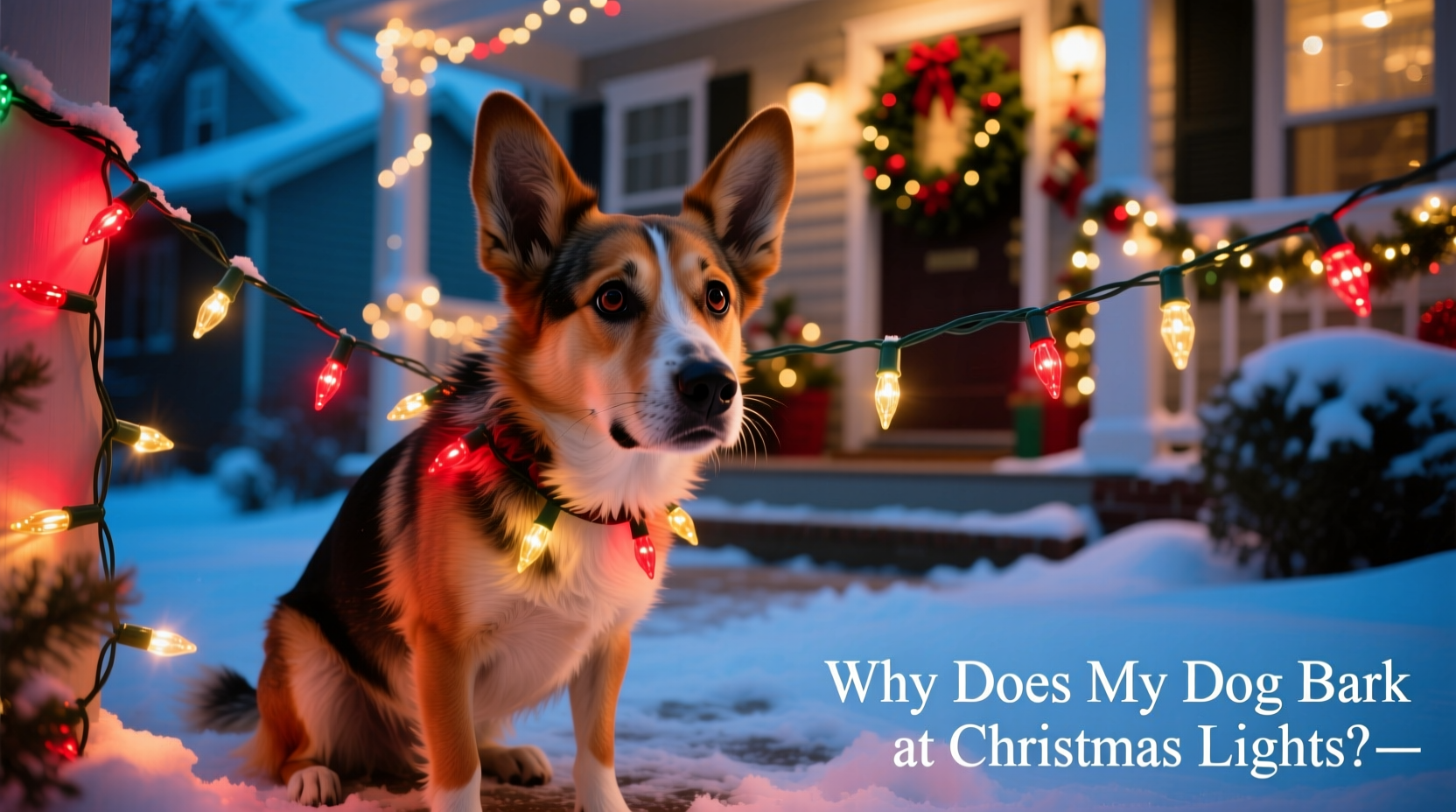
Dogs don’t interpret blinking LED strings or rotating projection patterns the way we do. Their visual system operates differently: higher flicker fusion threshold (they see rapid flashes as distinct pulses), greater motion sensitivity, and heightened peripheral awareness. A string of lights that appears steady to us may register as a chaotic strobe to your dog. Add in subtle electrical hums, intermittent buzzing from older transformers, reflections on windows or ornaments, and sudden movements caused by wind or passing cars—and the result is multisensory overload.
Neurologically, the amygdala—the brain’s threat-detection center—activates more readily in dogs exposed to unpredictable stimuli. Unlike familiar household objects, Christmas lights are novel, dynamic, and often introduced abruptly. For dogs with existing anxiety, noise sensitivity, or limited early exposure to artificial light patterns, this novelty becomes indistinguishable from danger. As Dr. Sarah Heath, European Veterinary Specialist in Behavioural Medicine, explains:
“Dogs don’t have the cognitive framework to understand ‘decorations.’ What they perceive is movement without source, light without warmth, and rhythm without predictability. That triggers vigilance—not mischief.” — Dr. Sarah Heath, BVSc, DACVB, DECVBM-CA
This isn’t learned misbehavior. It’s an instinctive, unfiltered reaction. Punishing the barking only deepens fear and erodes trust. The goal isn’t to silence the dog—it’s to change their emotional response to the stimulus.
Five Key Triggers—and How They Manifest
Not all light-related barking stems from the same cause. Recognizing which driver is dominant helps tailor your response:
- Flicker sensitivity: Dogs see LED and incandescent bulbs flicker at frequencies humans can’t detect. This creates a disorienting, almost nauseating visual effect—especially in low-light rooms where contrast is high.
- Motion misinterpretation: Wind-blown lights, rotating projectors, or fiber-optic strands moving across walls mimic prey or intruder movement. Herding or terrier breeds may bark to “alert” or “control” the motion.
- Reflection confusion: Light bouncing off glass doors, mirrors, or metallic ornaments creates shifting shapes dogs can’t contextualize—leading to fixation, barking, or even air-snapping at illusory targets.
- Electromagnetic or auditory cues: Some dogs detect faint electromagnetic fields from transformers or hear high-frequency harmonics from dimmer switches or cheap power supplies—sounds imperceptible to humans but physically uncomfortable.
- Contextual association: If past holiday seasons involved loud parties, unfamiliar guests, or disrupted routines, lights become a conditioned cue for chaos—even before the first guest arrives.
Practical, Humane Solutions That Work
Effective intervention combines environmental management, desensitization, and emotional regulation—not quick fixes or suppression. Here’s what actually helps, backed by clinical behavioral practice:
Step-by-Step Desensitization Protocol (Start 4–6 Weeks Before Peak Decor)
- Baseline observation: Note exactly when and where barking occurs (e.g., “barks only at porch lights after dusk,” “fixates on tree reflections in hallway mirror”).
- Remove access temporarily: Block visual access to problematic lights using closed blinds, baby gates, or rearranged furniture—while ensuring your dog still has safe, enriched space.
- Introduce lights at minimal intensity: Use one single, non-blinking white bulb on a lamp in another room. Keep it on for 2 minutes while offering high-value treats (chicken, cheese) *only* when your dog looks calmly at it—not when barking.
- Gradually increase complexity: Over 10–14 days, add one new element per session: a second bulb, then slow blink mode, then gentle motion (e.g., swaying a strand by hand), always paired with calm praise and treats.
- End each session on success: Stop *before* stress appears. Even 30 seconds of relaxed observation counts as progress.
This method leverages classical conditioning—pairing previously alarming stimuli with safety and reward. Rushing or forcing exposure backfires. Consistency matters more than duration: two 90-second sessions daily outperform one 20-minute session weekly.
What to Do (and Not Do): A Holiday Lights Behavior Checklist
| Action | Do | Don’t |
|---|---|---|
| Light selection | Choose warm-white, non-flickering LEDs; avoid strobes, rapid chases, or erratic patterns. | Use cheap, unregulated bulbs known for visible flicker or audible buzz. |
| Placement | Mount lights away from your dog’s primary resting zones; keep them off floors and low walls where motion is most threatening. | Wrap lights around furniture your dog uses, or drape them across doorways they must pass through. |
| Sound management | Test transformers for hum; replace buzzing units. Run white noise near windows if outdoor lights trigger barking. | Assume “silent” lights are truly silent—many emit ultrasonic frequencies dogs hear. |
| Distraction & redirection | Offer lick mats, food puzzles, or chew toys *during* light exposure—not after barking starts. | Wait until barking begins, then try to distract. By then, the stress response is already active. |
| Training reinforcement | Practice “look at that” (LAT) with neutral objects first, then introduce lights at distance with high-value rewards. | Try to “command” your dog to stop barking. Commands require voluntary control—stress overrides obedience. |
A Real Example: How Maya Calmed Her Rescue Terrier Mix
Maya adopted Leo, a 3-year-old Jack Russell/Beagle mix, in October. He’d never seen Christmas lights. When she hung her first string on the patio door, Leo barked nonstop for 17 minutes—panting, pacing, and refusing treats. She didn’t scold him. Instead, she followed the desensitization protocol: started with a single bulb in the laundry room, kept sessions under 90 seconds, and tracked his body language closely. By Week 3, Leo would sit and watch the bulb blink slowly—tail wagging, muscles relaxed. She added motion only after he consistently chose to look at the light instead of avoiding it. On December 1st, she introduced the patio lights—but only after installing blackout curtains on the adjacent window to eliminate reflections. Leo watched quietly for 4 minutes, then laid down. No barking. No anxiety. Just quiet curiosity. His progress wasn’t about “getting used to” the lights. It was about learning, over time, that lights meant safety—not threat.
When to Seek Professional Help
Most dogs improve with consistent, compassionate intervention. But some need extra support—especially if barking is accompanied by panting, drooling, trembling, destructive chewing, or attempts to escape. These signs indicate significant distress, not just annoyance. Consult a veterinarian first to rule out underlying pain or medical conditions (e.g., vision changes, thyroid imbalance, or age-related cognitive decline). Then, seek a board-certified veterinary behaviorist (DACVB or DECVBM-CA) or a certified professional dog trainer (CPDT-KA) with documented experience in fear-based behavior. Avoid trainers who rely on dominance theory, alpha rolls, or punishment-based tools—they worsen light-related anxiety and damage your relationship.
FAQ: Common Concerns Answered
Can I just cover the lights when my dog is home?
Yes—but only as a short-term management tool, not a long-term solution. Covering lights prevents rehearsal of the barking behavior and reduces stress *now*, but it doesn’t help your dog build resilience. Combine covering with gradual desensitization so your dog learns safety, not avoidance.
Will my puppy “grow out of” barking at lights?
Unlikely—and potentially harmful to assume so. Puppies learn through repetition and association. If barking at lights is repeatedly rewarded (even unintentionally, via attention or removal of the stimulus), it becomes entrenched. Early, positive exposure to varied lights (flashlights, car headlights, streetlamps) builds confidence. Wait until lights go up to begin socialization, and you’ve missed a critical developmental window.
Are certain breeds more likely to react?
Herding, terrier, and hound breeds show higher rates of light-reactive barking—not because they’re “more anxious,” but because their genetics prioritize visual acuity, motion detection, and environmental vigilance. That doesn’t mean they can’t adapt. It means they benefit from earlier, more structured exposure and gentler progression.
Conclusion: Peace Is Possible—One Light at a Time
Your dog isn’t misbehaving. They’re communicating discomfort in the only language they have. Christmas lights aren’t inherently dangerous—but to a dog’s nervous system, they can feel like a persistent, unpredictable threat. The good news? With patience, precise observation, and science-informed techniques, you can transform alarm into acceptance—and even curiosity. You won’t need to choose between festive cheer and your dog’s well-being. You can have both. Start small. Track progress. Celebrate quiet moments—not just the absence of barking, but the presence of calm breathing, soft eyes, and relaxed posture. This holiday season, give your dog the gift of safety. And in doing so, you’ll deepen the quiet, unspoken bond that makes them not just your pet—but your companion.




 浙公网安备
33010002000092号
浙公网安备
33010002000092号 浙B2-20120091-4
Comments
No comments yet. Why don't you start the discussion?