
Dogs don’t celebrate Christmas, but they certainly react to it. If you’ve ever noticed your dog lunging at an animated reindeer prancing across your neighbor’s lawn while barely glancing at a stationary, jingle-bell-singing snowman, you’re not alone. This seemingly odd behavior isn’t random—it reflects how dogs process sensory input, interpret motion, and respond to perceived threats in their environment.
The difference in reaction stems from a combination of visual cues, auditory sensitivity, movement patterns, and instinctual responses hardwired into your dog’s brain over thousands of years of evolution. Understanding these factors doesn’t just explain quirky holiday behavior—it offers insight into how your dog sees the world and what truly captures their attention.
The Role of Motion in Canine Perception
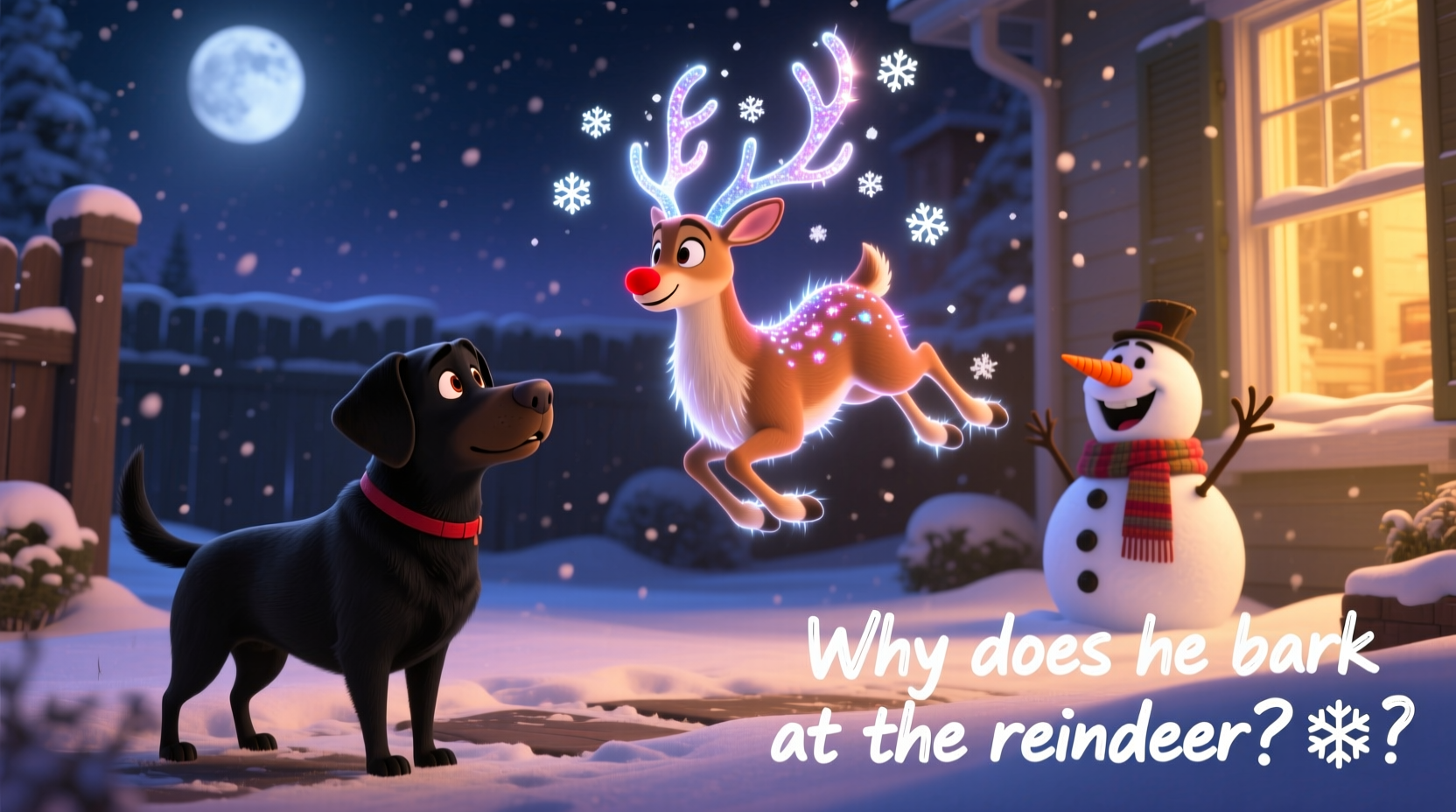
Dogs are highly attuned to movement. Their visual system evolved for detecting motion rather than fine detail, a trait essential for predators that needed to spot prey or avoid danger in low-light conditions. While humans rely heavily on color and static form, dogs prioritize motion as a primary signal.
An animated reindeer typically features jerky, unpredictable movements—twitching antlers, bobbing head, rotating body. These motions mimic those of live animals, triggering a dog’s alertness. In contrast, a singing snowman may emit sound, but if it remains largely stationary, it fails to activate the same level of visual interest.
Neurological studies suggest that dogs’ brains have specialized cells in the visual cortex that respond specifically to fast or erratic motion. A 2018 study published in *Frontiers in Veterinary Science* found that dogs show significantly higher arousal when exposed to moving stimuli compared to static ones—even when both include sound.
Sound vs. Movement: Why One Triggers Barking and the Other Doesn’t
It might seem logical that a singing snowman—with its music and voice—would be more stimulating than a silent reindeer. But for dogs, auditory input often plays second fiddle to visual motion unless the sound is sudden, loud, or emotionally charged (like a doorbell or another dog barking).
The singing snowman usually produces predictable, melodic sounds—carols, laughter, or rhythmic phrases—that dogs quickly learn to ignore through habituation. In contrast, the mechanical noises accompanying animated figures—creaking joints, whirring gears, or abrupt start-stop sounds—can compound the effect of movement, creating a multi-sensory trigger.
Moreover, dogs interpret irregular movement as potentially threatening. A reindeer that suddenly jerks its head may resemble a predator or rival animal preparing to charge. The snowman, even if louder, lacks this kinetic ambiguity. Its stillness signals non-threat, regardless of volume.
“Dogs don’t assess objects the way we do—they evaluate intent through motion. Erratic movement overrides familiar sounds every time.” — Dr. Lena Torres, Animal Behaviorist, University of Colorado School of Veterinary Medicine
Instinctual Responses: Territory, Prey Drive, and Social Cues
Barking at animated figures isn’t just about fear or surprise—it can stem from multiple overlapping instincts:
- Territorial defense: Dogs view their home and yard as territory. Any unexpected movement near boundaries activates guarding behaviors. An animated reindeer near a fence line may be interpreted as an intruder.
- Prey drive: Fast, twitchy motion triggers chase instincts, especially in herding or sporting breeds. Even if the object is clearly artificial, the reflex kicks in before cognition catches up.
- Social alerting: Some dogs bark to notify their humans of something unusual, expecting a response. It’s a form of communication: “Hey, look at this thing!”
A singing snowman, despite being more complex acoustically, doesn’t simulate intrusion or prey-like behavior. It stands still, smiles, and sings—none of which contradict canine social norms. Animated reindeer, however, move like living creatures without following expected behavioral rules. They don’t pause to sniff, look around, or respond to the dog. This inconsistency amplifies suspicion.
Mini Case Study: Max the Border Collie and the Holiday Lawn War
Max, a 4-year-old Border Collie in suburban Chicago, began barking intensely every evening when his owner turned on the front-yard display. The setup included a rotating sleigh, a winking Santa, and two animated reindeer with flapping wings. Max ignored Santa and the sleigh entirely but fixated on one reindeer whose head rotated 180 degrees.
His owner, Sarah, initially thought Max was reacting to the music. She tested this by playing holiday songs indoors—no reaction. Then she disabled the reindeer motor while keeping the lights and sound active—barking stopped. When only the reindeer moved (without sound), Max resumed barking within seconds.
A local trainer suggested covering the reindeer with a sheet for three days while Max observed from inside. Gradually, they exposed him to shorter activation periods. Within a week, Max showed minimal reaction. The key wasn’t sound desensitization—it was reducing the salience of unpredictable motion.
How Breed and Individual Temperament Influence Reactions
Not all dogs react the same way. Breed tendencies play a significant role:
| Breed Type | Typical Reaction | Reason |
|---|---|---|
| Herding (e.g., Border Collie, Australian Shepherd) | High reactivity to motion | Genetically wired to monitor and control movement |
| Scent Hounds (e.g., Beagle, Basset Hound) | Moderate to low reactivity | Less visually driven; more focused on smells |
| Guardian Breeds (e.g., German Shepherd, Rottweiler) | Strong territorial barking | Vigilant by nature; quick to alert on anomalies |
| Companion Breeds (e.g., Cavalier King Charles Spaniel) | Variable, often mild | Bred for human interaction, less environmental vigilance |
Individual temperament also matters. A dog with high environmental sensitivity or past anxiety around strangers or noises will be more likely to react strongly. Puppies and young dogs are more curious and impulsive, often barking first and assessing later. Older, well-socialized dogs may show indifference after initial investigation.
Step-by-Step Guide: Reducing Your Dog’s Reaction to Animated Decorations
If your dog’s barking is disruptive or stress-induced, follow this gradual approach to reduce reactivity:
- Observe and identify triggers: Is it the movement? The sound? Both? Note which decoration causes the strongest reaction.
- Start with neutral exposure: Place the decoration in a part of the house where your dog can see it but isn’t confined nearby. Keep it off initially.
- Activate without motion: Turn on lights or sound first, letting your dog get used to the presence.
- Introduce motion at low intensity: If possible, reduce speed or range of movement. Use timers to limit duration.
- Pair with positive reinforcement: Offer treats, play, or praise when your dog looks at the object calmly.
- Increase exposure gradually: Over 5–7 days, extend runtime and proximity while monitoring stress signals (panting, pacing, stiff posture).
- Block line of sight if needed: Use blinds, curtains, or barriers to prevent constant exposure, especially at night.
This method leverages counter-conditioning—a proven behavioral technique that changes emotional responses by associating a trigger with positive outcomes.
Checklist: Managing Holiday Decoration Reactions
- ☐ Identify which decorations trigger barking (motion-based or sound-based)
- ☐ Test reactions in controlled settings (indoor trials, partial activation)
- ☐ Avoid placing animated figures near boundary zones (fences, windows)
- ☐ Use distraction techniques (toys, chews) during initial exposure
- ☐ Monitor body language for signs of stress or overstimulation
- ☐ Limit nighttime operation to reduce sleep disruption
- ☐ Consult a certified trainer if barking escalates to aggression or anxiety
Frequently Asked Questions
Is it normal for my dog to bark at animated decorations?
Yes. Many dogs react to sudden or erratic motion, especially near their territory. As long as the behavior is situational and doesn’t lead to distress or aggression, it’s considered a normal expression of alertness.
Can I train my dog to stop barking at decorations?
Absolutely. With consistent desensitization and positive reinforcement, most dogs can learn to tolerate or ignore animated figures. Start early, proceed slowly, and avoid forcing prolonged exposure.
Should I remove decorations if my dog is stressed?
If your dog shows signs of chronic stress—refusing food, trembling, hiding—you should either remove the trigger or block access to it. Holidays should be enjoyable for everyone, including pets. Consider quieter alternatives like static light displays or indoor-only decor.
Conclusion: Seeing the Holidays Through Your Dog’s Eyes
Your dog isn’t being stubborn or dramatic when they bark at an animated reindeer while ignoring a cheerful snowman. They’re responding logically—to their world. What seems whimsical to us registers as ambiguous motion to them, activating ancient survival circuits. By understanding the interplay of vision, sound, and instinct, you can make the holiday season less stressful and more inclusive for your four-legged family member.
Small adjustments—strategic placement, gradual introduction, and positive associations—can transform a chaotic trigger into a background novelty. More importantly, this awareness deepens your connection. You begin to see not just what your dog does, but why.




 浙公网安备
33010002000092号
浙公网安备
33010002000092号 浙B2-20120091-4
Comments
No comments yet. Why don't you start the discussion?