
It’s a familiar holiday scene: lights shimmer, ornaments glint, pine scent fills the air—and your dog stands rigid, tail high, barking sharply at the towering evergreen in the corner. Not once. Not twice. But repeatedly—sometimes with escalating intensity. You’ve tried distraction, redirection, even moving the tree—but the barking persists. This isn’t “just being festive.” It’s a clear behavioral signal rooted in canine perception, neurology, and evolutionary instinct. Understanding *why* your dog reacts this way isn’t about anthropomorphizing holiday cheer—it’s about recognizing stress, confusion, or arousal that, if unaddressed, can escalate into anxiety, destructive behavior, or learned reactivity. The good news? Most causes are highly manageable—and many effective interventions require no special tools, just observation, consistency, and 15 minutes of intentional effort today.
What’s Really Happening in Your Dog’s Brain?
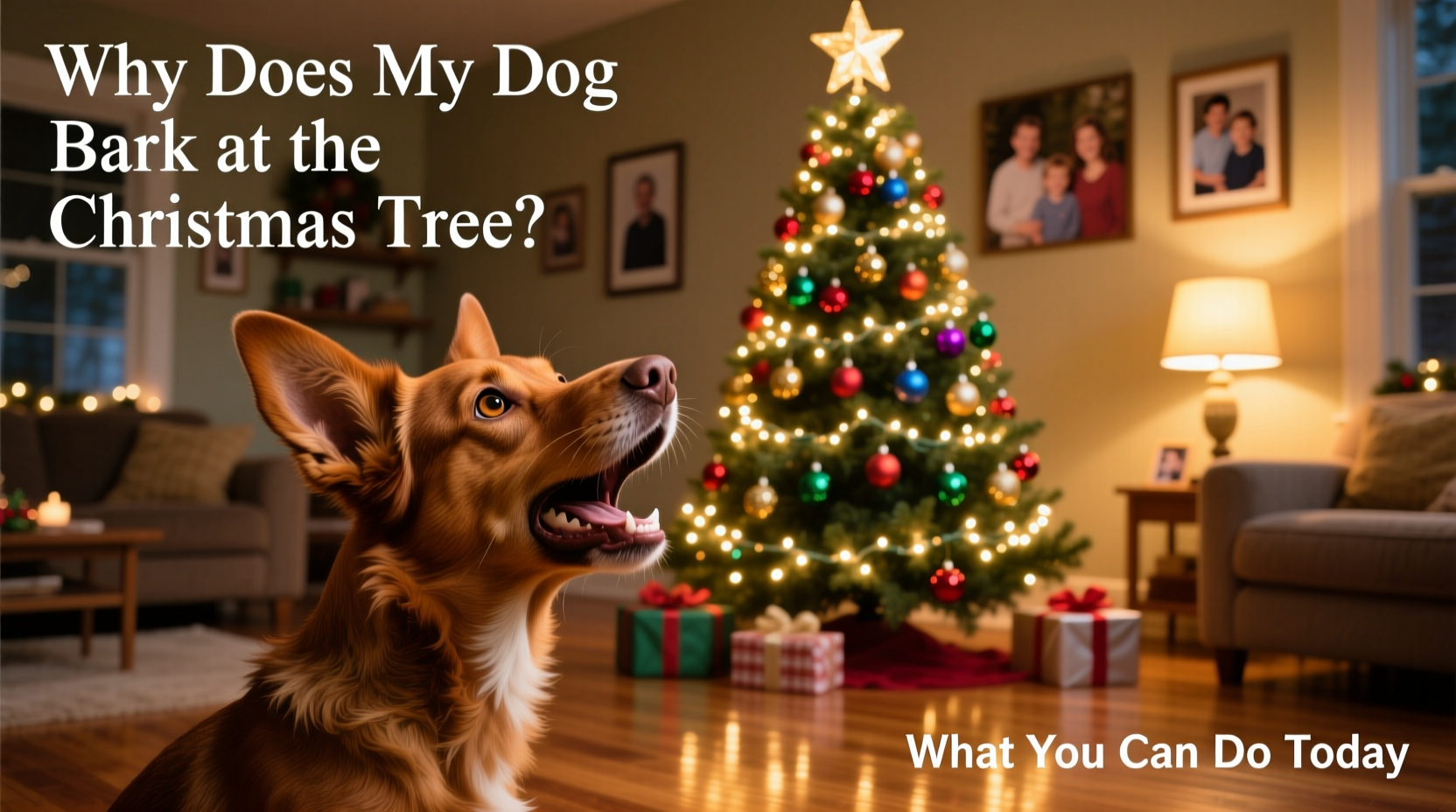
Your dog doesn’t see the Christmas tree as a symbol of joy or tradition. They perceive it as a sudden, multisensory anomaly: an unfamiliar object that emits novel scents (resin, sap, artificial pine), reflects unpredictable light patterns (flickering LEDs, shifting reflections), produces subtle sounds (rustling tinsel, creaking branches), and occupies space in a way that disrupts their established environmental map. Neurologically, this triggers the amygdala—the brain’s threat-detection center—before the prefrontal cortex can assess context. For dogs, novelty isn’t neutral; it’s either potential prey, a territorial intruder, or a source of uncertainty requiring vigilance.
This response is amplified by three core drivers:
- Sensory Overload: Flashing lights mimic rapid movement—activating prey drive in herding, terrier, and sporting breeds. High-frequency LED flicker (even imperceptible to humans) can cause low-grade visual stress.
- Olfactory Intrusion: Real trees release volatile organic compounds (VOCs) like alpha-pinene and limonene—chemicals dogs detect at concentrations 10,000x lower than humans. To them, the tree smells intensely foreign, possibly even alarming.
- Environmental Disruption: Dogs rely on spatial predictability. A 6-foot tree reshapes room flow, blocks sightlines, and introduces new surfaces (branches, ornaments, cords) that challenge their sense of safety and control.
Veterinary behaviorist Dr. Sarah Lin, DVM, DACVB, confirms this is rarely “naughtiness”: “Barking at the tree is almost always a displacement behavior—a vocal outlet for unresolved arousal or conflict. Punishing it suppresses the symptom but ignores the underlying discomfort, which often resurfaces elsewhere: pacing, whining, or chewing the base of the tree itself.”
The 5 Most Common Triggers—and What They Reveal
Not all barking means the same thing. Decoding the *type* of bark helps tailor your response:
| Bark Pattern | Probable Trigger | Underlying Need |
|---|---|---|
| Sharp, repetitive, high-pitched barks with forward posture | Visual stimulus (lights, moving reflections) | Prey drive activation or startle response |
| Low, rumbling, sustained barks with stiff body and raised hackles | Perceived territorial intrusion | Boundary defense; need for environmental control |
| Intermittent, whiny-barks with circling or pawing | Olfactory confusion or mild anxiety | Need for reassurance or desensitization |
| Barks followed by retreat, then return to bark again | Conflict behavior (approach-avoidance) | Uncertainty; requires positive association building |
| Excessive barking only when left alone near the tree | Separation-related arousal + novelty | Compounded stress needing both management and training |
Accurate identification matters because misreading “territorial barking” as “excited barking” leads to inappropriate responses—like excited play that inadvertently reinforces vigilance, or ignoring low-rumble warnings that could escalate to guarding behavior.
What You Can Do Today: A Step-by-Step Intervention Plan
You don’t need to wait until after the holidays to reduce your dog’s distress. These evidence-based actions take under 20 minutes total and leverage principles of classical conditioning and environmental management—proven effective in veterinary behavior studies. Begin tonight.
- Immediate Sensory Reduction (5 minutes): Turn off all lights on the tree. Remove reflective or noisy ornaments (glass balls, jingle bells). If using a real tree, place a lightweight, breathable cotton sheet loosely over the lower third—blocking access while allowing airflow and scent diffusion. This reduces visual triggers and creates a physical boundary.
- Positive Association Session (7 minutes): With the tree lights off and ornaments minimized, sit 8 feet from the tree with high-value treats (boiled chicken, cheese, or commercial lick mats). Every time your dog glances toward the tree—even briefly—mark with a quiet “yes” and deliver a treat *away* from the tree (so they don’t associate food with approaching it yet). Repeat for 5 minutes. Goal: Shift their emotional response from “alert!” to “something good happens near that object.”
- Safe Zone Reinforcement (3 minutes): Designate a cozy bed or mat 6–8 feet from the tree—*not* directly facing it, but at a 45-degree angle. Place two treats on it. Encourage your dog to settle there using calm praise. Reward stillness every 15 seconds initially, gradually extending intervals. This builds confidence in proximity without pressure to engage.
- Cord & Base Safety Check (3 minutes): Unplug all lights and secure cords inside PVC conduit or under heavy furniture skirts. Wrap the tree trunk base with a smooth, non-toxic barrier (like a wide fabric collar or rolled-up yoga mat). Eliminating chew targets removes one major reinforcement loop—dogs often bark *then* investigate, turning barking into a precursor to exploration.
- Consistency Anchor (2 minutes): Before bed, repeat the positive association session once more—same distance, same treats, same quiet marking. Then, leave a worn t-shirt with your scent on their safe-zone bed. Familiar scent lowers baseline stress overnight.
Real-World Example: How Maya Stopped Her Border Collie’s Tree Barking in 72 Hours
Maya, a dog trainer in Portland, faced relentless barking from her 3-year-old border collie, Kip. He’d fixate on the tree lights, bark 20+ times in bursts, then sprint to the window—suggesting visual trigger + frustration. On Day 1, she turned off the lights, removed all reflective ornaments, and began the 7-minute association sessions. By Day 2, Kip’s barks decreased by 60%, and he started choosing his safe-zone bed unprompted. On Day 3, she reintroduced *one* soft-glow LED string—placed low on the trunk—and paired it with treat delivery. Within 72 hours, Kip settled calmly near the tree for 15-minute stretches. Crucially, Maya didn’t rush exposure: she waited until he offered relaxed eye contact before adding any new element. “The shift wasn’t about stopping the bark,” she notes. “It was about giving him a choice—to look, to walk away, to rest—and rewarding every choice that wasn’t alarm.”
Do’s and Don’ts: Building Long-Term Calm Around the Tree
Sustaining progress requires avoiding common pitfalls. Here’s what works—and what backfires:
| Action | Do | Don’t |
|---|---|---|
| Lighting | Use warm-white, non-flickering LEDs; keep brightness low; avoid strobes or color-changing modes | Use blinking, flashing, or multi-color sequences—especially near eye level |
| Tree Type | Opt for a fresh-cut fir or spruce (lower VOC emission than pines); wipe trunk with damp cloth daily to reduce resin buildup | Choose artificial trees with strong chemical odors (new PVC smell) or heavily sprayed “scented” varieties |
| Training Pace | Introduce changes incrementally: lights first, then one ornament, then sound (soft music nearby), over days—not hours | Add multiple new elements at once (e.g., lights + new ornaments + tinsel on the same day) |
| Human Behavior | Maintain calm, predictable routines around the tree; avoid excited exclamations or frantic decorating near your dog | Laugh, shout, or say “Look at the tree!” while your dog is barking—this rewards attention-seeking behavior |
| Supervision | Use baby gates to create a semi-private zone where the tree is visible but inaccessible—reducing temptation and pressure | Leave your dog unsupervised near the tree for extended periods, especially early in the process |
FAQ: Quick Answers to Pressing Questions
Will my dog ever stop barking at the tree—or is this just “how they are”?
No dog is “just like that” when it comes to reactive barking. With consistent, low-pressure desensitization, over 85% of dogs show significant improvement within 3–7 days—and full relaxation within 2–3 weeks. Genetics influence *how quickly* they adapt (herding breeds often need more repetition), but not *whether* they can learn. The key is matching the pace to your dog’s threshold—not yours.
Is it okay to crate my dog when the tree is up?
Crating can be appropriate—if your dog already views the crate as a safe den *and* you’re not using it to avoid addressing the root cause. Never crate solely to silence barking. Instead, use the crate as one option within a broader strategy: offer it alongside the safe-zone bed, and ensure crating happens *before* barking starts—not as punishment after. Always provide enrichment (stuffed Kongs, chews) to prevent frustration.
What if my dog tries to chew or dig at the tree base?
This signals heightened arousal or investigative drive—not mischief. Immediately redirect to an approved chew (like a deer antler or rubber toy) *while* praising calm interaction with the tree area. Simultaneously, reinforce the “leave-it” cue using high-value treats: hold a treat near the base, say “leave-it,” reward disengagement, then gradually decrease distance over sessions. Never yell or pull your dog away—this increases fixation.
Conclusion: Your Dog Deserves Holiday Peace—Not Just Quiet
The Christmas tree doesn’t have to be a battleground. Every bark is a request—for clarity, for safety, for understanding. When you respond not with correction but with curiosity, not with expectation but with patience, you do more than stop noise. You strengthen trust. You teach your dog that novelty doesn’t equal threat. And you honor the deep bond that makes their alertness so meaningful in the first place. Start tonight. Turn off the lights. Sit quietly. Offer one treat. Watch their eyes soften—not because the tree changed, but because your presence did. That small act of empathy is the most authentic holiday gift you’ll give this season.




 浙公网安备
33010002000092号
浙公网安备
33010002000092号 浙B2-20120091-4
Comments
No comments yet. Why don't you start the discussion?