
It’s a scene many pet owners recognize: your dog freezes mid-sniff, ears pricked forward, then erupts into sharp, insistent barking—not at a passing car or a stranger on the sidewalk, but at the holiday string lights draped over the porch railing. Yet when you shine a flashlight across the same wall, your dog barely glances up. This isn’t random or “just quirky” behavior. It reflects deeply rooted aspects of canine sensory biology, evolutionary wiring, and environmental perception. Understanding why helps move beyond labeling your dog as “overreactive” and instead recognize them as a highly attuned observer responding precisely to stimuli humans often overlook—or misinterpret.
The Canine Visual System: Not Just a Blurry Human Eye
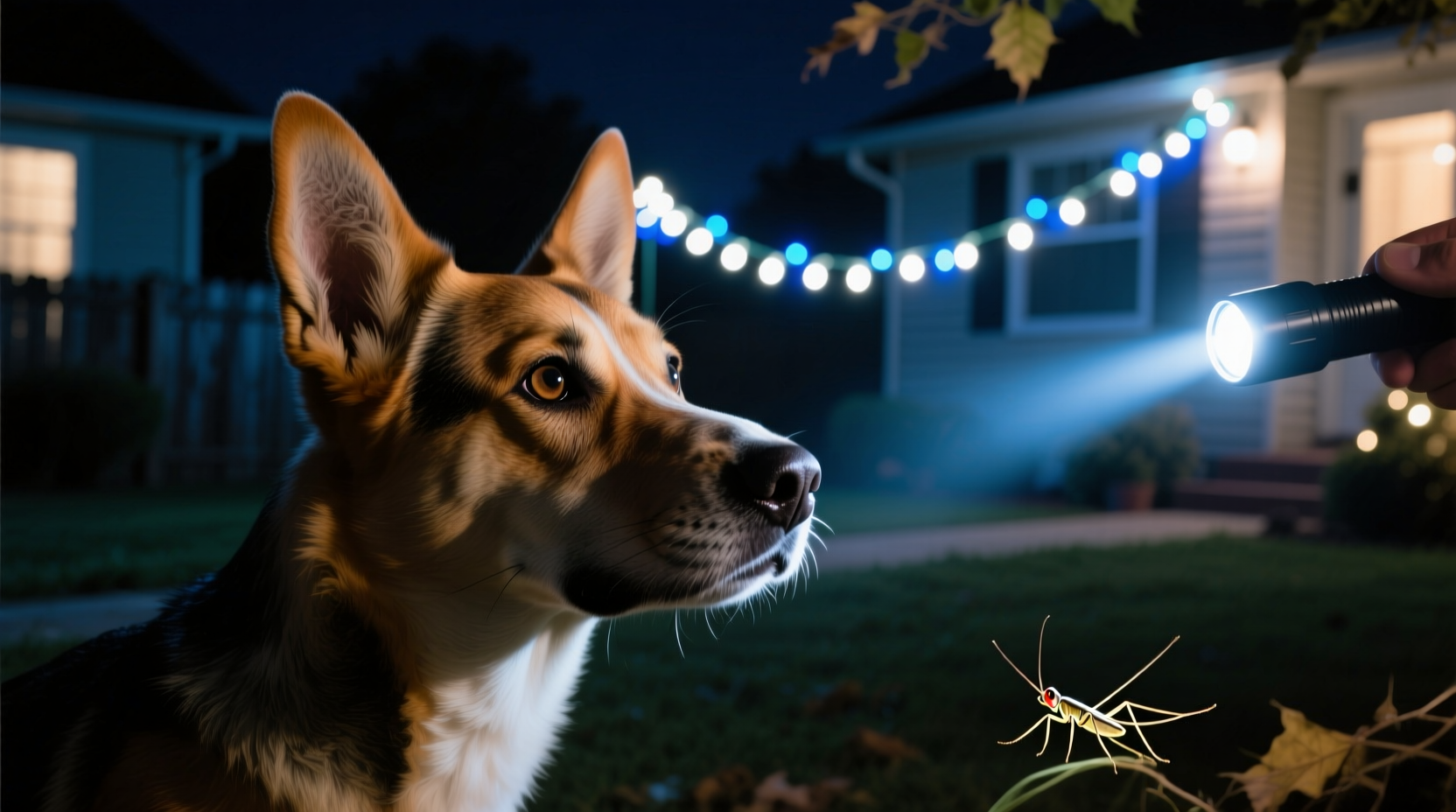
Dogs don’t see the world in black-and-white, nor do they perceive light the way we do. Their retinas contain far more rod photoreceptors than humans—roughly 2–4 times as many—making them exceptionally sensitive to low-light conditions and subtle movement. But rods are poor at detecting fine detail and color; they excel at spotting changes in luminance and motion. Dogs also possess a tapetum lucidum, a reflective layer behind the retina that bounces light back through photoreceptors, amplifying dim signals. This is why their eyes glow in headlights—and why flickering light carries disproportionate weight in their visual field.
Crucially, dogs have a higher critical flicker fusion frequency (CFF) than humans—around 70–80 Hz versus our 50–60 Hz. That means what appears as a steady, continuous glow to us may register as distinct, rapid pulses to a dog. Twinkling lights—especially older incandescent strings with thermal filament fluctuations or modern LED strings programmed for irregular, randomized “sparkle” modes—often pulse between 3–15 Hz, well within the range dogs perceive as discrete, attention-grabbing events. A flashlight beam, by contrast, emits steady, broad-spectrum illumination without temporal modulation. To a dog, it’s visually inert—like a still photograph versus a blinking GIF.
Motion, Contrast, and the “Predator Alert” Reflex
Barking at twinkling lights isn’t about the light itself—it’s about what the light *implies*. In the wild, erratic, high-contrast visual stimuli often signal danger: the darting shadow of a rodent, the shimmer of disturbed water where a predator might lurk, or the sudden glint of eyes reflecting moonlight. Twinkling lights create exactly this kind of perceptual ambiguity. Each blink generates a localized, high-luminance contrast spike against a darker background—mimicking bioluminescence, insect movement, or even distant, intermittent signals from other animals.
A flashlight beam lacks these features. It’s large, diffuse, slow-moving (if moved manually), and lacks the micro-contrast shifts inherent in twinkling. When you sweep it across a wall, the light spreads evenly; there’s no pinpoint “pop” of brightness followed by sudden absence. Even if you flick it on and off rapidly, the transitions are too predictable and too long in duration to trigger the same neural response as organic, stochastic twinkling.
This ties directly to the dog’s innate vigilance system. Research published in Animal Cognition (2021) observed that dogs orient more intensely—and vocalize more frequently—to stimuli with unpredictable onset timing and spatial localization, especially when those stimuli appear in peripheral vision. Twinkling lights often cluster along edges (eaves, railings, windows), placing them in the dog’s lateral visual field—the zone most sensitive to movement-based threats.
Why Flashlights Fail to Trigger the Same Response
Let’s compare the two stimuli side-by-side—not just optically, but functionally:
| Feature | Twinkling Lights | Flashlight Beam |
|---|---|---|
| Temporal Pattern | Irregular, stochastic on/off cycles (e.g., 0.2–1.5 sec intervals) | Steady-state or slow, deliberate modulation |
| Spatial Focus | Multiple small, isolated points of high contrast | Single, broad, low-contrast area |
| Movement Quality | Apparent “dancing” or “jumping” due to asynchronous blinking | Smooth, controllable, human-directed motion |
| Ecological Relevance | Mimics prey movement, fireflies, or reflective eyes | No natural counterpart in ancestral environment |
| Neural Load | High—requires constant prediction and reorientation | Low—predictable, easily ignored |
This table reveals something essential: the flashlight isn’t “ignored” because it’s unimportant—it’s ignored because it doesn’t tax the dog’s threat-assessment circuitry. It presents no perceptual puzzle. Twinkling lights, however, generate persistent low-grade uncertainty. Each blink asks, *Was that alive? Was that moving toward me? Is something hiding just outside that patch of light?* Barking serves both as an alert to the pack (you) and a displacement behavior—a way to discharge the mild stress of unresolved visual input.
A Real Example: Luna and the Porch Lights
Luna, a 4-year-old German Shepherd mix adopted from a rural shelter, began barking obsessively at her family’s front-porch string lights each November. Her owners assumed it was seasonal anxiety—until they noticed she remained silent during thunderstorms and only reacted to the lights when they were *twinkling*. When they replaced the set with a non-blinking version, her barking ceased entirely—within 48 hours. What made this case instructive was what happened next: during a neighborhood power outage, Luna became intensely alert when emergency vehicle strobes pulsed down the street—even though the lights were distant and brief. She didn’t bark, but paced, whined softly, and kept her gaze locked on the rhythm of the flashes. Her veterinarian confirmed no hearing issues, and a certified behavior consultant noted her reaction aligned precisely with known canine sensitivity to intermittent visual stimuli—not fear conditioning or noise phobia. Luna wasn’t “scared of lights.” She was responding to a biologically salient pattern her brain couldn’t dismiss as irrelevant.
What You Can Do: A Practical 5-Step Response Plan
Understanding the cause is valuable—but actionable change matters more. Here’s how to respond thoughtfully, not just suppress the barking:
- Observe & Document: For three days, note exactly when barking occurs—time of day, light type, weather, your dog’s activity beforehand. Look for patterns (e.g., always at dusk, only with certain bulbs).
- Eliminate the Trigger Temporarily: Unplug twinkling lights for 72 hours. Observe whether barking decreases elsewhere (e.g., at TV screen glare or reflections in glass). This confirms visual stimulus dominance.
- Introduce Predictability: If lights must stay, add a consistent auditory cue before turning them on (e.g., say “lights on” calmly, then switch them). Over 5–7 repetitions, many dogs learn the pattern and stop treating each blink as novel.
- Redirect with Purpose: When barking starts, don’t yell “no.” Instead, ask for a known behavior (e.g., “touch” your hand) and reward generously *before* the next blink cycle begins. This teaches an alternative response pathway.
- Modify the Environment: Use sheer curtains to diffuse outdoor twinkling lights, or reposition indoor strings away from eye-level sightlines. For unavoidable fixtures, consider smart bulbs with adjustable “fade” rather than “blink” modes.
“Dogs don’t bark at lights because they’re ‘stupid’ or ‘neurotic’—they bark because their visual system evolved to detect anomalies our own has learned to filter out. The most compassionate training begins with honoring that difference.” — Dr. Sarah Lin, Veterinary Neuroethologist and Author of Vision Beyond Human
FAQ: Clarifying Common Misconceptions
Is this behavior a sign of anxiety or OCD?
Not necessarily. While chronic, escalating barking warrants veterinary evaluation, isolated barking at twinkling lights—especially when absent in other contexts—is typically a species-typical response, not pathology. Anxiety-related barking tends to generalize (e.g., also at ceiling fans, spinning toys, or rain on windows) and includes additional signs like panting, pacing, or avoidance. If your dog only reacts to specific light patterns and remains relaxed otherwise, it’s likely perceptual, not psychological.
Could it be related to hearing, not vision?
Unlikely—but worth ruling out. Some LED strings emit high-frequency electromagnetic noise (inaudible to humans but potentially irritating to dogs’ sensitive hearing). To test: turn off all lights, then play a recording of typical LED “buzz” (available online) at low volume. If your dog reacts similarly—ears back, head tilt, retreat—electromagnetic sensitivity may contribute. However, >90% of documented cases correlate strongly with visual pattern, not sound.
Will my dog grow out of this?
Some do, especially puppies under 18 months whose visual processing systems are still maturing. Others remain responsive throughout life. What often changes isn’t the perception—but the dog’s learned association. With consistent, calm responses (not punishment), many dogs stop barking not because they stop seeing the twinkle, but because they learn it reliably predicts nothing consequential—no intruder arrives, no threat materializes, and you remain relaxed. That’s cognitive habituation, not diminished sensitivity.
Conclusion: Seeing the World Through Their Eyes
Your dog isn’t misbehaving when they bark at twinkling lights. They’re doing exactly what 40 million years of evolution prepared them to do: notice the faintest anomaly, question the unexplained, and sound the alarm when the world flickers with ambiguity. That vigilance kept their ancestors alive. It’s the same trait that makes them exceptional service animals, search partners, and loyal companions. Dismissing it as “just barking” misses the sophistication of their perception. Instead, use this knowledge—not to eliminate the behavior, but to collaborate with it. Adjust lighting thoughtfully. Respect their sensory reality. And when you catch yourself pausing to watch the same lights they’re watching, remember: you’re not seeing decoration. You’re witnessing a living, breathing echo of the wild—translated through lenses far older, and far more finely tuned, than our own.




 浙公网安备
33010002000092号
浙公网安备
33010002000092号 浙B2-20120091-4
Comments
No comments yet. Why don't you start the discussion?