
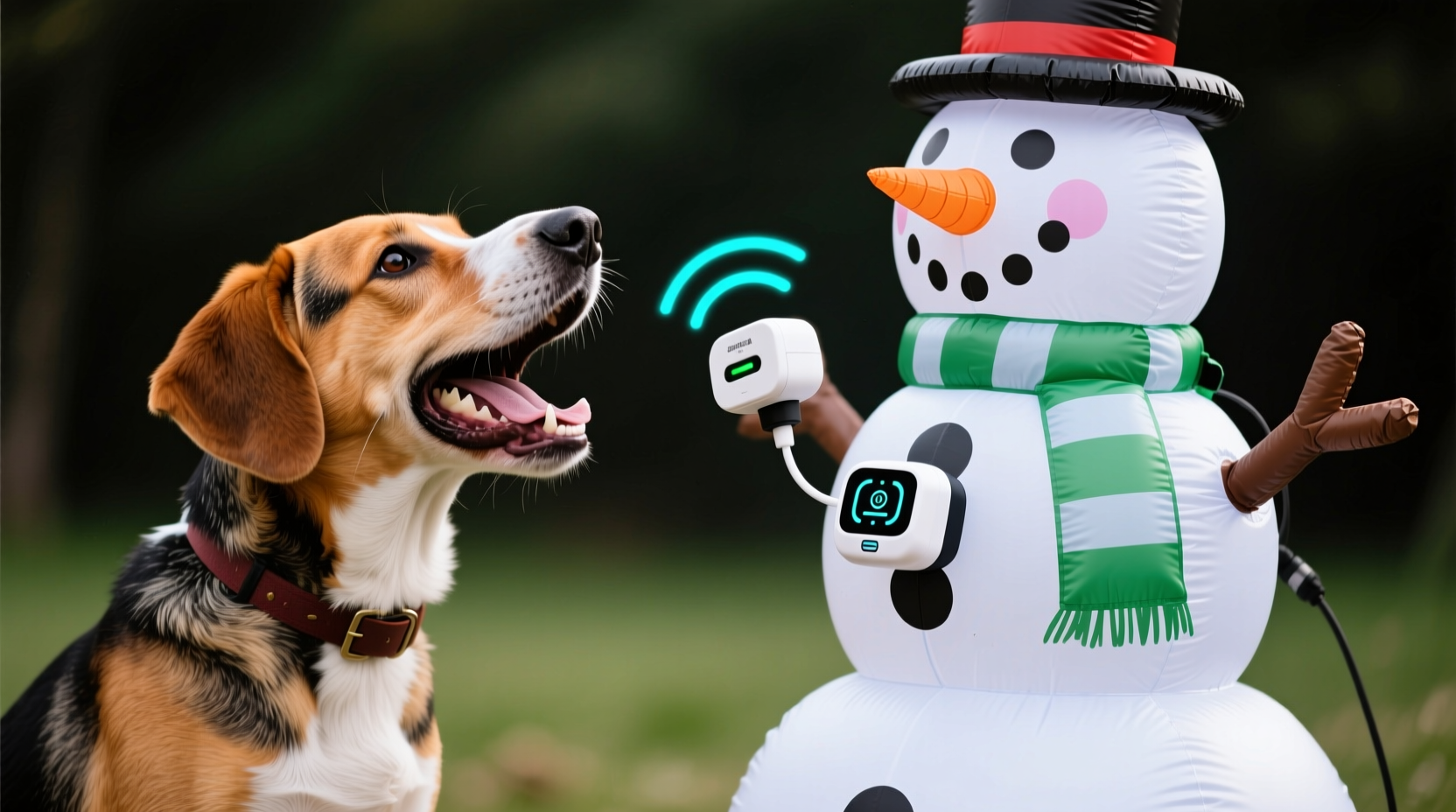
It’s a holiday-season riddle that leaves many pet owners baffled: your usually calm, well-socialized dog stands rigid at the window, hackles raised, barking intensely—not at passing cars, squirrels, or even delivery people—but specifically at that one inflatable snowman on the neighbor’s lawn… but only when it moves. The moment the wind dies down or the sensor resets, your dog turns away as if the snowman never existed. Static snowmen? Ignored completely. This isn’t random misbehavior—it’s a precise, biologically grounded response shaped by canine perception, evolutionary wiring, and modern environmental mismatch.
Dogs don’t see the world through human eyes—or interpret novelty, threat, or movement the same way we do. Their visual acuity is lower, but their motion detection is exceptional. Their hearing is broader in range, and their nervous systems are finely tuned to detect biological relevance: things that move unpredictably, make sudden sounds, or violate expectations of stillness. Inflatable snowmen with motion sensors trigger a cascade of neurobiological responses that static decorations simply cannot replicate. Understanding why requires unpacking canine sensory biology, behavioral ethology, and the unintended consequences of seasonal tech.
The Canine Motion-Detection Advantage
Dogs possess a visual system optimized for detecting movement—not fine detail. While humans have a high concentration of cone photoreceptors (for color and acuity), dogs rely more heavily on rod-dense retinas and a specialized structure called the tapetum lucidum, which enhances low-light vision and motion sensitivity. Crucially, dogs have a higher critical flicker fusion frequency—roughly 70–80 Hz compared to our 50–60 Hz—meaning they perceive rapid motion more fluidly and detect subtle shifts that appear “jittery” or “unstable” to us.
Motion-sensor inflatables exploit this vulnerability. Most operate on passive infrared (PIR) triggers that activate fans or sound modules when body heat crosses a threshold. The result? A sudden, jerky inflation—often accompanied by a low hum, a hiss of air, or an abrupt shift in silhouette. To a dog, this isn’t “a snowman coming to life.” It’s an ambiguous, self-propelled object violating core assumptions about physics and predictability. Static snowmen, by contrast, conform to the brain’s “background object” filter—they’re visually processed, categorized as inert, and ignored unless directly approached.
Sound, Timing, and the Startle Reflex
Motion-sensor inflatables rarely move in silence. Many emit audible cues: a mechanical whir as the fan kicks on, a sharp *pffft* of compressed air, or even pre-recorded jingles or laughter. Dogs hear frequencies up to 45 kHz—nearly twice the human upper limit—and are exquisitely sensitive to transient, high-amplitude sounds. A sudden 85-decibel burst (common in budget inflatables) activates the acoustic startle reflex—a hardwired, subcortical response mediated by the caudal pontine reticular nucleus. This reflex triggers immediate muscle tension, pupil dilation, and vocalization before the dog consciously registers the stimulus.
What makes this especially potent is the temporal pairing: movement + sound + unpredictable timing. Unlike a doorbell (which dogs learn to anticipate), motion sensors fire without consistent rhythm. One activation may occur at 3:14 p.m., the next at 3:17:22 p.m., then not again for 11 minutes. That irregularity prevents habituation—the neurological process by which repeated exposure reduces response intensity. Static snowmen produce no sound, no temporal surprise, and thus no startle pathway activation.
The “Biological Relevance” Filter
Canine attention operates on a principle called biological relevance: the brain prioritizes stimuli that could indicate prey, predator, conspecific, or environmental change. Movement is the strongest single cue for biological relevance—even more so than shape or size. A 2021 study published in Animal Cognition demonstrated that dogs fixate significantly longer on video clips of moving objects with erratic trajectories (e.g., a bouncing ball changing direction unpredictably) versus identical objects moving in straight lines—even when both are equally novel.
Inflatable snowmen with motion sensors behave like erratic, non-biological agents: they inflate upward rather than walking, rotate without limbs, emit sound without visible source, and stop abruptly mid-motion. To a dog’s perceptual system, this violates expectations of how living or mechanical things should behave. The brain flags it as “anomalous”—and anomaly detection is evolutionarily linked to threat assessment. Static snowmen, however, align with known categories: “decorative object,” “yard fixture,” “non-agent.” They pass the biological relevance filter and receive minimal neural bandwidth.
“Dogs don’t assess ‘snowman-ness.’ They assess motion signature, acoustic profile, and contextual violation. A motion-activated inflatable doesn’t look like a snowman to them—it looks like something that shouldn’t be able to do what it just did.” — Dr. Sarah Lin, Veterinary Neuroethologist, Cornell University College of Veterinary Medicine
A Real-World Case Study: Luna and the Lawn Sentinel
Luna, a 4-year-old German Shepherd mix in suburban Ohio, began barking obsessively each evening at 5:45 p.m. Her owner, Mark, installed security cameras and discovered the pattern: Luna’s barking spiked exactly when the neighbor’s Frosty the Snowman inflatable activated—triggered by the neighbor’s evening walk past the sensor. Mark tested variables methodically:
- He covered the inflatable with a tarp—barking ceased.
- He disabled the motion sensor but left the inflatable inflated—no barking.
- He recorded the inflation sound and played it alone—Luna startled but didn’t bark persistently.
- He triggered the inflation manually while Luna watched from indoors—she barked for 90 seconds, then disengaged.
- When the sensor reactivated unexpectedly during a snowstorm (with wind gusts triggering false positives), Luna barked 17 times in 4 minutes—each bout timed to a separate inflation event.
The conclusion was unambiguous: Luna wasn’t reacting to the snowman’s appearance, but to the specific sensor-driven event sequence—movement onset + sound + temporal unpredictability. Once Mark installed a physical barrier (a 4-foot privacy fence section angled to block the line of sight), Luna’s barking stopped entirely. No training, no desensitization protocol—just environmental management aligned with her perceptual reality.
Do’s and Don’ts for Managing Motion-Triggered Barking
| Action | Why It Works | Risk If Done Incorrectly |
|---|---|---|
| Block direct line of sight (e.g., frosted window film, strategic plantings, angled barriers) | Removes visual access to the triggering event—prevents neural activation before it begins | Using opaque curtains may increase anxiety if dog associates darkness with loss of control; avoid total visual deprivation |
| Desensitize using controlled playback (recorded inflation sounds + slow-motion video) | Allows gradual reassociation of stimulus with safety—uses classical conditioning principles | Playing audio at full volume too soon can worsen sensitization; always start at 20% volume and below threshold |
| Redirect with incompatible behavior (e.g., “touch” command to nose-target a quiet spot) | Engages prefrontal cortex, interrupting amygdala-driven reactivity; builds alternative neural pathways | Forcing interaction (e.g., “say hello”) increases stress; redirection must be voluntary and reward-based |
| Install sensor timers (disable between 4–7 p.m. when dog is most alert) | Reduces cumulative stress load—prevents repeated activation of fight-or-flight physiology | Setting timers without observing dog’s baseline activity may miss peak sensitivity windows |
| Replace with static alternatives (e.g., foam or fabric snowmen) | Eliminates the core trigger—motion + sound—without altering yard aesthetics | Introducing new static decor too close to windows may initially provoke investigation; introduce gradually |
Step-by-Step: Reducing Reactivity in 7 Days
- Day 1–2: Observe & Map — Log every bark episode: exact time, duration, weather, sensor activity (use phone camera to record the inflatable), and your dog’s body language (tail position, ear carriage, whether she pauses to watch). Note if barking occurs only during inflation or continues after.
- Day 3: Environmental Block — Install a temporary visual barrier (e.g., removable frosted film on the window pane your dog uses). Confirm reduction in barking over 24 hours.
- Day 4: Sound Baseline — Play the recorded inflation sound at 15% volume while your dog is relaxed (eating, resting). Repeat 3x daily. No reaction = proceed. Mild startle = reduce volume further.
- Day 5: Paired Association — At 20% volume, play sound → immediately give high-value treat (e.g., freeze-dried liver). Repeat 5x. Goal: dog looks at you expectantly when sound plays.
- Day 6: Visual + Audio Integration — Show slow-motion video of inflation (no sound) while feeding treats. Then add sound at 25% volume. Watch for relaxed blinking or tail wags.
- Day 7: Threshold Testing — With barrier partially removed, observe from 6 feet away. If dog remains calm, offer praise. If she stiffens, re-block and repeat Day 4–6.
- Ongoing: Reinforce Calm — Each time the inflatable activates (even with barrier), mark and reward your dog for looking away, sitting, or engaging with a toy—reinforcing alternative behaviors.
FAQ
Could this be separation anxiety instead?
No—separation anxiety manifests regardless of external triggers and includes pacing, destruction, vocalization across multiple contexts (not just when the snowman moves). Motion-specific barking is stimulus-driven, not state-driven. If your dog only barks at the snowman during your presence—and stops when you leave the room—it’s almost certainly a visual/auditory trigger, not anxiety.
Will neutering/spaying reduce this behavior?
Unlikely. This is not hormonally mediated aggression or territoriality. It’s a sensory-perceptual response rooted in neurology, not reproductive status. Surgical intervention won’t alter motion detection thresholds or startle reflex sensitivity.
My dog used to ignore it—but now barks constantly. Why the change?
This reflects sensitization: repeated exposure without resolution strengthens the neural pathway linking the stimulus to arousal. Each inflation event reinforces “this is important—pay attention.” Over time, the threshold for reaction lowers. Early intervention prevents escalation; waiting months often requires more intensive counterconditioning.
Conclusion
Your dog isn’t being “stubborn,” “overreactive,” or “bad.” She’s responding precisely as 40 million years of canine evolution prepared her to respond—to movement that defies expectation, to sounds that signal sudden change, to objects that behave like nothing in her ancestral world ever behaved. The inflatable snowman isn’t a decoration to her. It’s a perceptual paradox: a thing that moves without limbs, speaks without mouth, and appears without warning. Understanding that transforms frustration into insight—and insight into effective, compassionate action.
You don’t need to eliminate holiday cheer to restore peace. You don’t need to label your dog “reactive” or resign yourself to seasonal stress. You need only align your environment with her biology: block the trigger, reshape the association, and honor the intelligence behind the bark. Start today—not with correction, but with observation. Record one inflation event. Note your dog’s first micro-expression—the twitch of an ear, the shift in weight. That tiny detail holds the key to changing everything.




 浙公网安备
33010002000092号
浙公网安备
33010002000092号 浙B2-20120091-4
Comments
No comments yet. Why don't you start the discussion?