
Christmas trees sparkle with tradition—but for many dog owners, they also spark dread. One snapped ornament, one shattered glass bauble, one swallowed tinsel strand: it’s not just a mess. It’s a safety hazard, a stress trigger, and often a sign that something deeper is going on. Dogs don’t chew ornaments out of malice or holiday sabotage. They do it because their instincts, environment, developmental stage, or unmet needs converge at the base of that evergreen. Understanding the “why” is the first and most critical step—not just to protect your decorations, but to strengthen your bond and support your dog’s well-being.
The Root Causes: More Than Just Curiosity
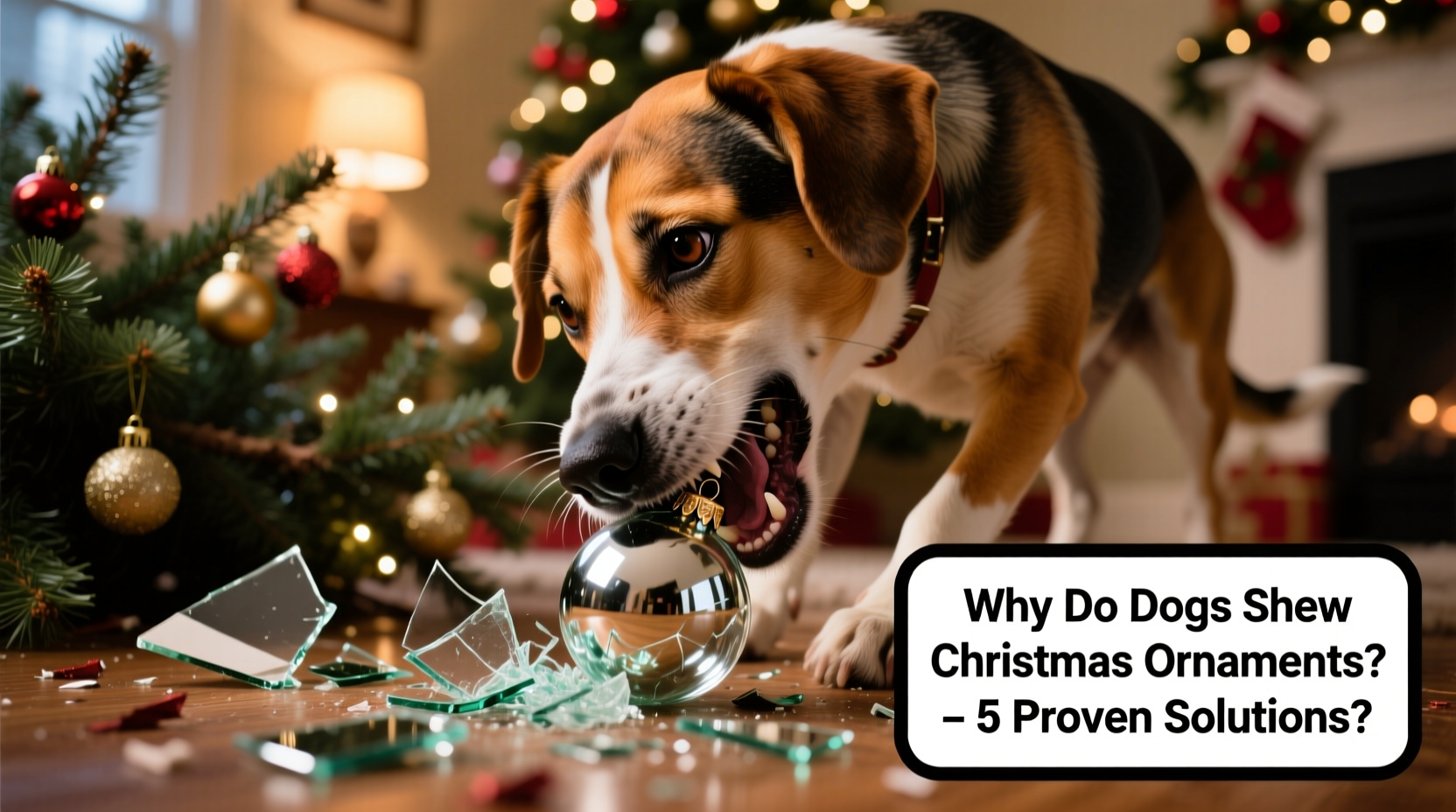
Dogs chew ornaments for reasons that fall into four overlapping categories: biological drive, environmental opportunity, emotional state, and learned reinforcement. None operate in isolation.
Teething and oral exploration are especially relevant for puppies under six months. Their gums ache as adult teeth erupt, and chewing provides soothing pressure. Ornaments—especially small, shiny, dangling ones—mimic prey movement and offer novel textures. Even adult dogs retain strong oral investigation instincts; scent, sound (a light *tink*), and texture make ornaments irresistible sensory targets.
Boredom and under-stimulation are among the most common culprits in household chewing. A dog left alone for hours near a glittering, fragrant, moving tree (thanks to drafts or pets brushing past) faces an irresistible puzzle. Without adequate physical exercise, mental enrichment, or interactive play, chewing becomes self-reinforcing: it relieves tension, passes time, and yields immediate sensory feedback.
Anxiety and stress can manifest as displacement chewing. The holiday season introduces profound environmental shifts: unfamiliar guests, altered routines, loud music, fireworks-like sounds from poppers or wrapping paper, and even changes in household scent profiles. For sensitive or insecure dogs, the tree may become both a focal point of chaos and a target for redirected coping behavior.
Attention-seeking and accidental reinforcement also play a role. If your dog chews an ornament and you rush over—yelling, grabbing, or even just giving intense eye contact—they may learn that this behavior reliably produces high-value interaction. Even negative attention satisfies a dog’s need for engagement when positive attention is inconsistent.
Evidence-Based Prevention Strategies
Effective prevention isn’t about making the tree “dog-proof” through brute-force barriers—it’s about reducing motivation while increasing acceptable alternatives. Here’s what veterinary behaviorists and certified trainers consistently recommend:
- Secure the tree physically: Use a weighted, stable stand and anchor the trunk to a wall stud with flexible, non-visible aircraft cable or heavy-duty zip ties. Avoid ribbon or string that could entangle.
- Control access, not just proximity: Install a freestanding baby gate or pet barrier that creates a 3–4 foot perimeter around the tree. Choose one tall enough to prevent jumping (at least 36 inches) and wide enough to block all angles—including behind furniture.
- Remove temptation systematically: Hang breakable, small, or edible-looking ornaments (like popcorn strings or candy canes) only on the top third of the tree—beyond reach even for large, determined dogs. Reserve lower branches for sturdy, oversized, non-fragile items (e.g., felt stars, wooden shapes).
- Neutralize scent appeal: Avoid scented sprays, pine-scented candles near the tree, or placing food-related decor (cinnamon sticks, dried orange slices) within sniffing range. Dogs detect volatile organic compounds far more acutely than humans—and scent drives much of their investigation.
- Introduce novelty elsewhere: Rotate puzzle feeders, snuffle mats, and chew toys daily. A dog mentally engaged with a frozen KONG stuffed with kibble and peanut butter is far less likely to fixate on tinsel.
A Step-by-Step Behavior Modification Plan
This 7-day plan combines management, classical conditioning, and operant training. It assumes no medical issues (always rule out dental pain or gastrointestinal discomfort with your vet first). Consistency across all household members is essential.
- Day 1–2: Full environmental control. Remove your dog from the room with the tree entirely when unsupervised. Supervise all visits with a leash attached to your belt for instant redirection.
- Day 3: Positive association building. With the tree fully decorated, sit with your dog 6 feet away. Toss high-value treats (e.g., diced chicken or cheese) every 5 seconds—*regardless* of where they’re looking—as long as they remain calm. Stop if they lunge or bark. Goal: tree = automatic treat rain.
- Day 4: Gradual approach. Increase proximity by 1 foot per successful 2-minute session. If your dog looks at the tree and then back at you, mark with “Yes!” and treat. If they fixate or move toward it, calmly pivot and walk 2 feet back—then restart.
- Day 5: Introduce alternative focus. Place a durable chew toy (e.g., a GoughNut or West Paw Toppl) 2 feet from the tree base. Reward sustained chewing on *that* item while near the tree. Never place the toy *under* the tree—keep it clearly separate.
- Day 6: Add duration and distraction. Ask your dog to “settle” on a mat beside the tree for 1 minute while you read aloud. Gradually increase to 5 minutes. If they break position, gently guide them back—no scolding. Reward stillness generously.
- Day 7: Test and generalize. Try the routine with soft holiday music playing. Then add one guest seated nearby. Monitor closely. If chewing resumes, revert to Day 3 and extend each phase by 1–2 days.
Do’s and Don’ts: What Works (and What Makes It Worse)
| Action | Why It Helps (or Hurts) | Evidence Summary |
|---|---|---|
| DO use bitter apple spray *on the tree skirt only* | Creates a safe, aversive taste barrier without risking ingestion of spray residue on ornaments | Studies show taste aversion works best when applied to surfaces dogs contact *before* reaching the target—not directly on fragile items where residue may transfer to paws or fur |
| DON’T punish after the fact | Dogs cannot connect delayed correction with past action; causes fear, not learning | ASPCA Behavioral Science confirms dogs associate punishment with the person present *at the moment*, not the object chewed minutes earlier |
| DO provide species-appropriate chew outlets daily | Satisfies oral motor needs and reduces frustration-driven chewing | Research in Applied Animal Behaviour Science shows dogs given structured chew time exhibit 68% less inappropriate chewing in enriched environments |
| DON’T use citrus peels or essential oils near the tree | Many are toxic if ingested or inhaled; can cause respiratory distress or liver damage | ASPCA Animal Poison Control reports a 42% spike in holiday-related essential oil toxicity cases in dogs each December |
Real Example: How Maya Redirected Her Rescue Dog’s Tree Fixation
Maya adopted Leo, a 2-year-old mixed breed, in early November. He’d been surrendered after chewing through three previous owners’ holiday decor—including swallowing a glass bulb fragment that required emergency surgery. At first, Maya tried everything: double-gating the living room, spraying ornaments with pet-safe deterrent, even moving the tree to the garage (which Leo howled at for hours). Nothing stuck.
Working with a certified behavior consultant, she shifted focus from suppression to substitution. She installed a 42-inch pet gate in a U-shape around the tree, placed a raised dog bed *just outside* the gate, and began daily 10-minute “tree-time” sessions using the step-by-step plan above. Crucially, she also added two 15-minute “nosework” games before dinner—hiding treats in cardboard boxes and towels. Within five days, Leo chose his bed over the tree 90% of the time. By Christmas Eve, he’d earned the privilege of being loose in the room—lying calmly on his bed while guests admired the tree. “He didn’t stop being curious,” Maya says. “He just learned the tree wasn’t where his needs got met—and that was enough.”
“Chewing ornaments isn’t ‘bad behavior’—it’s communication. Your dog is telling you they’re bored, anxious, teething, or simply haven’t been taught where chewing *is* appropriate. Responding with curiosity, not correction, transforms the problem into a relationship-building opportunity.” — Dr. Sarah Wilson, DACVB, Veterinary Behaviorist and author of Canine Enrichment for the Real World
FAQ: Practical Questions Answered
What should I do if my dog already swallowed an ornament?
Act immediately. Note the material (glass, plastic, metal, wood), size, and sharpness. Call your veterinarian or the ASPCA Animal Poison Control Center (888-426-4435) *before* inducing vomiting—some objects can cause more damage coming back up than staying down. Do not wait for symptoms; internal puncture or obstruction can occur silently for hours.
Are certain breeds more likely to chew ornaments?
Not inherently—but breeds selected for high prey drive (Terriers, Hounds), oral fixation (Bulldogs, Pugs), or working stamina (Border Collies, Australian Shepherds) may be more persistent if unstimulated. However, individual temperament, upbringing, and current environment matter far more than breed labels.
Can I use a fake tree to reduce risk?
PVC and plastic trees eliminate pine needle ingestion risks and reduce scent attraction—but many still have dangling hooks, wire frames, and lightweight stands that tempt chewing or tipping. Prioritize stability and barrier use regardless of tree type. Also note: some dogs find artificial trees *more* intriguing due to their novel texture and lack of natural deterrent scents.
Conclusion: Building a Safer, Calmer, More Joyful Holiday
Your dog’s ornament-chewing isn’t a flaw in their character—it’s data. It tells you about their energy levels, their anxiety thresholds, their need for mental challenge, and sometimes, their physical discomfort. When you respond with observation instead of outrage, with structure instead of scolding, and with compassion instead of frustration, you do more than protect your decorations. You teach your dog that their world is predictable, that their needs will be met, and that joy doesn’t require destruction. This holiday season, choose patience over panic, preparation over punishment, and presence over perfection. Start tonight: assess your tree’s setup, pull out one puzzle toy, and sit with your dog for five minutes—not to train, but to listen. That quiet connection is the most meaningful ornament of all.




 浙公网安备
33010002000092号
浙公网安备
33010002000092号 浙B2-20120091-4
Comments
No comments yet. Why don't you start the discussion?