
Christmas lights are festive, magical—and dangerously tempting to dogs. Each year, veterinary emergency clinics report a 37% spike in holiday-related ingestions between December 1st and January 5th, with electrical cords and light strands ranking among the top three foreign objects retrieved from dogs’ mouths or digestive tracts. Chewing isn’t just misbehavior; it’s a convergence of instinct, physiology, environment, and unmet needs. Understanding the “why” is the first step—not toward punishment, but toward compassionate, effective intervention. This article distills insights from veterinary behaviorists, certified dog trainers, and clinical animal nutritionists to help you protect your dog, your home, and your peace of mind this season.
The Real Reasons Behind the Chewing
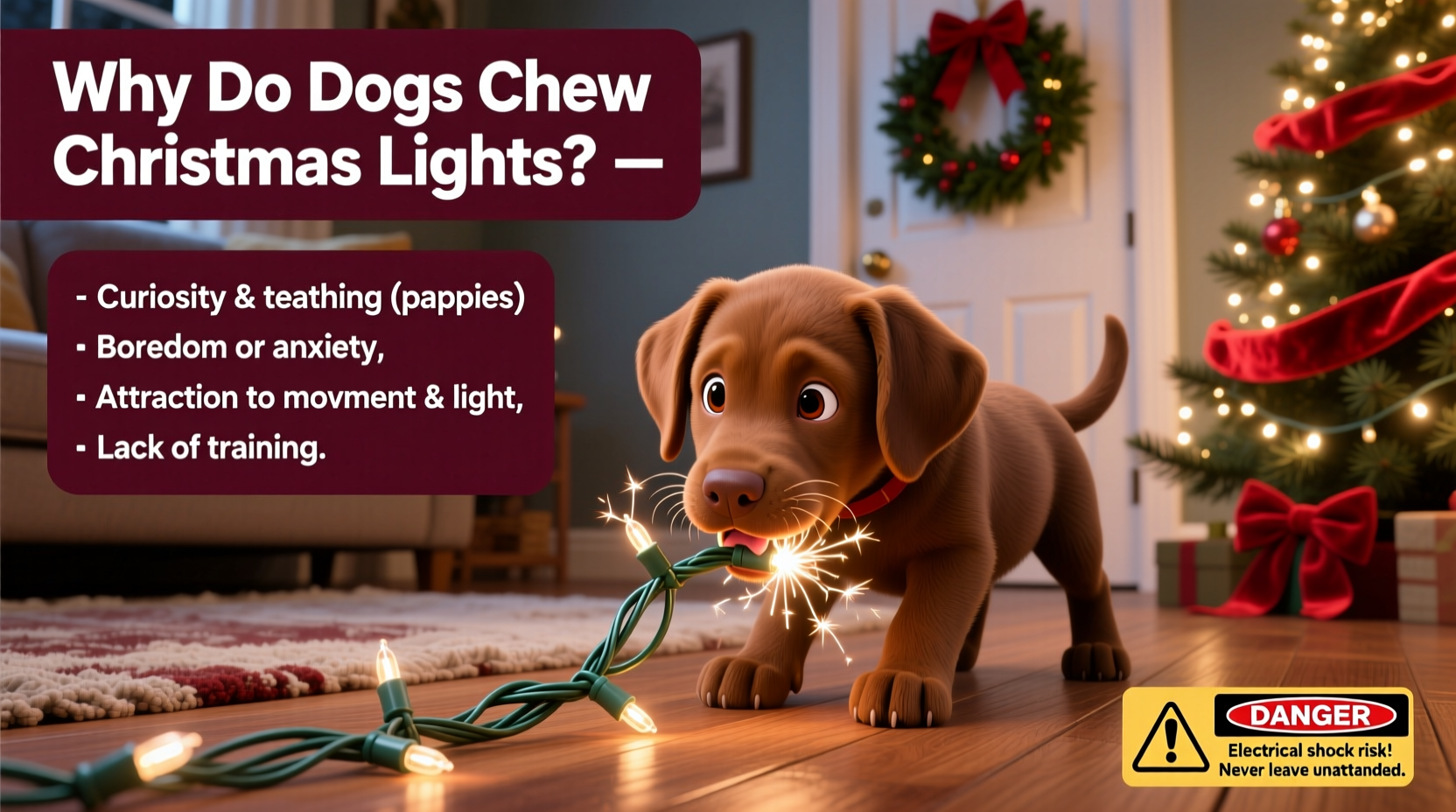
Dogs don’t chew lights because they’re “naughty” or “testing boundaries.” They chew because something in their biology, development, or environment makes those glowing, dangling wires irresistible—and often necessary. Here’s what’s actually happening:
- Teething & Oral Exploration (Puppies under 7 months): Puppies explore the world with their mouths. Their gums ache during teething—especially around 4–6 months—making cool, pliable, textured objects like insulated cords deeply soothing. The slight resistance and give of a light cord mimics natural chewing substrates like roots or hides.
- Boredom & Under-Stimulation (All ages, especially high-energy breeds): A dog left alone for extended periods during holiday prep may have no outlet for pent-up energy. Lights sway, emit faint hums, and reflect light—creating visual, auditory, and tactile novelty that triggers prey drive and investigative focus.
- Anxiety & Stress Response (Common in rescue dogs, seniors, or dogs facing household changes): Holiday chaos—new people, altered routines, loud music, unfamiliar scents—can elevate cortisol. Chewing releases endorphins, acting as self-soothing behavior. One study published in Applied Animal Behaviour Science found that 68% of dogs exhibiting destructive chewing during holidays showed elevated salivary cortisol levels compared to baseline.
- Nutritional Deficiencies or Pica (Less common but medically significant): While rare, chronic chewing of non-food items—including plastic, rubber, or wire insulation—can signal underlying issues: zinc or iron deficiency, gastrointestinal discomfort, or even neurological conditions. Always rule out medical causes before assuming behavioral origin.
- Positive Reinforcement Loop (Unintentional but powerful): If your dog chews lights and receives attention—even negative attention like shouting or chasing—their brain registers “I got a reaction.” That reinforces repetition. Likewise, if chewing coincides with excitement (e.g., lights going on at dusk), the dog may associate the behavior with positive environmental cues.
Vet-Approved Prevention Strategies That Actually Work
Effective prevention isn’t about making lights inaccessible—it’s about eliminating motivation while building reliable alternatives. Relying solely on bitter sprays or tape rarely succeeds long-term. Instead, integrate these layered, evidence-based approaches:
1. Environmental Management: Remove Temptation First
This is non-negotiable. Before adding training, secure every strand. Use heavy-duty cord organizers (not zip ties—dogs chew through them), route lights behind furniture or baseboards, and mount strands at least 4 feet off the ground using adhesive hooks rated for 5+ lbs. For trees, wrap the lowest 3 feet of trunk in aluminum foil (deterrent texture + noise) or double-layered chicken wire (cut ends smooth).
2. Redirect with High-Value, Long-Lasting Chew Alternatives
Offer chews that match the sensory profile of lights: cool, flexible, slightly resistant, and safe to gnaw for 15+ minutes. Avoid rawhide or synthetic bones that splinter. Opt instead for:
- Frozen KONG stuffed with low-sodium peanut butter + mashed banana + a few kibble pieces (freeze overnight)
- West Paw Zogoflex Qwizl filled with yogurt and blueberries, then frozen
- Elk antler (for large, aggressive chewers—supervised only)
3. Build a “Chew Cue” Routine
Don’t wait for chewing to start. Train your dog to choose appropriate chews *on cue*. Use a consistent verbal marker (“Chew!”) paired with immediate access to a designated chew toy. Reward heavily when they engage. Repeat 5x/day for 7 days. Within two weeks, most dogs will move toward their chew station when stressed or bored—bypassing wires entirely.
Step-by-Step Safety Intervention Plan (For Immediate Risk)
If your dog has already chewed lights—or you catch them mid-chew—follow this precise sequence. Speed and calmness prevent escalation and injury:
- Stop calmly: Say “Leave it” once, firmly but without yelling. Do not grab the cord—they may clamp down harder.
- Redirect immediately: Offer a pre-chilled, high-value chew (e.g., frozen beef tendon) directly in front of their nose. If they drop the cord to take it, praise quietly and let them chew.
- Secure the area: Unplug all lights within reach. Place a baby gate or exercise pen around the tree or mantel. Do not leave unsupervised for >90 seconds.
- Assess for injury: Check mouth for burns, bleeding, or embedded plastic. Look for drooling, pawing at mouth, or reluctance to eat. If any signs appear, contact your veterinarian immediately—even if no shock occurred. Insulation chemicals can cause chemical burns.
- Reset the environment: Re-route all cords using conduit or wall clips. Add motion-activated deterrents (e.g., PetSafe SSSCAT spray) pointed at the base of the tree—not at the dog—to interrupt approach patterns without fear association.
Do’s and Don’ts: What Works (and What Makes It Worse)
| Action | Do / Don’t | Why It Matters |
|---|---|---|
| Using bitter apple spray | Don’t rely on it alone | Only ~32% of dogs avoid cords after application (2023 Cornell Behavior Clinic trial). Many learn to lick it off or ignore taste after repeated exposure. |
| Leaving lights on when unattended | Don’t ever do this | Live wires pose electrocution risk even without chewing—frayed insulation can arc or spark near bedding or carpet. |
| Providing daily mental enrichment | Do—minimum 30 minutes | Dogs who receive puzzle feeders, scent games, or training sessions show 71% less destructive chewing (Journal of Veterinary Behavior, 2022). |
| Punishing after the fact | Don’t—ever | Dogs cannot connect delayed correction to past action. This erodes trust and increases anxiety-driven chewing. |
| Consulting your veterinarian before using supplements | Do—especially for anxious dogs | L-theanine, alpha-casozepine, or prescription anxiolytics (e.g., fluoxetine) may be indicated—but only after ruling out pain or thyroid dysfunction. |
Mini Case Study: Luna, a 2-Year-Old Australian Shepherd
Luna began chewing Christmas lights the week before Thanksgiving. Her owners—both remote workers—assumed she was bored. They tried bitter spray, crate confinement, and yelling. Nothing worked. By December 3rd, she’d severed two strands and received a mild oral burn.
Her veterinarian referred her to a board-certified veterinary behaviorist. Assessment revealed Luna wasn’t bored—she was anxious. Her owners had recently adopted a second dog, and Luna’s sleep schedule had shifted due to holiday travel plans. Her cortisol levels were elevated, and she’d stopped sleeping through the night.
The behaviorist prescribed a dual-track plan: environmental safety (all lights routed overhead via ceiling-mounted tracks) and behavioral support (scheduled 10-minute “sniff walks” before dawn, a weighted anxiety vest during family gatherings, and a predictable “quiet time” ritual with a slow-feeder mat). Within 11 days, Luna ignored the tree entirely. Her owners added a “chew basket” by the sofa—rotating frozen KONGs and dental chews daily. No lights damaged since.
“Dogs don’t chew cords to upset us. They chew because something is missing—security, stimulation, or physiological balance. Fix the root, not the symptom.” — Dr. Sarah Lin, DACVB, Veterinary Behavior Specialist, UC Davis School of Veterinary Medicine
FAQ: Your Most Pressing Questions Answered
Can I use LED lights instead of incandescent to reduce risk?
LEDs run cooler and draw less current—but they are not safer for chewing. The insulation material (often PVC or thermoplastic elastomer) remains toxic if ingested, and the copper wiring inside can still cause electrocution or intestinal perforation. Voltage reduction doesn’t eliminate hazard; it only changes the severity threshold. Prioritize physical barrier methods over bulb type.
My dog only chews lights at night. Is this a circadian issue?
Yes—this is highly likely. Dogs’ natural activity peaks at dawn and dusk (crepuscular rhythm). Dim lighting, quiet households, and reduced human supervision at night create ideal conditions for exploratory chewing. Install motion-sensor nightlights in hallways (not near cords) and provide a “night chew”—a durable, scent-rich toy placed beside their bed before dark. Avoid feeding or playing right before bedtime, which can increase arousal.
Will crate training solve this?
Crate training helps only if your dog is fully crate-conditioned *and* the crate is used proactively—not punitively. Forcing a stressed dog into confinement often worsens anxiety. Instead, build positive associations: feed all meals in the crate, toss treats inside while door is open, and gradually increase closed-door time. Never crate longer than 2 hours for puppies or 4 hours for adults—and never during active holiday events when stressors peak.
Conclusion: Safety Starts With Understanding
Your dog isn’t trying to ruin Christmas. They’re communicating—through teeth, tongue, and tension—that something feels unsafe, unbalanced, or unfulfilled. Chewing lights is a red flag, not a flaw. When you respond with curiosity instead of frustration, with science instead of superstition, and with compassion instead of correction, you transform a dangerous habit into a meaningful opportunity: to deepen your bond, refine your care, and create a home where both joy and safety coexist.
Start tonight. Unplug one strand. Route it behind the sofa. Fill a KONG and freeze it. Sit with your dog for five quiet minutes—no phone, no distractions—just presence. Notice how their breathing slows. Watch how their eyes soften. That’s the real magic of the season: not glitter or glow, but grounded connection.




 浙公网安备
33010002000092号
浙公网安备
33010002000092号 浙B2-20120091-4
Comments
No comments yet. Why don't you start the discussion?