
It’s December. The lights are strung, the ornaments hung, and the scent of pine fills the air—until you hear the unmistakable scritch-scritch-scritch of teeth grinding against metal or plastic. You rush into the living room to find your dog clamped onto the base of the Christmas tree stand, tail wagging, eyes bright with purpose. You gently pry their jaws apart—only to watch them pivot and lunge back within seconds. This isn’t just annoying. It’s dangerous: stands can contain sharp edges, toxic sealants, or residual water mixed with fertilizers and preservatives. Worse, chewing destabilizes the tree, risking collapse, injury, or fire hazard.
This behavior is far more common—and far more understandable—than most pet owners realize. It’s not “naughtiness.” It’s communication. And with the right insight and humane intervention, it’s entirely preventable. Below, we break down the science behind the chewing, real-world solutions that work (not just quick fixes), and a step-by-step plan grounded in veterinary behavior science—not folklore or outdated dominance myths.
Why dogs target Christmas tree stands: 5 root causes (not just boredom)
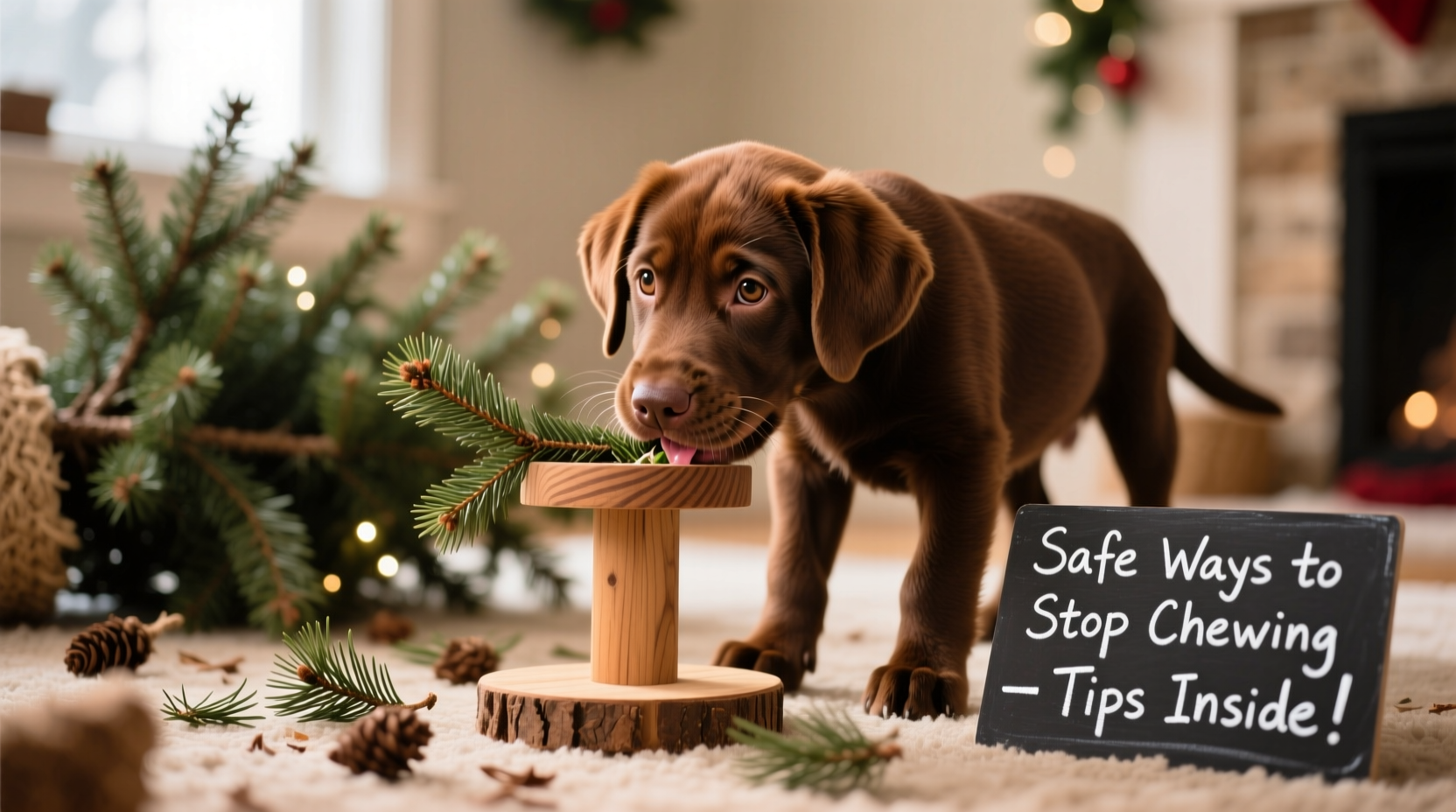
Dogs don’t chew stands because they “hate holidays.” They respond to specific sensory, physiological, and environmental triggers. Understanding these removes blame—and points directly to effective solutions.
- Olfactory fascination: Tree stands hold stagnant water infused with sap, pine resin, commercial tree preservatives (often containing sugars, dextrose, or even low-dose fertilizers), and sometimes mold spores. To a dog’s nose—10,000–100,000 times more sensitive than ours—this mixture smells like fermented fruit, sweet earth, and biological intrigue. It’s irresistible.
- Texture reinforcement: Many stands feature rubberized gaskets, textured plastic grips, or grooved metal surfaces that provide satisfying resistance and feedback when chewed—similar to high-value chew toys. This tactile reward reinforces repetition.
- Stress displacement: Holiday changes—guests, noise, altered schedules, new scents, and visual clutter—elevate canine cortisol. Chewing releases endorphins and serves as a self-soothing mechanism, especially for dogs with underlying anxiety or insufficient daily mental exercise.
- Attention-seeking (even negative): If your dog has ever been rushed toward, spoken to sharply, or physically removed from the stand—even once—their brain may now associate the act with guaranteed human interaction. For socially motivated dogs, reprimands function as reinforcement.
- Underlying medical or nutritional drivers: Chronic mild dehydration, zinc or iron deficiency (rare but documented), dental pain, or gastrointestinal discomfort can manifest as pica-like behavior. A 2022 study in the Journal of Veterinary Behavior found that 23% of dogs exhibiting persistent non-food chewing had undiagnosed oral pathology or micronutrient imbalances.
Safety first: What makes tree stands hazardous to dogs?
Not all stands pose equal risk—but many common models introduce serious, under-recognized dangers.
| Hazard Type | Common Stand Materials/Features | Risk to Dogs |
|---|---|---|
| Toxic exposure | Water additives (commercial preservatives, aspirin, sugar, fertilizer), PVC-coated metal, painted finishes with lead or cadmium traces | Oral ulceration, vomiting, kidney stress, tremors; symptoms may appear hours after ingestion |
| Physical injury | Exposed screw threads, jagged plastic fracture points, thin-gauge stamped metal edges | Lacerations to gums/tongue, embedded fragments, puncture wounds requiring surgical removal |
| Choking/aspiration | Detachable rubber gaskets, small plastic caps, loose screws | Airway obstruction, esophageal trauma, emergency endoscopy |
| Tree instability | All stands compromised by repeated chewing on support arms or base flanges | Falling tree causing spinal trauma, crushed limbs, or knocking over candles/fireplaces |
Dr. Lena Torres, DVM and board-certified veterinary behaviorist at the Animal Behavior Clinic of Chicago, emphasizes urgency: “A dog chewing a stand isn’t ‘just being festive.’ It’s a red flag—either for environmental stress, unmet behavioral needs, or an emerging medical issue. Ignoring it risks acute harm and normalizes dangerous oral exploration.”
Proven, humane strategies to stop the chewing—no punishment required
Effective intervention requires layering three approaches simultaneously: immediate environmental management, consistent behavioral redirection, and long-term need fulfillment. One alone rarely succeeds.
Step-by-step prevention protocol (7 days to stability)
- Day 1: Secure & assess
Move the tree to the least trafficked corner of the room. Install a freestanding baby gate (not pressure-mounted) forming a 3-foot radius around the trunk. Simultaneously, collect a fresh water sample from the stand and contact your veterinarian—many clinics offer rapid heavy-metal or toxin screening for $35–$65. - Day 2: Eliminate olfactory triggers
Empty the stand. Scrub thoroughly with white vinegar (1:1 with water), rinse twice, and dry completely. Refill with only plain, filtered water—no additives, no sugar, no aspirin. Cover the water surface with a stainless-steel mesh screen (like a fine pasta strainer) anchored securely to prevent displacement. - Day 3: Introduce functional alternatives
Rotate three high-value chew options on a strict schedule: (a) frozen KONG stuffed with low-sodium peanut butter + banana mash (frozen overnight), (b) deer antler slice soaked 24 hours in low-sodium broth, (c) GoughNuts Indestructible Ring (guaranteed replaceable if chewed through). Offer one for 20 minutes, twice daily—timed 30 minutes before peak household activity (e.g., morning coffee, evening prep). - Day 4: Build incompatible behavior
Teach “leave it” using positive markers (clicker or verbal “yes”) and high-value treats (boiled chicken, tripe strips). Practice near—but not at—the gated tree zone. Start at 6 feet distance; gradually decrease only when your dog consistently looks away on cue. Never test reliability near the stand until 10+ flawless repetitions at 1 foot. - Day 5: Enrich environment-wide
Add two 10-minute sessions of scentwork: hide 5 kibble pieces in shallow boxes filled with shredded paper. Rotate locations daily. This satisfies investigative drive without redirecting to the tree. - Day 6: Audit human behavior
Record all interactions near the tree for 2 hours. Note: Did you glance, speak, or move toward your dog when they approached the gate? Even silent attention reinforces proximity. Instead, practice “ignore-and-reward”: turn fully away when dog moves toward gate; immediately mark and treat when they choose a chew toy or lie on their bed. - Day 7: Reinforce success & adjust
If zero stand contact occurred, widen gate radius by 6 inches. If chewing resumed, revert to Day 2 protocols and add a veterinary consult for bloodwork (CBC, chemistry panel, zinc/iron levels).
Real-life example: How Maya redirected her rescue terrier mix
Maya adopted Leo, a 3-year-old Jack Russell–beagle mix, in November. By December 5, he’d chewed through two plastic stands and dislodged her 7-foot Fraser fir twice. Frustrated, she tried lemon spray, scolding, and crate confinement—none worked. She contacted a certified dog trainer who observed Leo’s behavior: he only approached the stand when guests arrived or during TV commercial breaks (predictable quiet moments). His saliva pooled visibly on the rubber gasket—a sign of intense olfactory focus.
The trainer recommended eliminating tree water additives (which Maya hadn’t realized were optional), installing a stainless-steel mesh cover, and introducing “find-it” games using dried apple slices hidden in pinecones. Within 48 hours, Leo’s stand interest dropped 80%. By Day 10, he’d chosen his KONG over the stand 19 out of 20 opportunities. Crucially, Maya stopped making eye contact when he passed the gate—and began rewarding him lavishly for lying on his mat facing away from the tree. “He wasn’t being defiant,” she said. “He was bored, curious, and slightly anxious about the noise. Once I gave him better jobs to do, he forgot the stand existed.”
What NOT to do—and why it backfires
Well-intentioned interventions often worsen the problem by increasing stress or reinforcing the behavior unintentionally.
- Don’t punish after the fact. Dogs cannot connect delayed reprimands with past actions. Yelling or grabbing your dog post-chew raises baseline anxiety—making future chewing more likely as a coping mechanism.
- Don’t rely solely on taste deterrents. Most commercial sprays fail because dogs habituate rapidly—or simply chew elsewhere on the stand where spray wasn’t applied. Bitter substances also irritate oral mucosa, potentially worsening gum inflammation that drives chewing.
- Don’t use electric mats or motion-activated sprayers near the tree. These create fear-based associations with the entire holiday space, potentially triggering resource guarding or generalized anxiety around decorations.
- Don’t assume “he’ll grow out of it.” Unaddressed chewing becomes a reinforced habit loop. Neuroplasticity means the more a dog repeats the behavior, the more efficiently their brain wires the pathway—making cessation harder over time.
FAQ: Your top concerns, answered by veterinary behavior science
Can I use a fake tree instead to avoid the problem?
Not necessarily—and sometimes, it’s worse. Many artificial trees use PVC bases with phthalates, and their plastic trunks emit volatile organic compounds (VOCs) dogs find intriguing to lick and chew. More critically, switching trees doesn’t address the underlying driver (e.g., anxiety, under-stimulation). Focus on resolving the cause—not just swapping the object.
My dog only chews the stand when I’m cooking. Is this food-related?
Yes—but indirectly. Cooking releases rich food aromas that heighten overall arousal and oral motivation. Combine this with holiday kitchen chaos (more movement, noise, dropped crumbs), and your dog seeks oral engagement. Mitigate by giving a stuffed KONG *before* you start cooking—not as a reaction, but as proactive enrichment.
Will neutering/spaying stop this behavior?
No. While intact dogs may show increased roaming or marking, chewing stands is unrelated to reproductive hormones. It’s driven by sensory input, learning history, and environmental stress—not testosterone or estrogen levels.
Conclusion: Turn holiday stress into shared calm
Your dog isn’t sabotaging the season. They’re asking—in the only language they have—for clarity, safety, and meaningful engagement. Chewing a Christmas tree stand is a symptom—not the disease. When you respond with curiosity instead of correction, with environmental design instead of discipline, and with compassion instead of frustration, you don’t just protect your tree. You deepen trust. You build resilience. You transform a seasonal headache into a demonstration of how well you truly understand your companion.
Start tonight. Empty that stand. Wipe it clean. Fill it with plain water. Place the mesh screen. Then hand your dog the frozen KONG—and sit beside them while they enjoy it. Notice how their body softens. How their breathing slows. That’s not obedience. That’s partnership.




 浙公网安备
33010002000092号
浙公网安备
33010002000092号 浙B2-20120091-4
Comments
No comments yet. Why don't you start the discussion?