
It happens every December: You step into the living room to admire your beautifully lit tree—only to find your dog crouched beneath it, jaws wrapped around a bundle of electrical cords, tail wagging like it’s just won a prize. Your heart drops. Not because of the ruined décor—but because those wires carry real danger: electrocution, internal burns, cardiac arrest, or even death. According to the ASPCA Animal Poison Control Center, electrical cord chewing ranks among the top five non-toxic household emergencies reported during the holiday season—and it’s entirely preventable.
This isn’t about “bad behavior” or willful disobedience. It’s about biology, environment, and unmet needs intersecting at the most festive—and fragile—time of year. Dogs don’t chew wires to spite you. They chew because something in their world is out of balance—and your tree, with its novel scents, textures, movement, and accessibility, becomes an irresistible focal point. The good news? With thoughtful observation and consistent, compassionate intervention, you can redirect this impulse without punishment, stress, or risk.
Why dogs target Christmas tree wires: more than curiosity
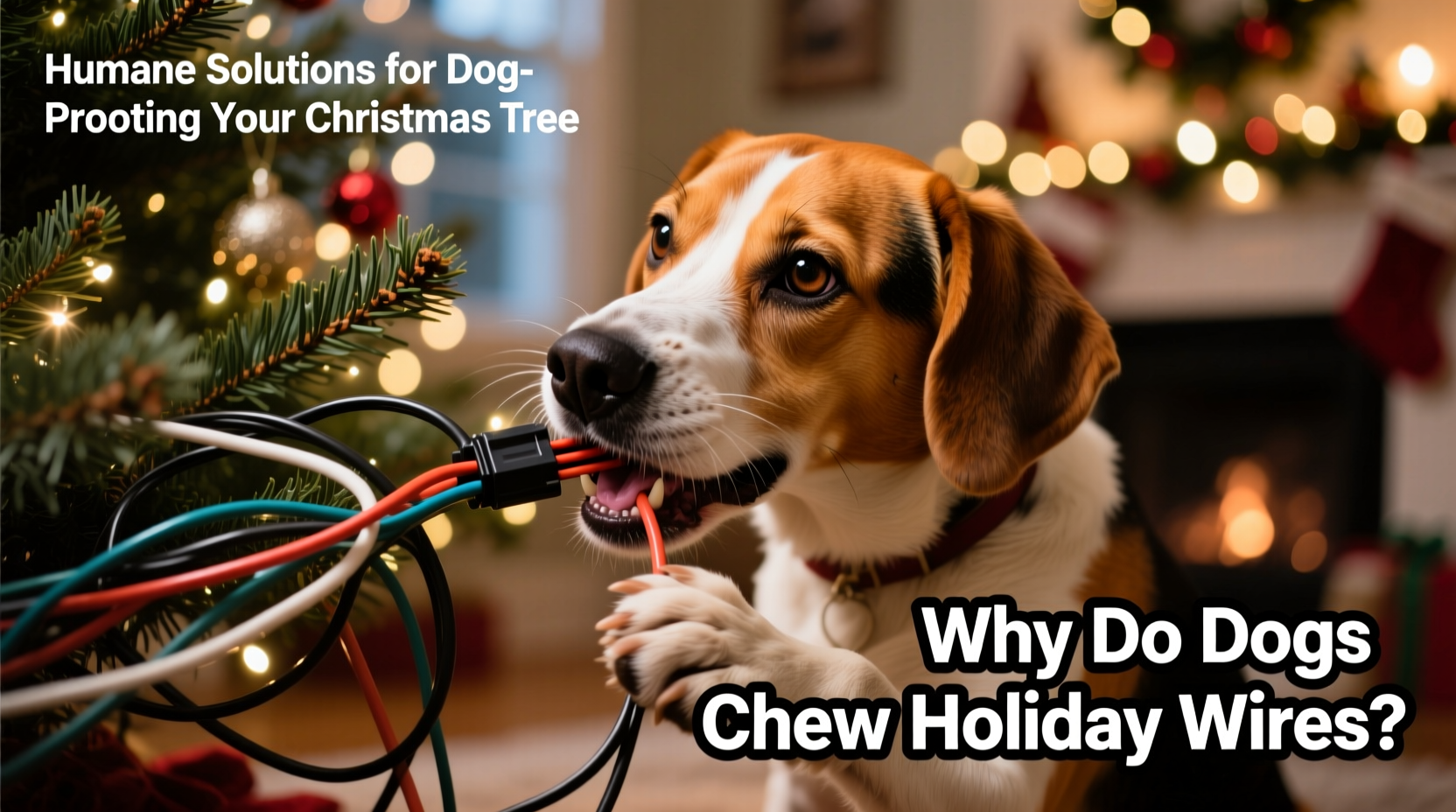
Dogs explore the world through their mouths—a behavior rooted in evolution and neurodevelopment. Puppies teethe; adult dogs investigate unfamiliar objects by mouthing them. But Christmas tree wires trigger a unique convergence of risk factors:
- Sensory novelty: Wires emit faint warmth, subtle vibrations (from current flow), and plastic or rubber odors that many dogs find intriguing—especially if they’re coated in PVC or contain trace chemical residues from manufacturing.
- Visual stimulation: Twinkling lights reflect off metallic conductors, creating flickering patterns that activate a dog’s prey drive. For high-energy or herding breeds, the intermittent flash mimics movement—inviting pursuit and interaction.
- Stress displacement: Holiday chaos—guests, loud music, altered routines, travel, and new scents—elevates cortisol in sensitive dogs. Chewing releases endorphins, offering self-soothing relief. Wires become accessible, portable “stress balls.”
- Boredom + under-stimulation: Shorter daylight hours, disrupted walks, and indoor confinement mean less physical and mental output. A dangling cord offers instant tactile feedback and novelty—far more engaging than an ignored Kong.
- Lack of appropriate alternatives: If a dog has never been taught what *is* acceptable to chew—or hasn’t had access to durable, satisfying chew options—they default to whatever is novel, textured, and within reach.
Crucially, this behavior is rarely tied to anxiety disorders alone. In a 2022 study published in Frontiers in Veterinary Science, researchers observed that 78% of dogs exhibiting seasonal wire-chewing showed no signs of generalized anxiety outside the holiday period—suggesting environmental triggers outweigh underlying pathology in most cases.
Humane, evidence-based prevention: what works (and what doesn’t)
Scolding, spraying bitter apple, or yelling when you catch your dog mid-chew may suppress the behavior temporarily—but it doesn’t address motivation, teaches fear of you or the tree, and often worsens stress-related chewing. Vets and veterinary behaviorists emphasize proactive, positive reinforcement over reactive correction.
Effective prevention hinges on three pillars: management (removing opportunity), enrichment (meeting needs), and training (teaching alternatives). All must be implemented together—and consistently—for lasting results.
Step-by-step: building a wire-safe holiday environment
- Secure all wiring before the tree goes up. Use heavy-duty cord organizers, PVC conduit, or flexible metal loom tubing—not tape or zip ties alone. Route wires behind furniture or along baseboards using adhesive clips designed for pet homes (e.g., PetSafe Cord Cover System).
- Create a physical barrier. Install a freestanding pet gate (minimum 36” height) around the tree base. Choose one with narrow spacing (<2”) to prevent paws or snouts from slipping through. For small dogs, consider a low-profile wooden or acrylic “tree corral” anchored to the floor.
- Eliminate visual and olfactory cues. Keep the tree stand filled only with water—no aspirin, sugar, or commercial preservatives, which can attract dogs with scent or taste. Cover the stand with a fabric skirt secured tightly (not draped loosely, which invites pulling).
- Introduce alternative chew stations. Place two to three high-value, species-appropriate chews (e.g., elk antler for power chewers, food-stuffed rubber toys for moderate chewers) near—but not under—the tree. Rotate daily to maintain novelty.
- Implement “tree time” supervision protocol. For the first 72 hours after setup, spend 15 minutes twice daily sitting beside the tree with your dog on a leash. Reward calm observation with quiet praise and treats. Gradually increase distance while maintaining positive association.
Do’s and Don’ts: a practical safety table
| Category | Do | Don’t |
|---|---|---|
| Wiring | Use UL-listed, grounded extension cords with built-in circuit breakers. Bundle and conceal all cords before decorating. | Run cords across high-traffic floor paths. Leave spare outlets uncovered or cords coiled loosely on the ground. |
| Tree Setup | Choose a stable, weighted base. Anchor the trunk to wall studs with breakaway straps (e.g., Tree Protector Straps). | Use tinsel, popcorn strings, or glass ornaments within 3 feet of the floor. These encourage investigation and pose choking hazards. |
| Chew Alternatives | Offer frozen Kongs stuffed with pumpkin + peanut butter (xylitol-free), or slow-feeder puzzle mats placed 6 feet from the tree. | Give rawhide, cooked bones, or nylon chews near the tree—these can splinter, cause obstruction, or reinforce proximity to danger zones. |
| Training Approach | Teach “leave it” using high-value treats and 0.5-second reward timing. Practice daily away from the tree first. | Yell “NO!” or grab the cord from your dog’s mouth. This creates resource guarding and increases arousal. |
Real-world example: Luna, a 3-year-old Australian Shepherd
Luna’s family loved their rustic farmhouse tree—until last December, when she snapped a live cord and received a mild shock. She yelped, retreated—but returned the next morning to gnaw the same spot. Her owners assumed she was “defiant.” A veterinary behaviorist observed Luna’s routine: walks shortened due to snow, children visiting constantly, and zero chew toys introduced since Thanksgiving. The behaviorist recommended three changes: (1) a 10-minute “sniff walk” before breakfast to fulfill olfactory needs; (2) rotating three durable chews (a GoughNuts ring, a West Paw Zogoflex Qwizl, and a sterilized beef shank) placed on a designated rug 5 feet from the tree; and (3) installing a pressure-mounted gate with a treat-dispensing toy mounted on its frame. Within four days, Luna stopped approaching the barrier. By Day 12, she’d learned to nudge the gate open *only* when invited—and then immediately went to her chew rug. No shocks. No scolding. Just clarity, consistency, and compassion.
“Chewing is communication—not defiance. When a dog targets wires, they’re telling us: ‘I’m bored, stressed, curious, or underserved.’ Our job isn’t to stop the mouth—it’s to listen, then respond with better options.” — Dr. Sarah Lin, DACVB, Veterinary Behaviorist and Co-Director of the Chicago Canine Wellness Institute
Essential checklist: prepare your home before the first light goes on
- ✅ Test all lights and cords for fraying, exposed wiring, or overheating before installation.
- ✅ Install cord covers *before* placing the tree—never retrofit.
- ✅ Set up barriers and chew stations at least 48 hours pre-tree to allow acclimation.
- ✅ Introduce “leave it” and “go to your mat” cues using low-distraction settings first.
- ✅ Stock at least six high-value, long-lasting chews—rotate two per day to sustain interest.
- ✅ Schedule extra sniff walks, puzzle feedings, or training sessions during peak holiday activity.
- ✅ Designate a quiet “decompression zone” (crate, bed, or room) where your dog can retreat without disturbance.
FAQ: answering urgent concerns
What if my dog already got shocked?
Seek immediate veterinary care—even if symptoms seem mild. Internal burns and cardiac arrhythmias may not appear for 12–48 hours. Do not induce vomiting or administer home remedies. Keep your dog calm and warm en route to the clinic. Document the voltage (check cord label) and duration of contact if known.
Are battery-operated lights safer?
Yes—low-voltage LED battery lights eliminate electrocution risk. However, they still pose ingestion hazards (small batteries, plastic casings) and may attract chewing due to blinking patterns. Always supervise and mount securely. Avoid lithium coin-cell batteries entirely—they cause severe esophageal corrosion in under 2 hours if swallowed.
Will crate training solve this?
Crate training helps manage access—but it’s not a standalone solution. Crating during unsupervised hours is wise, but dogs need enrichment *outside* the crate too. Relying solely on confinement without addressing root causes (boredom, stress, lack of alternatives) often leads to increased frustration and redirected chewing elsewhere—including furniture, shoes, or walls. Combine crating with proactive engagement.
Conclusion: safety begins with understanding—not suppression
Your dog isn’t plotting against your holiday spirit. They’re responding—predictably and biologically—to a sudden shift in their sensory landscape, routine, and emotional load. Wire chewing isn’t a character flaw. It’s a signal. And when you meet that signal with empathy, preparation, and science-backed strategy, you do far more than protect cords—you deepen trust, reduce stress, and honor the intelligence and sensitivity your dog brings into your home every day.
This season, choose curiosity over correction. Choose observation over assumption. Choose durability over decoration. Anchor your tree, cover your cords, rotate your chews, and breathe deeply when the chaos mounts. You don’t need a “perfect” holiday—you need a safe, joyful, and truly shared one.




 浙公网安备
33010002000092号
浙公网安备
33010002000092号 浙B2-20120091-4
Comments
No comments yet. Why don't you start the discussion?