
It happens every December: You wake up to the sharp scent of urine near the base of your freshly decorated tree—or worse, discover a damp patch on the carpet beneath its boughs. Your dog didn’t have an accident. They *intentionally* marked. This isn’t misbehavior; it’s communication. Dogs don’t pee near the Christmas tree because they’re spiteful or poorly trained. They do it because the tree triggers deep-rooted instincts tied to scent, novelty, hierarchy, and environmental stress. Understanding that distinction is the first step toward resolution—not punishment. In this article, we break down the biological and behavioral drivers behind this seasonal issue, outline practical interventions grounded in veterinary behavior science, and provide a clear path forward for restoring calm—and dry floors—during the holidays.
Why the Christmas Tree Triggers Marking Behavior
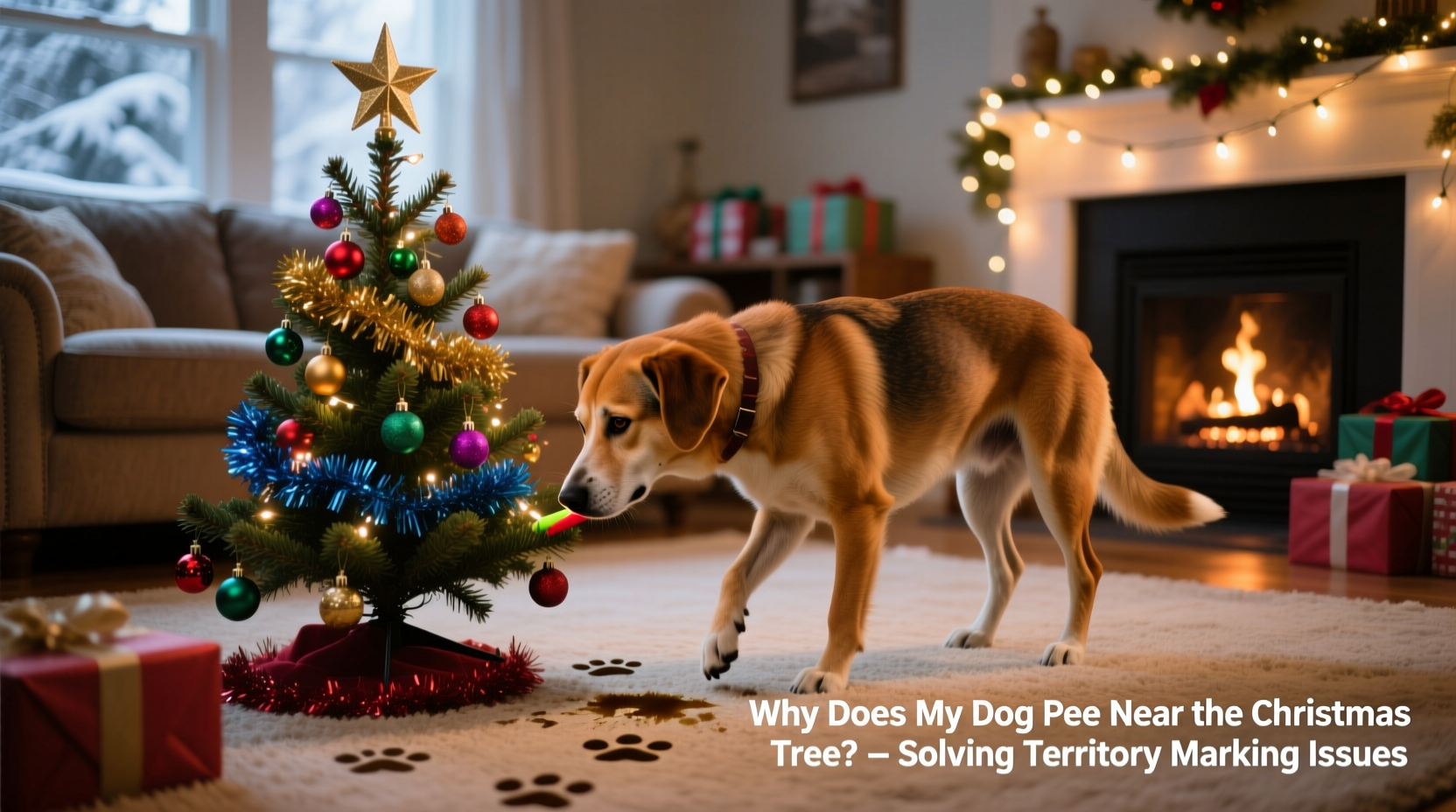
Dogs perceive the world primarily through scent. A live or even high-quality artificial Christmas tree introduces a concentrated burst of unfamiliar odors: pine resin, sap, soil (if potted), ornaments with metallic or plastic scents, tinsel, lights, and the lingering traces of human handling. To a dog, this isn’t festive décor—it’s an olfactory anomaly in their established territory. When something novel and potent enters a dog’s home environment, especially one that towers over them and occupies central floor space, it can signal potential intrusion or social ambiguity. That triggers an instinctive response: “I need to overlay my scent here to reaffirm ownership.”
This isn’t limited to unneutered males. While testosterone amplifies marking frequency, studies show that up to 40% of spayed females also engage in territorial marking—particularly in response to environmental change or perceived competition. The tree becomes a focal point not because it’s “special,” but because it’s *disruptive*: its height mimics another animal’s presence, its scent profile defies routine, and its placement often coincides with increased household activity—more guests, altered schedules, and new sounds—all of which elevate baseline anxiety.
Veterinary behaviorist Dr. Karen Overall explains:
“Marking is rarely about dominance or defiance. It’s a displacement behavior rooted in uncertainty. When a dog feels their sense of control erode—even subtly, like with a towering object emitting strange smells—they revert to an ancient, hardwired strategy: scent-signaling safety.”
5 Common Contributing Factors (and What They Really Mean)
Not all tree-related marking stems from the same cause. Identifying the dominant driver in your home allows for precise intervention. Below are the five most frequent contributors—and what each reveals about your dog’s emotional state:
| Factor | What It Indicates | Typical Signs Beyond Marking |
|---|---|---|
| New or Unfamiliar Tree | Your dog perceives the tree as a foreign entity invading core territory—especially if introduced abruptly or placed in a high-traffic area like the living room center. | Increased sniffing around the trunk, circling before urinating, reluctance to approach other family members near the tree. |
| Presence of Other Pets | Introduces social tension. Even harmonious multi-pet households experience subtle shifts in rank when novelty enters shared space. | Stiff posture near the tree, lip-licking, avoidance of eye contact between pets, redirected growling at objects near the base. |
| Recent Household Changes | A move, new baby, returning college student, or even rearranged furniture lowers your dog’s felt security—making scent-marking a coping mechanism. | Restlessness at night, increased vocalization, chewing on non-toy items, pacing near windows. |
| Inadequate Outdoor Access | When elimination routines shift due to cold weather, shorter walks, or holiday travel, dogs may resort to indoor marking as a functional outlet—not just territorial. | Sniffing urgently at doors, whining near exits, holding urine longer than usual, urinating immediately upon returning outside. |
| Past Negative Association | If your dog was previously corrected near the tree (e.g., yelled at or startled), they may now associate the location with fear—and mark as a stress response, not assertion. | Flattened ears near the tree, tail tucked while approaching, sudden freezing, or rapid retreat after sniffing. |
Actionable Solutions: A Step-by-Step Intervention Plan
Effective resolution requires consistency, timing, and empathy—not speed. This six-step plan is designed to interrupt the marking cycle while rebuilding your dog’s confidence in the changed environment. Implement all steps concurrently for best results. Most owners see measurable improvement within 7–10 days.
- Immediate Scent Removal (Day 1): Use an enzymatic cleaner—never ammonia- or vinegar-based products—on every surface where marking occurred. Enzymes break down urea crystals and pheromone residues that attract repeat visits. Apply generously, allow full 10-minute dwell time, then blot (don’t rub). Repeat daily for three days.
- Tree Zone Redefinition (Day 1–3): Physically block access using a low, removable barrier (e.g., baby gate or exercise pen) placed 3 feet from the trunk. This prevents reinforcement while allowing visual access. Do not punish attempts to approach—redirect calmly with a known command (“Let’s go”) and reward compliance with high-value treats.
- Controlled Exposure & Positive Pairing (Days 2–7): Twice daily, lead your dog on leash to the barrier edge. Offer a treat *only* when they look at the tree without posturing or sniffing intensely. Gradually decrease distance by 6 inches every two days—always rewarding calm observation, never proximity alone.
- Reinforce Alternative Marking Outlets (Ongoing): Increase outdoor potty opportunities by 20% during the holiday period. After each successful outdoor void, praise enthusiastically and offer play or a short training session. This strengthens the association: “My scent belongs outside—and good things happen there.”
- Environmental Calming (Days 1–14): Introduce Adaptil diffusers (dog-appeasing pheromone) in the main living area 48 hours before tree setup. Maintain consistent bedtime, feeding, and walk times—even amid holiday chaos. Predictability reduces the need for compensatory marking.
- Gradual Reintegration (Day 8+): Once your dog passes three consecutive 5-minute sessions standing calmly 12 inches from the barrier without sniffing the base, remove the barrier. Monitor closely for 72 hours. If marking recurs, return to Step 3 for 48 hours before retrying.
What Not to Do: A Critical Don’ts Checklist
Misguided reactions often worsen the problem by increasing stress or reinforcing the behavior unintentionally. Refer to this checklist before responding to an incident:
- ❌ Don’t punish after the fact. Dogs cannot connect delayed correction to the act. Yelling or rubbing their nose in urine increases fear and may generalize marking to other locations.
- ❌ Don’t use ammonia-based cleaners. Ammonia smells like urine to dogs, encouraging re-marking in the same spot.
- ❌ Don’t restrict water overnight to “prevent accidents.” Dehydration stresses the urinary tract and impairs bladder control—increasing urgency and accidents.
- ❌ Don’t ignore concurrent medical issues. Urinary tract infections, Cushing’s disease, or spinal arthritis can mimic marking behavior. Any dog over age 7 or with sudden onset should see a vet before assuming behavioral cause.
- ❌ Don’t assume neutering/spaying will resolve it instantly. While it reduces hormonal drive, learned marking habits persist without behavior modification. Wait at least 8 weeks post-surgery before expecting behavioral shifts.
Real-World Example: How Maya Stopped Her Rescue Dog’s Tree Marking
Maya adopted Leo, a 3-year-old mixed breed, in early November. By December 3rd, he’d marked twice near her Douglas fir—once on the rug, once on the leg of her antique side table. She’d tried scolding, covering the base with foil, and moving the tree to the corner—none worked. Frustrated, she consulted a certified veterinary behaviorist. Assessment revealed Leo had been surrendered after his previous owner added a second dog—a classic trigger for resource-guarding behaviors. The tree wasn’t the issue; it was the *symbol* of unpredictable change.
The behaviorist guided Maya through the six-step plan above—but with two adaptations: First, she placed Leo’s favorite bed *next to* the barrier (not facing the tree), pairing calm proximity with comfort. Second, she used clicker training to reinforce “look away” from the tree on cue, building impulse control. Within nine days, Leo stood quietly beside the tree while Maya decorated ornaments. By Christmas Eve, he slept peacefully 2 feet from the trunk—no barriers, no incidents. “It wasn’t about stopping him from peeing,” Maya shared. “It was about helping him trust that our home was still safe—even with glitter and pine needles everywhere.”
Frequently Asked Questions
Can I use a fake tree to avoid this problem?
Not necessarily. While artificial trees lack natural resins, many emit strong plastic or fire-retardant odors that dogs find equally novel—and some are treated with chemical sprays that intensify scent confusion. More important than tree type is how you introduce it: bring it out gradually over 3 days, let your dog investigate freely *before* decorating, and avoid placing it directly in front of doors or sleeping areas.
My dog only marks when guests are present. Is this attention-seeking?
Rarely. This is typically stress-related marking triggered by the influx of unfamiliar scents, voices, and movement. Guests often hover near the tree, amplifying its significance. Instead of interpreting it as manipulation, manage the environment: ask guests to avoid direct interaction with your dog for the first 15 minutes of arrival, and provide a quiet “safe zone” (crate or gated area) with chew toys away from the tree.
Will crate training solve this?
Crate training helps prevent opportunity—but doesn’t address the underlying cause. If your dog marks only when unsupervised, crating may reduce incidents temporarily. However, if marking occurs while you’re present or shortly after release, the root issue is likely anxiety or territorial insecurity—not lack of confinement. Focus on behavior modification first; use crating as a short-term management tool, not a solution.
Conclusion: Reclaiming Holiday Calm—Without Compromise
Your dog isn’t sabotaging your holiday spirit. They’re speaking a language older than tinsel and carols—one rooted in survival, identity, and the quiet need to feel anchored in a shifting world. When you respond with curiosity instead of frustration, with science instead of superstition, and with patience instead of pressure, you do more than stop marking. You deepen trust. You affirm safety. You transform a seasonal stressor into an opportunity for connection.
Start today—not by removing the tree, but by changing how your dog experiences it. Clean thoroughly. Block access gently. Reward stillness. Prioritize predictability. And remember: the goal isn’t a perfectly pristine tree base. It’s a home where both you and your dog can breathe deeply, celebrate fully, and rest easily—pine needles and all.




 浙公网安备
33010002000092号
浙公网安备
33010002000092号 浙B2-20120091-4
Comments
No comments yet. Why don't you start the discussion?