
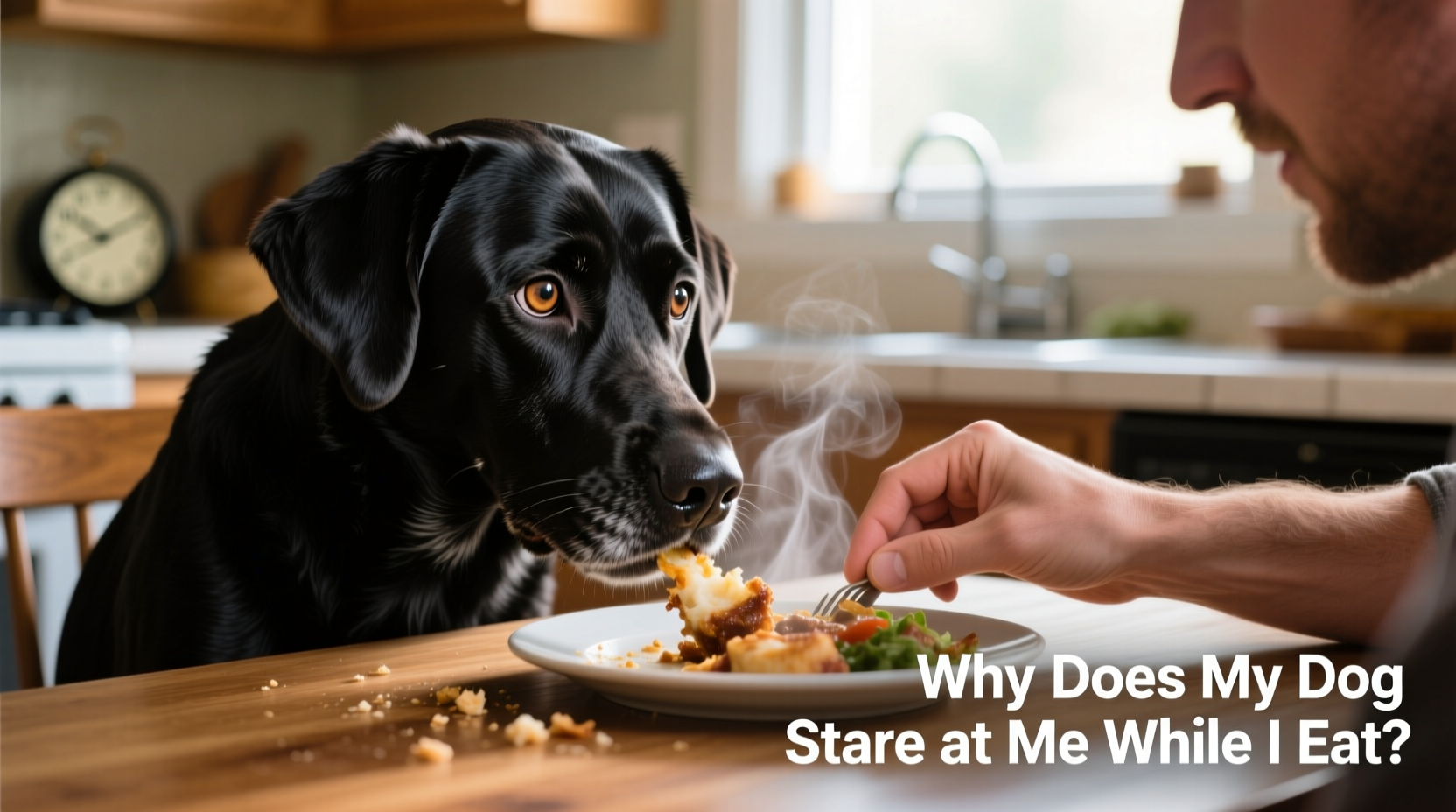
Dogs have an uncanny ability to appear exactly when you open a bag of chips or sit down with a plate of food. Their eyes lock onto yours, unblinking, their heads tilted slightly—waiting, hoping, perhaps even negotiating in silence. This behavior is so universal among dog owners that it’s become a running joke: “My dog thinks I’m withholding.” But behind that intense gaze lies a complex mix of instinct, learned behavior, and emotional connection. Understanding why your dog stares at you while you eat isn’t just about curiosity—it’s about deepening the bond between human and pet through insight.
The Evolutionary Roots of Food-Focused Behavior
Dogs are descendants of wolves, pack animals that relied on cooperative hunting and shared meals. In the wild, access to food was irregular and highly competitive. Scavenging opportunities were seized quickly, and social hierarchies determined who ate first. While domestication has softened many of these instincts, remnants remain embedded in your dog’s DNA.
Modern dogs no longer need to hunt for survival, but they still operate within a social framework where resources—including food—are distributed by dominant members (in a household, that’s usually you). Your dog’s stare may be an evolutionary echo—a silent inquiry into whether they’re included in the meal distribution process. It’s not greed; it’s strategy.
Research from the Wolf Science Center in Austria compared the behaviors of wolves and domesticated dogs around human food. The study found that dogs were significantly more likely than wolves to make prolonged eye contact with humans during feeding situations. This suggests that over thousands of years of co-evolution, dogs have developed a unique communication method centered on eye contact to solicit food or attention.
“Dogs have evolved to use eye contact as a tool for communication with humans—a skill not seen to the same degree in their wild ancestors.” — Dr. Brian Hare, Canine Cognition Researcher, Duke University
What the Stare Actually Means: Decoding Your Dog’s Intentions
Not all staring is created equal. Context matters. A soft, relaxed gaze from a seated dog might signal affection or anticipation. A fixed, intense stare with forward body posture could indicate fixation or mild anxiety. Here are the most common reasons your dog locks eyes with you during meals:
- Food anticipation: Your dog associates your eating with possible scraps or dropped morsels.
- Attention-seeking: Even negative attention (like being told “no”) reinforces the behavior.
- Emotional bonding: Mutual gazing releases oxytocin—the “love hormone”—in both humans and dogs.
- Learned behavior: If your dog has ever received food while you were eating, the stare becomes a conditioned response.
- Anxiety or resource guarding concern: Rarely, intense staring may reflect stress about food security or territoriality.
The key is observing accompanying body language. A wagging tail, relaxed ears, and sitting posture typically point to hopeful anticipation. Lip licking, whining, or creeping closer may suggest higher arousal or mild frustration.
When Bonding Meets Begging: The Oxytocin Connection
One of the most fascinating discoveries in canine science is the role of oxytocin in human-dog interactions. Often called the “cuddle chemical,” oxytocin promotes trust, attachment, and social bonding. Studies show that when dogs and humans engage in mutual gaze—especially during positive moments like feeding or petting—oxytocin levels rise in both species.
A landmark 2015 study published in Science demonstrated that when owners and their dogs gazed at each other, oxytocin concentrations increased significantly. This effect was not observed when dogs interacted with unfamiliar people. The implication? Your dog isn’t just staring for food—they may genuinely feel emotionally connected to you in that moment.
However, this loving gaze can blur with manipulation. Dogs quickly learn which behaviors get results. That soulful look may begin as affection but evolve into a calculated tactic if rewarded inconsistently. The challenge for owners is distinguishing genuine bonding from strategic begging.
How to Tell the Difference Between Love and Leverage
Use this simple checklist to assess your dog’s motivation:
- Does your dog only stare when you’re eating?
- Do they move away calmly when ignored, or persist with whining or nudging?
- Have they been rewarded with food during meals in the past?
- Is their body relaxed, or are they tense and focused?
- Do they seek eye contact at other times, like during walks or cuddle sessions?
If most answers lean toward situational and reward-driven behavior, the stare is likely learned. If your dog frequently makes gentle eye contact throughout the day, the behavior has deeper emotional roots.
Training Strategies to Manage Mealtime Gazing
You don’t need to eliminate eye contact—nor should you. It’s a vital part of your relationship. But if the constant staring disrupts your meals or encourages begging, structured training can help redirect the behavior.
Step-by-Step Guide: Teaching “Go to Mat” During Meals
This method gives your dog a positive alternative to staring and begging.
- Choose a designated mat or bed and place it several feet from your usual eating area.
- Practice when no food is present. Say “Go to mat” and lure your dog onto the spot with a treat.
- Mark and reward with a clicker or verbal cue (“Yes!”) the moment all four paws are on the mat.
- Gradually increase duration. Start with 5 seconds, then build to 1–2 minutes of staying in place.
- Introduce distractions. Practice with snacks on the table, then progress to full meals.
- Reward quietly and consistently. Offer a treat every 20–30 seconds while you eat to reinforce staying put.
Over time, your dog will associate mealtime with relaxation on their mat rather than intense focus on you.
Common Mistakes That Reinforce the Staring Habit
Even well-meaning owners accidentally train their dogs to stare by responding inconsistently. Below is a comparison of effective versus counterproductive responses.
| Behavior | Don’t Do This | Do This Instead |
|---|---|---|
| Dog stares during meal | Give a small bite “just this once” | Ignore the stare completely |
| Dog whines or paws | Yell “No!” or push them away | Calmly say “Go to mat” and redirect |
| Dog lies down quietly | Forget to reward | Quietly toss a treat to reinforce good behavior |
| After meal ends | Let dog scavenge leftovers | Clean thoroughly and offer a designated post-meal chew |
Inconsistent reinforcement is the fastest way to create a persistent beggar. Dogs thrive on predictability. When they learn that quiet behavior—not staring or whining—leads to rewards, the dynamic shifts.
Real-Life Example: Transforming Max’s Mealtime Behavior
Consider Max, a three-year-old Labrador Retriever adopted from a shelter. His owner, Sarah, noticed he would stand inches from her face during every meal, panting and staring without blinking. At first, she found it endearing and gave him occasional bites. Within weeks, Max began pacing the kitchen as soon as she opened the fridge.
Consulting a certified dog trainer, Sarah implemented the “Go to mat” protocol. She placed a cozy bed near the dining area and practiced daily for two weeks. Initially, Max resisted, returning to stare. But by rewarding only calm behavior and never feeding from the table, he gradually adapted.
After a month, Max automatically went to his mat when Sarah sat down to eat. He still glanced over occasionally, but the obsessive fixation had faded. More importantly, his overall anxiety around food decreased. The change wasn’t just about manners—it improved his sense of security.
“Dogs don’t misbehave out of defiance. They respond to what works. Change the outcome, and you change the behavior.” — Karen Pryor, Animal Behaviorist and Author
Frequently Asked Questions
Is it harmful to let my dog watch me eat?
Occasional observation isn’t harmful, but allowing consistent staring can reinforce begging and lead to food-related frustration. If your dog becomes anxious or obsessive, it’s best to establish boundaries using training techniques like “Go to mat.”
Should I ever feed my dog from the table?
It’s generally advised not to. Feeding from the table teaches dogs that human food comes from your plate, increasing the likelihood of jumping, pawing, or stealing. If you want to share safe foods, do so from a separate bowl after your meal.
Could staring be a sign of a health issue?
In rare cases, yes. Excessive staring, especially if accompanied by disorientation, pacing, or changes in sleep patterns, could indicate cognitive dysfunction (similar to dementia in older dogs) or neurological issues. Consult your veterinarian if the behavior appears sudden or compulsive.
Conclusion: Seeing Beyond the Stare
Your dog’s stare during meals is more than a quirky habit—it’s a window into their mind. Whether driven by ancient instincts, emotional connection, or learned expectations, this behavior reveals how deeply attuned dogs are to human routines and emotions. Rather than resenting the gaze, we can use it as an opportunity: to teach, to bond, and to understand our companions more fully.
By applying consistent training, recognizing the difference between affection and manipulation, and respecting your dog’s need for security, you can transform mealtime from a battle of wills into a peaceful, respectful routine. The goal isn’t to stop your dog from looking at you—but to ensure that when they do, it’s out of love, not leverage.




 浙公网安备
33010002000092号
浙公网安备
33010002000092号 浙B2-20120091-4
Comments
No comments yet. Why don't you start the discussion?