
Dogs do many things that seem odd to us—tilting their heads, chasing their tails, or suddenly zooming around the house for no apparent reason. But one of the more puzzling behaviors some dog owners report is this: their dog stares intently at them while defecating. It’s not aggressive, nor does it seem playful. It’s a quiet, focused gaze, often unblinking, delivered mid-squat. At first glance, it might seem comical or even awkward. But from a behavioral science perspective, this act is neither random nor trivial. It’s deeply rooted in canine psychology, social bonding, and survival instincts shaped over thousands of years of evolution.
Understanding why your dog locks eyes with you during such a vulnerable moment requires looking beyond human discomfort and into how dogs perceive safety, trust, and social hierarchy. This behavior isn’t about control, dominance, or mischief—it’s a complex interplay of emotional dependency, environmental awareness, and interspecies communication.
The Vulnerability Hypothesis: Safety in Numbers
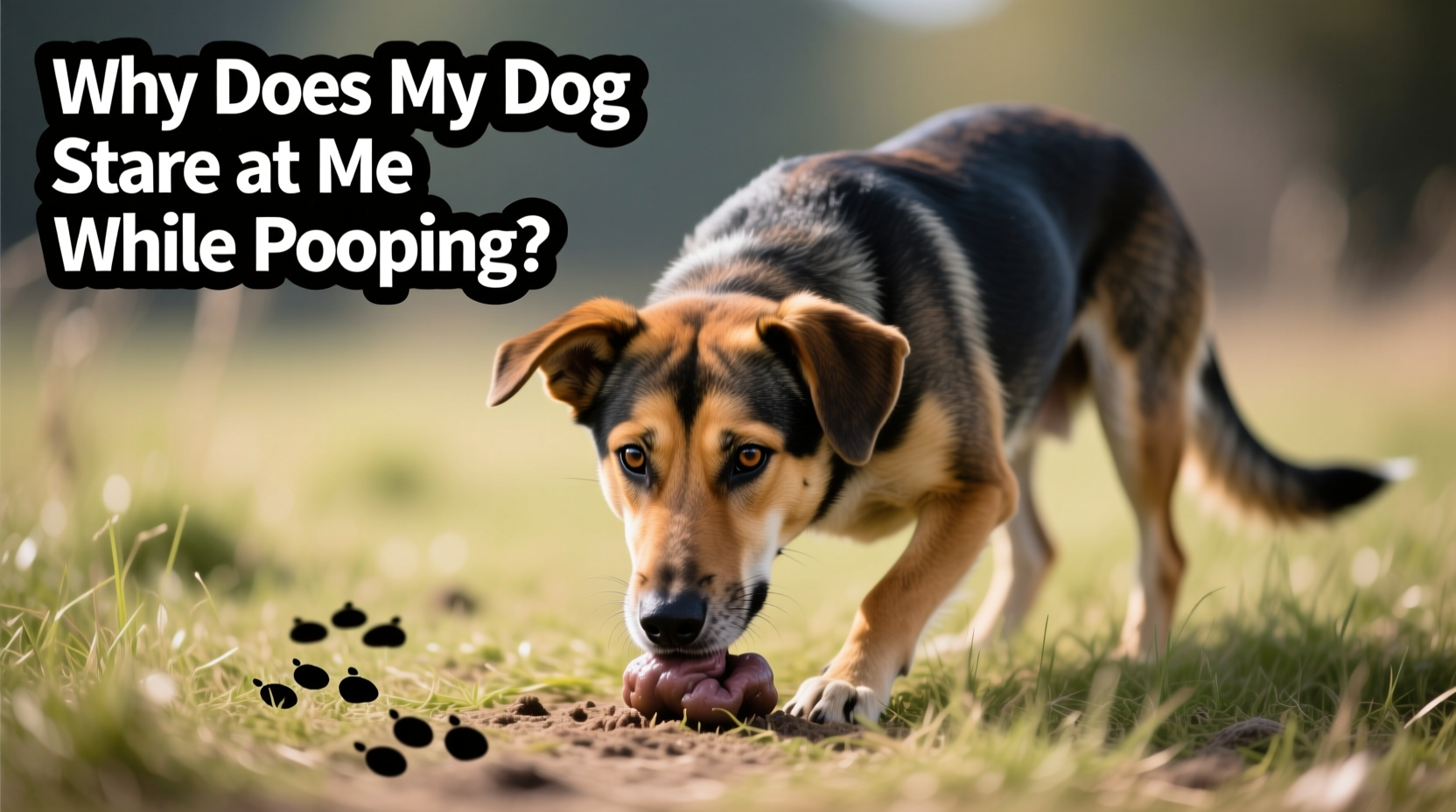
From an evolutionary standpoint, defecation is one of the most vulnerable acts a dog can perform. In the wild, animals are acutely aware of their exposure when they’re crouched low, unable to run quickly, and momentarily distracted. Predators exploit these moments. Even today, domesticated dogs retain this instinctual awareness. While your living room or backyard poses little real threat, your dog’s brain still operates on ancient survival programming.
When your dog stares at you while pooping, they may be checking in for reassurance. The gaze serves as a silent signal: “Are we safe? Are you watching for danger?” By maintaining eye contact, your dog confirms your presence and vigilance. You are their lookout.
“Eye contact during elimination is a sign of social dependence. The dog is using you as a sentinel, relying on you to monitor the environment while they’re physically compromised.” — Dr. Patricia McConnell, Certified Applied Animal Behaviorist
This dynamic mirrors pack behavior in wild canids like wolves or African wild dogs, where subordinate members may defecate under the watch of dominant individuals who remain alert. In a domestic setting, you’ve taken on that protective role—not through force, but through consistent care and companionship.
Bonding and Attachment: The Role of Oxytocin
Recent studies in canine neuroscience have revealed that eye contact between dogs and humans triggers the release of oxytocin—the so-called “love hormone”—in both species. This neurochemical loop strengthens attachment and mimics the bond between parent and child in humans. Unlike wolves (even hand-raised ones), domesticated dogs have evolved to use eye contact as a tool for emotional connection.
When your dog looks at you while pooping, they may not just be seeking protection—they may also be reinforcing their emotional bond with you. That moment of mutual gaze, however brief, could be a subconscious way of saying, “You’re my person. I trust you completely—even now.”
A 2015 study published in Science found that when dogs gazed into their owners’ eyes, oxytocin levels increased significantly. The longer the gaze, the greater the hormonal response. This suggests that even routine interactions—including those during elimination—are opportunities for emotional reinforcement.
It’s important to note that this behavior is rare or absent in solitary animals and even in less domesticated canines. The fact that dogs do this highlights how profoundly domestication has reshaped their social cognition.
Environmental Awareness and Communication
Dogs are highly attuned to context. They assess terrain, weather, smells, and social dynamics before deciding where and when to relieve themselves. The decision to poop isn’t purely physiological—it’s also strategic.
Staring at you during elimination may serve as a form of nonverbal communication. Your dog could be signaling several things simultaneously:
- Location approval: “Did I choose the right spot?”
- Duration check: “Am I taking too long?”
- Behavioral feedback: “Are you upset or impatient?”
Dogs are experts at reading human body language. A slight shift in posture, a glance at your watch, or a change in breathing can signal disapproval or urgency. By watching you, your dog gathers real-time feedback about whether their behavior aligns with your expectations.
This is especially common in dogs trained to eliminate on command or in specific areas. They’ve learned that your attention influences outcomes—whether it’s praise, a treat, or being allowed back inside. The stare becomes part of a conditioned response loop.
Do’s and Don’ts When Your Dog Stares During Elimination
How you respond to your dog’s gaze matters. Reacting incorrectly can increase anxiety or reinforce unwanted behaviors. The table below outlines best practices based on animal behavior research.
| Situation | Do | Don’t |
|---|---|---|
| Your dog stares intensely while pooping | Remain calm and neutral; avoid sudden movements | Stare back intensely or laugh nervously |
| Dog seems anxious or hesitant | Speak softly and give space if needed | Pull on leash or show impatience |
| Dog finishes and continues staring | Offer praise or cue return indoors | Ignore or scold for taking time |
| Dog avoids eye contact entirely | Monitor for signs of fear or illness | Force interaction or corner the dog |
Maintaining a relaxed demeanor helps your dog feel secure. Remember: your reaction shapes their future behavior. Consistency builds confidence.
Mini Case Study: Luna, the Rescue Border Collie
Luna, a three-year-old Border Collie adopted from a rural shelter, exhibited intense staring during elimination—so much so that her new owner, Mark, felt uncomfortable. He described it as “like she was judging me.” Initially, he would look away or chuckle, which seemed to make Luna more agitated. She’d sometimes stop mid-process and pace.
After consulting a certified dog behavior consultant, Mark learned that Luna’s past included inconsistent feeding and exposure to loud noises. Her hypervigilance during vulnerable acts was a trauma response. The solution wasn’t to discourage the gaze—but to reframe it.
The consultant advised Mark to stand quietly two steps behind Luna, facing the same direction (to reduce perceived confrontation), and speak in a low, soothing tone once she finished. Over six weeks, Luna’s anxiety decreased. The staring didn’t disappear—but it became calmer, shorter, and less frequent. Most importantly, she began eliminating faster and with greater ease.
This case illustrates that while the behavior itself is normal, its intensity can reflect underlying stress. Context matters.
Step-by-Step: How to Support Your Dog During Elimination
If your dog’s staring concerns you—or if they seem stressed—follow this science-backed sequence to promote comfort and confidence:
- Choose a consistent location: Dogs thrive on routine. Use the same area every time to reduce decision fatigue.
- Allow ample time: Rushing increases stress. Give your dog 3–5 minutes to sniff and settle.
- Stand neutrally: Position yourself slightly behind or beside your dog. Avoid looming over them.
- Minimize distractions: Silence phones, avoid loud talking, and keep other pets at a distance.
- Observe without reacting: Let your dog initiate eye contact. Don’t force interaction.
- Reinforce calmly: Once finished, offer quiet praise or a treat. Avoid overexcitement.
- Track changes: Note any shifts in frequency, posture, or eye contact. Sudden changes may indicate medical issues.
This approach supports both physical health and emotional well-being. Over time, many dogs naturally reduce prolonged staring as their sense of safety grows.
FAQ: Common Questions About Dog Staring During Pooping
Is it normal for my dog to stare at me while pooping?
Yes, it’s very common and generally normal. It reflects trust, vulnerability, and social bonding. As long as your dog isn’t showing signs of distress (whining, pacing, inability to go), the behavior is likely harmless and even healthy.
Should I look back at my dog when they stare?
Use caution. Direct eye contact from humans can be interpreted as confrontational by some dogs, especially if sustained. A brief soft glance is fine, but avoid intense staring. Instead, focus on calm body language—slightly averted gaze, relaxed shoulders.
Could this behavior indicate a medical problem?
Not usually. However, if your dog strains excessively, cries, or shows reluctance to squat despite staring, consult a veterinarian. These could be signs of constipation, anal gland issues, or spinal pain. Behavioral cues should always be evaluated alongside physical symptoms.
Expert Insight: The Canine-Human Gaze Loop
The human-dog gaze relationship is unique in the animal kingdom. While most animals avoid direct eye contact as a sign of aggression, dogs have evolved to use it positively. This reversal is a cornerstone of domestication.
“The dog-human gaze is a co-evolved behavior. We didn’t train dogs to look at us—we selected for those who did. Over generations, ‘gazers’ were rewarded with food and affection, making eye contact a survival advantage.” — Brian Hare, PhD, Cognitive Neuroscientist and Founder of Duke Canine Cognition Center
This explains why staring during vulnerable acts like eating, sleeping, or eliminating has become a normative behavior in domestic dogs. It’s not defiance. It’s dependence—and in canine terms, that’s a compliment.
Checklist: Is Your Dog’s Staring Healthy?
Use this checklist to assess whether your dog’s behavior falls within normal range:
- ✅ The stare is calm and brief (2–5 seconds)
- ✅ Your dog completes elimination without interruption
- ✅ Body posture is relaxed (no tucked tail, flattened ears)
- ✅ No signs of pain (straining, whining, bloody stool)
- ✅ Behavior occurs consistently across environments (yard, walks, travel)
- ✅ Stops when called or cued to move
If all boxes are checked, the behavior is almost certainly a sign of trust. If several are unchecked, consider consulting a veterinary behaviorist.
Conclusion: Trust in Plain Sight
Your dog staring at you while pooping isn’t strange—it’s intimate. It’s a raw, unfiltered expression of trust forged through millennia of coexistence. In that moment, your dog is not just relieving themselves; they are reaffirming a bond that transcends species.
Instead of feeling awkward, recognize the gesture for what it is: a testament to your role as protector, provider, and companion. The next time your dog locks eyes mid-squat, don’t look away in embarrassment. Offer a quiet nod, a soft word, or simply your steady presence. That’s all they need.




 浙公网安备
33010002000092号
浙公网安备
33010002000092号 浙B2-20120091-4
Comments
No comments yet. Why don't you start the discussion?