
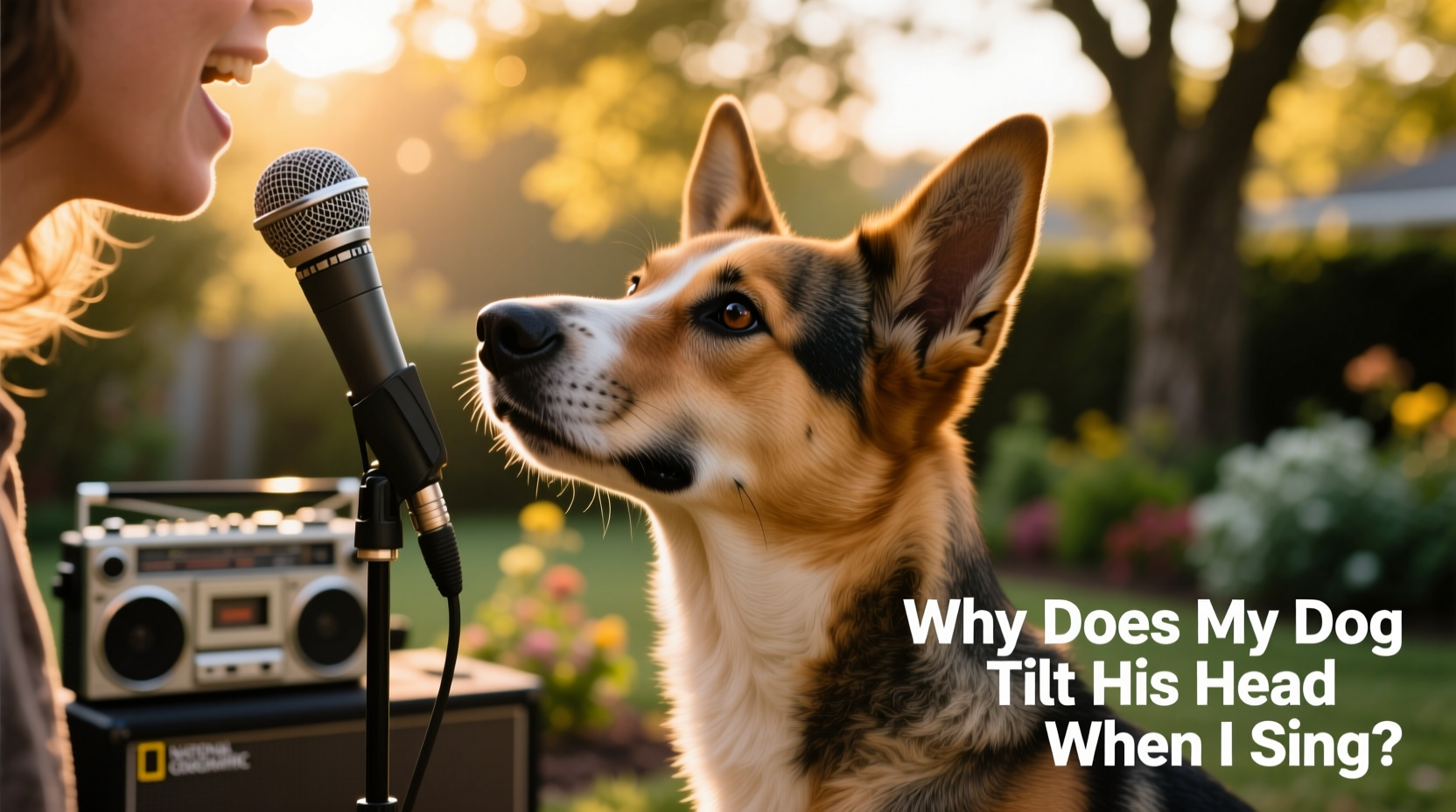
Dogs are masters of nonverbal communication. Their ears perk up, tails wag, and sometimes, they cock their heads in a way that melts hearts and sparks curiosity. One of the most endearing behaviors pet owners report is their dog tilting its head when they sing. While it may seem like a simple act of cuteness, there’s more beneath the surface. This seemingly whimsical gesture is rooted in biology, auditory processing, social bonding, and learned behavior. Understanding why dogs do this not only deepens our appreciation for their intelligence but also strengthens the human-canine relationship.
The Science Behind the Tilt: How Dogs Process Sound
Dogs hear frequencies far beyond the human range—typically from 40 Hz to 60,000 Hz, compared to our 20 Hz to 20,000 Hz. When you sing, especially with pitch variations or unusual tones, your dog's highly sensitive ears detect nuances we might miss. But hearing isn’t just about detecting sound; it’s about locating and interpreting it.
A dog’s ear anatomy plays a crucial role. With up to 18 muscles controlling each ear, they can swivel, tilt, and cup sound like satellite dishes. However, breeds with longer muzzles (like Collies or Shepherds) may physically obstruct sound waves entering the ear canal. Tilting the head adjusts the angle of the ear canal, helping sound travel more efficiently to the eardrum. Think of it as fine-tuning a radio signal for clearer reception.
“Head tilting is often a sign of active listening. Dogs use subtle physical adjustments to enhance auditory input, especially when processing unfamiliar or complex sounds.” — Dr. Sarah Jensen, Veterinary Ethologist
This is particularly relevant when you sing. Singing introduces irregular rhythms, exaggerated pitches, and emotional intonations—all of which stand out from normal speech. Your dog may tilt its head to better pinpoint where the sound is coming from and what it means.
Social Cues and Emotional Connection
Beyond hearing mechanics, head tilting is deeply tied to social interaction. Dogs are acutely attuned to human facial expressions, tone of voice, and body language. When you sing, your face changes—your mouth moves differently, your eyes may close, and your energy shifts. Your dog notices these cues and responds accordingly.
Tilting the head may serve as a form of engagement—a way of saying, “I’m paying attention.” It signals focus and interest, much like a person leaning forward during a conversation. In fact, studies suggest that dogs who frequently interact with humans develop stronger abilities to interpret our vocal and visual signals.
Moreover, singing often occurs in emotionally charged moments—lullabies before bedtime, joyful tunes during play, or comforting melodies when someone feels down. Your dog associates these sounds with affection, safety, and routine. The head tilt becomes part of a feedback loop: you sing → dog tilts head → you smile and reward → dog repeats the behavior.
Is It Learned Behavior?
While some head tilting stems from biological necessity, much of it is shaped by experience. Dogs are quick learners, especially when rewards are involved. If every time your dog tilts its head while you sing, you laugh, pet it, or say “Aww, so cute!”, it learns that this action yields positive outcomes.
This is operant conditioning in action. The behavior (head tilt) leads to a reward (attention), increasing the likelihood of repetition. Over time, your dog may tilt its head even before you start singing—anticipating your reaction based on past patterns.
Interestingly, not all dogs do this equally. Some breeds, such as Shetland Sheepdogs and Cavalier King Charles Spaniels, are more prone to head tilting than others. Individual temperament also matters. More socially responsive dogs tend to exhibit this behavior more frequently, suggesting a blend of genetics and environment at play.
Mini Case Study: Max the Golden Retriever
Max, a three-year-old Golden Retriever, lived with a singer-songwriter named Clara. Every evening, she played guitar and sang original songs in her living room. From early on, Max would sit nearby, ears pricked, and tilt his head slightly whenever she hit higher notes.
Clara noticed that over several months, Max began positioning himself closer during performances. He’d tilt his head earlier in the song and hold the pose longer. Curious, she conducted an informal test: one night, she spoke lyrics instead of singing them. Max showed little reaction. Another night, she sang nursery rhymes in a monotone voice—still minimal response. But when she returned to melodic, expressive singing, Max tilted his head immediately.
Further observation revealed that Clara often praised Max after performances: “Good boy, you listened so well!” This reinforcement likely encouraged Max to associate head tilting with approval. His behavior evolved from a natural auditory adjustment into a socially reinforced gesture of connection.
When to Be Concerned: Medical Considerations
While occasional head tilting is normal and often charming, persistent or involuntary tilting can indicate health issues. A constant head tilt—especially if accompanied by circling, loss of balance, eye twitching (nystagmus), or disorientation—may point to vestibular disease, ear infections, or neurological problems.
The vestibular system, responsible for balance and spatial orientation, can be disrupted by inner ear inflammation, tumors, or age-related degeneration (commonly called “old dog vestibular syndrome”). Unlike the brief, responsive tilt seen during singing, medical tilts are rigid and don’t resolve quickly.
| Behavior Type | Normal Head Tilt | Potential Medical Issue |
|---|---|---|
| Duration | Fleeting (seconds to minutes) | Persistent (hours to days) |
| Triggers | Vocal sounds, commands, music | No clear trigger |
| Eye Movement | Normal | Rapid involuntary twitching |
| Balance | Stable walking and posture | Leaning, falling, circling |
| Response to Touch | Alert and responsive | Lethargic or irritable |
Decoding the Full Picture: A Step-by-Step Guide to Understanding Your Dog’s Response
To determine whether your dog’s head tilt during singing is behavioral, auditory, or something else, follow this observational process:
- Observe the Timing: Does the tilt occur only during singing, or also during speech, doorbells, or other sounds? If limited to melodic or high-pitched noises, it’s likely auditory-based.
- Note the Duration: Is the tilt momentary and fluid, or does it linger? Brief adjustments suggest active listening; prolonged tilts warrant closer inspection.
- Check for Reciprocity: Does your dog look at your face while tilting? Eye contact indicates social engagement. Avoidance may suggest discomfort.
- Test Variability: Sing different styles—soft ballads vs. loud rock. Does the tilt change in intensity or frequency? Greater responsiveness to dynamic vocals supports the emotional cue theory.
- Remove Reinforcement Temporarily: For a few days, avoid reacting when your dog tilts its head. If the behavior decreases, it was likely reinforced by attention.
- Monitor Overall Health: Watch for additional symptoms like scratching, head shaking, or imbalance. These could indicate underlying conditions needing veterinary care.
Expert Insight: What Trainers and Scientists Say
Animal behaviorists emphasize that dogs don’t perform actions randomly. Even seemingly trivial gestures carry meaning within their sensory and social world.
“Dogs live in a cross-species social environment. They’ve evolved to read us as carefully as we read each other. The head tilt isn’t just cute—it’s cognitive. It shows they’re analyzing both sound and emotion.” — Dr. Lisa Monroe, Canine Cognition Researcher, University of Edinburgh
Modern research using fMRI scans has shown that dogs’ brains respond selectively to human voices, particularly those expressing positive emotions. Singing, with its rhythmic and affective qualities, activates regions associated with reward and attention. The physical act of tilting may be the outward manifestation of internal neural processing.
Frequently Asked Questions
Do all dogs tilt their heads when sung to?
No. While many dogs do, the behavior varies by breed, individual personality, and past experiences. Brachycephalic breeds (like Pugs or Bulldogs) may tilt less due to shorter muzzles reducing sound obstruction. Some dogs simply don’t feel the need—or haven’t learned that it draws attention.
Can I train my dog to tilt its head on command?
Yes, using positive reinforcement. Hold a treat slightly above and behind your dog’s line of sight so they naturally tilt to follow it. Pair the movement with a verbal cue like “listen” and reward immediately. With consistency, your dog can learn to perform the tilt on cue—even without singing.
Does head tilting mean my dog likes the song?
Not necessarily. It means your dog is engaged, but not always approving. Just as humans furrow brows when concentrating, dogs may tilt not because they enjoy the music, but because they’re trying to make sense of it. That said, relaxed body language (soft eyes, loose posture) alongside the tilt suggests positive association.
Actionable Checklist: Strengthening Communication Through Music
- ✅ Sing regularly to build familiarity and strengthen auditory recognition
- ✅ Use varied pitch and rhythm to stimulate mental engagement
- ✅ Observe your dog’s full-body language—not just the head tilt
- ✅ Avoid over-reinforcing the tilt if you suspect it masks discomfort
- ✅ Schedule annual vet checkups to rule out hearing or balance issues
- ✅ Record videos of your dog’s reactions to track behavioral changes over time
Conclusion: Listening Beyond the Surface
Your dog’s head tilt when you sing is more than a photogenic quirk—it’s a window into how they perceive the world. Whether driven by the need to hear better, the desire to connect, or the hope for a belly rub, this small motion speaks volumes about canine intelligence and empathy. By paying attention to when and why it happens, you deepen your understanding of your pet’s inner life.
Next time you break into song, pause and observe. Notice the flick of the ears, the shift of weight, the soft gaze. These are the subtle languages of love and curiosity. Cherish them. Respond with kindness, clarity, and care. And if you ever wonder whether your voice matters to your dog—just watch the tilt. It’s their silent applause.




 浙公网安备
33010002000092号
浙公网安备
33010002000092号 浙B2-20120091-4
Comments
No comments yet. Why don't you start the discussion?