
Dog owners often find themselves pausing mid-sentence when their pet suddenly cocks their head to the side. That subtle movement—ears perked, eyes wide, neck slightly bent—is one of the most endearing behaviors in the canine world. But beyond its charm, this gesture raises a compelling question: Why do dogs tilt their heads when we speak? While it may seem like a simple expression of curiosity or affection, the behavior is rooted in a complex mix of auditory processing, visual perception, social learning, and emotional engagement. Understanding the science behind this habit offers deeper insight into how dogs interpret human communication and strengthen their bond with us.
The Auditory Explanation: Tuning Into Sound
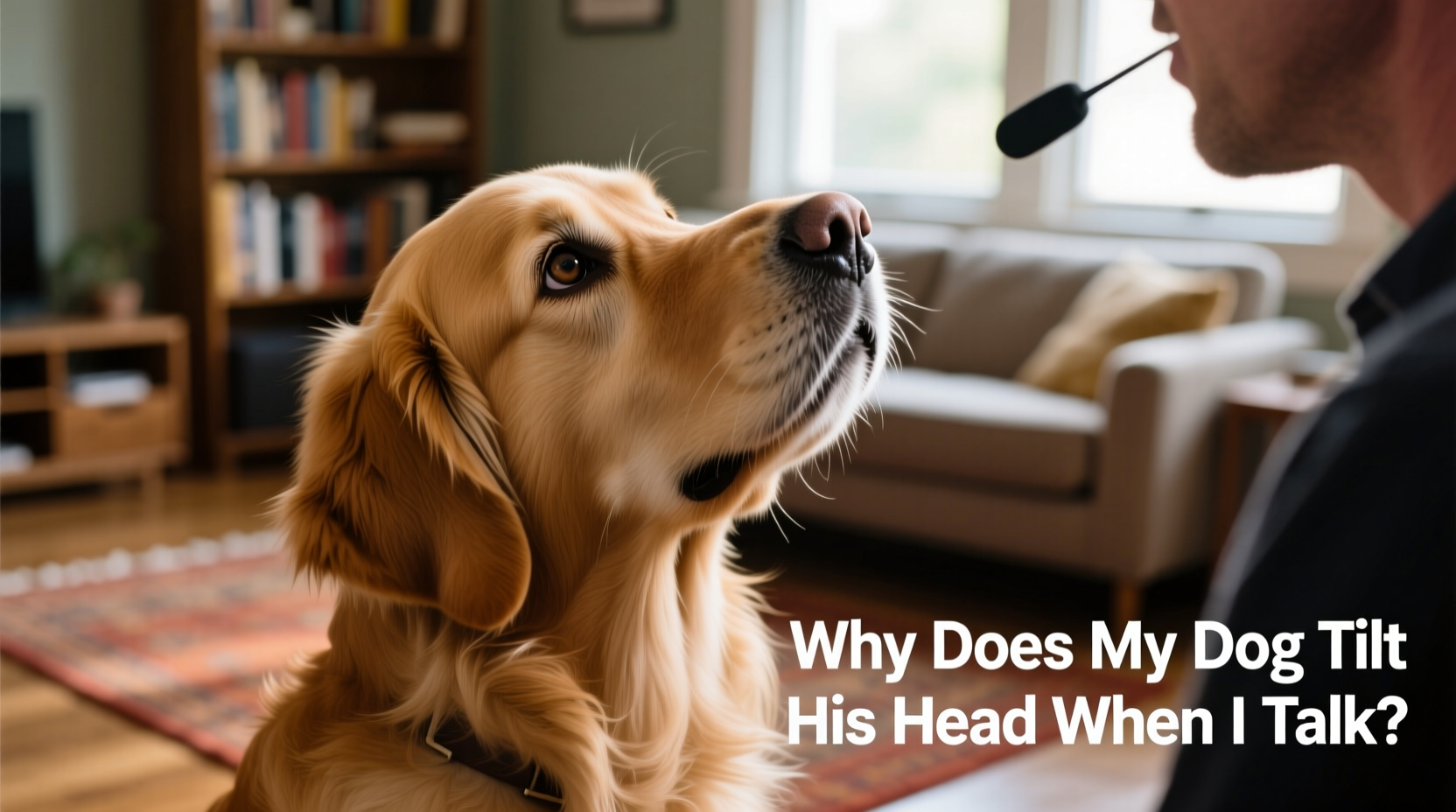
Dogs rely heavily on their hearing to navigate the world. Their ears are designed to capture a broad range of frequencies—up to 65,000 Hz, compared to humans’ 20,000 Hz. When a dog tilts its head while you're speaking, one theory suggests they are adjusting the position of their ears to better locate the source and clarity of sound.
Just as humans might cup their ear or lean in during a noisy conversation, dogs use head tilting to fine-tune auditory input. By shifting the angle of their head, they can alter how sound waves enter the ear canal, potentially improving localization and comprehension. This is especially useful when trying to pick out familiar words—like “walk,” “treat,” or their name—from background noise.
Dr. Stanley Coren, a prominent canine psychologist and author of *How Dogs Think*, explains:
“Head tilting may be a way for dogs to sharpen their acoustic focus. Since their muzzles can partially obstruct sound reception, a slight tilt changes the ear position relative to the sound source, helping them isolate speech patterns more effectively.” — Dr. Stanley Coren, Canine Behavior Researcher
This behavior is more common in dogs with longer muzzles or floppy ears, which may physically interfere with sound transmission. Breeds like Collies, Spaniels, and Shepherds exhibit head tilting more frequently than flat-faced breeds such as Pugs or Bulldogs.
Visual Perception and Facial Cues
Hearing isn’t the only sense at play. Vision plays a crucial role in how dogs interpret human speech. Unlike humans, dogs don’t rely solely on words—they read tone, body language, and facial expressions to understand intent.
A dog’s muzzle can obstruct part of their forward field of vision. When you speak, especially at close range, your facial movements—lips forming words, eyebrow raises, smiles—are key signals. Tilting the head may allow the dog to see your mouth and eyes more clearly, helping them decode emotional context.
Research from the University of Salford found that dogs are highly attuned to human facial expressions and lip movements. In experiments, dogs were able to distinguish between happy and angry faces, even in still images. The head tilt could function as an adaptive behavior to improve line-of-sight, particularly when the speaker is below eye level (such as children or seated adults).
Moreover, dogs learn through reinforcement. If a head tilt consistently elicits positive reactions—laughter, praise, treats—they may repeat the behavior not just to listen better, but to communicate attentiveness and earn rewards.
Emotional Engagement and Social Bonding
Beyond sensory mechanics, head tilting is deeply tied to emotional intelligence. Dogs are remarkably skilled at reading human emotions and responding empathetically. A tilted head often coincides with soft eyes, relaxed ears, and a calm posture—all signs of focused, affectionate attention.
This behavior likely evolved as part of the domestication process. Over thousands of years, dogs have been selected for traits that enhance human-dog communication. Those who displayed behaviors interpreted as “cute” or “attentive” were more likely to receive care, food, and companionship. Head tilting, whether initially functional or accidental, became reinforced through positive human interaction.
In essence, the head tilt functions as a nonverbal signal: I’m listening. I care. I’m trying to understand you. It strengthens the emotional feedback loop between pet and owner, deepening trust and connection.
A real-life example illustrates this well:
Mini Case Study: Max the Rescue Terrier
Max, a three-year-old mixed-breed rescue, was initially withdrawn and anxious. His adoptive owner, Sarah, made a habit of speaking softly to him while maintaining eye contact. Within weeks, she noticed Max began tilting his head whenever she used a gentle tone. Over time, the behavior became more frequent and was accompanied by tail wags and paw lifts. A veterinarian noted that Max had moderate hearing loss, suggesting the tilt helped him compensate. But more importantly, the gesture marked a turning point in bonding—it signaled Max’s growing confidence and emotional responsiveness.
When Head Tilting Might Signal a Health Concern
While occasional head tilting is normal and healthy, persistent or uncontrolled tilting—especially when accompanied by other symptoms—can indicate underlying medical issues. Owners should be vigilant for signs such as:
- Continuous head tilt (even at rest)
- Loss of balance or coordination
- Circling or falling
- Nystagmus (rapid eye movement)
- Vomiting or disorientation
These symptoms may point to vestibular disease, ear infections, neurological disorders, or even tumors. The vestibular system, responsible for balance and spatial orientation, can be disrupted by inner ear inflammation or age-related degeneration (commonly called “old dog vestibular syndrome”).
If your dog suddenly begins tilting their head without the usual context—such as during conversation—and appears distressed or unsteady, consult a veterinarian promptly.
| Normal Head Tilt | Potentially Concerning Head Tilt |
|---|---|
| Occurs during interaction | Present all the time, even when alone |
| Paired with alertness and eye contact | Accompanied by dizziness or stumbling |
| Temporary and responsive to stimuli | Lasts for hours or days without relief |
| No pain or discomfort observed | Dog scratches ears or shows signs of pain |
Step-by-Step: How to Respond to Your Dog’s Head Tilt
Understanding the cause is only half the story. Knowing how to respond appropriately ensures your dog feels heard and safe. Follow this sequence when your dog tilts their head during conversation:
- Pause and maintain eye contact – Show your dog that you acknowledge their attention. This reinforces mutual respect.
- Speak in a clear, calm tone – Use simple words and consistent phrasing to aid comprehension.
- Observe body language – Check for signs of confusion, excitement, or discomfort. Are their ears forward? Is their tail relaxed?
- Reinforce positively—if appropriate – If the tilt reflects understanding (e.g., after a command), offer praise or a treat.
- Monitor frequency and context – If tilting increases without trigger, consider a vet visit to rule out hearing or balance issues.
Frequently Asked Questions
Is head tilting a sign of intelligence in dogs?
Not directly. While intelligent dogs may be more attentive and thus tilt their heads more often, the behavior itself is not a measure of IQ. It’s more about sensory adaptation and social learning than cognitive superiority.
Do all dogs tilt their heads?
No. Some dogs never develop the habit, while others do it frequently. Individual personality, breed anatomy, hearing ability, and learned behavior all influence whether a dog exhibits this trait.
Can I train my dog to tilt their head on command?
Yes—but ethically, it's best to avoid training behaviors that mimic natural responses unless done gently and without pressure. If your dog naturally tilts their head, you can pair the action with a verbal cue and reward, but never force or exaggerate the motion.
Actionable Checklist: Supporting Healthy Communication With Your Dog
To foster clear, meaningful interactions and ensure your dog’s head tilting remains a healthy behavior, follow this checklist:
- ✅ Speak clearly and consistently using keywords (e.g., “sit,” “dinner,” “park”)
- ✅ Maintain face-level eye contact when giving commands or affection
- ✅ Schedule annual veterinary exams, including ear and neurological checks
- ✅ Minimize background noise during training sessions
- ✅ Observe changes in head-tilting patterns—note duration, frequency, and triggers
- ✅ Reward understanding, not just performance
- ✅ Keep ears clean and free of infection, especially in floppy-eared breeds
Conclusion: More Than Just a Cute Gesture
The head tilt is far more than an adorable quirk—it’s a window into your dog’s mind. Whether driven by a need to hear better, see your face more clearly, or express emotional connection, this small movement speaks volumes about the depth of canine-human communication. By paying attention to when and why your dog tilts their head, you gain insight into their sensory world and emotional state.
But remember: while we may adore the look, our response matters. Treat the behavior as part of a two-way conversation. Listen as intently as your dog does. And if something feels off—too frequent, too rigid, too isolated—don’t hesitate to seek professional advice. After all, the healthiest relationships are built on mutual understanding.




 浙公网安备
33010002000092号
浙公网安备
33010002000092号 浙B2-20120091-4
Comments
No comments yet. Why don't you start the discussion?