
Dog owners often find themselves pausing mid-sentence, captivated by a sudden, endearing movement: their dog tilting its head. One ear perks up, the other dips slightly, and those curious eyes lock onto yours with intense focus. While it’s one of the most universally loved behaviors in dogs, it’s more than just charm—it may be rooted in biology, cognition, and communication. Scientists and animal behaviorists have spent years observing and studying this phenomenon, uncovering clues that go beyond simple cuteness. Understanding why dogs tilt their heads when we speak can deepen our bond with them and reveal how they interpret human language, tone, and emotion.
The Anatomy Behind the Tilt
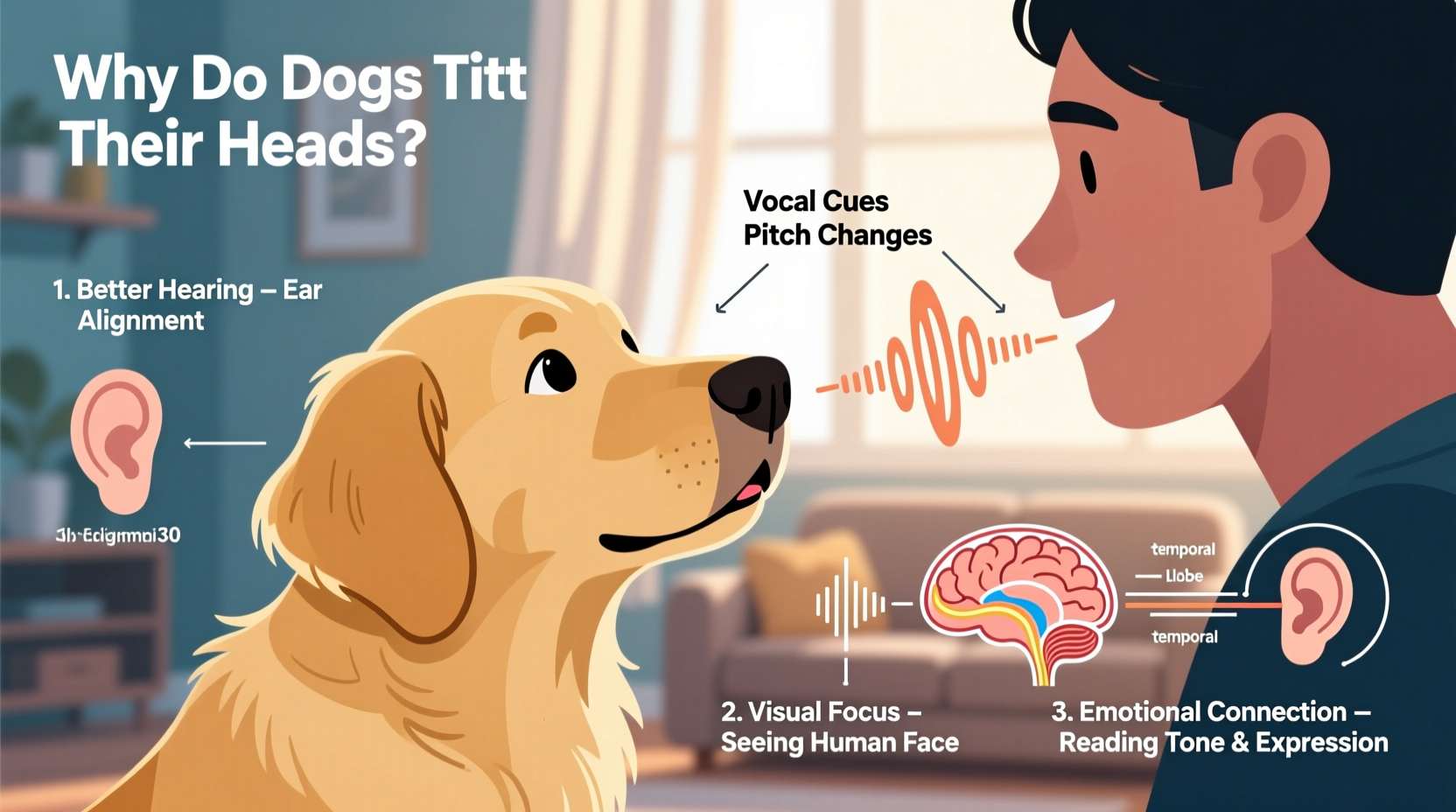
A dog’s skull structure and ear placement play a crucial role in how they process sound. Unlike humans, who have relatively symmetrical hearing aligned with our forward-facing eyes, dogs have varied ear shapes—some upright, some floppy—that affect how sound waves enter the auditory canal. When a dog tilts its head, it subtly adjusts the position of its ears to better capture sound from a specific direction.
This adjustment helps them pinpoint the source of a noise, especially if it's faint or unfamiliar. For instance, a Border Collie with erect ears might tilt less than a Basset Hound with long, drooping ears that partially cover the ear canal. The physical repositioning allows the latter to “tune in” more effectively, much like cupping a hand behind your ear to hear better.
Additionally, the angle of the tilt can influence how sound resonates within the inner ear. By shifting the head, dogs may enhance high-frequency perception—particularly useful when distinguishing between similar-sounding words or commands.
Cognitive Processing and Language Recognition
Research suggests that dogs don’t just react to tone; they can recognize specific words. A landmark 2016 study conducted at Eötvös Loránd University in Budapest used fMRI scans to show that dogs process both the meaning of words and the emotional tone of voice in ways similar to humans. The left hemisphere of the dog’s brain responded to the verbal content, while the right processed intonation.
When you say “walk,” “treat,” or “bath,” your dog isn’t just responding to excitement in your voice—they may actually recognize the word itself, especially if it’s been consistently paired with an action. Head tilting could be a visible sign of this cognitive processing—a moment where the dog is mentally cross-referencing the word they heard with stored memories and associations.
“Dogs are not just reacting emotionally to speech—they’re listening for meaning. The head tilt might reflect that split-second pause when a dog is retrieving a word from memory.” — Dr. Attila Andics, Cognitive Neuroscientist, ELTE Department of Ethology
This mental effort may manifest physically. Just as a person might squint or cock their head when trying to recall a name, a dog may tilt to aid concentration. It’s not merely passive listening; it’s active comprehension.
Social Communication and Reinforcement
While biological and cognitive factors contribute, social learning plays a powerful role. Dogs are exceptionally attuned to human reactions. If a dog tilts its head and receives positive feedback—such as laughter, affection, or treats—it learns that this behavior yields rewards.
In essence, the head tilt becomes a learned communicative gesture. Over time, dogs may perform it intentionally when they sense uncertainty in conversation or when seeking attention. This doesn’t make it any less genuine; rather, it highlights the depth of interspecies social bonding. Your dog has figured out what makes you smile—and uses it strategically.
Interestingly, not all dogs exhibit this behavior equally. Some breeds, such as German Shepherds or Bulldogs, may rarely tilt their heads, while others like Poodles, Shelties, and Terriers do so frequently. This variation points to both anatomical differences and individual personality traits.
Factors Influencing Frequency of Head Tilting
| Factor | Effect on Head Tilting |
|---|---|
| Hearing ability | Dogs with partial hearing loss may tilt more to compensate |
| Breed anatomy | Long-eared breeds tilt more to optimize sound capture |
| Age | Puppies tilt less; frequency increases with experience |
| Reinforcement history | Dogs rewarded for tilting do so more often |
| Vocabulary size | Dogs knowing more words may tilt during word retrieval |
When Head Tilting Signals Something Else
While occasional head tilting is normal and healthy, persistent or uncontrolled tilting—especially if accompanied by circling, imbalance, or eye twitching—can indicate a medical issue. The most common cause is vestibular disease, which affects the balance system in the inner ear or brainstem. Other possible causes include ear infections, tumors, or inflammation.
If your dog suddenly begins tilting its head constantly—even when not being spoken to—or appears disoriented, consult a veterinarian promptly. Early diagnosis can prevent complications and ensure proper treatment.
Real-World Example: The Case of Max the Rescue Dog
Max, a three-year-old mixed-breed rescue, was adopted by a retired teacher named Linda. At first, Max showed little reaction when spoken to. But after six weeks of consistent training using clear commands and positive reinforcement, Linda noticed something remarkable: whenever she said “outside” or “dinner,” Max would tilt his head slightly before sprinting to the door or his bowl.
Curious, Linda began recording these moments. She observed that Max only tilted his head for words he wasn’t entirely sure about—like “vet” or “bath”—but responded instantly to familiar ones without hesitation. Over time, as his vocabulary grew, the tilting decreased for established commands but remained for new phrases.
This case illustrates how head tilting correlates with cognitive load. Max wasn’t being confused—he was thinking. His brain was accessing stored information, weighing context, and preparing a response. The tilt was the outward sign of an inward decision-making process.
How to Encourage Healthy Communication (Without Overusing the Tilt)
While it’s tempting to encourage head tilting because it’s adorable, focusing on meaningful communication benefits your dog more in the long run. Here’s how to foster understanding without relying on manipulative cues:
- Use consistent vocabulary. Stick to the same word for each command (e.g., always “sit,” never alternating with “down” for sitting).
- Pair words with actions early. Repeat “treat” while giving food so the dog links the sound with the reward.
- Observe body language. Notice when your dog tilts, pauses, or looks away—these are signs of processing or confusion.
- Avoid excessive repetition. Saying “Come! Come! COME!” teaches dogs to ignore the first few calls. Use one clear command.
- Test comprehension occasionally. Say a known command in a new location or with distractions to see if understanding holds.
Do’s and Don’ts of Responding to Head Tilting
| Do | Don't |
|---|---|
| Respond with calm praise when the dog follows a command after tilting | Reward every single head tilt regardless of behavior |
| Use the moment to reinforce learning (“Yes! That’s ‘spin’!”) | Repeat unclear phrases multiple times expecting understanding |
| Monitor for changes in frequency or balance | Assume constant tilting is always harmless |
| Encourage mental stimulation through games and puzzles | Overuse high-pitched voices that may confuse word recognition |
Frequently Asked Questions
Is head tilting a sign of intelligence?
Not directly. However, frequent head tilting during speech may indicate a dog is actively processing language, which reflects cognitive engagement. Dogs with larger vocabularies, like Border Collies or Poodles, often display this behavior more during learning phases.
Do all dogs tilt their heads?
No. Some dogs never tilt their heads, and that’s perfectly normal. Factors like breed, ear shape, hearing ability, and personality influence whether a dog exhibits this behavior. Lack of tilting doesn’t mean a dog isn’t listening or bonding with you.
Can I train my dog to stop tilting his head?
You could, but there’s no need unless it’s medically related. If the tilt is part of normal communication and causes no discomfort, it’s best to let it happen naturally. Suppressing harmless behaviors can create unnecessary stress.
Conclusion: More Than Just Cute—It’s Connection
The next time your dog tilts its head while you’re speaking, take a moment to appreciate what’s really happening beneath the surface. It’s not just a reflex or a trick for treats. It’s a complex interplay of anatomy, auditory processing, memory recall, and social bonding. Your dog is listening—not just to your words, but to your tone, your rhythm, and your intent.
That slight lean to the side is a silent acknowledgment: *I’m paying attention. I care. I want to understand you.* In a world full of noise, your dog chooses to focus on your voice. That’s not just cute—it’s profound.




 浙公网安备
33010002000092号
浙公网安备
33010002000092号 浙B2-20120091-4
Comments
No comments yet. Why don't you start the discussion?