
Dogs are masters of subtle communication. One of the most endearing and puzzling behaviors they exhibit is tilting their heads when spoken to. Whether you're calling their name or simply chatting nearby, that slight cock of the head often triggers an immediate \"aww\" from onlookers. But beyond its charm, this gesture has deep roots in canine cognition, auditory processing, and social learning. Understanding why dogs tilt their heads isn't just about decoding a cute habit—it reveals how dogs interpret human language, adapt to our environments, and form emotional bonds with us.
The Auditory Explanation: Tuning Into Human Speech
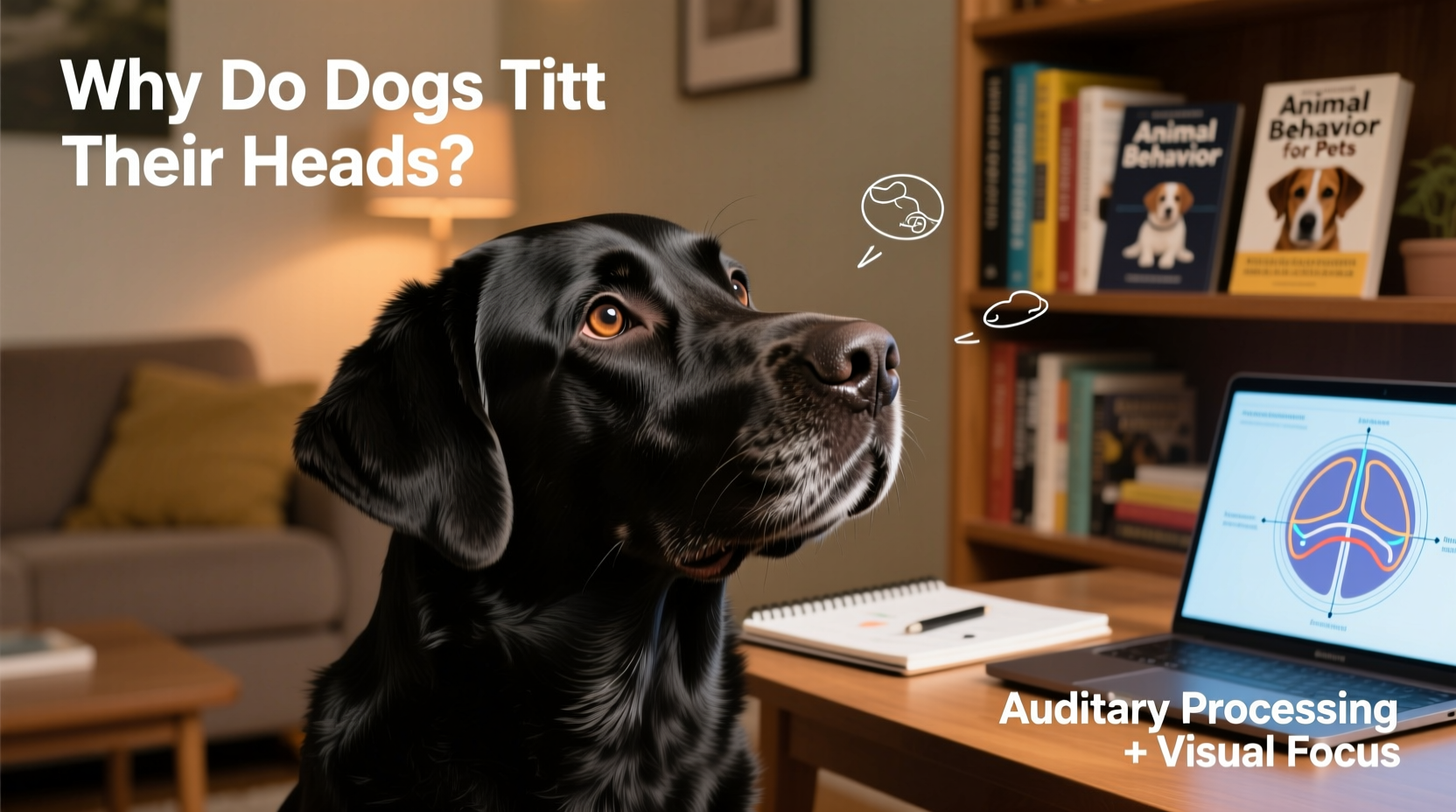
One of the primary reasons dogs tilt their heads when we speak lies in their hearing mechanics. Unlike humans, who have ears positioned on the sides of our heads with minimal mobility, dogs possess highly mobile pinnae—the external parts of the ear—that can swivel independently to capture sound. However, when trying to locate the source or meaning of unfamiliar sounds, especially those embedded in complex human speech, dogs may physically adjust their head position to improve sound localization.
By tilting their head, dogs alter the position of their ears relative to the sound source, which helps them better triangulate where a noise is coming from. This is particularly useful for high-pitched tones or muffled syllables. For example, a dog might tilt its head when you use a sing-song voice or say words like “treat” or “walk,” both of which contain sharp frequency changes that stand out in a dog’s auditory range.
How Dogs Process Sound Differently Than Humans
Dogs hear frequencies between 40 Hz and 60,000 Hz, compared to the human range of 20 Hz to 20,000 Hz. This means they detect higher-pitched sounds far beyond our perception. However, while their hearing sensitivity is superior, understanding spoken language requires more than just detecting pitch. It involves parsing phonemes, recognizing patterns, and associating sounds with meaning—all tasks that rely on both auditory input and brain processing.
When a dog tilts its head upon hearing a new word or unusual intonation, it may be fine-tuning its auditory focus. Think of it as adjusting the angle of a satellite dish to get a clearer signal. The movement helps align their ear canals more directly with the sound waves, enhancing clarity and reducing interference from ambient noise.
Visual Compensation: Seeing Around the Muzzle
Another compelling theory involves vision. Many dog breeds, especially those with longer snouts like Collies, Shepherds, or Retrievers, have facial structures that partially obstruct their line of sight to human faces. When we speak, we use facial expressions extensively to convey emotion and intent. A dog may tilt its head to shift its muzzle out of the way, gaining a clearer view of your mouth, eyes, and overall facial expression.
This visual adjustment allows them to pick up on subtle cues such as lip movements, eyebrow raises, or smiles—key components in cross-species communication. In fact, studies show that dogs are remarkably skilled at reading human faces, often outperforming even chimpanzees in certain social cognition tasks.
“Dogs have evolved to be hypersensitive to human communicative signals, including gaze direction, pointing, and facial expressions. Head tilting may serve as a behavioral adaptation to enhance visual access during interaction.” — Dr. Brian Hare, Canine Cognition Researcher, Duke University
Breed Differences in Head-Tilting Frequency
Interestingly, not all dogs tilt their heads equally. Brachycephalic breeds (those with shorter muzzles, like Pugs or Bulldogs) tend to do it less frequently than dolichocephalic breeds (long-snouted dogs). This supports the idea that muzzle length plays a role in the need for visual compensation. Shorter muzzles provide a wider field of view, reducing the necessity to tilt for better sightlines.
| Breed Type | Muzzle Length | Average Head-Tilt Frequency | Possible Reason |
|---|---|---|---|
| Border Collie | Long | High | Enhanced visual and auditory focus needed |
| Golden Retriever | Medium-Long | High | Social attentiveness and trainability |
| Poodle | Medium | Moderate | Intelligent; uses multiple sensory inputs |
| Bulldog | Short | Low | Less visual obstruction from muzzle |
| Shih Tzu | Short | Low-Moderate | Dependent on context and training history |
Learning and Reinforcement: The Power of Positive Feedback
While biological factors explain the origin of head-tilting, learned behavior amplifies its frequency. Dogs are keen observers of human reactions. If a dog tilts its head and receives positive reinforcement—such as laughter, affection, treats, or excited praise—it quickly learns that this action yields rewarding outcomes.
In essence, head-tilting can become a conditioned response. A dog may not only tilt its head to process sound or see your face but also because it knows you love the gesture. Over time, this transforms a functional movement into a social tool—a way to engage attention and elicit affection.
Mini Case Study: Max the Curious Terrier
Max, a four-year-old Jack Russell Terrier, began tilting his head whenever his owner said phrases like “Do you want dinner?” or “Ready for bed?” Initially, the behavior was sporadic. But after Max noticed that his owner would laugh, call him “so smart,” and sometimes give him a treat just for reacting, the head tilt became almost automatic at mealtime cues.
Over several weeks, Max started tilting his head even before food was mentioned—just at the sound of his owner entering the kitchen. The behavior wasn’t purely instinctive anymore; it had become part of a learned social exchange. Eventually, the owner realized she had unintentionally trained Max to perform the gesture by consistently rewarding it, regardless of whether he truly needed to hear or see better.
Cognitive Engagement: Decoding Language and Emotion
Recent research suggests that dogs may understand more of human language than previously believed. A 2016 study published in *Science* demonstrated that dogs process words and intonation in a manner similar to humans—using the left hemisphere for word meaning and the right for emotional tone. When exposed to familiar commands delivered in a praising tone, dogs showed increased activity in brain regions associated with reward.
Head-tilting could be a physical manifestation of this dual-processing effort. As dogs attempt to separate semantic content (“sit,” “stay”) from emotional context (happy, stern, playful), they may tilt their heads as a sign of focused concentration—akin to a person furrowing their brow while solving a puzzle.
- Dogs recognize an average of 89 words, with some gifted individuals learning over 200.
- They respond more strongly to praise when it matches the meaning of the word used.
- Head-tilting increases when owners use novel words or unexpected phrasing.
This cognitive load may trigger micro-adjustments in posture, including head tilting, as the dog integrates auditory data, visual cues, and memory recall. It’s not just listening—it’s interpreting.
When Head Tilting Warrants Attention
While occasional head tilting is normal and often benign, persistent or uncontrolled tilting can indicate underlying health issues. A constant head tilt—especially if accompanied by loss of balance, circling, vomiting, or disorientation—may point to vestibular disease, ear infections, neurological disorders, or even tumors.
The vestibular system, located in the inner ear, controls balance and spatial orientation. Inflammation or infection in this area (commonly referred to as “old dog vestibular disease”) can cause sudden onset of head tilt without pain, mimicking the cute version but requiring veterinary care.
Checklist: When to See a Veterinarian
- Head remains tilted continuously for more than 24 hours.
- Dog shows signs of dizziness or difficulty walking straight.
- Nystagmus (rapid eye movement) is present.
- Foul odor or discharge from the ears.
- Loss of appetite or vomiting accompanies the tilt.
- Behavioral changes such as lethargy or confusion occur.
If any of these symptoms appear, consult a veterinarian promptly. Early diagnosis improves outcomes significantly, especially in cases involving ear infections or neurological conditions.
Frequently Asked Questions
Is head tilting a sign of intelligence in dogs?
Not directly. While intelligent dogs may be more attentive and thus more likely to tilt their heads during communication, the gesture itself is not a measure of IQ. It reflects attentiveness, curiosity, and sensory processing rather than raw cognitive ability.
Can I train my dog to tilt its head on command?
Yes. Using positive reinforcement techniques, you can shape the behavior by rewarding natural head tilts and gradually introducing a verbal cue like “think.” Clicker training works well for capturing the precise moment the dog moves its head. However, avoid over-practicing, as repetitive motions may cause neck strain.
Do puppies tilt their heads more than adult dogs?
Not necessarily. Puppies may display the behavior less frequently simply because they haven’t yet developed refined auditory and visual processing skills. As they mature and learn to associate speech with meaning, head tilting often becomes more pronounced, especially in responsive, socially engaged individuals.
Conclusion: More Than Just Cute—A Window Into Canine Mindfulness
The head tilt is one of the most recognizable and beloved behaviors in domestic dogs. Far from being mere theatrics, it represents a convergence of evolutionary adaptation, sensory refinement, and emotional intelligence. Whether adjusting for better hearing, improving facial visibility, or seeking a treat-laden reaction, each tilt offers insight into how dogs navigate the human world.
Understanding the science behind this small gesture deepens our appreciation for canine companionship. It reminds us that even the simplest actions carry layers of meaning shaped by biology, experience, and relationship. So the next time your dog cocks its head mid-sentence, take a moment to acknowledge the complexity behind that innocent look—you’re witnessing a finely tuned mind at work.




 浙公网安备
33010002000092号
浙公网安备
33010002000092号 浙B2-20120091-4
Comments
No comments yet. Why don't you start the discussion?