
Dog owners often find themselves charmed by one of the most endearing canine quirks: the head tilt. When you speak to your dog, they may slowly cock their head to one side, ears perking up, eyes wide with curiosity. While it’s undeniably cute, many pet parents wonder—what’s really going on in that furry little brain? Is it a sign of confusion? Intelligence? Or simply a clever tactic to get treats? The truth lies in a combination of biology, auditory processing, social learning, and emotional connection. This article explores the scientific underpinnings of the dog head tilt, drawing from veterinary research, animal behavior studies, and cognitive science to provide a comprehensive understanding of this beloved behavior.
Hearing and Sound Localization
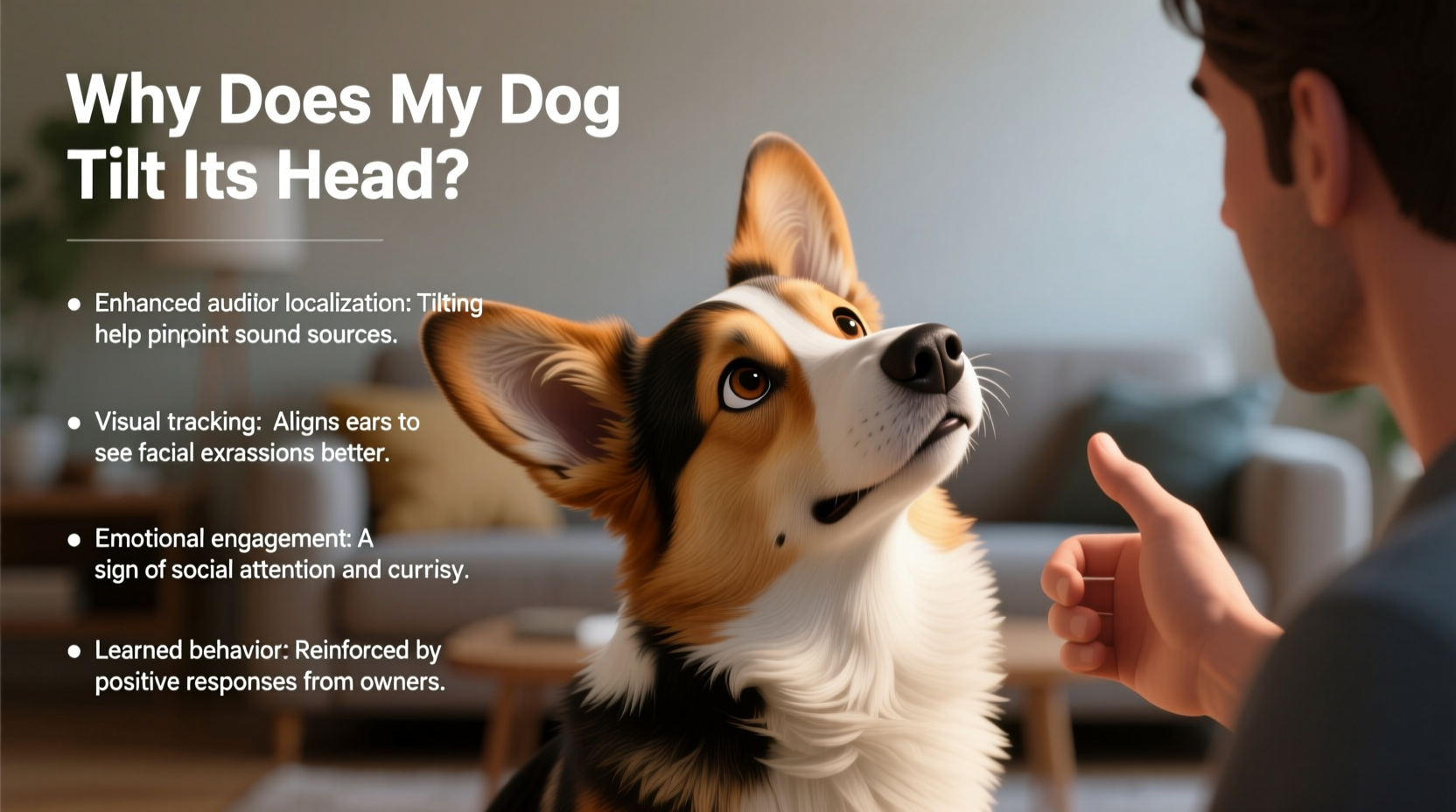
Dogs rely heavily on their sense of hearing—often far more than humans do. With the ability to detect frequencies up to 65,000 Hz (compared to our 20,000 Hz limit), their auditory world is rich and complex. But even with such powerful hearing, pinpointing exactly where a sound originates can be challenging, especially for higher-pitched voices or muffled words.
The head tilt plays a functional role in sound localization. By tilting their head, dogs adjust the position of their ears relative to the sound source. This subtle movement helps them fine-tune how sound waves enter the ear canal, improving their ability to determine direction and distance. Think of it like adjusting an antenna for better reception.
This behavior is especially common in dogs with longer muzzles or floppy ears, such as Basset Hounds or Cocker Spaniels. Their ear anatomy can partially obstruct sound entry, making the tilt a practical adjustment. Shorter-muzzled breeds like Pugs may tilt less frequently because their ear positioning already allows for clearer sound capture.
“Dogs use head movements to enhance auditory input, much like we might cup our ears when trying to hear something faint.” — Dr. Stanley Coren, Professor Emeritus of Psychology, University of British Columbia
Vision and Facial Recognition
While hearing is a major factor, vision also contributes to the head tilt phenomenon. Dogs are highly attuned to human facial expressions and mouth movements, particularly when they’re trying to interpret commands or emotional cues.
A dog’s muzzle can obstruct part of their field of view, especially when looking up at a standing human. By tilting their head, they shift their line of sight, allowing them to see more of your face—particularly your mouth. Since dogs learn to associate certain sounds with specific outcomes (e.g., “walk” = leash time), seeing your lips move helps them decode what you’re saying.
Research published in *Animal Cognition* suggests that dogs who are more skilled at reading human gestures—such as pointing or eye contact—are also more likely to tilt their heads during interactions. This implies a link between visual processing and the behavior.
Moreover, the tilt may help align their eyes for optimal depth perception. Unlike humans, whose eyes are positioned frontally, dogs have eyes set more laterally. Tilting adjusts binocular vision, helping them focus on your face with greater clarity.
Visual vs. Auditory Triggers for Head Tilting
| Stimulus Type | Likely to Trigger Tilt? | Reason |
|---|---|---|
| High-pitched voice | Yes | Harder to localize; prompts auditory adjustment |
| Familiar command word | Yes | Dog focuses on lip reading and context |
| Low-frequency noise | No | Easily localized; less need for correction |
| Non-verbal cue (hand signal) | Rarely | Relies on full-body posture, not head angle |
Emotional Engagement and Social Bonding
Beyond sensory mechanics, the head tilt has a strong social component. Dogs are pack animals evolved to read social signals, and they’ve become exceptionally skilled at interpreting human emotions. The tilt often occurs when a dog senses something unusual in your tone—a change in pitch, volume, or rhythm—that suggests emotion, such as concern, excitement, or affection.
In these moments, the head tilt may serve as a form of active listening. It signals attention and engagement, much like nodding does in humans. Your dog isn’t just hearing you—they’re trying to understand your emotional state. This behavior strengthens the human-canine bond, reinforcing communication and trust.
Studies using fMRI scans have shown that dogs’ brains respond to human voices in areas associated with reward and emotion. When you speak lovingly to your dog, their brain lights up similarly to how a human child’s would. The head tilt could be a physical manifestation of this neural engagement—an instinctive response to emotionally charged speech.
Interestingly, dogs who live in highly communicative households—where owners frequently talk to them or use varied tones—tend to tilt their heads more often. This suggests the behavior is partly learned through positive reinforcement. If tilting earns attention, pets, or treats, the dog is more likely to repeat it.
Training and Learned Behavior
Not all head tilts are purely instinctual. Some are shaped by experience. Dogs are masters of operant conditioning—they quickly learn which behaviors yield rewards. If a dog tilts their head and receives laughter, affection, or a treat, they’re likely to repeat the action in similar contexts.
This explains why some dogs seem to “perform” the tilt on command, even without verbal cues. They’ve associated the gesture with positive outcomes and deploy it strategically. In fact, trainers report that dogs with strong bonds to their owners are more prone to exaggerated or repeated tilting, especially when seeking attention.
However, this doesn’t diminish the authenticity of the behavior. Even if reinforced by rewards, the initial trigger remains rooted in genuine curiosity or sensory processing. The learned aspect simply amplifies its frequency.
Mini Case Study: Max the Border Collie
Max, a 4-year-old Border Collie from Colorado, began tilting his head whenever his owner said the word “vet.” At first, his family thought he was anxious. But closer observation revealed a pattern: Max only tilted after hearing high-pitched syllables, especially those ending in “-ee” sounds. His owner often used a singsong voice when discussing appointments.
A veterinary behaviorist evaluated Max and concluded that the tilt was primarily auditory. The “ee” sound was difficult for Max to localize due to its frequency and the acoustics of their kitchen (where most conversations occurred). Once the family started using a calmer, lower tone when mentioning medical topics, Max’s head tilting decreased significantly—though he still tilted when praised, suggesting a dual function: sound processing and emotional response.
When to Be Concerned: Medical Causes of Head Tilting
While occasional head tilting during conversation is normal, persistent or unbalanced tilting—especially when not interacting with people—can indicate a medical issue. A constant head tilt, particularly if accompanied by other symptoms, may point to neurological or vestibular problems.
The vestibular system, located in the inner ear, controls balance and spatial orientation. Infections, inflammation, tumors, or idiopathic vestibular disease (common in older dogs) can disrupt this system, causing a dog to hold their head tilted to one side continuously.
Other red flags include:
- Nystagmus (involuntary eye movement)
- Loss of coordination or circling
- Vomiting or nausea
- Reluctance to eat or drink
- Sudden onset without social triggers
If your dog begins tilting their head outside of social interactions—or if the tilt becomes fixed—it’s essential to consult a veterinarian. Diagnostic tests such as ear exams, blood work, or MRI scans may be needed to rule out underlying conditions.
“A head tilt during conversation is charming. A constant head tilt at rest is a symptom.” — Dr. Karen Becker, Integrative Veterinarian
Do’s and Don’ts of Responding to Head Tilting
| Do’s | Don’ts |
|---|---|
| Observe the context—social or solitary? | Assume all tilting is behavioral |
| Praise natural, engaged tilting | Over-reward until it becomes performative |
| Monitor for changes in frequency or balance | Ignore sudden, persistent tilting |
| Use clear, consistent verbal cues | Shout or use erratic tones that confuse |
Step-by-Step Guide to Understanding Your Dog’s Head Tilt
To distinguish between normal behavior and potential concerns, follow this practical timeline:
- Observe the trigger: Note when the tilt happens. Is it during speech, sudden noises, or in silence?
- Check the tone: Are you using a high-pitched, emotional, or unfamiliar voice?
- Look at the environment: Is there background noise or poor lighting affecting sensory input?
- Assess repetition: Does the dog tilt repeatedly in non-social settings?
- Monitor duration: Does the head return to neutral, or stay tilted?
- Watch for other symptoms: Look for imbalance, eye movement, or disorientation.
- Consult a professional: If in doubt, schedule a vet visit to rule out medical causes.
Frequently Asked Questions
Is head tilting a sign of intelligence in dogs?
Not directly. While intelligent dogs may be more observant and responsive to human cues—which could increase tilting frequency—the behavior itself is not a measure of IQ. It’s more about sensory processing and social attentiveness than cognitive superiority.
Do all dogs tilt their heads?
No. Individual variation plays a big role. Some dogs never tilt, while others do it frequently. Breed, ear shape, personality, and upbringing influence the likelihood. Shy or less socially bonded dogs may exhibit it less often.
Can I train my dog to tilt on command?
Yes, but ethically, it’s best not to. While tricks like “tilt” are popular in obedience shows, encouraging the behavior artificially may dilute its natural communicative value. Allow it to occur organically as part of your dog’s expressive repertoire.
Conclusion: Embracing the Quirk with Knowledge
The dog head tilt is far more than a photogenic pose. It’s a window into your pet’s sensory world, emotional intelligence, and deep-seated desire to connect with you. Whether adjusting to catch a whisper, reading your lips for clues, or simply showing they’re tuned in, your dog’s tilt is a testament to the remarkable bond you share.
Understanding the science behind it enriches that relationship. You’re no longer just charmed—you’re informed. And with that knowledge comes responsibility: to listen as closely to them as they do to you, to notice when a charming habit might signal something deeper, and to nurture a communication style built on mutual respect.




 浙公网安备
33010002000092号
浙公网安备
33010002000092号 浙B2-20120091-4
Comments
No comments yet. Why don't you start the discussion?