
Dog owners know that moment well: you speak to your pet in a soft or curious tone, and almost instantly, they cock their head to one side, ears perked, eyes wide with interest. It’s one of the most endearing behaviors dogs display, often prompting smiles and camera phones. But beyond the cuteness, what’s really happening? Is your dog trying to understand your words, adjusting for better hearing, or simply mimicking a behavior that gets them attention? The answer lies at the intersection of anatomy, cognition, and social bonding.
Scientists and animal behaviorists have studied this phenomenon for years, and while no single explanation fits every instance, a growing body of research suggests that head tilting is a complex, multifaceted behavior influenced by both physical and emotional factors.
The Anatomy Behind the Tilt
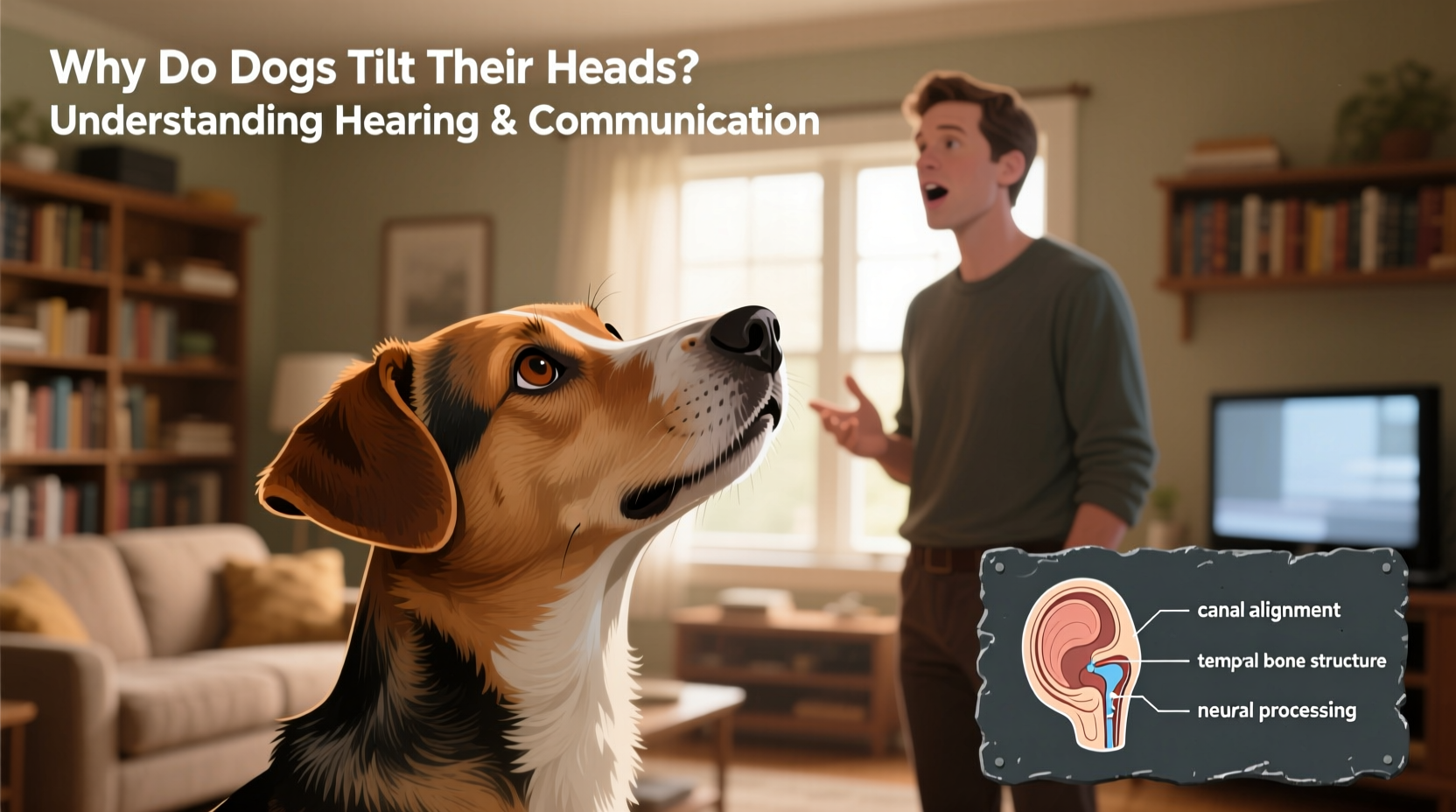
A dog’s skull structure differs significantly from ours. Their muzzles vary in length and width across breeds, which affects how sound reaches their ears. When a dog tilts its head, it subtly changes the position of its ear canals relative to the source of sound. This small adjustment may help localize where a noise is coming from or improve auditory clarity, especially for high-pitched or unfamiliar tones.
For example, dogs with longer muzzles—like Collies or Greyhounds—may need to tilt more than brachycephalic (short-nosed) breeds such as Pugs or Bulldogs. The muzzle can partially obstruct sound waves entering the ear canal, so shifting the angle helps bypass that barrier. Think of it like cupping your hand behind your ear to hear someone better—it’s a natural acoustic aid.
Cognitive Processing and Word Recognition
While anatomy plays a role, cognitive science reveals an even more fascinating layer: dogs may tilt their heads when processing language. Research conducted at Eötvös Loránd University in Hungary used fMRI scans to show that dogs process human speech in brain regions similar to humans, particularly when recognizing familiar words or intonations.
In one landmark study, researchers trained border collies to retrieve specific toys by name. When presented with a new object and asked to fetch a toy whose name they knew, the dogs often tilted their heads—suggesting active mental engagement. Dr. Attila Andics, lead researcher, noted:
“Dogs don’t just respond to tone; they pay attention to both word meaning and how it’s said. The head tilt might be part of that deeper processing.” — Dr. Attila Andics, Cognitive Ethologist, Eötvös Loránd University
This implies that head tilting isn’t merely reflexive—it may signal a dog actively trying to decode what you’re saying, especially if the sentence contains a known command or emotionally charged word like “walk” or “bath.”
Breed Differences in Language Comprehension
Not all dogs respond the same way. Breeds historically selected for responsiveness to human commands—such as Border Collies, Poodles, and German Shepherds—tend to exhibit more frequent head tilts during verbal interaction. These breeds also demonstrate higher vocabulary retention. Rico, a famous Border Collie, learned over 200 words through fast-mapping, a skill once thought unique to humans.
In contrast, more independent breeds like Siberian Huskies or Basenjis may tilt less often, not because they’re disinterested, but because they rely less on verbal cues and more on environmental context.
Social Bonding and Learned Behavior
Another compelling theory is that head tilting has become a socially reinforced behavior. Dogs are highly attuned to human reactions. If a dog tilts its head and receives positive feedback—such as laughter, affection, or treats—it learns that this gesture pays off.
Over time, the behavior can become conditioned. A dog may begin tilting not because it needs to hear better or is processing language, but because it knows this action makes its owner happy. In essence, the head tilt becomes a communicative tool, much like a smile or a wagging tail.
This doesn’t make the behavior any less genuine. On the contrary, it highlights the depth of the dog-human bond. Dogs don’t just react to us—they adapt their behavior to connect with us emotionally.
Real Example: Max the Rescue Terrier
Consider Max, a mixed-breed rescue adopted by a couple in Portland. Initially shy and unresponsive, Max rarely made eye contact or reacted to verbal cues. Over months of consistent training and gentle interaction, his owners noticed he began tilting his head whenever they used certain phrases like “good boy” or “dinner time.”
What started as occasional curiosity evolved into a regular response. His foster mom kept a log and found that head tilts increased after she began praising him immediately following the gesture. Within weeks, Max was not only responding faster to commands but using the head tilt as a way to initiate play or seek reassurance.
This case illustrates how head tilting can emerge from a blend of learning, emotional safety, and social reward.
When Head Tilting Might Signal a Health Issue
While occasional head tilting is normal, persistent or abnormal tilting—especially if accompanied by other symptoms—can indicate underlying medical problems. Conditions such as ear infections, vestibular disease, or neurological disorders may cause a dog to hold its head crookedly even at rest.
Key signs that warrant veterinary attention include:
- Constant head tilt without returning to neutral
- Loss of balance or coordination
- Frequent scratching or head shaking
- Discharge or odor from the ears
- Nystagmus (involuntary eye movement)
Vestibular disease, sometimes called “old dog vestibular syndrome,” mimics stroke-like symptoms but often resolves on its own. However, proper diagnosis is crucial to rule out tumors, inner ear damage, or infections.
Do’s and Don’ts of Responding to Head Tilting
| Do | Don't |
|---|---|
| Encourage gentle interaction when your dog tilts—this strengthens bonding. | Force or mimic the tilt repeatedly to provoke a reaction. |
| Use consistent commands and praise to reinforce comprehension. | Ignore sudden changes in frequency or posture. |
| Check ears regularly for wax buildup or irritation. | Assume all tilting is purely behavioral without considering health. |
| Observe patterns—does it happen with high-pitched voices or certain words? | Overuse emotionally loaded words just to see the tilt. |
Step-by-Step: How to Encourage Healthy Communication
If you’d like to better understand your dog’s responses—and support their ability to engage with language—follow this practical guide:
- Use clear, consistent vocabulary. Stick to one word per command (e.g., “sit,” not “sit down now”). Repetition builds recognition.
- Pair words with gestures. Dogs are visual learners. Combine verbal cues with hand signals for stronger association.
- Observe when tilting occurs. Keep notes for a week: time of day, tone of voice, type of phrase. Look for patterns.
- Minimize background noise. Test comprehension in quiet environments first, then gradually introduce distractions.
- Reinforce positively—but not excessively. Reward correct responses with treats or affection, but avoid reinforcing the tilt itself unless paired with understanding.
- Schedule annual ear checkups. Ensure hearing health supports cognitive engagement.
Frequently Asked Questions
Do dogs understand the words we say?
Yes, but selectively. Most dogs learn to associate specific sounds (words) with actions or outcomes through repetition. Studies show some dogs can recognize over 150 words, especially if trained early. They combine this with tone and body language to interpret intent.
Is head tilting a sign of intelligence?
Not directly. While intelligent breeds may tilt more due to higher engagement, the gesture itself reflects attentiveness rather than IQ. Even less verbally responsive dogs may tilt their heads out of curiosity or social motivation.
Should I be worried if my dog never tilts their head?
No. Just like people, dogs have individual personalities and communication styles. Some are more expressive; others show focus through stillness, eye contact, or ear movement. Absence of tilting doesn’t imply lack of understanding.
Conclusion: More Than Just Cute—It’s Connection
The dog’s head tilt is far more than a charming quirk. It’s a window into their world—a blend of biological adaptation, cognitive effort, and emotional connection. Whether they’re fine-tuning their hearing, parsing your words, or seeking your approval, each tilt speaks volumes about the depth of interspecies communication.
Understanding this behavior enriches our relationship with our pets. Instead of merely reacting to the cuteness, we can appreciate the complexity behind it. By listening closely—not just with our ears, but with empathy—we deepen the bond that makes dog ownership so uniquely rewarding.




 浙公网安备
33010002000092号
浙公网安备
33010002000092号 浙B2-20120091-4
Comments
No comments yet. Why don't you start the discussion?