
Dog owners often find themselves pausing mid-sentence, captivated by a sudden, endearing motion: their dog cocking their head to one side. This subtle tilt—sometimes accompanied by wide, curious eyes and perked ears—is more than just a photogenic moment. It's a complex behavior rooted in biology, cognition, and communication. While it may seem whimsical, scientists and veterinarians have studied this gesture extensively, uncovering layers of sensory processing, social bonding, and learned responses. Understanding why dogs tilt their heads when we speak offers insight into how they perceive the world—and how deeply attuned they are to human interaction.
The Role of Hearing and Sound Localization
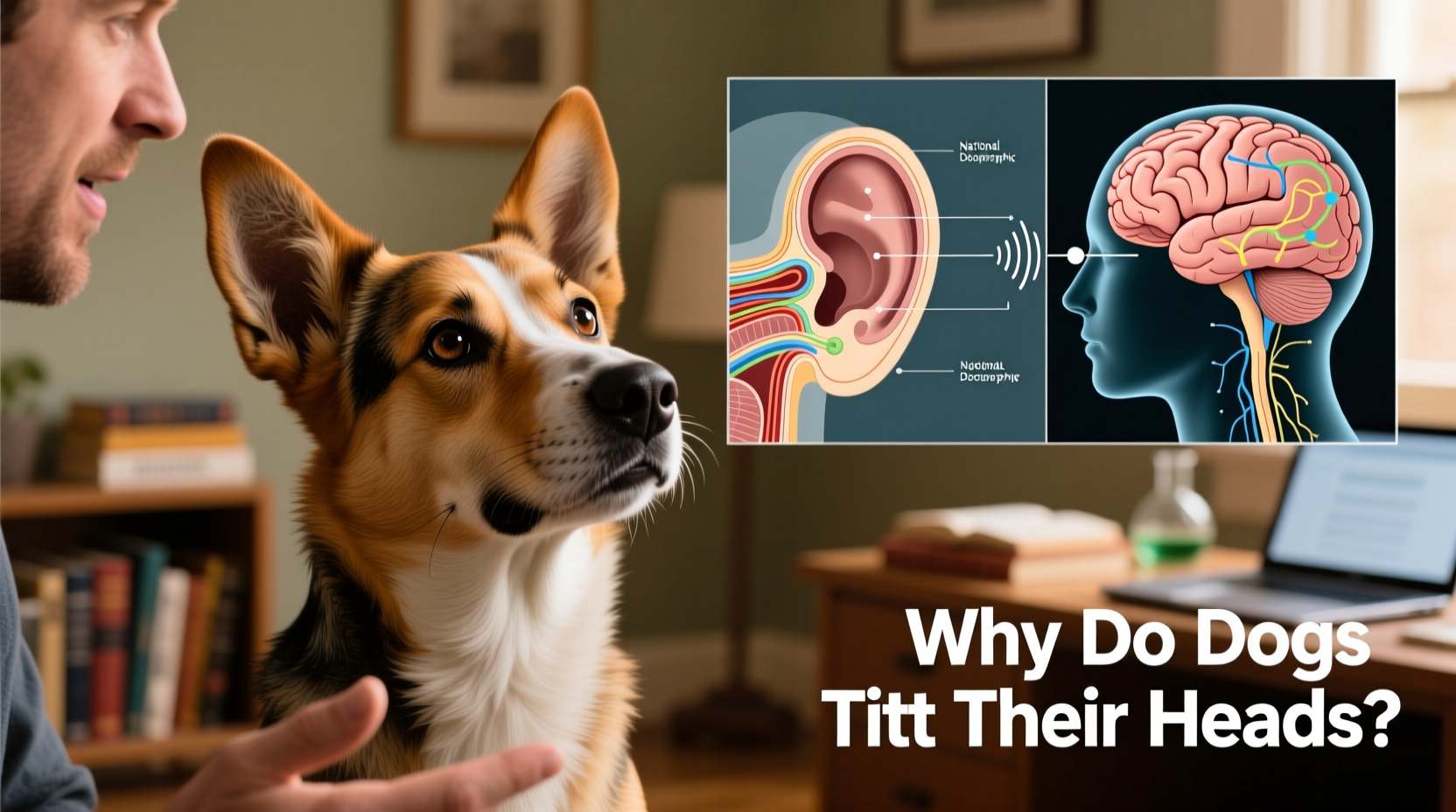
Dogs possess exceptional hearing, capable of detecting frequencies far beyond the human range. However, unlike humans who can easily pinpoint sound direction using fixed ear placement, dogs rely on physical adjustments to interpret auditory cues accurately. When a dog hears an unfamiliar or high-pitched sound—especially within human speech—they may tilt their head to optimize sound reception.
This movement alters the position of the ear canal relative to the sound source, helping the dog determine where the noise is coming from. For breeds with longer muzzles or floppy ears—like Basset Hounds or Cocker Spaniels—the muzzle can partially obstruct incoming sounds. Tilting shifts the jaw slightly, reducing interference and allowing for better acoustic clarity.
“Head tilting is often a functional response to auditory stimuli. Dogs are fine-tuning their ability to locate and interpret sounds, especially those embedded in human language.” — Dr. Alexandra Horowitz, Canine Cognition Researcher, Barnard College
In essence, the head tilt acts like a biological antenna adjustment. It helps dogs distinguish between familiar words (such as “walk” or “treat”) and background noise, enhancing their comprehension of vocal patterns.
Vision and Facial Expression Interpretation
Beyond hearing, vision plays a crucial role in canine communication. Dogs are highly observant of human facial expressions, body language, and lip movements. When we speak, our faces move in specific ways that convey tone, emotion, and intent. A dog’s muzzle length can limit their field of view when looking directly at a person’s face, particularly when standing close.
By tilting their head, dogs gain a clearer line of sight to the lower half of the face—specifically the mouth and chin area—where key visual speech cues occur. This slight repositioning allows them to read lips and detect subtle changes in expression, such as smiles or frowns, which help them interpret emotional context.
Studies suggest that dogs use both auditory and visual input together to understand human commands. This multimodal perception strengthens their ability to respond appropriately, making the head tilt not just a reflex, but a strategic act of attention.
Social Bonding and Learned Behavior
While sensory mechanics explain part of the behavior, another powerful driver is social reinforcement. Dogs are masters of operant conditioning—they learn quickly which actions yield positive outcomes. If a dog tilts their head and receives affection, laughter, or treats in return, they’re likely to repeat the behavior.
Over time, the head tilt becomes a conditioned response, used intentionally to engage their owner’s attention. It functions as a nonverbal cue that says, “I’m listening,” or even, “I want to please you.” In this way, the gesture evolves from a physiological adjustment into a communicative tool shaped by relationship dynamics.
Interestingly, individual dogs vary significantly in how often they exhibit this behavior. Some tilt constantly; others rarely do. This variation correlates with temperament, breed predispositions, and the strength of the human-animal bond. Dogs with higher social engagement tend to display more frequent head tilts, suggesting a link between emotional intelligence and expressive behaviors.
Mini Case Study: Max, the Responsive Border Collie
Max, a 4-year-old Border Collie, began tilting his head consistently whenever his owner said the word “vet.” Initially, the behavior seemed random. But upon closer observation, Max’s owner realized he only tilted his head when the word was spoken in a certain tone—usually one laced with anxiety. Over several weeks, she experimented by saying “vet” in neutral tones, cheerful voices, and worried pitches. Max responded with a head tilt only during anxious deliveries.
This indicated that Max wasn’t just reacting to the word itself, but to the emotional undertone paired with it. The head tilt served dual purposes: gathering auditory details and signaling concern or inquiry. Once Max’s owner started rewarding calm reactions instead of unintentionally reinforcing worry, the frequency of head tilts decreased—proving how deeply dogs associate tone, context, and consequence.
Cognitive Processing and Word Recognition
Recent research has shown that some dogs can recognize over 200 words, particularly those associated with objects, actions, or rewards. When a dog hears a familiar word embedded in a sentence, their brain activates regions linked to memory and meaning retrieval. The head tilt may coincide with this cognitive effort—a visible sign of mental focus.
A 2016 study published in *Animal Cognition* observed that dogs were more likely to tilt their heads when presented with novel commands or ambiguous phrases. The researchers concluded that the behavior correlated with increased neural activity, suggesting that the tilt accompanies problem-solving attempts or attempts to decode unclear information.
This aligns with observations that dogs often tilt their heads when asked questions (“Do you want to go outside?”) rather than given direct orders (“Sit!”). The interrogative structure introduces uncertainty, prompting the dog to assess tone, word choice, and context—all while physically adjusting to gather more data.
| Context | Likelihood of Head Tilt | Potential Reason |
|---|---|---|
| Hearing a high-pitched sound | High | Improved sound localization |
| Seeing a new object | Moderate | Visual angle adjustment |
| Receiving a known command | Low | No additional processing needed |
| Unclear or unfamiliar phrase | Very High | Cognitive effort and attention |
| Owner showing affection | Moderate-High | Learned social response |
When to Be Concerned: Medical Considerations
While occasional head tilting is normal, persistent or involuntary tilting—especially if accompanied by loss of balance, circling, or ear scratching—can signal underlying health issues. One common cause is vestibular disease, which affects the inner ear and balance system. Other potential causes include ear infections, neurological disorders, or tumors.
Unlike the voluntary, responsive tilt seen during conversation, pathological tilting tends to remain fixed in one direction and doesn’t resolve when distracted. If your dog suddenly begins tilting their head without stimulus, consult a veterinarian promptly.
Checklist: Is Your Dog’s Head Tilt Normal?
- ✅ Occurs intermittently during interaction
- ✅ Responds to changes in voice or environment
- ✅ Resolves quickly after stimulus ends
- ✅ No signs of disorientation or imbalance
- ✅ Symmetrical posture when not tilting
- ❌ Persistent tilt lasting hours or days
- ❌ Accompanied by stumbling, nausea, or nystagmus (eye flickering)
- ❌ Head shake or ear pain present
If most checked items are positive (✅), the behavior is likely normal. If red flags (❌) appear, seek veterinary evaluation.
Step-by-Step: Encouraging Healthy Communication Without Overstimulation
You don’t need to stop talking to your dog—but understanding how they process language can improve your interactions. Follow these steps to support clear, meaningful communication:
- Use consistent vocabulary: Stick to the same words for commands (e.g., always say “sit,” not “sit down” or “take a seat”).
- Speak clearly and calmly: Avoid exaggerated tones unless training a new cue. Dogs respond best to moderate pitch and steady rhythm.
- Pair words with gestures: Combine verbal cues with hand signals to reinforce understanding through multiple senses.
- Observe your dog’s responses: Note when they tilt, bark, sit, or ignore. Adjust your approach based on what works.
- Limit repetition: Saying “come here” ten times teaches a dog to ignore the first nine. Use once, then redirect with a treat or leash if needed.
- Reward attention, not just obedience: Praise your dog for focusing—even if they don’t perform perfectly—to build listening habits.
This structured method reduces confusion and supports cognitive development, minimizing unnecessary head tilting due to ambiguity.
Frequently Asked Questions
Is head tilting a sign of intelligence?
Not directly. While intelligent dogs may process language more effectively, head tilting is primarily a sensory or socially reinforced behavior. However, frequent tilting in response to new words or tones can indicate strong observational skills and learning aptitude.
Do all dog breeds tilt their heads equally?
No. Breeds with shorter muzzles (brachycephalic), like Pugs or Boston Terriers, tend to tilt less because their facial structure provides a wider field of view. Conversely, long-muzzled breeds like Collies or Greyhounds may tilt more often to adjust their line of sight. Individual personality also plays a major role.
Can I train my dog to stop tilting their head?
You can, but there’s no need unless it’s medically related. The behavior is harmless and often a sign of engagement. If you’d prefer less tilting, avoid reinforcing it with excessive praise or treats. Instead, reward alternative behaviors like sitting quietly or making eye contact.
Conclusion: A Gesture Rooted in Connection
The head tilt is more than a charming quirk—it’s a window into the canine mind. It reflects a sophisticated interplay of hearing, vision, cognition, and emotion. Every time your dog cocks their head, they’re doing more than being cute; they’re actively trying to understand you. They’re tuning into your voice, reading your face, and seeking connection.
Far from mere instinct, this behavior illustrates how deeply dogs have adapted to live alongside humans. They’ve evolved not just to obey commands, but to participate in our emotional world. Recognizing the science behind the tilt deepens our appreciation for their perceptiveness and loyalty.




 浙公网安备
33010002000092号
浙公网安备
33010002000092号 浙B2-20120091-4
Comments
No comments yet. Why don't you start the discussion?