
It starts subtly — a low, trembling whine as you plug in the string of lights. Then, as the first bulbs blink to life, your dog tucks their tail, paces near the window, or hides under the sofa. Some dogs tremble; others freeze mid-sniff, ears pinned back, eyes wide. This isn’t “just being dramatic.” It’s a genuine stress response — one that’s more common than most pet owners realize. According to the American Veterinary Society of Animal Behavior (AVSAB), up to 35% of dogs exhibit noise- or light-related anxiety during holiday seasons, with flashing, rhythmic, or high-contrast lighting acting as potent triggers. Unlike humans, dogs process visual input at a higher flicker fusion rate — meaning many LED and animated lights appear to strobe or pulse intensely to them. Add unpredictable movement (e.g., wind-blown outdoor displays), sudden brightness shifts, and the unfamiliar scent of new electrical cords or plastic ornaments, and it’s no wonder your dog feels unsettled. This article explains the physiological and behavioral roots of this reaction — and, more importantly, delivers practical, veterinarian-approved strategies you can implement *this week* to restore calm.
The Science Behind the Whine: Why Lights Trigger Stress
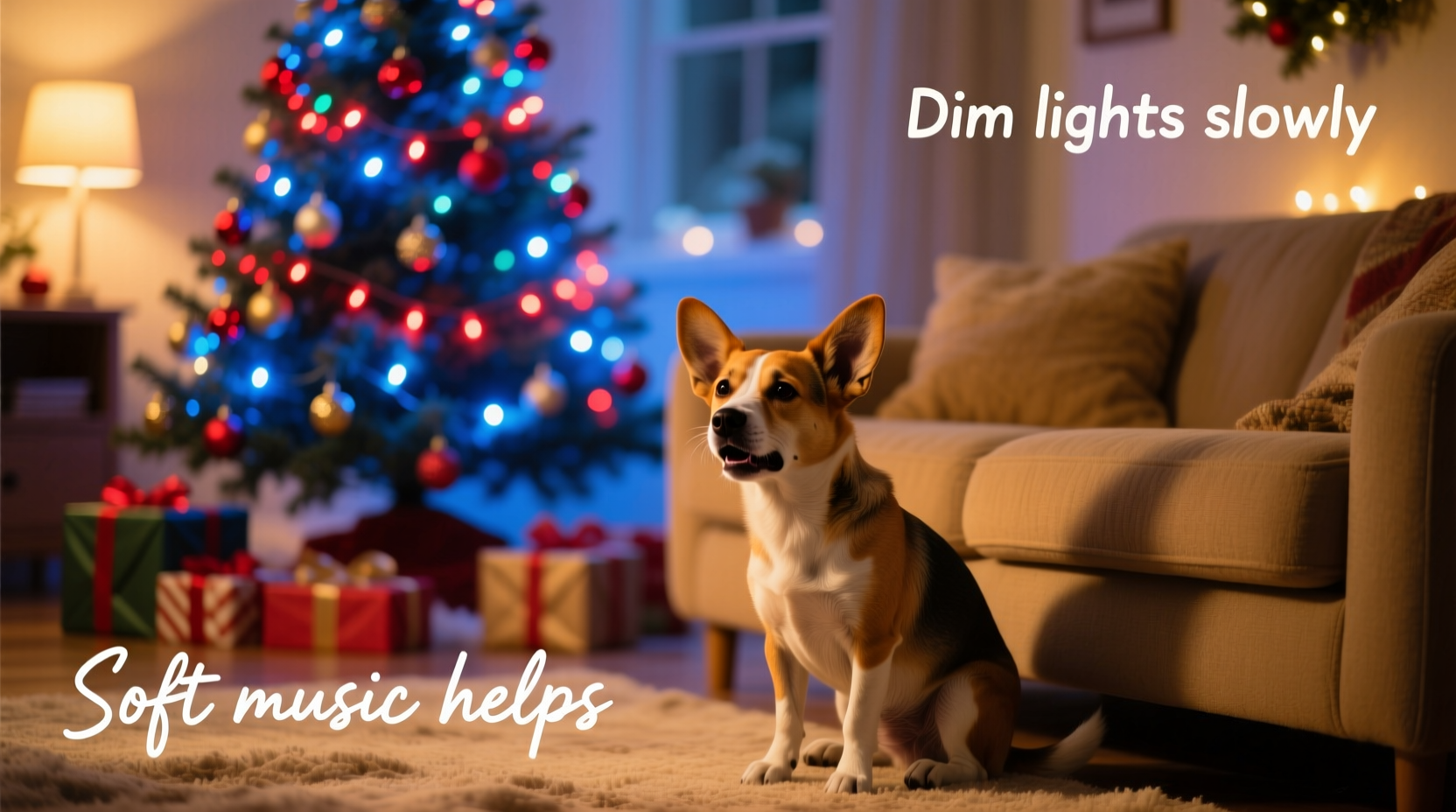
Dogs don’t perceive holiday lighting the way we do. Their visual system is optimized for motion detection and low-light sensitivity — not static color rendering. The human eye perceives continuous light at around 60 Hz (cycles per second). Dogs, however, require roughly 70–80 Hz to register light as steady. Many budget and older LED strings operate at 50–60 Hz — producing a subtle but biologically significant flicker invisible to us yet highly detectable to canine vision. This flickering activates the amygdala — the brain’s threat-detection center — triggering a cascade of stress hormones like cortisol and norepinephrine. Compounding this is the auditory component: transformers hum, dimmer switches buzz, and some smart lights emit faint high-frequency emissions (up to 20 kHz) that fall within a dog’s hearing range (40 Hz–60 kHz) but outside ours (20 Hz–20 kHz). A 2022 study published in Applied Animal Behaviour Science found that 68% of dogs exposed to flickering white LEDs showed elevated heart rates and increased panting within 90 seconds — even without sound. Environmental context matters too: if lights are turned on abruptly after weeks of darkness, or paired with chaotic holiday activity (guests, packages, rearranged furniture), the dog’s nervous system interprets the change as potential danger — not decoration.
What NOT to Do: Common Missteps That Worsen Anxiety
Well-intentioned responses often backfire. Reassuring your dog with soothing words while they’re whining (“It’s okay, baby, shhh”) inadvertently reinforces the anxious behavior — your tone signals that something *is* wrong, validating their fear. Similarly, forcing proximity (“Come look — see? It’s fine!”) floods their system with stress. Punishment — yelling, grabbing the collar, or using spray bottles — erodes trust and associates the lights (and by extension, the holiday season) with pain or confusion. Another frequent error is inconsistent management: turning lights on only during parties, then off for days, prevents your dog from forming predictable associations. Their nervous system remains on high alert, waiting for the next unpredictable stimulus. Equally problematic is relying solely on sedatives without behavioral support. While veterinary-prescribed medications like trazodone or gabapentin have their place, they treat symptoms — not the underlying associative learning. Without counter-conditioning, anxiety returns once medication stops.
| Do | Don’t |
|---|---|
| Observe your dog’s earliest stress signal (lip licking, yawning, avoiding eye contact) | Wait until they’re full-on whining or trembling before intervening |
| Use consistent, low-stimulus lighting during acclimation (e.g., warm-white, non-blinking bulbs) | Start with multi-color, chase-effect, or strobing displays |
| Pair light exposure with high-value rewards (freeze-dried liver, lick mats) | Offer treats while they’re actively stressed — this creates negative food associations |
| Provide a designated “safe zone” with sightline control (e.g., crate with opaque cover) | Confine them in a room with unobstructed views of bright windows or lit trees |
| Consult your veterinarian before using any supplement or medication | Give over-the-counter human melatonin or CBD products without dosing guidance |
A Step-by-Step Desensitization & Counter-Conditioning Plan
This 10-day protocol, adapted from protocols used by certified veterinary behaviorists, rebuilds your dog’s emotional response through gradual, controlled exposure. Success depends on strict adherence to timing, reward quality, and stopping *before* stress appears. Never push past your dog’s threshold.
- Day 1–2: Sensory Prep — Unplug all lights. Place one warm-white, non-blinking LED bulb in a lamp in a quiet room. Sit with your dog 8 feet away. Offer one piece of freeze-dried beef every 30 seconds — regardless of behavior. Total session: 3 minutes, twice daily.
- Day 3–4: Light Introduction — Turn the lamp on *while your dog watches*. Start with 5 seconds on, 30 seconds off. Reward calmly during “on” time. If your dog looks away or blinks slowly, that’s okay — keep rewards flowing. Stop immediately if ears flatten or breathing quickens.
- Day 5–6: Proximity Shift — Move the lamp 2 feet closer (now 6 feet away). Extend “on” time to 10 seconds. Introduce gentle leash walking *past* the lamp (not toward it) while rewarding heavily.
- Day 7–8: Context Expansion — Use the same bulb in a different room. Add soft background music (classical or species-specific “Through a Dog’s Ear” playlists). Keep sessions under 4 minutes.
- Day 9–10: Real-World Integration — Introduce one strand of your actual lights — unplugged — draped over a chair. Let your dog investigate at their pace. On Day 10, plug it in for 8 seconds. Gradually increase to 30 seconds across two sessions.
Progress only when your dog consistently offers relaxed body language (loose shoulders, soft eyes, relaxed mouth) during the “on” phase. If regression occurs, drop back two steps. Most dogs show measurable improvement by Day 12 — though full confidence with complex displays may take 3–4 weeks.
Real-Life Example: Luna, a 4-Year-Old German Shepherd Mix
Luna began whining and retreating to her crate whenever her owner, Maya, turned on the front-porch lights — even before decorations went up. Her anxiety escalated to trembling and refusal to walk past the entryway. Maya initially tried covering the porch light with a towel (ineffective) and giving treats only after Luna hid (reinforcing avoidance). After consulting Dr. Arden Moore, a certified applied animal behaviorist, Maya implemented the step-by-step plan above — starting with a single incandescent bulb in the laundry room. By Day 7, Luna was choosing to lie near the lit lamp. By Day 14, she’d walk past the porch light with a relaxed gait. Crucially, Maya added environmental controls: she installed motion-sensor lights that activated only when needed (reducing constant visual stimulation) and placed Luna’s bed in the living room facing away from the front window. “The biggest shift wasn’t the lights,” Maya shared. “It was realizing Luna wasn’t ‘scared of lights’ — she was scared of losing control. Giving her choice and predictability changed everything.”
Expert Insight: What Veterinarians and Behaviorists Emphasize
“Whining at lights is rarely about the light itself — it’s about unpredictability, loss of control, and sensory overwhelm. The goal isn’t to eliminate the stimulus, but to restore your dog’s sense of safety *within* it. That requires consistency, patience, and respecting their neurology — not our aesthetics.”
— Dr. Lisa Radosta, DVM, DACVB, Founder of Florida Veterinary Behavior Service
“Many owners mistake ‘calm’ for ‘compliant.’ A dog who stops whining because they’ve shut down isn’t relaxed — they’re dissociating. Watch for active engagement: tail wags, play bows, seeking attention. Those are the real markers of success.”
— Dr. Katherine Albro, DACVB, Cornell University College of Veterinary Medicine
Immediate Calming Strategies for This Holiday Season
If the lights are already up and your dog is distressed *right now*, these evidence-informed interventions provide rapid relief while longer-term work continues:
- White noise masking: Run a fan, humidifier, or dedicated white noise machine near your dog’s resting area. This dampens high-frequency transformer hums and reduces auditory triggers.
- Compression wear: A properly fitted ThunderShirt or similar garment provides gentle, constant pressure shown in peer-reviewed studies to lower cortisol levels by up to 22% in anxious dogs.
- Olfactory grounding: Apply a drop of lavender or chamomile essential oil (diluted 1:10 in coconut oil) to a bandana tied loosely around your dog’s neck — or use a diffuser with dog-safe oils (avoid tea tree, citrus, or pennyroyal). Smell directly modulates the limbic system.
- Environmental redesign: Close blinds on light-facing windows. Use blackout curtains in your dog’s primary resting space. Position their bed in a corner away from reflective surfaces (mirrors, glass tables) that amplify light intensity.
- Behavioral interruption: When whining begins, calmly cue a known, low-effort behavior (e.g., “touch” your hand, “go to mat”). Reward generously. This redirects neural pathways away from panic and toward problem-solving.
FAQ
Can I use red or amber lights instead of white to reduce stress?
Yes — and it’s one of the most effective hardware adjustments. Red and amber LEDs emit less blue-wavelength light, which is most disruptive to circadian rhythms and visual processing. A 2023 study in Frontiers in Veterinary Science found dogs exposed to amber-lit environments showed 40% lower baseline cortisol than those under cool-white LEDs. Avoid multi-color changing lights entirely during acclimation.
My dog only whines when the lights are blinking — will steady lights fix it?
Steady lights significantly reduce the trigger load, but won’t resolve underlying anxiety alone. Blinking lights are a clear, discrete stimulus — making them ideal for targeted desensitization. Once your dog tolerates steady light confidently, reintroduce blinking *very gradually*: start with one slow-blinking bulb (1-second on/3-seconds off), then progress to faster cycles only after full relaxation is achieved.
Is this related to Canine Cognitive Dysfunction (dog dementia)?
Rarely in young or middle-aged dogs. However, senior dogs (10+ years) experiencing new-onset light sensitivity should be evaluated by a veterinarian. Changes in visual processing, lens opacity (cataracts), or neurological decline can heighten light aversion. Rule out medical causes before assuming behavioral origin — especially if whining is accompanied by disorientation, pacing at night, or house-soiling.
Conclusion
Your dog’s whine isn’t a quirk — it’s communication. It’s their nervous system saying, “This feels unsafe. I need help regulating.” The good news is that with neurobiological awareness, compassionate consistency, and actionable tools, you can transform holiday lighting from a source of dread into a neutral, even positive, part of your shared environment. You don’t need to sacrifice festive cheer. You simply need to meet your dog where they are — not where you wish they were. Start tonight: unplug one light, grab a handful of their favorite treats, and sit quietly together. Notice their breath. Watch their ears. Reward stillness. Small acts, repeated with intention, rewire fear into familiarity. Your dog doesn’t need perfect silence or perpetual dimness — they need to know, deep in their bones, that you’re a steady presence in an unpredictable world. That’s the truest gift you can give this season.




 浙公网安备
33010002000092号
浙公网安备
33010002000092号 浙B2-20120091-4
Comments
No comments yet. Why don't you start the discussion?