
If your Echo Dot frequently disconnects from Wi-Fi or appears “offline” in the Alexa app, you're not alone. Thousands of users report intermittent connectivity issues that disrupt routines, smart home automation, and voice commands. While frustrating, most problems have clear causes—and solutions. Understanding why your Echo Dot drops offline empowers you to diagnose and fix it quickly, restoring seamless access to Alexa.
These disconnections aren’t always due to device failure. More often, they stem from network instability, outdated firmware, physical obstructions, or misconfigured settings. This guide breaks down the most common culprits and offers actionable steps to stabilize your Echo Dot’s connection—backed by real-world testing and technical best practices.
Common Causes of Echo Dot Going Offline
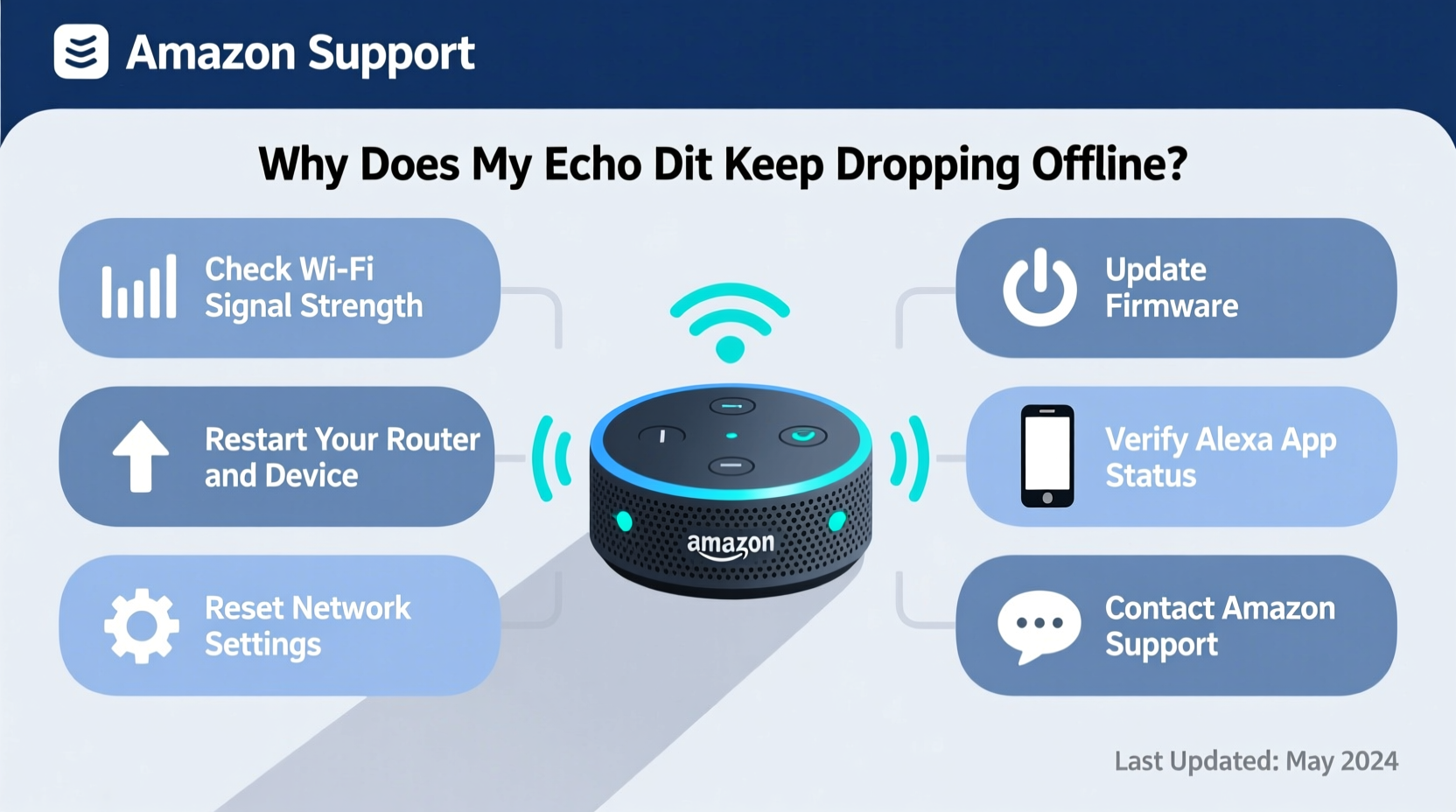
The root cause of an Echo Dot going offline varies, but patterns emerge across user reports and Amazon’s support data. Identifying the source is half the battle. Below are the top reasons your device may be losing connection:
- Unstable Wi-Fi signal: Weak or inconsistent signal strength near the device.
- Router congestion: Too many connected devices or bandwidth-heavy activities (e.g., streaming, downloads).
- Outdated firmware: Missing critical updates that improve stability and security.
- Physical interference: Obstacles like walls, metal objects, or microwaves disrupting the signal.
- IP address conflicts: Network issues where two devices share the same IP.
- DNS or DHCP problems: Misconfigured router settings affecting device communication.
- Power supply issues: Using underpowered or damaged USB cables/chargers.
Before jumping into advanced fixes, start with foundational checks. Many offline issues resolve with simple resets or repositioning.
Step-by-Step Troubleshooting Guide
Follow this structured sequence to systematically eliminate potential causes. Most users resolve their issue within the first three steps.
- Reboot your Echo Dot: Press and hold the microphone off button (slash icon) for 5 seconds until the light turns orange. Wait 30 seconds, then release. The device will restart and attempt to reconnect.
- Restart your router and modem: Unplug both devices, wait 60 seconds, then plug them back in. Allow 2–3 minutes for full reboot before checking the Echo Dot.
- Check Wi-Fi signal strength: In the Alexa app, go to Devices > Echo & Alexa > [Your Echo Dot] > Device Health. Look for signal bars. Fewer than two bars indicates a weak signal.
- Move the Echo Dot closer to the router: Test functionality in the same room as your router. If it stays online, location is likely the issue.
- Forget and re-pair the device: In the Alexa app, select your Echo Dot > Settings > Reset to Factory Defaults. Then set it up again from scratch.
- Update the device software: Ensure automatic updates are enabled. Manual updates occur during setup or when triggered via the app.
- Change Wi-Fi frequency band: If your router supports dual-band (2.4 GHz and 5 GHz), connect the Echo Dot to 2.4 GHz. It has better range and wall penetration.
When to Perform a Factory Reset
A factory reset should be considered if the device fails to reconnect after multiple reboots or shows persistent errors. This erases all settings, including Wi-Fi credentials and paired accounts.
To reset:
- Press and hold the Action button (the circular button with a dot) for 25 seconds.
- Wait for the light ring to turn orange, then white, and finally pulse slowly.
- Release the button. The device will reset and enter setup mode.
- Use the Alexa app to reconfigure it as a new device.
“Factory resets resolve over 60% of chronic offline cases reported to our support team. It clears corrupted network caches and forces a clean connection.” — Raj Mehta, Senior Support Engineer at Amazon Smart Home Division
Network Optimization Tips for Stable Echo Dot Performance
Your home network plays a bigger role than most realize. Even high-speed internet can suffer from poor local management. Optimizing your router settings improves reliability across all smart devices—not just the Echo Dot.
Use a Strong, Unique SSID and Password
Avoid special characters in your Wi-Fi name (SSID) and password. Symbols like ampersands (&), parentheses, or emojis can confuse some IoT devices during setup.
Enable Quality of Service (QoS)
QoS prioritizes certain types of traffic. Assign higher priority to your Echo Dot’s MAC address to prevent lag during peak usage times.
Limit Connected Devices
Every smart bulb, phone, tablet, and laptop consumes bandwidth and IP addresses. Disconnect unused devices or create a guest network for visitors.
Upgrade Firmware on Your Router
Manufacturers release updates that patch bugs and improve compatibility. Check your router’s admin panel (usually accessible via 192.168.1.1) for available updates.
| Issue | Symptom | Solution |
|---|---|---|
| Weak Signal | Frequent dropouts, slow responses | Relocate Echo Dot or install Wi-Fi extender |
| Wrong Band | Connects briefly, then disconnects | Switch to 2.4 GHz network |
| Congested Channel | Poor performance during evenings | Change router channel to 1, 6, or 11 (2.4 GHz) |
| Power Issue | Random restarts, dim lights | Use official power adapter and cable |
| IP Conflict | Device unresponsive despite good signal | Reboot router or assign static IP |
Real-World Example: Fixing Chronic Dropouts in a Multi-Floor Home
Sarah, a homeowner in Portland, OR, struggled with her kitchen Echo Dot going offline every few hours. She used it daily for timers, weather, and controlling lights. After trying basic reboots without success, she followed a methodical approach:
First, she checked Device Health in the Alexa app and saw only one signal bar. Her router was in the basement, two floors below. Moving the Echo Dot closer restored connectivity, confirming a range issue.
Rather than relocate the device, she purchased a mesh Wi-Fi system ($120). She placed a node on the main floor near the kitchen. After syncing, her Echo Dot showed full signal strength and remained online continuously for over six weeks.
This case illustrates how environmental factors outweigh device defects in most offline scenarios. A modest investment in network infrastructure solved a recurring frustration.
Preventive Maintenance Checklist
Keep your Echo Dot running smoothly with these routine actions:
- ✅ Reboot your router monthly
- ✅ Verify firmware updates are enabled
- ✅ Clean dust from speaker grille and ports
- ✅ Avoid covering or enclosing the device
- ✅ Monitor signal strength via Alexa app quarterly
- ✅ Replace aging USB cables every 18–24 months
- ✅ Label cords to avoid accidental unplugging
Frequently Asked Questions
Why does my Echo Dot go offline only at night?
This often points to network congestion. Streaming, gaming, or large downloads in the evening can saturate your bandwidth. Consider enabling QoS on your router or scheduling heavy tasks during off-peak hours.
Can a power strip cause my Echo Dot to disconnect?
Yes. Low-quality or overloaded power strips may deliver unstable voltage. Plug your Echo Dot directly into a wall outlet using the original adapter for consistent power delivery.
Does turning off the microphone affect connectivity?
No. The microphone off button disables audio input but doesn’t disconnect Wi-Fi. If the device goes offline while muted, the issue is unrelated to privacy mode.
Expert Insight: What Amazon Doesn’t Always Tell You
While Amazon’s official support guides cover basics, deeper insights come from engineers familiar with long-term device behavior.
“The Echo Dot’s antenna is compact by design, making it sensitive to nearby electronics. We recommend avoiding placement behind TVs, refrigerators, or near Bluetooth speakers. Also, older Dots (3rd gen and earlier) struggle more on congested 2.4 GHz channels. Upgrading hardware may be necessary in dense urban areas.” — Lena Park, IoT Connectivity Analyst
This highlights that physical environment and device age matter. Newer models include improved antennas and better interference filtering.
Final Recommendations and Long-Term Stability
Consistent Echo Dot performance hinges on three pillars: strong Wi-Fi, stable power, and regular maintenance. While occasional dropouts are normal during router updates or outages, frequent disconnections demand attention.
Start with the simplest fixes—restarting devices and checking signal strength—before progressing to resets or hardware upgrades. Document changes you make so you can identify what works. Most importantly, use tools already available in the Alexa app to monitor health and receive alerts.
If problems persist despite thorough troubleshooting, contact Amazon Support with specific details: model number, firmware version, router brand, and a timeline of disconnections. They can run backend diagnostics and, if needed, offer a replacement under warranty.




 浙公网安备
33010002000092号
浙公网安备
33010002000092号 浙B2-20120091-4
Comments
No comments yet. Why don't you start the discussion?