
Email remains one of the most essential tools for personal and professional communication. Yet, when it takes minutes instead of seconds to open your inbox, productivity grinds to a halt. Slow email loading isn't just frustrating—it can signal deeper technical problems. While many users immediately blame their internet connection, the real culprit often lies within the email server infrastructure or configuration. Understanding the root causes behind delayed email delivery and sluggish interface response times empowers you to diagnose and resolve these issues efficiently.
Understanding Email Server Architecture
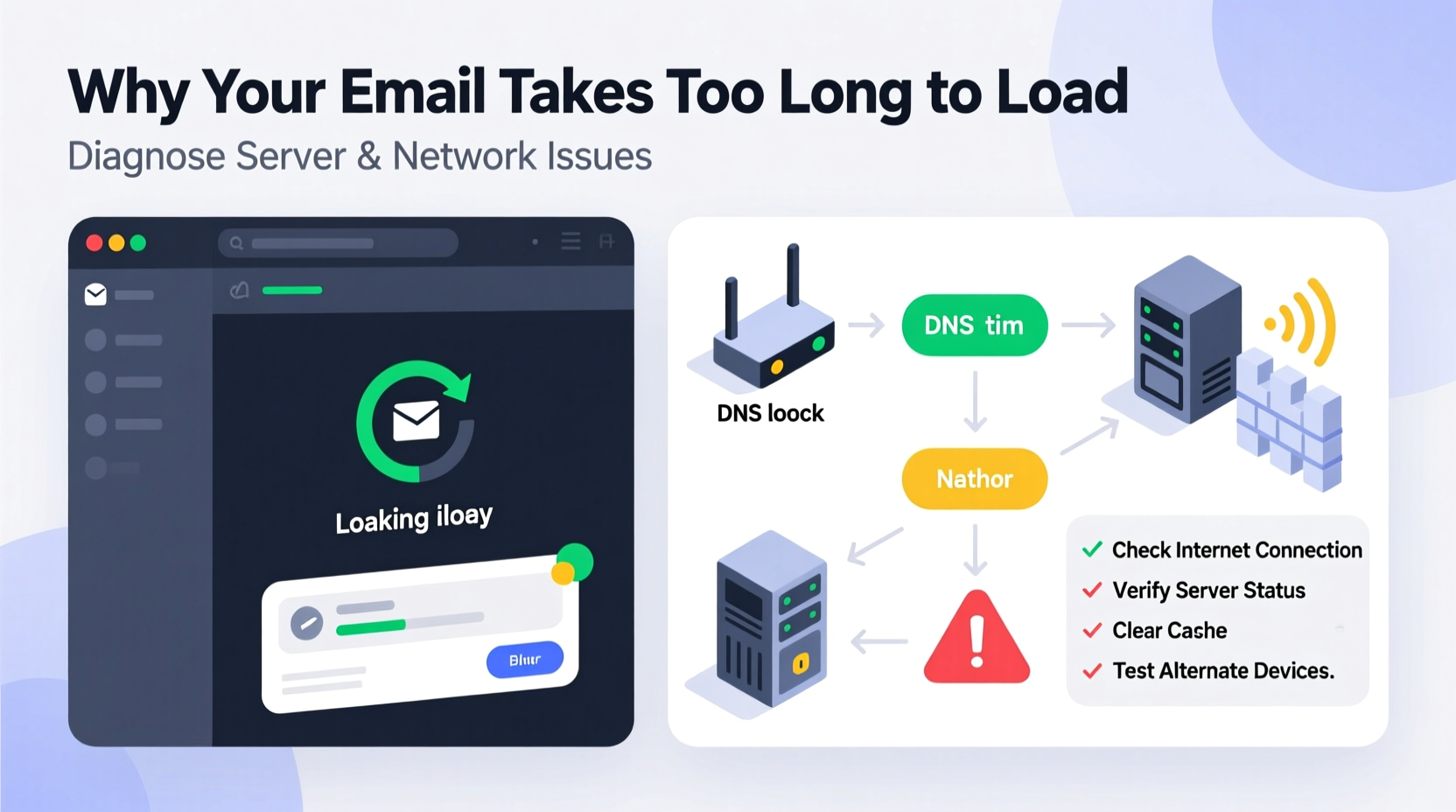
Email systems rely on a complex network of servers and protocols to send, receive, and store messages. When you open your email client—whether it's Outlook, Gmail, Apple Mail, or another platform—a request travels from your device to a remote mail server. That server retrieves your messages using protocols like IMAP (Internet Message Access Protocol), POP3 (Post Office Protocol), or Exchange ActiveSync. Any delay in this chain can result in slow loading.
The primary components involved include:
- Mail Transfer Agent (MTA): Responsible for routing emails between servers.
- Mail Delivery Agent (MDA): Delivers incoming messages to user mailboxes.
- Mail User Agent (MUA): The email client you interact with (e.g., Thunderbird, iOS Mail).
- Authentication Servers: Verify login credentials before granting access.
If any part of this system experiences high latency, overload, or misconfiguration, your email will feel unresponsive. For example, an overloaded MTA might queue messages instead of delivering them instantly. Similarly, if your MDA is scanning every message for malware without adequate processing power, retrieval slows down significantly.
“Server-side bottlenecks are responsible for over 60% of reported email performance issues.” — Dr. Rajiv Mehta, Network Systems Engineer at CloudFlow Technologies
Common Causes of Slow Email Loading
While user-end factors like poor Wi-Fi play a role, server-related problems are frequently overlooked. Below are the most prevalent server-side causes of delayed email loading:
1. Overloaded Mail Servers
Shared hosting environments or under-resourced private servers may struggle during peak usage hours. If your provider hosts thousands of domains on a single machine, resource contention—especially CPU and RAM—can cause delays in fetching and syncing messages.
2. Poor Server Location and Latency
The physical distance between your location and the email server affects response time. A server hosted in Europe serving users in Australia will naturally have higher ping times than a locally hosted one. High latency leads to slower synchronization and longer wait times when opening folders or searching through messages.
3. Inefficient Database Indexing
Email platforms store messages in databases. Without proper indexing, retrieving specific emails—especially from large archives—requires scanning entire tables. This process becomes exponentially slower as mailbox size grows.
4. Misconfigured DNS or MX Records
Domain Name System (DNS) settings direct traffic to the correct mail servers. Incorrect or outdated MX (Mail Exchange) records can lead to routing loops, failed lookups, or fallback attempts that increase load time. Even minor TTL (Time to Live) misconfigurations can propagate delays across global DNS caches.
5. Aggressive Spam Filtering or Antivirus Scanning
Security is critical, but overly strict filters can bottleneck message flow. Each incoming email passing through multiple scanning layers adds milliseconds—or even seconds—to delivery. Some enterprise-grade filters analyze attachments, URLs, and sender reputation in real-time, which compounds delays during heavy traffic periods.
6. Sync Frequency and Polling Intervals
IMAP clients typically poll the server at set intervals to check for new mail. Short polling cycles increase server load, while long ones reduce responsiveness. Poorly tuned sync settings create either excessive strain or noticeable lag in receiving new messages.
Troubleshooting Server-Related Email Delays
When faced with persistent email slowness, follow this structured approach to identify and fix server-level issues.
Step-by-Step Guide: Diagnosing Server Performance
- Test connectivity with ping and traceroute: Open terminal or command prompt and run
ping yourmailserver.com. Response times above 150ms indicate potential latency. Follow up withtracert yourmailserver.com(Windows) ortraceroute yourmailserver.com(Mac/Linux) to see where delays occur along the route. <
- Check server status: Visit your email provider’s status page (e.g., status.google.com for Gmail). Look for ongoing incidents related to Gmail IMAP, SMTP, or directory services.
- Review DNS configuration: Use online tools like MXToolbox or DNSChecker to verify your domain’s MX records. Ensure they point to the correct mail servers and have appropriate priority levels.
- Analyze mailbox size: Large mailboxes (>10GB) strain server resources. Archive old messages or enable auto-purge policies to reduce data load.
- Monitor authentication logs: Failed login attempts or repeated re-authentication due to token expiration can cause apparent lag. Check server logs for spikes in auth requests.
- Evaluate third-party integrations: Plugins, forwarding rules, or connected apps (like CRM tools syncing with your inbox) may trigger background processes that consume server resources.
Mini Case Study: Corporate Email Delay Resolved
A mid-sized marketing firm using a self-hosted Zimbra email server began experiencing severe delays—some employees waited over two minutes to load their inbox. Initial suspicion fell on office bandwidth, but speed tests showed stable 100 Mbps connections. Upon investigation, the IT team discovered the database storing user mailboxes had grown to 18TB without optimization. Index fragmentation was causing full table scans on every folder access. After rebuilding indexes and offloading historical data to cold storage, average load time dropped from 128 seconds to under 7 seconds. Additionally, upgrading RAM from 16GB to 64GB eliminated memory swapping, further improving responsiveness.
Do’s and Don’ts: Managing Email Server Health
| Do’s | Don’ts |
|---|---|
| Migrate to cloud-based email platforms with SLAs guaranteeing uptime and performance. | Run email servers on outdated hardware or virtual machines with insufficient RAM. |
| Regularly audit mailbox sizes and enforce archiving policies. | Allow unlimited mailbox growth without monitoring. |
| Use Content Delivery Networks (CDNs) for webmail interfaces to reduce geographic latency. | Host email servers in regions far from your primary user base. |
| Enable caching in email clients to minimize repeated server queries. | Disable client-side caching, forcing constant server round-trips. |
| Implement rate limiting and fail2ban to prevent brute-force attacks from overwhelming the server. | Leave SSH and SMTP ports exposed without firewall protection. |
Expert Recommendations for Long-Term Stability
Sustained email performance requires proactive maintenance. Industry experts emphasize several best practices:
- Adopt a tiered storage model: Keep recent emails on fast SSD-backed servers and move older messages to cheaper, high-capacity drives.
- Use load balancers for high-traffic environments: Distribute incoming connections across multiple backend servers to prevent single points of failure.
- Monitor key metrics: Track server CPU, memory, disk I/O, and concurrent connections. Set alerts for thresholds exceeding 75% utilization.
- Update software regularly: Patch management prevents exploits and often includes performance improvements for mail handling daemons.
“Email performance isn’t just about speed—it’s about reliability and predictability. A well-maintained server should respond consistently, not just quickly.” — Lena Torres, Senior Systems Architect at NexaCore Inc.
Quick Action Checklist
To rapidly address slow email loading, complete the following checklist:
- ✅ Run a ping test to your mail server to assess baseline latency.
- ✅ Verify MX records using MXToolbox or similar DNS diagnostic tool.
- ✅ Confirm there are no active outages reported by your email service provider.
- ✅ Reduce mailbox clutter by deleting or archiving unnecessary messages.
- ✅ Disable non-essential plugins or add-ons in your email client.
- ✅ Switch from POP3 to IMAP if you need real-time syncing across devices.
- ✅ Contact your hosting provider to inquire about server upgrades or migration options.
Frequently Asked Questions
Why does my email load slowly only on certain devices?
This often indicates a client-specific issue rather than a server problem. However, if all devices accessing the same account experience slowness simultaneously, the server is likely the bottleneck. Differences in OS, app version, or local cache health can explain variation in performance across devices.
Can antivirus software slow down my email?
Yes. Desktop antivirus programs that scan incoming and outgoing emails in real time can introduce noticeable delays, especially with large attachments. Server-side scanning also contributes, but endpoint solutions are more likely to affect perceived speed since they operate on less powerful hardware than enterprise servers.
Is switching to a different email provider worth it for better speed?
In many cases, yes. Providers like Google Workspace and Microsoft 365 invest heavily in global infrastructure, edge caching, and protocol optimization. They typically outperform generic shared hosting email services, particularly for businesses with more than a handful of users. Migration effort is usually offset by improved reliability and support.
Conclusion
Email performance hinges on more than just your internet connection. Behind every smoothly functioning inbox lies a well-tuned server environment, optimized configurations, and proactive monitoring. When emails take too long to load, the issue often traces back to server capacity, geographical latency, database inefficiencies, or security overhead. By systematically evaluating these factors—and applying targeted fixes—you can restore snappy responsiveness to your email experience.
Don’t accept chronic slowness as inevitable. Whether you manage your own server or rely on a third-party provider, understanding the underlying mechanics gives you the leverage to demand better performance. Implement the strategies outlined here, monitor changes, and advocate for infrastructure improvements when needed.




 浙公网安备
33010002000092号
浙公网安备
33010002000092号 浙B2-20120091-4
Comments
No comments yet. Why don't you start the discussion?