
Every holiday season, thousands of homeowners notice something unsettling: their extension cord feels warm—or even hot—to the touch while powering outdoor or indoor Christmas lights. A mild warmth may seem harmless, especially when the lights are strung across a porch, wrapped around a tree, or draped over banisters. But heat is electricity’s most visible warning sign—and ignoring it can lead to melted insulation, arcing, tripped breakers, or worse: an electrical fire.
This isn’t about fear-mongering. It’s about understanding what your cord is telling you. Extension cords are not permanent wiring. They’re temporary power bridges—engineered for short-term, appropriately sized loads. When you daisy-chain multiple light strands, use indoor-rated cords outdoors, or plug into an overloaded outlet, physics takes over: resistance increases, electrons collide more vigorously with conductor atoms, and energy converts to heat. That heat is measurable—and meaningful.
In this article, we’ll walk through the science behind cord heating, decode real-world risk thresholds, and give you actionable tools to assess safety—not guesswork. You’ll learn how to calculate load capacity, recognize danger signs before they escalate, and make informed decisions that protect your home, your family, and your holiday peace of mind.
How Electrical Resistance Turns Power Into Heat
All conductors resist the flow of electricity to some degree. Copper and aluminum wires aren’t perfect; they impede electron movement, converting a small portion of electrical energy into thermal energy. This is known as Joule heating, governed by the formula P = I² × R, where P is power (in watts), I is current (in amps), and R is resistance (in ohms).
For a standard 16-gauge extension cord—common in retail stores—the resistance is roughly 0.004 ohms per foot. At first glance, that seems negligible. But multiply it across a 50-foot run carrying 10 amps (a realistic load for 300–400 incandescent mini-lights), and resistance contributes meaningfully to heat buildup. Worse, resistance rises with temperature: as the cord warms, its internal resistance increases, creating a feedback loop that accelerates heating.
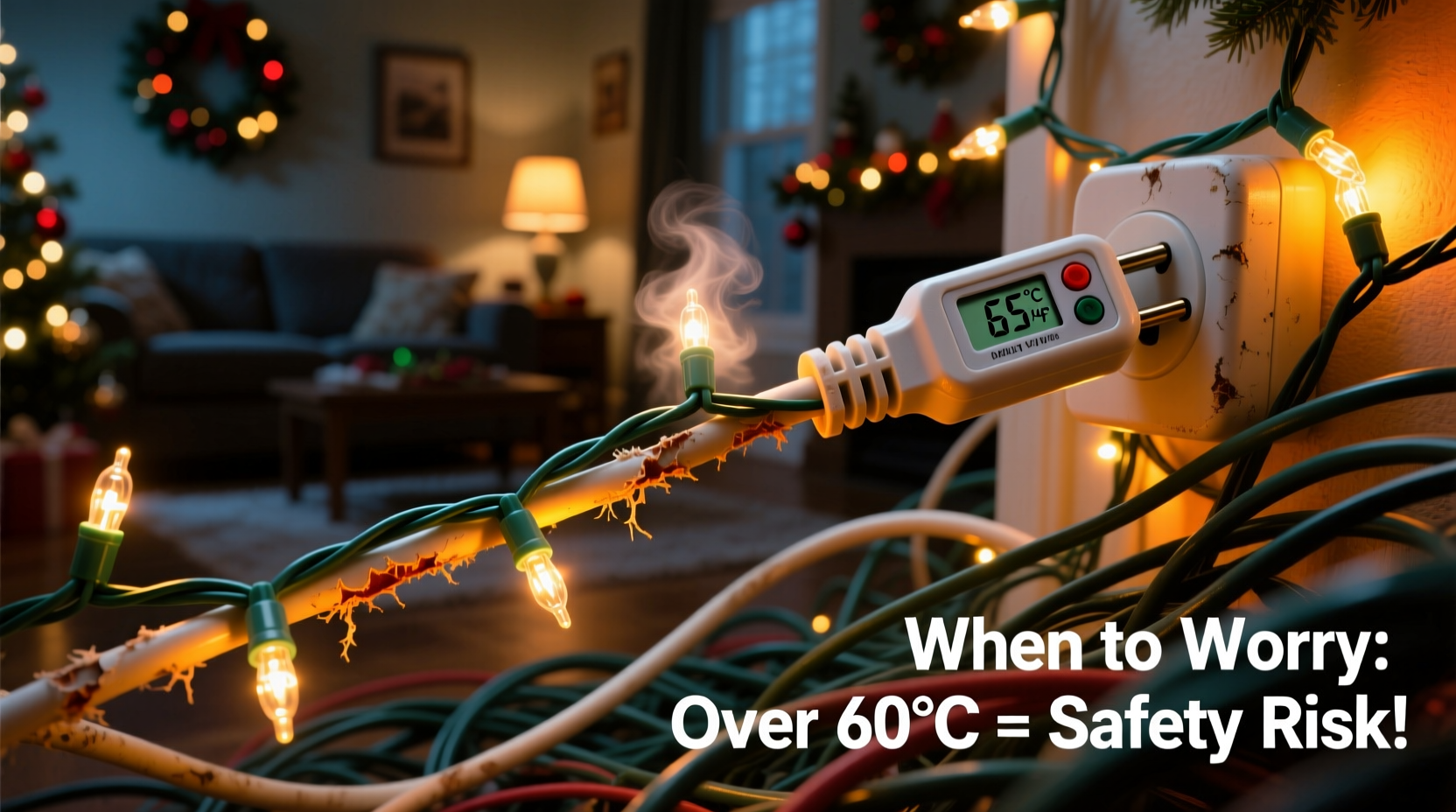
Insulation compounds the issue. PVC or thermoplastic jackets trap heat rather than dissipate it. When coiled, bundled under mulch, pinned beneath furniture, or buried in snow, airflow vanishes—and surface temperatures climb rapidly. UL testing shows that a 16-gauge cord operating at 80% of its rated capacity can reach 60°C (140°F) on the jacket surface in just 15 minutes under restricted cooling conditions. That’s hot enough to soften insulation and degrade long-term integrity.
When Warmth Is Normal — And When It’s Not
Not all heat is dangerous—but distinguishing between safe and unsafe requires context. A cord that feels slightly warm (around body temperature, ~37°C / 98°F) after several hours of continuous operation with a properly matched load may be within design tolerances. But “warm” is subjective—and human skin senses temperature poorly at low gradients. What matters are objective indicators and operational conditions.
Here’s a practical reference table comparing cord behavior, underlying causes, and recommended actions:
| Surface Sensation | Probable Cause | Immediate Action Required? | Maximum Safe Duration |
|---|---|---|---|
| Slightly warm (noticeable but comfortable to hold) | Normal resistance at near-rated load; minor airflow restriction | No—monitor closely | Up to 8 hours continuously |
| Warm to hot (uncomfortable to hold >3 seconds) | Overload (>80% of amp rating), undersized gauge, damaged wire, or poor connection | Yes—unplug immediately | 0 minutes—discontinue use |
| Hot enough to smell plastic or see discoloration | Severe overload, internal damage, or junction failure; imminent insulation breakdown | Yes—shut off circuit, inspect, replace cord | 0 seconds—emergency response |
| Intermittent warmth (cycles on/off) | Faulty outlet, loose plug contact, or failing internal connection | Yes—test outlet and plug integrity before reuse | Do not reuse until diagnosed |
Note: These thresholds assume standard 120V residential power and typical ambient temperatures (10–25°C). In freezing conditions, cord brittleness increases risk of cracking; in high humidity, moisture ingress lowers insulation resistance and accelerates heating.
A Real-World Scenario: The Porch Light Cascade
In December 2022, a homeowner in Portland, Oregon, plugged three 100-light incandescent strands (each drawing 0.33A) into a single 50-foot, 16-gauge indoor-rated extension cord. He then connected that cord to a second identical cord using a generic “power strip adapter,” running both across his wooden porch floor beneath a rug. After four hours, he noticed the cord near the outlet was too hot to touch—and smelled faintly of burnt plastic.
He unplugged everything and measured the load: total draw was 0.99A. On paper, that seemed trivial—well below the 13A rating of a 16-gauge cord. But he’d missed three critical factors: (1) the indoor-rated cord wasn’t designed for outdoor temperature swings or moisture exposure; (2) the rug created near-total thermal insulation; and (3) the adapter introduced a high-resistance point—measured later at 0.8Ω—concentrating heat at the junction.
His cord didn’t fail catastrophically—but infrared imaging revealed localized temperatures exceeding 92°C (198°F) at the adapter. Had the setup run overnight, the PVC jacket would have softened, exposing bare copper and increasing arc-flash risk. This case underscores a vital truth: cord safety depends less on total amperage and more on *how* and *where* electricity flows.
Step-by-Step: How to Audit Your Holiday Lighting Setup
Before hanging a single bulb, follow this field-tested audit process. It takes under 10 minutes—and prevents 90% of preventable cord heating incidents.
- Identify cord specifications: Locate the printed label on the cord jacket. Note gauge (e.g., “16 AWG”), rating (e.g., “13A”), and use designation (“Indoor,” “Outdoor,” or “Wet Location”). Discard any cord without legible labeling.
- Calculate total load: Add the amperage of every light strand. Find this on the UL tag—don’t rely on packaging claims. If only wattage is listed, divide by 120 (e.g., 48W ÷ 120V = 0.4A). Sum all strands on that cord.
- Compare load to capacity: For 16 AWG: max 13A; 14 AWG: 15A; 12 AWG: 20A. Never exceed 80% of rated capacity for continuous loads (>3 hours). So a 16 AWG cord should carry ≤10.4A.
- Inspect physical condition: Check for cracked, brittle, or discolored insulation; bent or corroded prongs; kinks or flattened sections; and evidence of prior overheating (shiny, stiff, or warped areas).
- Evaluate deployment: Ensure the cord lies flat and uncoiled. Confirm it’s rated for the environment (outdoor use requires SJTW or similar). Verify no part is covered, pinched, or submerged—even briefly.
- Test connections: Gently wiggle each plug where it enters the cord and the outlet. Any looseness, sparking, or audible buzzing indicates a high-resistance joint—replace immediately.
Repeat this audit for every cord in your display—even “just one more string” added to an existing run can tip the balance.
Expert Insight: What Electricians See Behind the Scenes
We spoke with Master Electrician Rafael Torres, who inspects over 200 holiday lighting setups annually for a Midwest utility company. His observations cut through common misconceptions:
“The biggest myth is that ‘if it’s not smoking, it’s fine.’ We routinely find cords operating at 75–85°C—hot enough to bake insulation into a brittle shell—yet still conducting power. That degradation doesn’t reverse. Every time you use it, the cord weakens further. One cold snap, one surge, one vibration—and it fails. Heat isn’t a symptom of trouble. It *is* the trouble, unfolding in slow motion.” — Rafael Torres, Master Electrician & NFPA 70E Certified Trainer
Torres also emphasizes that LED lights—while drawing far less current—aren’t risk-free. Their low-voltage drivers and rectifiers generate high-frequency harmonics that increase effective resistance in older cords. And because LEDs encourage longer runs and more strings, cumulative voltage drop can cause drivers to draw more current to compensate—creating unexpected heating at the source end.
FAQ: Your Top Safety Questions Answered
Can I safely plug multiple extension cords together?
No. Daisy-chaining cords multiplies resistance, reduces voltage at the endpoint, and dramatically increases heat generation at each connection point. Each added plug introduces a potential failure zone. UL explicitly prohibits connecting more than one extension cord for decorative lighting. If you need greater reach, use a single cord rated for the full distance and load—or install a weatherproof outdoor outlet closer to your display.
My cord feels warm only near the plug—is that okay?
No. Heat concentrated at the plug or receptacle almost always signals a poor connection—either corroded contacts, loose terminal screws, or undersized wiring inside the outlet itself. This is among the most common causes of residential electrical fires during the holidays. Replace the cord *and* have an electrician inspect the outlet for tightness, corrosion, and proper grounding.
Do LED Christmas lights eliminate cord heating concerns?
They significantly reduce—but don’t eliminate—risk. A 500-LED string draws ~0.04A versus ~0.33A for incandescent. However, cheap LED sets often use substandard internal wiring and lack surge protection. When dozens are chained, cumulative capacitance and switching noise can stress cord insulation. Always verify LED sets are UL-listed and match cord ratings—even if the math looks forgiving.
When to Replace, When to Repair, and When to Call a Pro
Extension cords are consumables—not heirlooms. There is no safe repair for damaged insulation, bent blades, or internal wire breaks. Soldering, tape, or heat-shrink fixes violate NEC Article 400 and void UL listing. Replacement is the only compliant option.
Replace immediately if you observe any of these:
- Discoloration (yellowing, browning, or blackening) of the jacket
- Cracking, brittleness, or tackiness in the insulation
- Exposed copper, frayed ends, or missing ground prongs
- Plugs that feel loose, wobble, or require wiggling to stay powered
- Any history of overheating—even once
Call a licensed electrician if:
- Your circuit breaker trips repeatedly when lights are on
- Outlets feel warm, buzz, or show scorch marks
- You rely on multiple power strips or adapters to extend coverage
- You’re installing permanent fixtures (e.g., roofline lighting) without dedicated circuits
Remember: Your home’s wiring system is designed for predictable, steady loads—not the variable, clustered, and often poorly distributed demands of seasonal lighting. When in doubt, consult a professional. Most will perform a basic holiday safety inspection for under $75—and many utilities offer free seasonal checkups.
Conclusion: Heat Is Data—Not Background Noise
Your extension cord getting hot isn’t a quirk of the season. It’s precise, real-time feedback from the laws of physics—telling you exactly where resistance is winning, where insulation is degrading, and where safety margins are vanishing. Ignoring it doesn’t make the risk disappear; it simply delays discovery until conditions align for failure.
This holiday, treat warmth as data—not discomfort to endure. Measure your loads. Respect cord ratings. Uncoil, unbundle, and inspect. Choose outdoor-rated, properly gauged cords—not whatever’s left in the garage. And if something feels off—stop, unplug, and investigate. A few minutes now saves hours of insurance paperwork, months of reconstruction, and incalculable peace of mind.
Your lights should sparkle—not your wiring. Prioritize safety not as a constraint, but as the foundation of a joyful, worry-free season.




 浙公网安备
33010002000092号
浙公网安备
33010002000092号 浙B2-20120091-4
Comments
No comments yet. Why don't you start the discussion?