
It’s a familiar scene: holiday lights strung across the porch, patio stringers wrapped around railings, or multiple strands of LED and incandescent lights draped over trees and shrubs—all plugged into a single extension cord. Then you notice it: the cord feels warm to the touch—not scalding, not smoking, but distinctly warmer than ambient air. Your instinct may be to ignore it. After all, “it’s just a little warm.” But warmth in an extension cord is never neutral. It’s physics speaking—and often, it’s warning you.
This isn’t about faulty manufacturing alone. It’s about electrical fundamentals interacting with real-world usage: wire gauge, length, total wattage, connector quality, ambient temperature, and even how tightly the cord is coiled. Understanding why warmth occurs—and distinguishing between acceptable thermal rise and hazardous overheating—is essential for preventing equipment damage, energy waste, and, critically, fire risk. This article unpacks the science, diagnoses common causes, and gives you actionable, code-informed strategies to power your lighting safely—no guesswork required.
The Physics Behind the Warmth: Resistance, Current, and Power Loss
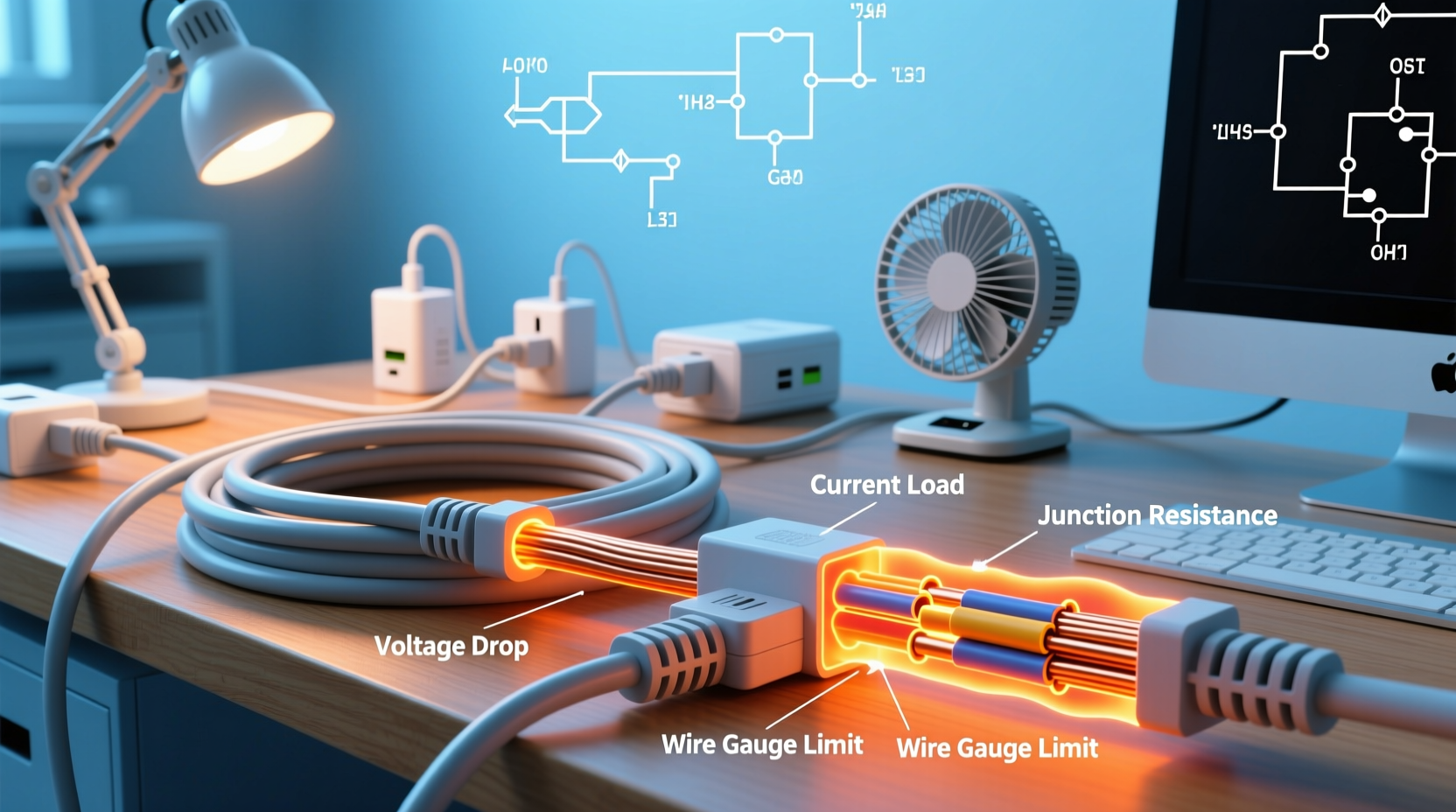
When electricity flows through a conductor like copper or aluminum wire, it encounters resistance—even in good-quality wire. That resistance converts some electrical energy into heat, following Joule’s Law: P = I² × R, where P is power loss (in watts), I is current (in amperes), and R is resistance (in ohms). The critical insight? Heat generation increases with the *square* of the current. Double the current, and heat quadruples.
A typical 50-foot, 16-gauge extension cord has a resistance of roughly 0.4 ohms per conductor (hot + neutral = ~0.8 Ω round-trip). Now consider powering ten 50-light incandescent strands rated at 20 watts each: that’s 1,000 watts total. At 120 volts, that draws 8.3 amps. Plug that into the formula: P = (8.3)² × 0.8 ≈ 55 watts lost as heat in the cord itself. That’s equivalent to leaving a small nightlight glowing inside the insulation—continuously. No wonder it warms up.
LED strands change the math—but not the principle. A comparable 10-strand LED setup might draw only 1.2 amps (144 watts), generating less than 1 watt of heat in the same cord. Yet if you use a long, thin, low-quality cord—or daisy-chain multiple cords—the cumulative resistance still adds up. Warmth is always evidence of energy conversion. The question isn’t *whether* heat is generated—it’s *how much*, and whether it exceeds safe thermal limits.
When Warmth Crosses the Line: Recognizing Hazardous Overheating
Not all warmth is equal. UL (Underwriters Laboratories) standards permit cord surface temperatures up to 60°C (140°F) for standard-duty cords during continuous operation—a noticeable warmth, but not painful to hold briefly. However, sustained temperatures above 70°C (158°F) degrade PVC insulation, embrittle jacketing, and accelerate oxidation at plug contacts. Above 90°C, you’re entering fire-risk territory.
Here’s how to assess what you’re feeling:
Warning signs go beyond touch:
- Localized hot spots—especially near plugs, splices, or kinks—indicate high-resistance connections, not uniform resistive heating.
- Burning odor—even faint—means insulation is thermally decomposing. Unplug and discard the cord.
- Discoloration or softening of the outer jacket signals irreversible polymer degradation.
- Flickering lights or intermittent outages often precede thermal failure, as expanding/contracting metal contacts lose continuity.
Remember: Extension cords are *temporary* wiring solutions—not permanent circuit extensions. Their design assumes intermittent, monitored use—not 12-hour daily loads over weeks or months. Persistent warmth is rarely “normal.” It’s a symptom demanding diagnosis.
Common Causes & Real-World Scenarios
Warmth rarely stems from a single flaw. It’s usually the result of compounding factors. Below is a realistic mini case study illustrating how everyday decisions cascade into thermal stress.
Mini Case Study: The Overloaded Porch Display
Sarah installed 14 strands of pre-lit outdoor lights on her front porch—seven warm-white incandescent (20W each) and seven multicolor LEDs (4.8W each). She used a single 100-foot, 16-gauge “heavy-duty” extension cord purchased from a discount store, coiled loosely near her outlet. By dusk, the cord felt warm; by midnight, it was too hot to hold. She didn’t realize the cord’s rating was 13A *only* for lengths under 25 feet—and dropped to 10A at 50 feet and just 7A at 100 feet. Her total load? 14 × 20W + 14 × 4.8W = 347W → 2.9A. That should’ve been fine… until she noticed the cord was coiled. Coiling traps heat, reducing dissipation. Ambient temperature that night was 88°F, further limiting cooling. The combination of derated ampacity, poor heat dissipation, and marginal connector quality pushed surface temps past 85°C. Sarah replaced it with two 50-foot, 14-gauge cords (rated 15A at 50 ft), ran them uncoiled, and separated the loads. The warmth disappeared.
This scenario highlights three critical, interrelated issues: ampacity derating by length, thermal confinement, and connector integrity. Let’s break down the top five causes behind cord warming:
- Exceeding Ampacity: Using a cord rated for 10A to supply 12A—even briefly—causes disproportionate heating.
- Undersized Wire Gauge: 16-gauge is common but marginal for multi-strand displays; 14-gauge or 12-gauge is safer for sustained loads.
- Daisy-Chaining: Plugging one cord into another multiplies resistance and creates multiple failure points (plugs, receptacles).
- Poor Connections: Corroded, bent, or loose prongs increase contact resistance—often the hottest spot on the entire circuit.
- Ambient & Installation Factors: Direct sun exposure, insulation contact (e.g., under mulch or carpet), or tight bundling prevents heat dissipation.
Practical Safety Checklist & Load Calculation Guide
You don’t need a multimeter to stay safe—but you do need discipline. Follow this checklist before every seasonal lighting installation:
Extension Cord Safety Checklist
- ☑️ Verify cord rating: Check the printed label for AWG (e.g., “14 AWG”) and maximum amperage *at your intended length* (not just “15A”).
- ☑️ Calculate total load: Add wattages of *all* devices on the cord. Divide by 120V to get amps (e.g., 840W ÷ 120V = 7A).
- ☑️ Leave 20% headroom: If cord is rated for 10A, keep load ≤ 8A. Never max it out.
- ☑️ Uncoil completely: Never operate a cord while coiled or tightly bundled—even “storage-wound” cords must unwind fully.
- ☑️ Inspect every connection: Look for bent prongs, cracked housings, exposed wires, or discoloration. Replace damaged components.
- ☑️ Use outdoor-rated cords only: Look for “SOW,” “SOOW,” or “W-A” suffixes—indicates UV- and moisture-resistant jacketing.
- ☑️ Plug directly into GFCI outlets: Especially outdoors. GFCIs cut power within milliseconds if ground fault is detected—preventing shock and reducing fire risk.
To calculate load accurately, refer to this comparison table of common light strand types and their real-world power draw:
| Strand Type | Lights per Strand | Typical Wattage | Amps @ 120V | Notes |
|---|---|---|---|---|
| Incandescent Mini | 50 | 20 W | 0.17 A | High heat output; avoid prolonged use |
| LED Warm White | 100 | 4.8 W | 0.04 A | Lowest risk; ideal for long runs |
| LED Multicolor (battery-style) | 200 | 7.2 W | 0.06 A | Often marketed as “low voltage” but run on 120V adapters |
| C7/C9 Incandescent | 25 | 175 W | 1.46 A | Very high wattage—use 12-gauge cord minimum |
| Commercial LED Rope Light | 16.4 ft | 24 W | 0.20 A | Check manufacturer specs—some draw more |
Pro tip: Add 10% to your total calculated wattage to account for aging bulbs, voltage fluctuations, and adapter inefficiencies. And remember—transformers and power supplies for low-voltage LED systems have their own efficiency losses (typically 15–25%). Those losses become heat *at the transformer*, not the cord—but they still contribute to your overall thermal management strategy.
Expert Insight: What Electrical Codes and Professionals Say
Residential electrical codes aren’t arbitrary—they reflect decades of incident analysis. The National Electrical Code (NEC) Article 400 explicitly prohibits using extension cords as a substitute for permanent wiring. While the NEC doesn’t specify “warmth thresholds,” NFPA 70E (Electrical Safety in the Workplace) and UL 817 (Standard for Cord Sets) provide critical context on thermal performance.
“The most overlooked hazard isn’t overload—it’s *misapplication*. A cord rated for 15A at 25 feet drops to less than half that capacity at 100 feet. Yet consumers buy ‘100-ft heavy-duty’ cords assuming ‘heavy-duty’ means ‘handles anything.’ It doesn’t. It means ‘built to last longer under rated load’—not ‘immune to physics.’”
— Carlos Mendez, P.E., Senior Electrical Inspector, International Association of Electrical Inspectors (IAEI)
Mendez emphasizes that cord warmth is often misdiagnosed as “just how they get.” In reality, it’s a direct indicator of inefficiency and risk accumulation. His team reviews hundreds of fire investigation reports annually—over 60% involving extension cords cite “excessive heat buildup due to sustained overload or inadequate conductor size” as a primary or contributing factor.
FAQ: Your Top Questions Answered
Can I use indoor extension cords outdoors if it’s not raining?
No. Indoor cords lack UV-stabilized jackets and moisture-resistant insulation. Even brief exposure to humidity, dew, or temperature cycling degrades the PVC, increasing brittleness and resistance. Outdoor-rated cords (marked “W” or “W-A”) use thermoplastic elastomer (TPE) or chlorinated polyethylene (CPE) compounds specifically engineered for weather resilience.
My cord feels warm only near the plug. Is that normal?
No—this is a red flag. Heat concentrated at connectors almost always indicates high-resistance contact: corroded prongs, bent blades, loose internal screws, or oxidation in the receptacle. These points can reach 150°C+ while the rest of the cord remains cool. Replace both the cord end and inspect the outlet for burn marks or looseness.
Will switching to all LED lights eliminate cord warming?
It dramatically reduces risk—but doesn’t eliminate it. A 50-strand LED display drawing 3.5A on a 100-ft, 16-gauge cord still generates ~12W of heat. Add poor ventilation, high ambient temps, or daisy-chaining, and warmth reappears. LEDs make safe operation *easier*, not automatic. Always match cord gauge and length to your actual load.
Conclusion: Respect the Physics, Protect Your Home
That gentle warmth in your extension cord isn’t benign feedback—it’s electrons doing work they weren’t meant to do: heating copper instead of lighting your home. Every degree of excess temperature shortens the cord’s lifespan, increases fire risk, and wastes energy. You wouldn’t ignore a warm engine block or a hot stove burner—yet we routinely dismiss cord warmth as “just how it is.”
Armed with ampacity charts, load calculations, and a disciplined safety checklist, you no longer need to guess. Choose the right gauge. Uncoil fully. Respect length-based derating. Inspect connections. Prioritize outdoor-rated, UL-listed products. And when in doubt—split the load across multiple circuits rather than pushing one cord to its limit.
Your lights deserve to shine brightly—not dangerously. Your home deserves protection that begins with understanding the simple, non-negotiable relationship between current, resistance, and heat. Take five minutes now to audit your setup. Replace that questionable 16-gauge coil. Calculate your real load. Share this knowledge with a neighbor setting up their first holiday display. Because warmth you can feel today might be the warning sign that prevents smoke tomorrow.




 浙公网安备
33010002000092号
浙公网安备
33010002000092号 浙B2-20120091-4
Comments
No comments yet. Why don't you start the discussion?