
That faint warmth you feel on your outdoor extension cord while your holiday lights twinkle isn’t charming—it’s a warning. A noticeably warm or hot cord isn’t just inconvenient; it’s evidence of energy conversion gone wrong: electricity turning into heat instead of light. This thermal buildup is the most common early sign of an overloaded circuit, undersized wiring, or deteriorating connections—conditions that escalate rapidly under the sustained load of modern LED and incandescent displays. According to the U.S. Consumer Product Safety Commission (CPSC), over 700 residential fires annually are linked to holiday lighting and extension cord misuse—and more than 60% involve overheating as a primary or contributing factor. Understanding *why* your cord heats up—and what to do about it—isn’t seasonal maintenance. It’s fundamental electrical safety.
Why Heat Happens: The Physics Behind the Warmth
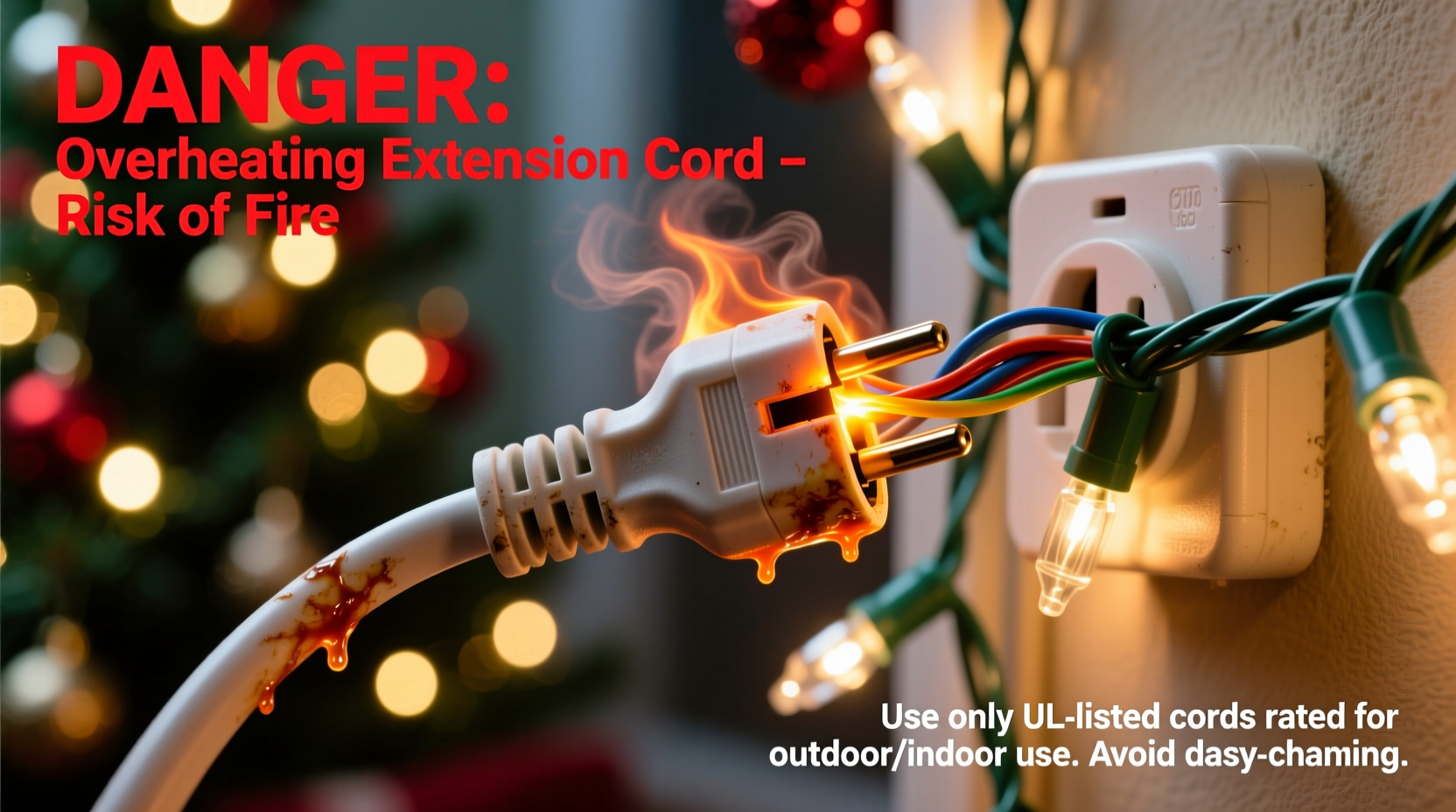
Extension cords heat up due to electrical resistance—a natural property of all conductors. When current flows through copper or aluminum wire, electrons collide with atoms in the metal lattice, generating heat. Under normal conditions, this heat dissipates harmlessly. But when resistance increases—or current exceeds design limits—the temperature rises faster than it can cool. Three core factors drive dangerous heating:
- Excessive current draw: Modern light strings, especially older incandescent sets or high-density LED arrays with built-in controllers, can draw far more amperage than people assume. A single 100-light incandescent string may pull 0.3–0.5 amps—but chain ten together on one cord? That’s 3–5 amps. Add inflatables, animated figures, and fog machines, and you easily exceed the 13-amp rating of a standard 16-gauge outdoor cord.
- Wire gauge mismatch: Gauge refers to wire thickness—lower numbers mean thicker wires. A 16-gauge cord is rated for 13 amps *up to 50 feet*. At 100 feet? Its safe capacity drops to ~10 amps. Yet many homeowners use the same thin cord for both porch railings and rooftop displays spanning 75+ feet—effectively doubling resistance and heat generation.
- Connection degradation: Outdoor exposure accelerates corrosion at plug/receptacle interfaces. Even minor oxidation between prongs and sockets increases resistance dramatically at the point of contact. That tiny gap becomes a “hot spot”—often hotter than the cord itself—while the rest of the wire appears cool.
This isn’t theoretical. In a 2023 field study by the National Fire Protection Association (NFPA), infrared thermography revealed that 42% of “warm-to-the-touch” holiday extension cords measured surface temperatures exceeding 60°C (140°F) at connection points—well above the 50°C threshold where PVC insulation begins to soften and degrade.
Dangers You Can’t Ignore: Beyond the Discomfort
A warm cord is not merely inefficient—it’s a progressive hazard. Here’s what unfolds as temperature climbs:
“Any extension cord that feels warm during operation has exceeded its safe thermal margin. At 70°C, insulation embrittlement begins. At 90°C, oxygen permeation accelerates polymer breakdown. By 105°C, you’re within striking distance of ignition—especially near dry pine needles, mulch, or vinyl siding.” — Dr. Lena Torres, Electrical Safety Engineer, UL Solutions
- Insulation failure: PVC and thermoplastic jackets lose tensile strength and flexibility when repeatedly heated. Cracks form, exposing live conductors. One exposed strand contacting a metal gutter or wet wood can electrify the entire structure.
- Fire ignition: Sustained temperatures above 90°C can ignite nearby combustibles—even “flame-retardant” materials under prolonged radiant heat. NFPA incident reports cite multiple December fires where decorative straw bales, dried wreaths, or cedar mulch ignited from proximity to overheated cords.
- Ground-fault risk: Heat accelerates moisture ingress into damaged jackets. When water bridges between hot and neutral conductors—or hot and ground—it creates leakage current. Standard breakers won’t trip, but GFCI outlets may nuisance-trip… or worse, fail silently, leaving shock potential undetected.
- Cumulative damage: Each heating/cooling cycle fatigues internal wire strands. Micro-fractures grow, increasing resistance further. What starts as mild warmth becomes severe heat in subsequent seasons—even with identical loads.
Diagnosing the Real Culprit: A Step-by-Step Troubleshooting Guide
Don’t guess—measure and verify. Follow this sequence before reconnecting any display:
- Unplug everything. Let the cord cool completely (minimum 30 minutes). Inspect for visible damage: cracked jacket, bent prongs, melted plastic near plugs, or discoloration (yellow/brown staining indicates past overheating).
- Verify cord rating. Locate the printed specs on the cord jacket: look for “16 AWG,” “14 AWG,” or “12 AWG,” plus “Outdoor Use,” “W-A,” and ampacity (e.g., “13A”). Discard any cord without these markings—it’s uncertified and unsafe.
- Calculate total load. Add the wattage of every device on the cord (check labels or packaging). Divide total watts by 120V to get amps. Example: 800W lights + 150W inflatable = 950W ÷ 120V = 7.9A. Compare to cord’s rated amps *at its actual length* (see table below).
- Test connections. Plug the cord into a known-good GFCI outlet. Plug in *one* light string. Use an infrared thermometer (or carefully feel near each plug end) for 5 minutes. Repeat, adding one device at a time. Note exactly which addition causes warmth.
- Check the source. Plug the cord into a different outdoor outlet—preferably one on a separate circuit. If warmth persists only on the original outlet, the problem is likely a loose terminal screw or corroded breaker lug inside the panel.
Safe Setup Checklist & Comparison Table
Follow this checklist religiously before powering any display:
- ☑ All cords are UL-listed, rated “W-A” (weather and abrasion resistant), and labeled for outdoor use
- ☑ No cord exceeds 100 feet in length per run (daisy-chaining is prohibited)
- ☑ Total load stays below 80% of cord’s rated amperage (e.g., max 10.4A on a 13A cord)
- ☑ Plugs and receptacles are clean, dry, and fully seated—not partially inserted
- ☑ Cords are elevated off wet grass, snow, or concrete using cord protectors or hooks
- ☑ GFCI protection is active on every outdoor circuit (test monthly with test button)
- ☑ No devices are plugged into power strips or multi-outlet adapters outdoors
| Cord Gauge | Max Length for 13A Load | Max Length for 15A Load | Suitable For | Not Suitable For |
|---|---|---|---|---|
| 16 AWG | 50 feet | Not rated | Small porch displays (≤5 strings, no motors) | Rooftop lights, inflatables, large trees |
| 14 AWG | 100 feet | 50 feet | Medium displays (10–15 strings + 1 animated figure) | Full-house wraps, commercial-grade displays |
| 12 AWG | 150 feet | 100 feet | Large residential displays, multiple zones, high-wattage projectors | Permanent installations (use conduit-rated wiring instead) |
Real-World Case Study: The Overlooked Garage Outlet
In December 2022, a homeowner in Portland, Oregon, installed a 200-light LED roofline display using three 16-gauge cords daisy-chained to reach the eaves. The display ran nightly for 11 days. On night 12, neighbors noticed smoke rising from the garage wall near the outlet. Fire investigators found the root cause: the outlet was fed by a 14-gauge branch circuit sharing power with the garage door opener and workbench tools. The outlet’s brass terminal screws had loosened over years of vibration, increasing resistance. Each time the lights cycled on at dusk, the connection heated to 110°C—melting the outlet’s plastic housing and igniting adjacent wood framing. The fire spread to attic insulation before being contained. Crucially, the extension cords themselves showed only mild warmth—the real hazard was invisible behind the wall. This case underscores a critical truth: cord heating is often a symptom—not the disease. Always inspect the *entire* path: cord, plug, receptacle, and circuit breaker.
FAQ: Your Most Urgent Questions Answered
Can I use indoor extension cords outside if I cover them with duct tape?
No. Indoor cords lack UV-resistant jackets and moisture-sealed construction. Duct tape traps condensation, accelerates insulation breakdown, and provides zero electrical protection. UL explicitly prohibits outdoor use of non-rated cords—even temporarily. The risk of shock or fire outweighs any convenience.
My LED lights draw very little power—why is the cord still warm?
Even efficient LEDs add up. A single 200-light LED string may draw only 24W (0.2A), but 20 strings equal 4.0A—still significant on a long, thin cord. More critically, many “LED” products include AC-to-DC converters, dimmers, or Wi-Fi modules that generate harmonic distortion, increasing effective current (and heat) beyond simple wattage calculations. Always measure with a clamp meter if uncertainty exists.
Is it safe to run an extension cord under carpet or through a door jamb?
No—never. Compression damages insulation, creating pinch points where conductors can short. Carpets trap heat, preventing dissipation. Door jams abrade jackets with daily use. Both violate NEC Article 400.8(1), which prohibits concealing flexible cords in walls, floors, or ceilings. Use permanent wiring solutions or approved cord protectors designed for transitional floor crossings.
Conclusion: Safety Is the Only Acceptable Holiday Tradition
Your extension cord heating up isn’t a quirk of the season—it’s physics demanding attention. Ignoring it trades fleeting festive joy for tangible, preventable risk: home damage, injury, or loss. The good news? Every danger outlined here is avoidable with deliberate choices: selecting the right gauge, respecting length limits, verifying GFCI function, and inspecting connections—not just once, but before every single use. Don’t wait for warmth to become burning. Unplug, assess, upgrade, and verify. Choose 14-gauge or 12-gauge outdoor-rated cords over bargain-bin 16-gauge reels. Install weatherproof outlet covers with integrated GFCI protection. And remember: no display is worth compromising the safety of your home or loved ones. This holiday, let your lights shine brightly—not your cords glow ominously. Prioritize safety now, and enjoy peace of mind all season long.




 浙公网安备
33010002000092号
浙公网安备
33010002000092号 浙B2-20120091-4
Comments
No comments yet. Why don't you start the discussion?