
It’s a familiar holiday scene: strings of lights twinkle across the porch, wrap around railings, cascade down trees—and halfway through the evening, you notice the extension cord feels warm. Not just warm—distinctly hot to the touch. You pause, unplug it, and wonder: Is this normal? Is it dangerous? Why does this happen? The answer isn’t about faulty bulbs or bad weather. It’s rooted in fundamental electrical principles—and often, in decisions made before the first strand was plugged in. Extension cords are not passive conduits; they’re active components in your circuit, with real limits. When those limits are exceeded—even slightly—the result is measurable heat. That warmth isn’t just inconvenient. It’s physics signaling stress, resistance, and potential failure.
The Physics Behind the Heat: Resistance and Power Load
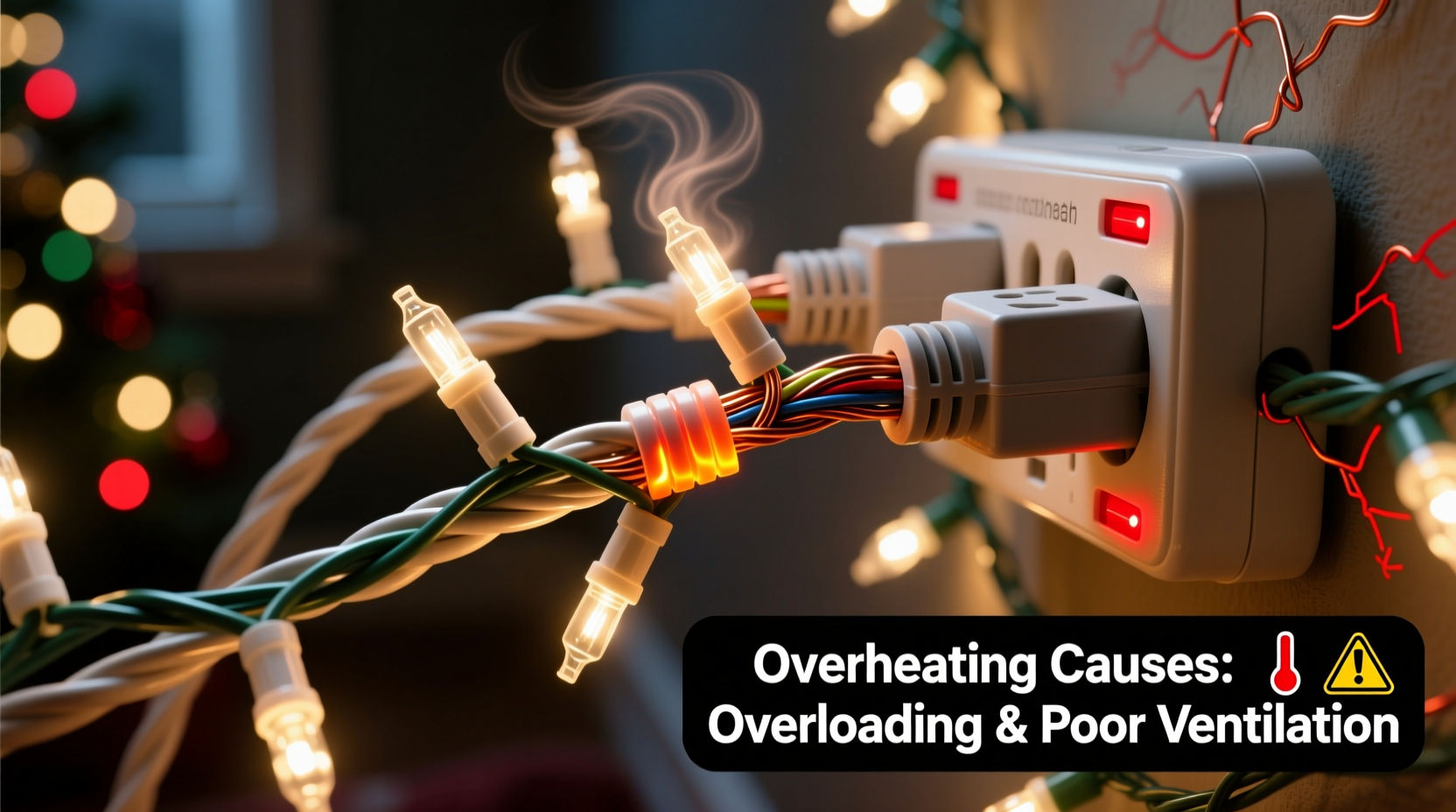
Every wire has inherent electrical resistance—measured in ohms per foot. When current flows through that wire, energy converts to heat according to Joule’s Law: P = I² × R, where P is power dissipated as heat, I is current (in amperes), and R is resistance. Double the current, and heat generation quadruples. Most standard indoor extension cords use 16-gauge or 18-gauge wire. A typical 50-light incandescent mini-string draws about 0.3–0.4 amps. LED versions draw far less—often 0.02–0.05 amps per strand. But when you daisy-chain five or six strands into one outlet via a single cord, the cumulative load adds up quickly.
Consider this scenario: Six 100-light LED strands, each drawing 0.04 amps, total 0.24 amps—well within safe range. But add two older incandescent C7 strands (each drawing 0.8 amps), and the load jumps to 1.84 amps. Now factor in voltage drop over distance: a 50-foot cord introduces additional resistance, raising the effective R in the equation. Even if the outlet supplies 120 volts at the source, the cord may deliver only 112–114 volts at the far end—forcing devices to draw slightly more current to maintain brightness, further increasing heat.
Why Daisy-Chaining Makes It Worse—And Why “Just One More Strand” Is Risky
Daisy-chaining—plugging one extension cord into another—is among the most common causes of dangerous overheating. Each connection point introduces contact resistance. Loose prongs, oxidized metal, or minor misalignment increase resistance at the junction. That tiny gap becomes a hotspot—sometimes reaching temperatures exceeding 140°F (60°C) while the rest of the cord remains warm. Worse, daisy-chaining masks the true load: a 12-gauge outdoor-rated cord rated for 15 amps may feed a second 16-gauge cord rated for only 10 amps. The system is only as strong as its weakest link—and the smaller cord overheats long before the larger one shows strain.
Manufacturers design extension cords for specific duty cycles: light-duty (indoor, short-term), medium-duty (seasonal outdoor use), and heavy-duty (construction-grade, continuous load). Using a light-duty cord outdoors—or leaving any cord coiled while energized—traps heat, preventing natural convection cooling. A tightly wound cord can reach temperatures 25–40% higher than the same cord fully unwound, even under identical load.
Real-World Example: The Porch Overload Incident
In December 2022, a homeowner in Portland, Oregon, connected eight strands of vintage incandescent lights (C9 bulbs, 0.55 amps each) to a single 50-foot, 16-gauge indoor extension cord. He’d used the same setup for three years without issue—until that year, he added a pre-lit wreath (0.3 amps) and an animated light-up snowman (0.6 amps). Total load: 4.7 amps. While still below the cord’s theoretical 10-amp rating, the cord had been stored coiled in a damp garage for 11 months, causing slight jacket degradation and increased internal resistance. By 8 p.m., the cord felt hot near the outlet end. At 10:15 p.m., the insulation began to soften and emit a faint acrid odor. He unplugged it immediately—but not before the outer jacket developed micro-cracks visible upon inspection. An electrician later confirmed the cord had exceeded its thermal endurance limit by 18°C. No fire occurred—but the near-miss underscores how multiple small factors compound into tangible risk.
Do’s and Don’ts: Safe Holiday Lighting Practices
| Action | Do | Don’t |
|---|---|---|
| Cord Selection | Use 12-gauge or 14-gauge outdoor-rated cords for runs over 25 feet or loads above 100 watts per strand. | Use indoor-only cords outdoors, or rely on 16/18-gauge cords for more than three LED strands or one incandescent strand. |
| Connection Method | Plug multiple cords directly into a GFCI-protected multi-outlet strip rated for outdoor use (e.g., 15-amp, UL-listed). | Daisy-chain more than one extension cord—or plug a power strip into an extension cord. |
| Physical Handling | Uncoil cords fully before use; secure them with UV-resistant cable ties—not nails or staples. | Run cords under rugs, pinch them in doorways, or leave them coiled while powered. |
| Load Management | Use a plug-in power meter ($15–$25) to verify actual amperage at the outlet during operation. | Estimate load by “number of strands” or assume “LED = always safe.” |
| Inspection & Maintenance | Inspect cords before each season: check for cracked insulation, bent prongs, discoloration, or stiffness. | Use cords with visible damage, fraying, or melted sections—even if they “still work.” |
Step-by-Step: How to Audit Your Current Setup in Under 10 Minutes
- Identify every light strand: Locate the label on each string—note voltage, watts, and amps. If only watts are listed, divide by 120 (e.g., 48W ÷ 120V = 0.4A).
- Map your connections: Trace each cord from outlet to last strand. Note gauge (usually printed: “16 AWG”), length, and whether it’s rated for indoor/outdoor use.
- Calculate total amperage: Sum all amps on strands fed by the same cord. Add 0.1A for each 25 feet of cord length beyond 10 feet (for voltage-drop compensation).
- Compare to cord rating: Find the cord’s amp rating (e.g., “10A MAX” on jacket). Your calculated load must be ≤ 80% of that rating (NEC recommendation for continuous loads).
- Verify physical condition: Flex the cord gently along its length. Does it crackle? Feel brittle? Smell like plastic when warmed? If yes, retire it.
- Test temperature: After lights have run for 30 minutes, carefully feel the cord—especially near plugs and mid-span. Slight warmth (<104°F / 40°C) is acceptable. Anything noticeably hot (>113°F / 45°C) requires immediate correction.
Expert Insight: What Electrical Safety Standards Actually Require
“Most consumers don’t realize that UL 817—the safety standard for extension cords—requires thermal testing at 110% of rated load for 100 hours. If a cord heats beyond 50°C above ambient during that test, it fails. Yet many users operate cords at 120–150% load for weeks during holidays—without understanding that each 10°C rise above design temp cuts insulation lifespan in half.” — Rafael Mendez, Senior Electrical Engineer, Underwriters Laboratories (UL)
This insight clarifies why “a little heat” is never benign. Insulation isn’t just a barrier—it’s a precision-engineered polymer blend with a defined thermal aging curve. Exceeding its thermal budget accelerates molecular breakdown, making cracks, brittleness, and eventual short circuits inevitable—not hypothetical.
FAQ: Common Questions—Answered with Precision
Can I use a heavy-duty extension cord for all my lights—even indoors?
Yes—if it’s UL-listed for both indoor and outdoor use (look for “SJTW” or “STW” designation on the jacket). However, avoid unnecessarily bulky 10-gauge cords indoors unless powering high-wattage displays (e.g., inflatable figures with internal fans/heaters). They’re harder to conceal and pose greater trip hazards. For most residential lighting, 14-gauge outdoor-rated cords strike the best balance of safety, flexibility, and capacity.
Why do LED lights still cause heating if they use so little power?
LED strands themselves generate minimal heat—but cheap LED controllers, rectifiers, and poorly regulated power supplies can introduce harmonic distortion and ripple current. This forces the cord to carry non-sinusoidal waveforms, increasing effective RMS current and resistive losses. Additionally, many “LED” strings include legacy wiring designed for incandescent loads—meaning oversized conductors aren’t always paired with optimized electronics. Always verify compatibility: look for cords labeled “LED-optimized” or with built-in surge suppression.
Is it safe to wrap lights around an extension cord to hide it?
No. Wrapping lights—or anything else—around a live extension cord impedes heat dissipation. Even low-heat LED strands retain warmth, and bundling them with the cord creates a localized thermal envelope. This traps heat at the conductor level, accelerating insulation degradation and increasing fire risk. Use cord covers designed for outdoor use (with ventilation slots) or route cords behind structures where airflow remains unobstructed.
Conclusion: Heat Is a Warning Signal—Not a Feature
An extension cord warming up under load isn’t a quirk of holiday cheer—it’s Ohm’s Law speaking plainly. It tells you that electrons are meeting resistance, energy is converting to heat, and materials are operating outside their engineered tolerances. Ignoring it invites more than inconvenience: it risks melted insulation, arcing faults, tripped breakers, and worst of all, ignition. But this isn’t a reason to scale back your celebrations. It’s a call to engage deliberately—to read labels, measure loads, choose appropriate hardware, and respect the physics that govern every circuit in your home. Replace worn cords. Uncoil before use. Distribute loads across multiple outlets. Invest in a $20 power meter—it pays for itself in avoided replacements and peace of mind. Your lights should shine brightly. Your extension cords should stay cool, reliable, and invisible—not hot, stressed, and silently failing. This season, let safety be the quiet foundation beneath every sparkle.




 浙公网安备
33010002000092号
浙公网安备
33010002000092号 浙B2-20120091-4
Comments
No comments yet. Why don't you start the discussion?