
A garage door opening on its own is more than just a nuisance—it can be a serious safety hazard. You might wake up to find it partially open, or notice it activating when no one is near the remote. While this behavior can seem mysterious, the root cause often lies in malfunctioning sensors or external interference affecting your garage door opener system. Understanding how modern garage door sensors work—and what can disrupt them—is essential for restoring security and reliability.
Today’s automatic garage doors rely on a network of electronic components, including wall switches, remotes, safety sensors, and radio frequency (RF) receivers. When any part of this system is compromised, unintended operation can occur. Sensor interference is one of the most common culprits behind self-activating garage doors. This article explains the technical reasons behind such malfunctions, outlines practical diagnostic steps, and provides actionable solutions to keep your garage secure.
How Garage Door Sensors Work: The Basics
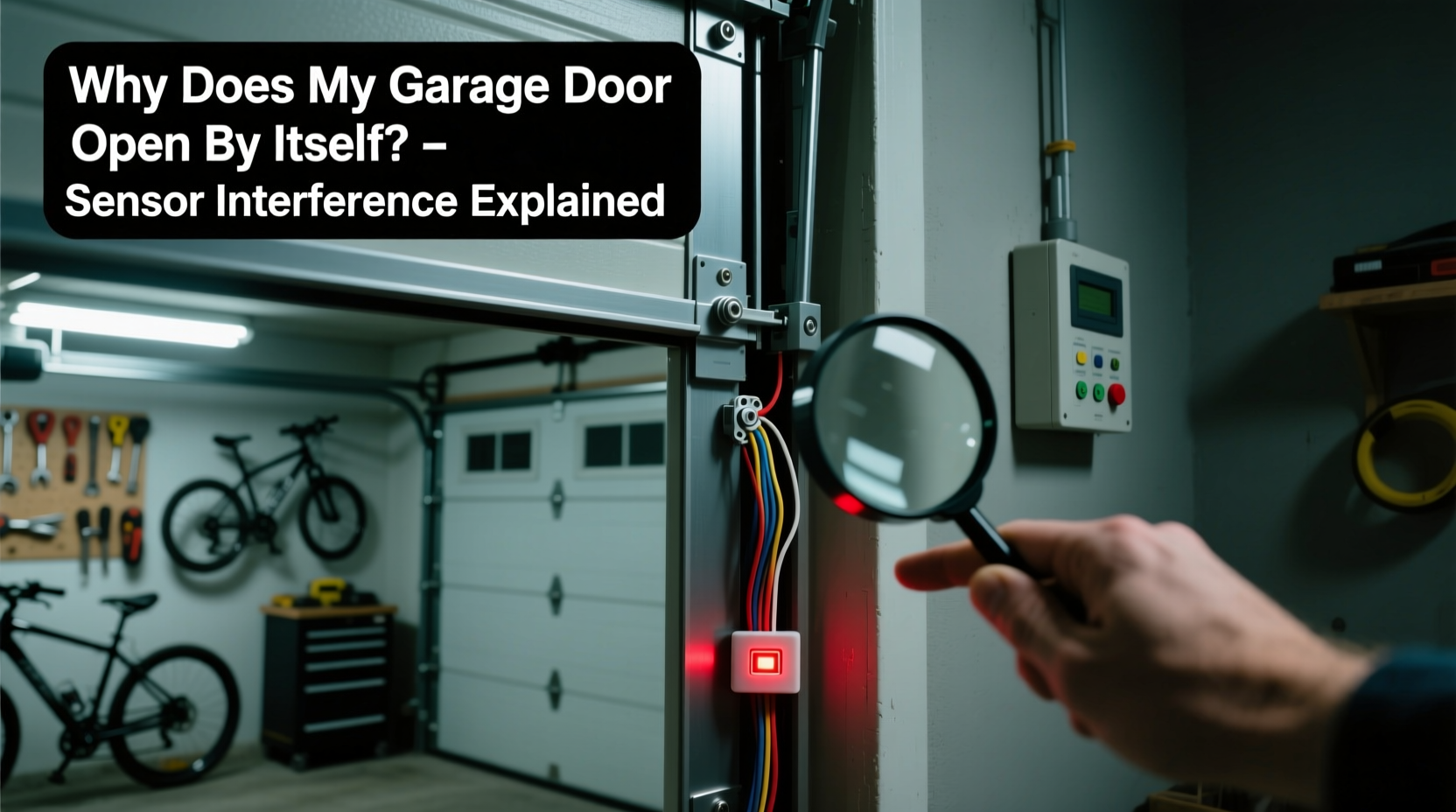
Modern garage door openers are equipped with photoelectric safety sensors located near the bottom of the door tracks, typically about six inches above the floor. These sensors emit an invisible infrared beam between two units—one on each side of the door opening. If the beam is interrupted while the door is closing, the system immediately reverses direction to prevent injury or damage.
While these sensors are designed primarily for safety, they also play a role in overall system stability. However, their sensitivity to environmental factors and electromagnetic signals makes them vulnerable to interference. More importantly, the control board that interprets signals from the sensors and remote controls can sometimes misread inputs due to electrical noise or signal conflicts.
The primary types of signals involved include:
- Infrared beams – Used by safety sensors to detect obstructions.
- Radiowaves (RF) – Transmitted by remotes, keypads, and smart home integrations (typically at 300–400 MHz).
- Electrical pulses – Sent through internal wiring from wall buttons and logic boards.
When foreign signals mimic legitimate commands or distort sensor data, the opener may interpret this as a request to open—resulting in spontaneous activation.
Common Causes of Sensor Interference and Unintended Activation
Sensor interference isn't always obvious. Unlike mechanical failures, electronic disruptions don’t leave visible signs. Below are the most frequent sources of interference that lead to a garage door opening unexpectedly.
1. Radio Frequency (RF) Interference
Devices operating on similar frequencies can inadvertently transmit signals that your garage door receiver picks up. Common offenders include:
- Nearby ham radios or CB transmitters
- Power tools with strong motors (e.g., jackhammers, welders)
- Digital alarm systems or wireless security cameras
- Smart meters installed by utility companies
- Neighbor’s garage door remotes (especially older models without rolling codes)
One homeowner in suburban Ohio reported that his garage door opened every time he used a cordless drill. After investigation, it was found that the tool emitted RF spikes within the 315 MHz band—exactly matching his opener’s frequency.
2. Faulty or Misaligned Safety Sensors
If the infrared beam between sensors is weak, intermittent, or blocked, the logic board may enter an error state. Some models respond to inconsistent sensor input by defaulting to “open” mode as a fail-safe. Dust, cobwebs, paint splatter, or physical bumps can misalign sensors enough to trigger erratic behavior.
3. Electrical Noise from Power Surges
Voltage fluctuations caused by lightning, downed power lines, or large appliances cycling on/off can induce transient currents in low-voltage control circuits. These surges may trick the opener’s microprocessor into registering a false \"open\" command.
4. Failing Internal Components
Over time, capacitors degrade, circuit boards corrode, and relays stick. A failing relay on the control board might intermittently close the circuit that activates the motor—even without a valid signal.
5. Smart Home Integration Glitches
If your garage door connects to Wi-Fi via smart hubs like MyQ, Alexa, or Google Home, software bugs or unauthorized access could cause unintended triggers. In rare cases, cloud-based automation rules may execute incorrectly due to sync delays or app errors.
“Electronic interference in residential garage systems has increased over the past decade due to the proliferation of wireless devices. It's not magic—it's physics.” — Dr. Alan Reeves, Electrical Engineer & Building Automation Consultant
Step-by-Step Guide to Diagnose and Fix the Issue
Follow this systematic approach to identify and resolve the cause of unexplained garage door activation.
- Disconnect all smart devices: Temporarily disable Wi-Fi-connected controllers. Observe the door for 24 hours. If the problem stops, investigate your smart hub settings or mobile app for accidental triggers.
- Inspect sensor alignment: Clean the lenses with a soft cloth. Ensure both sensors face each other directly and show steady indicator lights (usually green). Adjust mounting brackets if needed.
- Test for RF interference: Turn off non-essential electronics one by one—especially those near the opener or on the same circuit. Use a handheld AM radio tuned between stations; wave it near the opener motor. Static bursts may indicate RF emissions from nearby equipment.
- Check wiring integrity: Examine low-voltage wires connecting wall buttons and sensors. Look for fraying, staples piercing insulation, or connections touching metal framing. Replace damaged wiring with 20-gauge stranded wire.
- Reset the opener: Unplug the unit for 30 seconds, then reconnect. Reprogram remotes and reconfigure safety sensors. This clears temporary memory glitches.
- Replace aging hardware: If your opener is over 10 years old, consider upgrading to a newer model with better shielding, encrypted rolling codes, and surge protection.
Do’s and Don’ts: Preventing Future Issues
| Do | Don’t |
|---|---|
| Perform quarterly visual checks of sensor alignment and lens cleanliness. | Ignore flickering sensor lights—they indicate instability. |
| Install a surge protector rated for garage door openers. | Use extension cords or multi-plug adapters for the opener’s power supply. |
| Upgrade to openers with AES encryption and frequency-hopping technology. | Allow children to play with remotes or wall switches unsupervised. |
| Keep spare batteries away from heat sources to avoid leakage into remotes. | Paint over sensor housings—this can block infrared signals. |
Real-World Example: The Case of the Phantom Opener
In Lakewood, Colorado, a family noticed their garage door would open around 7:15 PM every evening—despite no one pressing a button. They lived in a newer neighborhood with underground utilities and smart meters. After ruling out remotes and sensor issues, a technician used a spectrum analyzer and discovered strong RF emissions coinciding with the smart meter’s daily transmission cycle.
The utility company confirmed that the meter transmitted usage data at 390 MHz—close enough to the garage opener’s 375 MHz frequency to cause cross-talk. Installing an RF filter on the opener’s antenna resolved the issue instantly. This case highlights how modern infrastructure can unintentionally interfere with legacy systems.
Troubleshooting Checklist
Use this checklist to methodically eliminate potential causes:
- ✅ Confirm no remotes or keypads are stuck or leaking signals
- ✅ Verify both safety sensors emit steady light (no blinking)
- ✅ Check for physical obstructions in the sensor path
- ✅ Test wall button wiring for shorts or moisture damage
- ✅ Eliminate nearby sources of electromagnetic interference
- ✅ Review smart home automation logs for scheduled triggers
- ✅ Inspect opener for signs of water intrusion or overheating
- ✅ Consider professional inspection if symptoms persist
Frequently Asked Questions
Can sunlight interfere with garage door sensors?
Yes. Direct sunlight, especially during sunrise or sunset, can flood the receiver lens with infrared radiation, overwhelming the signal. Install sun shields or angle the sensors slightly downward to reduce exposure. Newer models have improved filtering, but older units remain vulnerable.
Is it possible for a neighbor to accidentally open my garage door?
With older openers using fixed codes (pre-1993), yes. Modern systems use rolling codes that change with each use, making duplication nearly impossible. However, if your neighbor uses a device emitting RF noise near your opener’s frequency, interference—not code theft—could be the cause.
Should I replace my garage door opener if it opens randomly?
Not necessarily. Many issues stem from correctable problems like misalignment or interference. However, if your unit is over a decade old, lacks modern safety features (like entrapment reversal), or has recurring electronic faults, replacement is a wise investment for safety and reliability.
Protect Your Home: Take Action Today
Your garage door is part of your home’s security envelope. When it behaves unpredictably, it compromises both convenience and safety. Sensor interference may seem like a minor technical glitch, but left unchecked, it can lead to break-ins, property damage, or injury—especially if children or pets are nearby when the door moves unexpectedly.
By understanding the underlying causes and applying the diagnostic steps outlined here, you can regain full control. Start with simple inspections: clean the sensors, check for loose wires, and eliminate potential RF sources. If problems continue, consult a certified garage door technician who can perform advanced diagnostics and recommend upgrades.
Technology should make life easier, not create new risks. Take a few minutes today to ensure your garage door operates only when you intend it to.




 浙公网安备
33010002000092号
浙公网安备
33010002000092号 浙B2-20120091-4
Comments
No comments yet. Why don't you start the discussion?