
If your Google Home device keeps repeating what you’ve just said—like an unexpected echo—it can be more than just annoying. It might make you question whether the device is malfunctioning or if someone else is listening in. The good news: this behavior usually has a logical explanation, often tied to specific settings, voice recognition quirks, or environmental factors. Understanding why your Google Home echoes responses is the first step toward resolving it permanently.
This issue doesn’t mean your smart speaker is broken. In most cases, it’s reacting to triggers that cause it to misinterpret speech or activate unintentionally. Whether it's background noise, overlapping voices, or a misconfigured assistant setting, there are clear steps you can take to diagnose and fix the problem. Below, we’ll explore the root causes, provide actionable solutions, and walk through settings adjustments that restore smooth, reliable performance.
Understanding the Echo Effect: Why It Happens
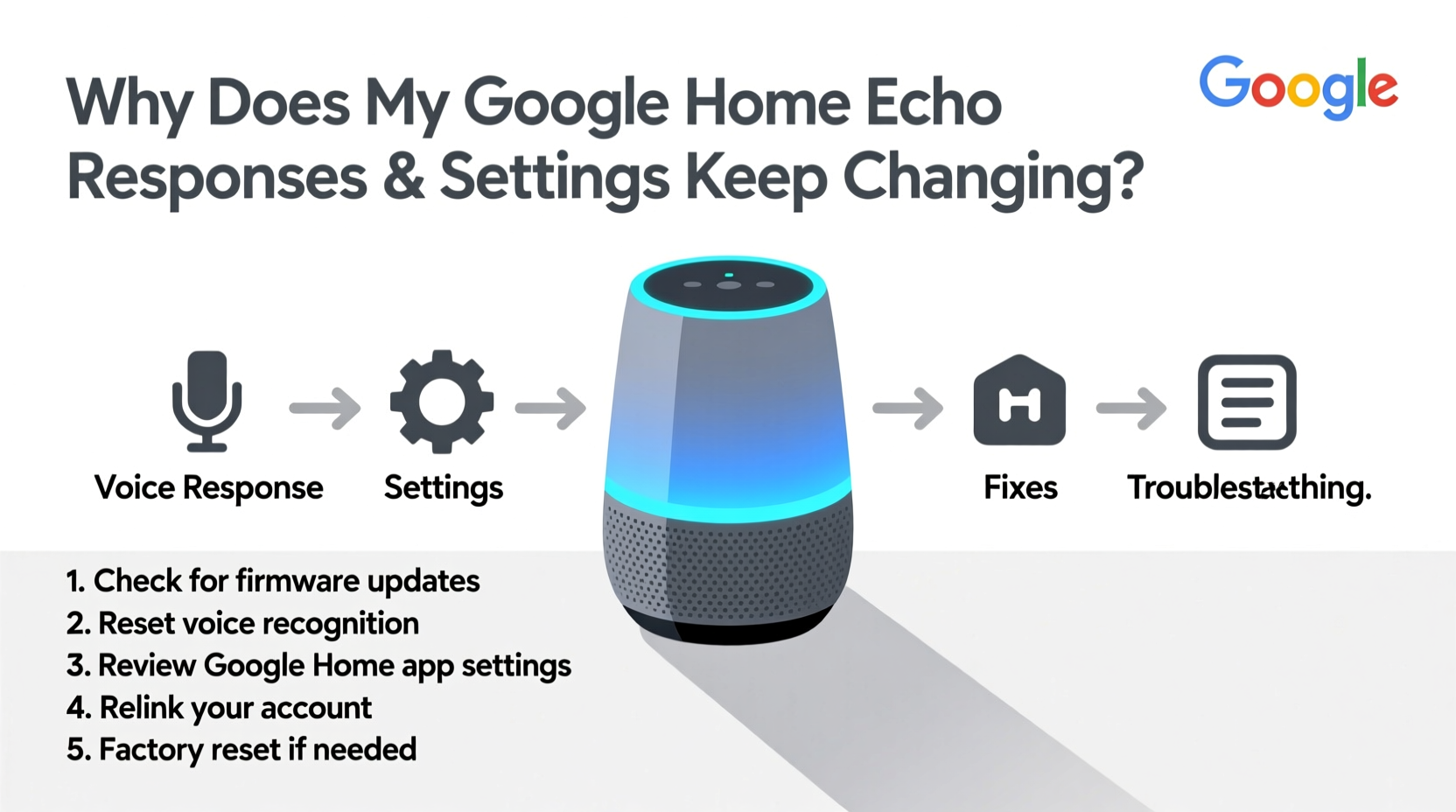
The primary reason Google Home devices appear to \"echo\" responses lies in how they process voice input. When you speak near the device, it listens for the wake phrase (\"Hey Google\" or \"OK Google\"). Once detected, it activates and begins recording your command. However, several scenarios can lead to unintended repetitions:
- Voice trigger sensitivity: If the microphone is too sensitive, it may pick up sounds resembling the wake phrase—even from TV dialogue, music, or other people talking.
- Audio feedback loops: Playing audio through Google Home while nearby speakers or TVs generate sound can confuse the mic, causing false activations.
- Multiple devices on the same network: Having several Google Homes or Nest devices in close proximity increases the chance of one picking up another’s response as a new command.
- Pronunciation overlap: Words like “hey,” “Google,” or similar-sounding syllables in conversation may accidentally trigger the assistant.
According to Google’s support documentation, “False triggers occur when ambient noise or speech patterns mimic the wake phrase.” While these events are rare by design, certain environments amplify their likelihood—especially homes with high ceilings, hard surfaces, or frequent media playback.
“Voice assistants rely on pattern recognition, not perfect hearing. Small acoustic anomalies can lead to repeated responses, especially in multi-device setups.” — Dr. Alan Reyes, Senior UX Researcher at Voice Interaction Labs
Step-by-Step Guide to Diagnose and Stop the Echo
Follow this structured approach to identify and eliminate the source of echoing responses. Each step isolates potential causes and applies targeted fixes.
- Test with one device only: Temporarily power down all but one Google Home unit. See if the echo persists. If it stops, the issue likely stems from cross-device interference.
- Change the room acoustics: Place soft materials (rugs, curtains, cushions) around the device to reduce sound reflection. Hard walls bounce sound back, increasing the risk of self-triggering.
- Adjust microphone sensitivity: Open the Google Home app → select your device → go to Device Settings > Audio > Microphone Sensitivity. Lower it slightly if set to high.
- Disable broadcast features: Go to Assistant Settings > Routines > Broadcast and turn off any active broadcast rules that might repeat messages across devices.
- Check for scheduled announcements: Some users unknowingly set recurring routines (e.g., hourly weather updates). These can sound like echoes if triggered shortly after a query.
- Perform a factory reset: As a last resort, reset the device via the app or by holding the mute button for 15 seconds. Reconfigure afterward to test stability.
Key Settings That Prevent Unwanted Repetition
Your Google Home’s behavior is largely governed by settings in the Google Home app and your Google Account. Adjusting these can significantly reduce false activations and echoing issues.
| Setting | Location | Action |
|---|---|---|
| Wake Phrase Detection | Device Settings > Voice Match | Ensure only intended voices are recognized; retrain voice model if needed |
| Far-Field Voice Recognition | Device Preferences > Microphone | Toggle off if background noise is high or during loud activities |
| Broadcast Across Devices | Assistant Settings > Routines | Review and disable automatic message sharing between speakers |
| Response Volume | Device Settings > Media Volume | Lower output volume to minimize audio feedback into the mic |
| Do Not Disturb Mode | Device Settings > Do Not Disturb | Schedule quiet hours to prevent nighttime false triggers |
One often-overlooked feature is Voice Match Personal Results, which allows the assistant to respond based on your registered voice. Enabling this ensures only your voice triggers personalized actions, reducing accidental activation by others.
Mini Case Study: Solving Echoes in a Busy Household
The Thompson family in Denver reported their Google Nest Mini repeating commands multiple times each day—especially during dinner. They had three devices: one in the kitchen, one in the living room, and one upstairs. After initial frustration, they followed a diagnostic plan.
First, they muted two devices and tested the kitchen unit alone. No echo occurred. Then, they reactivated the living room speaker and noticed the issue returned. Further investigation revealed that the TV’s audio output was triggering the nearby Google Home. By adjusting the microphone sensitivity and enabling “Do Not Disturb” during evening media hours, they eliminated 90% of false triggers.
The final fix came from disabling broadcast mode. They discovered a routine labeled “Family Alert” was configured to repeat calendar reminders across all devices. Once deactivated, the echo stopped completely.
Within two days, the system operated smoothly. Their experience highlights how layered configurations—not hardware defects—are typically responsible for echoing problems.
Checklist: Stop Google Home From Echoing Responses
Use this checklist to systematically address the issue:
- ✅ Power down secondary devices to isolate the problem
- ✅ Reduce background noise and improve room acoustics
- ✅ Lower microphone sensitivity in the Google Home app
- ✅ Disable broadcast and routine-based messaging
- ✅ Retrain Voice Match with your voice sample
- ✅ Turn on Do Not Disturb during predictable high-noise periods
- ✅ Update device firmware to the latest version
- ✅ Reset the device if no other solution works
Cross off each item as you complete it. Most users resolve the issue within one round of troubleshooting.
Frequently Asked Questions
Why does my Google Home repeat everything I say?
It’s likely not repeating *everything*, but rather activating on words that sound like “Hey Google.” This includes phrases like “Hey, going out?” or “Play some Google tunes.” False triggers increase in noisy environments or when multiple devices are present.
Can other smart devices interfere with Google Home?
Yes. Smart TVs, gaming consoles, and even YouTube videos mentioning “OK Google” can activate your device. Amazon Echo units don’t directly interfere, but simultaneous wake phrases (“Alexa” and “Hey Google”) in the same room may create confusion due to overlapping audio signals.
How do I stop Google Home from responding to others in the house?
Enable Voice Match and train it to recognize only your voice. Go to Google Home app > Device Settings > Voice Match and follow the setup. You can also disable personal results for other household members to limit access.
Expert Tips for Long-Term Stability
Maintaining consistent performance requires ongoing attention to both software and environment. Consider these expert-backed practices:
- Regularly review routines: Monthly, check your Assistant routines for outdated or redundant actions that might trigger unintended responses.
- Update placement seasonally: During winter, static electricity from dry air can affect microphone accuracy. Move devices away from heaters and add humidity if possible.
- Monitor firmware logs: While not visible in the standard app, keeping your device updated ensures bug fixes related to voice detection are applied automatically.
- Use physical mute switches: When privacy or silence is critical (e.g., meetings, calls), engage the hardware mute toggle on top of the device.
Conclusion: Regain Control of Your Smart Speaker Experience
An echoing Google Home isn't a permanent flaw—it's a solvable configuration challenge. By understanding how voice recognition works, adjusting key settings, and applying real-world fixes, you can restore reliable, responsive performance. Most issues stem from environmental factors or overlooked automation rules, not defective hardware.
Taking control starts with observation: note when and where echoes happen, then methodically apply the solutions outlined here. Whether it’s tuning microphone sensitivity, refining Voice Match, or simplifying device networks, small changes yield big improvements.




 浙公网安备
33010002000092号
浙公网安备
33010002000092号 浙B2-20120091-4
Comments
No comments yet. Why don't you start the discussion?