
After spending time carefully straightening your hair, nothing is more frustrating than stepping outside only to watch it puff up into a halo of frizz minutes later. You're not alone—millions of people struggle with post-straightening frizz, especially in humid climates. The issue isn't just about technique; it's deeply rooted in hair biology, environmental conditions, and product choices. Understanding the science behind this common problem is the first step toward achieving sleek, lasting results.
Frizz doesn’t mean your hair is damaged beyond repair or that your flat iron failed you. Instead, it signals a mismatch between your hair’s natural behavior and the environment it’s exposed to. By identifying the root causes and applying targeted strategies, you can maintain smooth, straight hair for days—even in high humidity.
The Science Behind Frizz: What Happens When Hair Absorbs Moisture
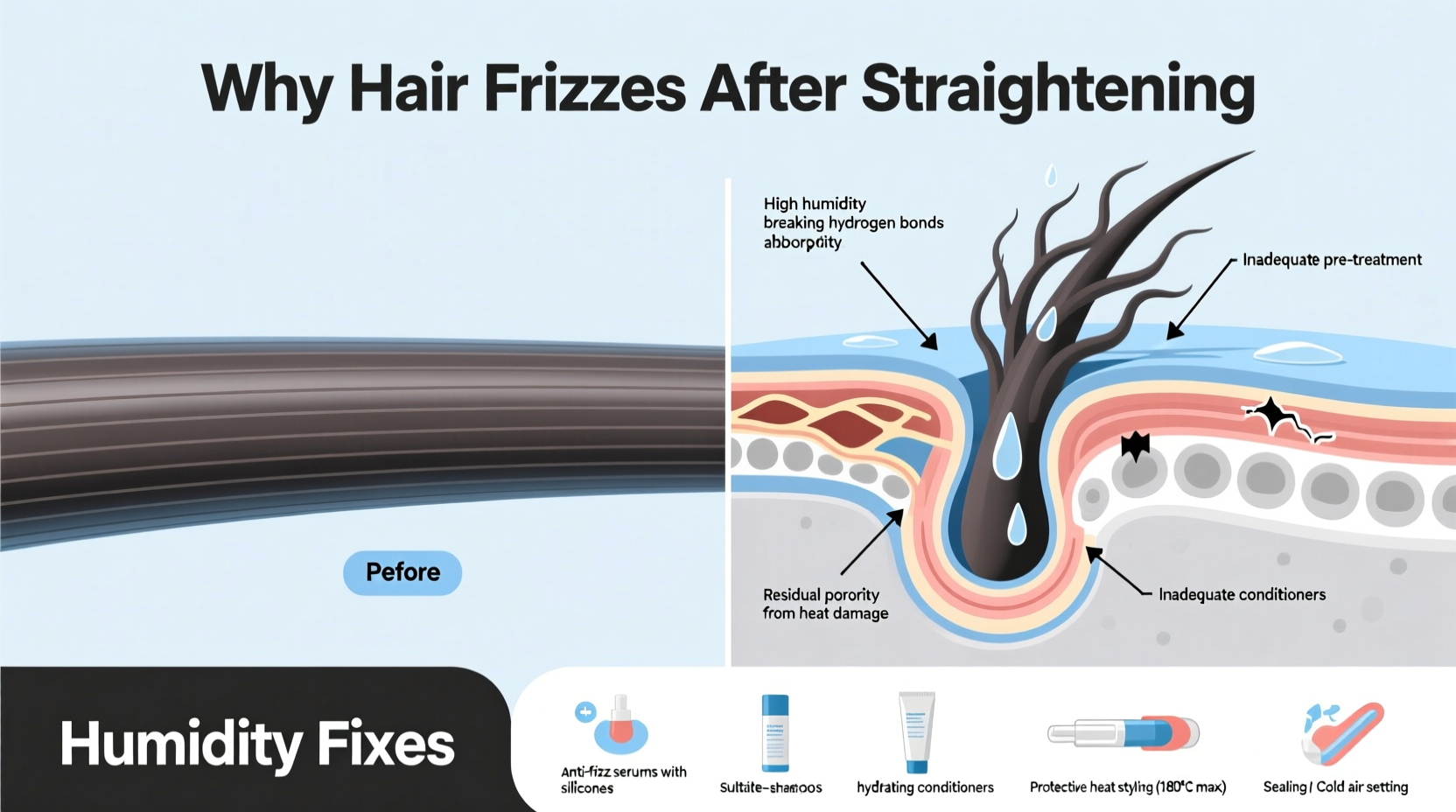
Hair is made primarily of keratin, a protein that naturally responds to changes in moisture levels. Each strand has a cuticle layer—the outermost shield—that protects the inner cortex. When this cuticle is smooth and tightly closed, light reflects evenly, giving hair a shiny, sleek appearance. But when humidity rises, water molecules in the air penetrate the hair shaft, causing the cortex to swell. This swelling lifts the cuticle, disrupting the surface and creating roughness—what we perceive as frizz.
Straightening temporarily breaks hydrogen bonds in the hair, allowing it to be reshaped into a straight form. However, these bonds are reversible and easily reformed when exposed to moisture. That’s why humidity is public enemy number one for straightened hair—it reintroduces water, triggering the reformation of curls or waves and inviting frizz back into the picture.
“Humidity doesn’t just affect style longevity—it compromises the structural integrity of the straightened bond. Without proper sealing and protection, even the best blowout won’t last two hours.” — Dr. Lena Torres, Trichologist and Hair Research Specialist
Why Straightened Hair Is More Vulnerable to Humidity
You might assume that once hair is straightened, it should stay that way until washed. But the reality is more complex. The process of thermal styling alters the hair’s structure temporarily, but it also weakens the cuticle slightly, making it more porous and prone to attracting moisture from the air.
This vulnerability increases if your hair is already compromised by coloring, bleaching, or frequent heat use. Damaged hair has gaps in the cuticle, acting like open doors for humidity. Even minor exposure—like walking through a misty morning or sitting near a steamy shower—can undo hours of styling effort.
Additionally, certain hair types are inherently more susceptible. Curly, wavy, and coily textures have a natural tendency to expand when hydrated. These hair types often have uneven cuticle layers and varying diameters along the strand, which create weak points where frizz emerges most aggressively after straightening.
Common Mistakes That Invite Post-Straightening Frizz
- Skipping pre-styling products: Going straight to the flat iron without applying a smoothing serum or anti-humidity spray leaves hair defenseless.
- Using incorrect heat settings: Too low, and the style won’t set; too high, and you damage the cuticle, increasing porosity.
- Touching hair after straightening: Fingers transfer oils and moisture, disrupting the cooled-down bond formation.
- Not cooling the hair properly: Immediately covering or tying down hair traps heat, preventing the new shape from stabilizing.
- Ignoring environmental forecasts: Styling for a flat look on a 90% humidity day without protection is setting yourself up for failure.
Effective Fixes for Humidity-Induced Frizz After Straightening
Prevention is always better than correction, but if frizz has already taken over, there are immediate and long-term strategies to regain control.
Immediate Rescue Techniques
- Blot, don’t rub: Use a microfiber cloth or cotton t-shirt to gently press out excess moisture if you’ve been caught in damp air.
- Reapply a lightweight serum: Focus on mid-lengths to ends. Avoid roots to prevent greasiness.
- Use a touch-up flat iron: Briefly glide over sections with low heat (under 350°F) to reseal the cuticle.
- Try a silk scarf wrap: Covering hair loosely with silk creates a friction-free barrier against humid air.
Long-Term Preventive Solutions
To consistently beat frizz, integrate humidity-resistant habits into your routine. The goal is to strengthen the hair’s defenses and minimize moisture uptake.
Best Anti-Frizz Products and How to Layer Them
Not all products are created equal. Choosing the right combination—and applying them in the correct order—is critical for locking in smoothness.
| Product Type | Purpose | Key Ingredients | When to Apply |
|---|---|---|---|
| Heat Protectant | Shields cuticle from heat damage and adds moisture barrier | Silicones (dimethicone), ceramides | Before any heat tool use |
| Smoothing Serum | Seals cuticle, adds shine, repels humidity | Argan oil, cyclomethicone | On damp or dry hair before styling |
| Anti-Humidity Spray | Forms invisible shield against moisture | Polymer blends, PVP/VA copolymers | After styling, as final step |
| Leave-In Conditioner | Hydrates without weighing hair down | Hyaluronic acid, panthenol | On towel-dried hair |
Layering matters. Start with a leave-in conditioner to hydrate, then apply heat protectant, followed by a small amount of serum. After straightening, finish with an anti-frizz mist designed for humidity resistance. Avoid overloading—too many products can build up and attract dirt and moisture instead of repelling it.
Real Example: Maria’s Humidity Struggle in Miami
Maria, a graphic designer living in Miami, spent years battling frizz despite meticulous straightening routines. She used high-end tools and expensive shampoos but still saw her style collapse within an hour of leaving home. After consulting a trichologist, she discovered two key issues: her hair was highly porous due to bleach treatments, and she wasn’t using polymer-based finishing sprays.
She adjusted her routine: introduced a weekly protein treatment to strengthen her cuticle, switched to a humidity-blocking spray containing PVP, and began using a diffuser on cool settings to dry hair before straightening. Within three weeks, her straight styles lasted two to three days, even during rainy season. Her breakthrough wasn’t a miracle product—it was understanding her hair’s needs and matching them with science-backed solutions.
Step-by-Step Routine for Long-Lasting Smoothness
Follow this daily ritual to maximize the lifespan of your straightened style in humid conditions:
- Wash with a sulfate-free shampoo to avoid stripping natural oils that help regulate moisture balance.
- Apply a lightweight leave-in conditioner focusing on ends. Avoid heavy creams that can weigh hair down.
- Towel-dry gently with a microfiber cloth. Never rub—this causes cuticle disruption.
- Apply heat protectant evenly from roots to ends. Use a wide-tooth comb to distribute.
- Blow-dry completely using a concentrator nozzle and tension. Hair must be fully dry before flat ironing.
- Section hair into four parts for consistent heat application.
- Straighten with medium heat (300–375°F depending on hair thickness). Pass each section only once to reduce damage.
- Let hair cool completely before touching or styling further. This allows hydrogen bonds to stabilize.
- Finish with an anti-humidity spray held 8–10 inches from the head. Light misting is sufficient.
- Sleep on a silk pillowcase or wrap hair in a silk bonnet to reduce friction overnight.
Frequently Asked Questions
Can I straighten my hair every day without causing frizz?
Daily straightening increases cuticle wear, making hair more porous and frizz-prone over time. If necessary, use lower heat settings, always apply heat protection, and incorporate weekly deep conditioning to maintain integrity.
Does drinking water help reduce hair frizz?
Internal hydration supports overall hair health, but frizz is primarily caused by external moisture absorption. While staying hydrated improves scalp function and elasticity, it won’t directly prevent humidity-induced frizz.
Are there foods that help fight frizz?
Yes. Omega-3 fatty acids (found in salmon, flaxseeds, and walnuts) support sebum production, which naturally conditions hair. Biotin-rich foods like eggs and almonds also promote stronger, smoother strands less prone to breakage and frizz.
Expert-Backed Checklist for Frizz-Free Straight Hair
“Smooth hair isn’t about suppressing texture—it’s about managing moisture exchange. Think of your regimen as building armor, not flattening identity.” — Jamal Reed, Celebrity Stylist and Texture Specialist
Use this checklist before every straightening session to ensure optimal results:
- ✅ Wash hair with a smoothing shampoo and conditioner
- ✅ Apply a leave-in detangler or moisturizer
- ✅ Use a heat protectant suitable for your hair type
- ✅ Dry hair completely before straightening
- ✅ Set flat iron to appropriate temperature (fine: 300°F, thick: 375°F)
- ✅ Work in small, even sections
- ✅ Avoid repeated passes over the same strand
- ✅ Allow hair to cool undisturbed for at least 15 minutes
- ✅ Seal style with an anti-humidity finishing spray
- ✅ Store hair loose or in a loose top knot—no tight elastics
Conclusion: Take Control of Your Style, No Matter the Weather
Frizz after straightening isn’t inevitable—it’s a signal that your current routine needs refinement. With the right knowledge, products, and techniques, you can achieve sleek, polished hair that withstands humidity and lasts far beyond the salon chair. The key lies in respecting your hair’s biology while strategically blocking environmental interference.
Start small: pick one change from this guide—whether it’s adding a humidity-blocking spray or adjusting your drying method—and build from there. Consistency beats perfection. Over time, these adjustments compound into dramatically better results.




 浙公网安备
33010002000092号
浙公网安备
33010002000092号 浙B2-20120091-4
Comments
No comments yet. Why don't you start the discussion?