
It’s a familiar scenario: you step outside on a drizzly morning, umbrella in hand, only to find your smooth, styled hair transforming into a voluminous halo of frizz within minutes. No matter how carefully you prepped it, the rain seems to have a personal vendetta against your hairstyle. But this isn’t just bad luck—it’s science. Understanding why hair frizzes more in humid or wet conditions requires a dive into the structure of hair, its interaction with moisture, and the biological principles that govern hygroscopy—the ability of a material to attract and hold water molecules from the surrounding environment.
Frizz isn't merely an aesthetic issue; it's a physical response rooted in hair chemistry. When rain falls or humidity rises, the air becomes saturated with water vapor, and your hair—especially if it's curly, wavy, or chemically treated—responds dramatically. This article breaks down the scientific mechanisms behind moisture absorption in hair, explains why some hair types are more vulnerable, and provides actionable strategies to minimize damage and maintain control—even in monsoon season.
The Structure of Hair and Its Relationship with Moisture
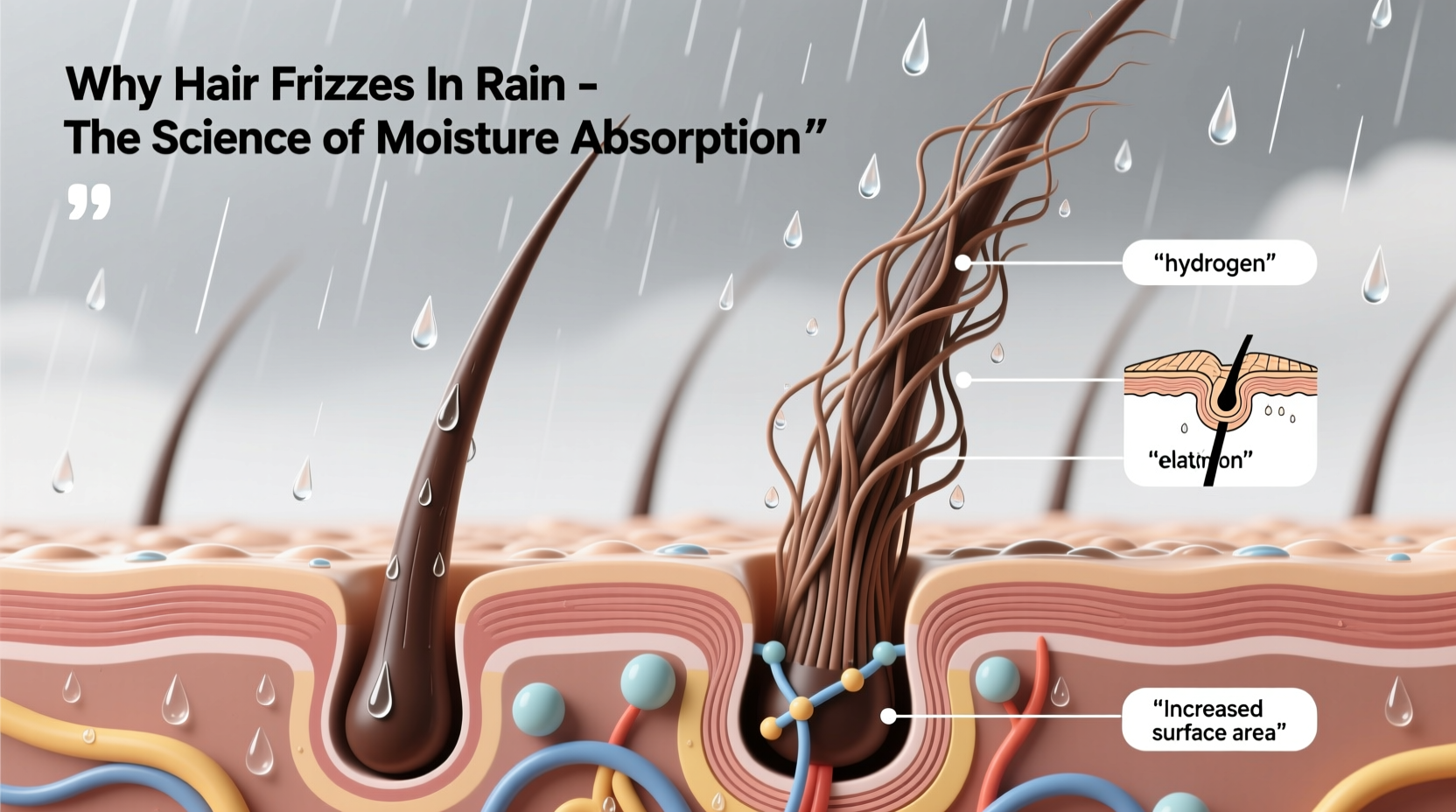
To understand frizz, we must first examine the anatomy of a single strand of hair. Each strand consists of three primary layers: the cuticle, cortex, and medulla (though the medulla is absent in fine hair). The outermost layer, the cuticle, acts as a protective shield made of overlapping keratin scales, much like shingles on a roof. Beneath it lies the cortex, which contains fibrous proteins and melanin responsible for strength, elasticity, and color. It's here—within the cortex—where moisture absorption primarily occurs.
Keratin, the dominant protein in hair, has a natural affinity for water due to its amino acid composition. Hydrophilic groups such as hydroxyl (-OH) and carboxyl (-COOH) attract water molecules from the atmosphere. In moderate humidity, this is beneficial: hair gains flexibility and resilience. However, when exposed to excessive moisture—like during rainfall—the cortex swells as it absorbs water rapidly. This expansion pushes against the cuticle, causing the scales to lift and distort the hair’s smooth surface.
When thousands of hair strands undergo this swelling simultaneously, the result is visible frizz: hair that appears fuzzy, uneven, and unmanageable. The effect is amplified in porous hair—common in curly, bleached, or heat-damaged textures—because their cuticles are already compromised, allowing even faster moisture penetration.
Why Rain Triggers More Frizz Than Regular Humidity
You might wonder: if humidity causes frizz, why does rain make it significantly worse? The answer lies in both the concentration of moisture and the mechanical impact of falling water droplets.
During rainfall, relative humidity often reaches 100%, meaning the air is fully saturated with water vapor. At this level, the driving force for moisture absorption is maximized. Unlike gradual exposure to humid air, direct contact with raindrops delivers a sudden influx of water directly onto the hair shaft. These droplets don’t just sit on the surface—they begin penetrating the cuticle almost immediately, especially if the hair is already porous.
Moreover, rainwater is not pure H₂O. It contains dissolved gases like carbon dioxide, which forms weak carbonic acid, slightly lowering its pH. While not corrosive, this mild acidity can further disrupt the cuticle’s integrity over time, particularly in chemically treated hair. Additionally, environmental pollutants carried by rain—such as sulfates or nitrates in urban areas—can deposit on the scalp and hair, increasing surface roughness and electrostatic repulsion between strands, contributing to flyaways.
In essence, rain combines extreme humidity with direct hydration and environmental stressors, creating the perfect storm for frizz.
How Hair Type Influences Frizz Susceptibility
Not everyone experiences rain-induced frizz equally. Genetics play a crucial role in determining hair shape, porosity, and lipid content—all factors that influence moisture retention.
- Curly and Coily Hair: Naturally more porous due to its spiral structure, which creates microscopic gaps in the cuticle. This allows quicker water absorption and greater swelling, leading to pronounced frizz.
- Wavy Hair: Moderate porosity. May frizz under heavy rain but often holds up better than tighter curl patterns.
- Straight Hair: Typically has a flatter, more compact cuticle, making it less porous. Resists frizz initially but can still absorb moisture over prolonged exposure.
- Damaged or Chemically Treated Hair: Bleaching, perming, or frequent heat styling strips away lipids and disrupts the cuticle, increasing porosity regardless of natural texture.
A study published in the Journal of Cosmetic Science found that bleached hair can absorb up to 50% more water than untreated hair under identical humidity conditions. This means someone with highlighted waves may experience frizz comparable to naturally coily hair—even in light drizzle.
“Hair behaves like a smart material—it responds dynamically to environmental moisture. The key to managing frizz is understanding your hair’s unique porosity and adjusting your regimen accordingly.” — Dr. Lena Patel, Trichologist and Hair Biophysics Researcher
Effective Strategies to Combat Rain-Induced Frizz
While you can’t control the weather, you can control how your hair responds to it. The goal isn’t to eliminate moisture absorption entirely—that would require sealing the hair in plastic—but to manage it intelligently. Below is a comprehensive checklist and guide to help you stay sleek, even when clouds gather.
✅ Frizz Defense Checklist
- Apply a silicone-based serum or anti-humidity spray before going outside
- Use sulfate-free shampoos to preserve natural oils
- Deep condition weekly to improve cuticle integrity
- Limit heat styling to reduce long-term porosity
- Seal ends with oils like argan or jojoba
- Wear protective styles (braids, buns) during rainy seasons
- Carry a microfiber scarf or compact umbrella
Step-by-Step Guide: Preparing Your Hair for Rainy Weather
- Cleanse gently: Use a moisturizing, low-pH shampoo to avoid stripping essential lipids.
- Condition deeply: Apply a mask rich in ceramides or shea butter, focusing on mid-lengths and ends. Leave for 10–15 minutes.
- Apply a humidity barrier: While hair is damp, use a leave-in conditioner followed by a lightweight oil or silicon-based serum (e.g., dimethicone).
- Style with protection: Air-dry or diffuse on low heat. Avoid brushing dry hair, which raises the cuticle.
- Shield externally: Wear a hat or hood lined with satin to prevent direct water contact without crushing curls.
Do’s and Don’ts: Managing Moisture Absorption
| Do | Don’t |
|---|---|
| Use products with occlusive agents (e.g., silicones, oils) to slow moisture entry | Rely solely on humectants like glycerin in rainy weather |
| Refresh curls with a water-oil-mixture spray instead of plain water | Run fingers through hair repeatedly—it increases static and frizz |
| Store hair tools in dry environments to prevent mold and residue buildup | Use cotton towels to dry hair—opt for microfiber or a cotton T-shirt instead |
| Trim split ends every 8–10 weeks to reduce porosity at the tips | Overwash hair, which strips natural sebum and increases dryness |
Real-World Example: A Commuter’s Rainy Morning
Consider Maria, a graphic designer in Seattle with shoulder-length, color-treated wavy hair. Every autumn, she struggles with frizz during her 15-minute walk to the office. Despite using expensive shampoos, her hair puffs up within minutes of stepping outside.
After consulting a trichologist, she adjusted her routine. She switched to a sulfate-free cleanser, incorporated a weekly reconstructing mask with keratin, and began applying a dime-sized amount of dimethicone serum on damp hair. She also started wearing a foldable wide-brimmed hat with a satin interior lining.
Within two weeks, her morning transformation diminished significantly. Even in steady rain, her waves remained defined, with minimal puffiness. Her secret? She stopped fighting moisture and instead created a controlled interface between her hair and the environment.
Frequently Asked Questions
Can drinking more water reduce hair frizz?
No—internal hydration improves overall hair health but doesn’t affect surface frizz. Frizz is caused by external moisture interacting with the hair shaft, not dehydration from within. However, well-hydrated hair is stronger and less prone to breakage, which indirectly supports smoother texture.
Are there specific ingredients that fight humidity?
Yes. Look for:
- Dimethicone or cyclomethicone: Silicones that form a breathable barrier
- Ceramides: Reinforce the cuticle and reduce porosity
- Hydrolyzed proteins: Penetrate the cortex to strengthen and stabilize structure
Does cold rain cause less frizz than warm rain?
Marginally. Cooler temperatures reduce the kinetic energy of water molecules, slightly slowing absorption. However, the difference is negligible in practice. What matters more is duration of exposure and hair’s existing condition—not the temperature of the rain.
Conclusion: Mastering the Science to Regain Control
Frizz in the rain isn’t a flaw—it’s physics in action. Hair’s innate ability to absorb moisture is both a vulnerability and a testament to its dynamic nature. By understanding the science of hygroscopic behavior, cuticle integrity, and environmental interaction, you shift from battling frizz to managing it strategically.
The most effective solutions aren’t about eliminating moisture but regulating access. Whether through product selection, protective styling, or behavioral adjustments, you can significantly reduce frizz without sacrificing style or comfort. Start by assessing your hair’s porosity, then tailor your routine to create a resilient, responsive defense against the elements.




 浙公网安备
33010002000092号
浙公网安备
33010002000092号 浙B2-20120091-4
Comments
No comments yet. Why don't you start the discussion?