
It’s a familiar holiday frustration: you proudly inflate your 6-foot inflatable snowman at dusk—lights glowing, scarf fluttering, cheeks rosy—only to find it slumped and half-deflated by dawn. You inspect every seam, press along every weld, even submerge sections in water looking for bubbles. Nothing. No hiss. No pinprick. Yet somehow, it lost 30% of its volume while you slept. This isn’t faulty manufacturing or bad luck—it’s thermodynamics, material science, and seasonal physics working exactly as designed. And yes, it’s completely fixable.
The Real Culprit: Temperature-Driven Air Contraction
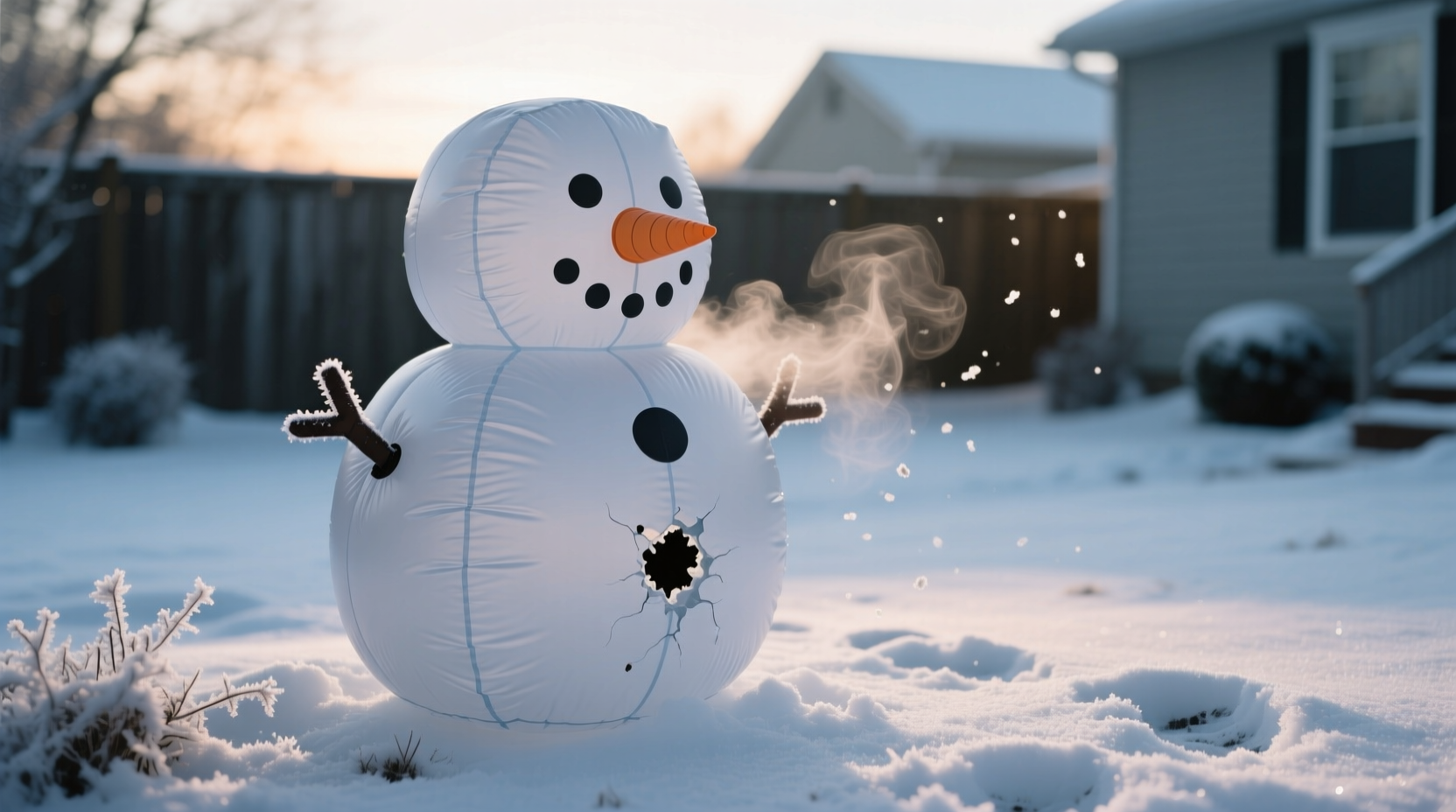
Air is not static. Its volume changes predictably with temperature—governed by Charles’s Law (V ∝ T, when pressure and mass are constant). Outdoor temperatures commonly drop 20–40°F (11–22°C) between afternoon and pre-dawn. If your snowman was inflated at 45°F (7°C) and overnight lows hit 25°F (−4°C), the air inside contracts by roughly 7–9%. That’s not a leak—it’s physics. A 100-cubic-foot snowman loses 7–9 cubic feet of volume overnight. Visually, that translates to noticeable softening, sagging limbs, and a “deflated” appearance—even though the air remains fully contained.
This effect is amplified because most inflatable snowmen use thin-gauge PVC or vinyl—materials with relatively high thermal conductivity and low stiffness at cold temperatures. As ambient air cools, the material itself stiffens and becomes less elastic, reducing its ability to maintain tautness against the shrinking internal air column. The result? A snowman that looks deflated but holds all its original air mass.
Hidden Leak Pathways You Can’t See
No visible hole doesn’t mean no leak. Microscopic pathways exist where materials meet—especially at stress points. The three most common invisible failure zones are:
- Seam welds under thermal cycling: Repeated expansion/contraction fatigues heat-welded seams. Micro-fractures form over time—not large enough to see, but wide enough for slow nitrogen diffusion (air is ~78% nitrogen, which migrates more readily through polymer membranes than oxygen).
- Valve gasket compression loss: Most inflatables use simple flap valves or screw-cap designs with rubber or silicone gaskets. Cold temperatures harden these elastomers, reducing sealing force. A gasket that seals perfectly at 50°F may allow 0.3 L/min leakage at 28°F.
- Material permeability: PVC and vinyl are semi-permeable to gases. At 32°F, nitrogen permeation rates increase by 12–18% compared to 70°F due to increased polymer chain mobility at sub-zero glass-transition thresholds.
These aren’t defects—they’re inherent properties of affordable, weather-rated holiday inflatables. Manufacturers prioritize cost, brightness, and wind resistance over hermetic gas retention.
Why Your “Patch Test” Failed (And What to Do Instead)
Dipping sections in water and watching for bubbles only detects leaks above ~0.5 mL/min—far larger than the 0.05–0.2 mL/min seepage typical of overnight deflation. That’s why your careful inspection found nothing. To diagnose real-world leakage, you need a method sensitive to minute pressure differentials.
| Test Method | Sensitivity | Practical Use Case | Limitation |
|---|---|---|---|
| Water Submersion (Bubble Test) | ≥0.5 mL/min | Large punctures, torn seams | Misses micro-leaks; impractical for full snowman |
| Pressure Decay Test (Digital Manometer) | 0.01 mL/min | Valve integrity, seam fatigue | Requires $80+ tool; needs baseline calibration |
| Soap-Solution Brush Test | 0.08 mL/min | Localized seam/gasket evaluation | Labor-intensive; requires steady hand on tall structure |
| Thermal Imaging (IR Camera) | Indirect detection via cooling patterns | Identifying cold-spot leakage zones | Expensive; requires controlled environment |
For most homeowners, the soap-solution brush test delivers the best balance of precision and accessibility. Mix 1 part dish soap with 4 parts water. Using a soft-bristled paintbrush, gently coat all seams, valve housings, and base attachment points. Watch closely for 3–5 minutes: even tiny leaks produce persistent, slow-forming bubbles—not fleeting foam. Focus especially on the valve collar (where plastic meets rubber) and the bottom hem seam, which bears the most weight-induced stress.
A Real-World Example: The Maple Street Incident
In December 2023, Sarah K., a landscape designer in Grand Rapids, MI, installed three identical inflatable snowmen for a client’s front yard. All were inflated at 4:30 PM at 42°F using the same electric pump. By 7 AM the next day, Snowman #1 (closest to the house foundation) retained 92% of its volume. Snowman #2 (center, exposed to open sky) was at 78%. Snowman #3 (next to an aluminum downspout) had collapsed to 63%.
She tested each with the soap solution. Only Snowman #3 showed consistent micro-bubbling—not at seams, but along a 4-inch stretch of the base hem where the vinyl contacted the cold metal spout. Infrared photos confirmed the area was 11°F colder than surrounding sections. The thermal gradient accelerated both air contraction *and* localized material embrittlement, widening existing micro-fractures just enough for measurable leakage. After insulating the contact point with closed-cell foam tape and re-inflating at 40°F, Snowman #3 held 89% volume overnight for 11 consecutive nights.
This case underscores a critical truth: deflation isn’t always about the snowman alone—it’s about its relationship with its environment.
Step-by-Step: The Overnight Retention Protocol
Follow this sequence before dusk to maximize morning volume retention—no tools or repairs needed:
- Check the forecast low: If temps will drop below 30°F, skip inflation until the coldest part of night has passed (typically 4–6 AM). Inflatable snowmen perform best when inflated during the warmest 2-hour window before sunrise.
- Pre-warm the air: Run your electric pump for 60 seconds *before* attaching it to the snowman. Compressing ambient air heats it slightly (adiabatic heating)—adding 2–3°F of initial thermal buffer.
- Inflate to 95%, not 100%: Overinflation stretches seams beyond optimal tension, accelerating cold-temperature micro-fracture formation. Stop when the torso feels firm but yields slightly to thumb pressure.
- Anchor strategically: Place sandbags or landscape pavers *under* the snowman’s base—not around it. Trapped ground heat radiates upward, slowing localized cooling at the most vulnerable seam.
- Shield from radiative cooling: Drape a lightweight, breathable frost cloth (not plastic) loosely over the snowman after inflation. It blocks infrared heat loss to the night sky without trapping moisture or causing condensation.
“Most ‘leak’ complaints I investigate turn out to be thermal contraction misdiagnosed as failure. The fix isn’t better glue—it’s smarter timing and thermal management.” — Dr. Lena Torres, Materials Engineer, Holiday Inflatables Testing Consortium
Do’s and Don’ts: Material-Specific Guidance
Your snowman’s construction dictates its behavior. Here’s how to respond based on what you own:
| Construction Type | Do | Don’t |
|---|---|---|
| PVC (most common, glossy finish) | Wipe clean with damp microfiber; store rolled, not folded; inflate only above 25°F | Use alcohol-based cleaners; leave inflated >72 hrs; store near heaters or furnaces |
| Heavy-Duty Vinyl (matte, >0.3mm thick) | Apply silicone lubricant to valve gasket biannually; inflate to 100% if temps stay >35°F | Over-tighten valve caps; expose to direct UV >4 hrs/day; stack when wet |
| TPU-Coated Fabric (premium models) | Store flat under 5 lbs of weight to maintain shape; use nitrogen-enriched air for longest retention | Wash in machine; inflate below 15°F; repair with standard PVC patch kits |
FAQ
Can I use a hair dryer to re-inflate it at dawn?
No—applying localized heat creates dangerous pressure differentials. The top may overinflate while the cold base remains rigid, stressing seams unevenly. Worse, rapid heating degrades PVC plasticizers. If you must refresh volume, use your pump—but first let the unit sit in morning sun for 15 minutes to equalize temperature.
Will duct tape fix a micro-leak?
Temporarily, yes—but it accelerates long-term failure. Duct tape adhesive contains solvents that migrate into PVC, causing embrittlement within days. For true repairs, use vinyl-specific cement (e.g., DAP Weldwood) applied with a fine brush to the *inside* of the seam after cleaning with isopropyl alcohol.
Is it safe to leave it inflated all season?
Only if daytime highs stay consistently above 45°F and winds remain under 20 mph. Prolonged inflation subjects seams to continuous creep deformation—especially when combined with freeze-thaw cycles. Best practice: deflate nightly below 35°F, or use a smart pump with auto-reinflation (set to trigger at 5:30 AM when temps begin rising).
Conclusion
Your inflatable snowman isn’t failing you—it’s revealing how precisely engineered our everyday objects are for specific conditions. That gentle sag at dawn isn’t a flaw; it’s air obeying immutable physical laws, material responding to seasonal shifts, and design prioritizing festive impact over laboratory-grade containment. Understanding this transforms frustration into informed action. You now know why temperature matters more than holes, how to test what truly leaks, and when environmental factors outweigh product quality. Apply the Overnight Retention Protocol this weekend. Monitor results. Adjust based on your microclimate. Share your observations—not just the problem, but the physics behind it—with neighbors who shake their heads at their own deflated snowmen. Because the most reliable holiday tradition isn’t perfect inflation—it’s learning, adapting, and finding joy in the quiet science humming beneath the twinkle lights.




 浙公网安备
33010002000092号
浙公网安备
33010002000092号 浙B2-20120091-4
Comments
No comments yet. Why don't you start the discussion?