
It’s a familiar frustration: you wake up to a notification about the latest iOS update, install it, and suddenly find your iPhone nearly full—sometimes with no apparent reason. You didn’t download new apps or take hundreds of photos. So where did all that space go? This issue affects millions of iPhone users after major or minor software updates. The truth is, iOS updates don’t just add features—they can also temporarily inflate your storage usage through system files, cached data, and background processes. Understanding why this happens and knowing how to reclaim your lost space is essential for keeping your device running smoothly.
Why iPhone Storage Fills Up After a Software Update
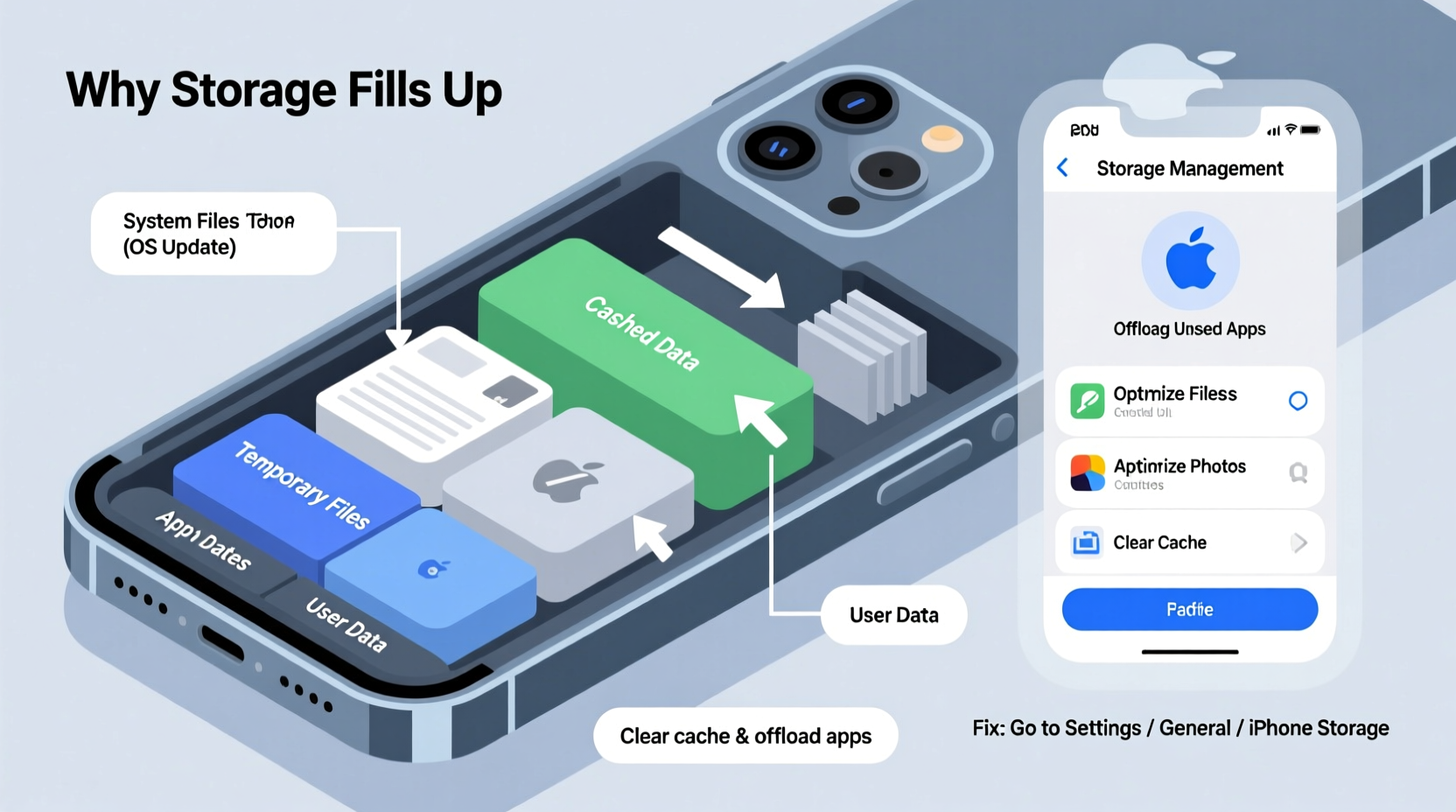
When Apple releases a new iOS version, it includes updated frameworks, security patches, redesigned interfaces, and enhanced functionality. To install this update, your iPhone downloads a large file—often ranging from 2GB to over 5GB—depending on the size of changes. But even after installation, remnants of that process linger in your device’s storage.
The primary culprits behind sudden storage bloat are:
- Update Cache Files: Temporary files created during download and installation remain until manually cleared.
- System Data Growth: iOS creates logs, caches, and temporary databases during the update process, which may not be cleaned automatically.
- App Reinstallation & Optimization: Apps rebuild their caches post-update, sometimes duplicating data or increasing footprint.
- Photos and Messages Indexing: After an update, iOS reindexes media libraries and message threads, generating temporary files.
- Bug or Glitch in Storage Calculation: Occasionally, iOS misreports used space due to bugs in storage analytics.
According to Apple Support documentation, “After installing a software update, your iPhone may show higher storage use temporarily as system files are optimized.” However, if the space doesn’t recover within 48 hours, manual intervention is usually required.
“Software updates often leave behind residual data that the system assumes will be needed soon. In reality, much of it becomes obsolete quickly.” — David Lin, Senior Mobile Systems Analyst at TechInsight Group
How to Fix Full iPhone Storage After an Update
The good news is that most post-update storage issues can be resolved without losing personal data. Below is a comprehensive, step-by-step guide to help you regain control of your iPhone's storage.
Step 1: Restart Your iPhone
Before diving into complex solutions, try the simplest one first. A restart clears volatile memory and allows iOS to finalize background tasks related to the update.
- Press and hold the side button (or side + volume button on older models).
- Slide to power off.
- Wait 30 seconds, then press and hold the side button again to turn it back on.
- Allow the phone to fully boot up.
After restarting, check Settings > General > iPhone Storage to see if available space has improved. Sometimes, just rebooting resolves phantom storage usage.
Step 2: Clear Update Download Residue
iOS typically removes the downloaded update package after installation, but occasionally it fails to do so. These leftover files can consume several gigabytes.
To remove them:
- Go to Settings > General > iPhone Storage.
- Scroll down and look for “iOS [Version Number]” listed under apps.
- If present, tap it and select Delete Update.
This action removes the original downloaded installer file, freeing up significant space instantly.
Step 3: Offload Unused Apps
Some apps accumulate large caches over time, especially social media, streaming, and productivity tools. Instead of deleting them entirely, use Apple’s built-in offload feature to keep documents while removing the app binary.
Navigate to:
- Settings > General > iPhone Storage
- Review the list of apps sorted by storage used
- Select any infrequently used app consuming more than 500MB
- Choose Offload App
You can reinstall the app later with one tap, and your data will restore automatically.
Step 4: Clean Safari and Browser Cache
Safari, especially with heavy usage, can store hundreds of megabytes in cache, history, and website data. After an update, these files are often duplicated or expanded.
To clear them:
- Open Settings > Safari
- Tap Clear History and Website Data
- Confirm the action
Note: This won’t affect saved passwords unless you disable iCloud Keychain syncing.
Step 5: Analyze and Reduce System Data
“System” data includes caches, logs, Siri voices, and other non-user files. If this category exceeds 10–15GB, it may indicate bloated caches.
While you can't directly delete system data, you can reduce it indirectly:
- Restart your device (as above)
- Turn off iCloud Photos sync temporarily and re-enable it
- Reset all settings: Settings > General > Transfer or Reset iPhone > Reset > Reset All Settings (this does not erase data)
This forces iOS to rebuild system configurations and purge outdated caches.
Essential Tips to Prevent Future Storage Issues
Prevention is far more effective than cleanup. Implement these habits to avoid recurring storage problems after future updates.
| Action | Benefit | Frequency |
|---|---|---|
| Check storage weekly | Catch issues early | Weekly |
| Offload unused apps | Free up space without losing data | Monthly |
| Clear Safari cache | Improve speed and reclaim space | Bi-weekly |
| Backup and restart | Clear system clutter | After every major update |
Real-World Example: Sarah’s Post-iOS 17 Storage Crisis
Sarah, a freelance photographer, updated her iPhone 13 to iOS 17. Within hours, she received a warning: “Storage Almost Full.” She hadn’t taken new photos, yet only 1.2GB remained on her 128GB device.
She checked Settings > General > iPhone Storage and noticed “iOS 17” still listed as using 4.2GB. She tapped it and selected “Delete Update.” Instantly, 4GB was freed. Then, she offloaded Instagram and TikTok—two apps using over 1.8GB combined in cache. Finally, she cleared Safari data and restarted her phone.
Total recovered space: 7.1GB. Her iPhone returned to normal operation within 20 minutes—all without losing a single photo or message.
Checklist: Recover iPhone Storage After Update
Use this actionable checklist whenever your iPhone runs out of space after a software update:
- ✅ Restart your iPhone
- ✅ Check for leftover iOS update file and delete it
- ✅ Clear Safari history and website data
- ✅ Offload large, rarely used apps
- ✅ Review largest apps and manage their storage
- ✅ Reset all settings (if system data is unusually high)
- ✅ Wait 24–48 hours post-update before panicking—some optimization takes time
Frequently Asked Questions
Does updating iOS permanently reduce my available storage?
No. While newer iOS versions require slightly more system space (typically 500MB–1.5GB), the drastic drops you see immediately after update are usually due to temporary files. Once cleaned, your usable space should stabilize at a level consistent with the OS requirements.
Can I prevent the update from downloading automatically?
Yes. Go to Settings > App Store and toggle off Automatic Updates under the \"Software Updates\" section. Alternatively, connect only via Wi-Fi and monitor update sizes before installing.
Is it safe to delete “System” data on iPhone?
You cannot manually delete system data, nor should you attempt to force-remove it via third-party tools. Doing so may corrupt your device. Instead, let iOS manage it by maintaining good storage hygiene and performing regular restarts.
Conclusion: Take Control of Your iPhone’s Storage
An unexpected storage crunch after an iOS update doesn’t have to derail your day. With a clear understanding of what causes the spike—and a reliable set of recovery steps—you can quickly restore your iPhone’s performance. The key is acting promptly: don’t ignore early warnings, and always verify whether a large iOS file remains post-installation. By incorporating simple maintenance habits like periodic cache clearing and app offloading, you’ll not only solve today’s problem but prevent tomorrow’s.




 浙公网安备
33010002000092号
浙公网安备
33010002000092号 浙B2-20120091-4
Comments
No comments yet. Why don't you start the discussion?