
Squatting is a fundamental movement pattern used in daily life and exercise. Whether you're sitting down, standing up, or performing weighted squats at the gym, your knees bear significant load. It's not uncommon for people to hear or feel a clicking, popping, or snapping sensation in their knees during these movements. While many dismiss it as harmless, others worry it signals underlying damage. The truth lies somewhere in between — most knee clicks are benign, but some can indicate problems that need attention.
This article explores the science behind knee crepitus (the medical term for joint noise), breaks down common causes, highlights red flags, and offers practical steps to maintain long-term joint health. If you've ever paused mid-squat wondering, \"Should I be concerned?\" — this guide will give you clarity.
What Causes Knee Clicking When You Squat?
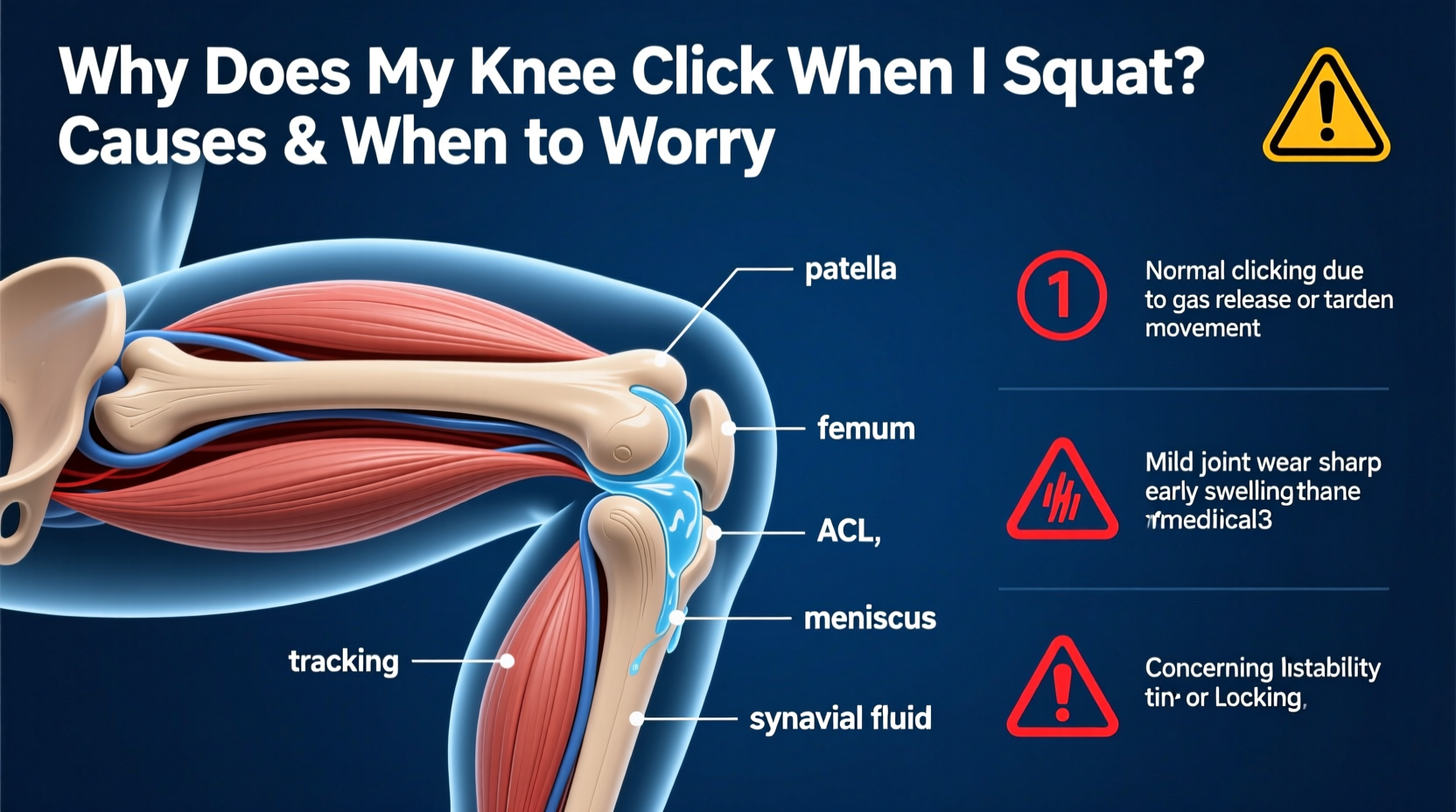
The knee joint is a complex structure involving bones, ligaments, tendons, cartilage, and synovial fluid. When you squat, multiple components move in coordination. Any disruption in this system — even minor — can produce audible or palpable clicks.
Here are the most common physiological explanations:
- Cavitation: A sudden change in joint pressure can cause dissolved gases in synovial fluid to form bubbles that pop, creating a cracking sound. This is the same mechanism behind knuckle cracking and is generally harmless.
- Soft Tissue Movement: Tendons or ligaments may snap over bony prominences as the knee bends and straightens. This is especially common in individuals with tight iliotibial (IT) bands or patellar tendons.
- Plica Syndrome: The synovial folds (plicae) inside the knee can catch during motion, producing a clicking sensation, often on the inner side of the knee.
- Cartilage Wear (Early Osteoarthritis): As articular cartilage thins, surfaces become less smooth, leading to grinding or clicking. This is more common with age or after injury.
- Meniscus Tears: A torn meniscus — the shock-absorbing cartilage between the femur and tibia — can flap into the joint space, causing intermittent clicking, catching, or locking.
- Patellar Tracking Issues: If the kneecap (patella) doesn’t glide smoothly in its groove due to muscle imbalances, it may shift slightly, producing noise and sometimes discomfort.
In most cases, isolated clicking without pain, swelling, or instability is considered normal. However, context matters — frequency, associated symptoms, and activity level all influence whether further evaluation is needed.
When Should You Be Concerned About Knee Clicking?
Not all joint noise requires intervention. The key differentiator is whether the sound is accompanied by other symptoms. Pain-free clicking is usually a mechanical curiosity, not a clinical issue. But certain warning signs suggest underlying pathology.
“Joint sounds alone are rarely diagnostic. It’s the combination with pain, swelling, or functional limitation that raises concern.” — Dr. Lena Torres, Sports Medicine Physician
Red Flags That Warrant Medical Evaluation
- Pain with clicking: Discomfort localized to the knee, especially if reproducible during specific movements.
- Swelling or warmth: Indicates inflammation, possibly from injury or degenerative conditions.
- Locking or catching: Inability to fully straighten the knee suggests a mechanical block, such as a displaced meniscal fragment.
- Instability: Feeling like the knee might give out points to ligament damage or severe cartilage loss.
- Recurrent clicking with decreased performance: Athletes noticing reduced strength, endurance, or range of motion should seek assessment.
If any of these symptoms occur regularly — particularly after an injury or increase in physical activity — consulting a healthcare provider is advisable. Early diagnosis can prevent progression of joint damage.
Common Conditions Linked to Symptomatic Knee Clicking
While occasional noise is normal, persistent or painful clicking may point to specific diagnoses. Understanding these can help you communicate effectively with your doctor.
| Condition | Symptoms | Common Triggers | Treatment Approach |
|---|---|---|---|
| Meniscus Tear | Clicking, catching, swelling, limited extension | Squatting, twisting motions | Physical therapy; arthroscopic surgery if severe |
| Chondromalacia Patellae | Front-knee pain with grinding under kneecap | Stair climbing, prolonged sitting | Quadriceps strengthening, activity modification |
| Plica Syndrome | Intermittent clicking, inner knee irritation | Repetitive bending, overuse | Stretching, anti-inflammatory meds, rarely surgery |
| Early Osteoarthritis | Grinding sensation, stiffness, morning ache | Aging, prior trauma, obesity | Weight management, low-impact exercise, injections |
| Patellar Maltracking | Noise with lateral knee pull, pain during loading | Muscle imbalance (weak VMO, tight IT band) | Corrective exercises, taping, orthotics |
Diagnosis typically involves a physical exam, imaging (like MRI or ultrasound), and sometimes dynamic assessments such as squat tests or gait analysis. Self-diagnosis is risky — symptoms often overlap across conditions.
Real-Life Example: The Weekend Warrior’s Dilemma
Mark, a 38-year-old software engineer, started experiencing knee clicking during his home workouts. Initially, he ignored it — until he felt a sharp twinge while descending stairs. The pain worsened over two weeks, and his knee began swelling after leg day sessions.
He visited a sports clinic where an MRI revealed a small medial meniscus tear. The doctor explained that the clicking was caused by the torn flap catching in the joint. With six weeks of targeted physical therapy focusing on hamstring and glute activation, Mark reduced his symptoms significantly. Surgery wasn’t needed, but early intervention prevented further deterioration.
His case illustrates how seemingly minor noises can escalate if ignored — especially when combined with lifestyle factors like sudden increases in training volume or poor biomechanics.
Step-by-Step Guide to Assessing and Managing Knee Clicks
If you notice knee clicking during squats, follow this structured approach to determine whether it’s harmless or needs attention.
- Observe Without Reacting: Note when the click happens — at depth, during ascent, or only under load. Is it consistent or random?
- Check for Symptoms: Does it hurt? Swell? Feel unstable? If no, monitor for changes.
- Test Range of Motion: Can you fully bend and straighten your knee without restriction or pain?
- Evaluate Strength and Alignment: Perform bodyweight squats in front of a mirror. Do your knees cave inward (valgus)? This may indicate weak glutes or poor motor control.
- Modify Activity Temporarily: Reduce high-load or deep squats if pain develops. Switch to partial range or alternative exercises (e.g., step-ups).
- Engage in Preventive Strengthening: Focus on eccentric quadriceps control, hip abductors, and core stability.
- Seek Professional Input: If symptoms persist beyond 2–3 weeks despite rest and modification, consult a physiotherapist or orthopedic specialist.
This methodical process prevents unnecessary alarm while ensuring timely care when warranted.
Practical Tips to Maintain Healthy Knees
Prevention is always better than treatment. Even if your knee clicking is currently pain-free, adopting joint-friendly habits supports long-term mobility.
- Warm Up Properly: Dynamic stretches like leg swings and air squats prepare tissues for loading.
- Improve Movement Mechanics: Film your squat form. Look for knee alignment over toes, controlled descent, and upright posture.
- Build Balanced Leg Strength: Don’t neglect hamstrings, glutes, and calves. Imbalances increase stress on the knee.
- Maintain a Healthy Weight: Every extra pound adds 3–4 times the force on your knees during squatting.
- Choose Footwear Wisely: Shoes with proper arch support reduce abnormal knee rotation.
- Listen to Your Body: Delayed onset soreness is normal; sharp joint pain is not.
Frequently Asked Questions
Is knee clicking dangerous if there’s no pain?
Generally, no. Painless crepitus is common and often due to harmless gas release or soft tissue movement. However, if new or increasing in frequency, periodic monitoring is wise — especially with risk factors like previous injury or family history of arthritis.
Can I keep squatting if my knee clicks?
Yes, provided there’s no pain, swelling, or mechanical symptoms. In fact, avoiding movement can weaken supporting muscles and worsen joint health. Focus on proper form and gradually build tolerance.
Will knee clicking get worse over time?
It depends. Age-related cartilage changes may increase joint noise, but progression isn't inevitable. Maintaining strength, flexibility, and healthy loading patterns can minimize degeneration and preserve function well into later years.
Action Plan: What to Do Next
Your knees are designed to move — and occasionally make noise. The presence of a click isn’t a verdict on your joint health; it’s data. Use it wisely.
Start by assessing your symptoms objectively. If everything else feels normal, continue moving with attention to form and load management. Incorporate preventive exercises and listen closely to any changes. But if pain, swelling, or dysfunction emerges, don’t wait. Early consultation with a physical therapist or sports medicine professional can save months of discomfort and potential long-term damage.
“The best joint protection isn’t avoidance — it’s intelligent, consistent movement.” — Dr. Rajiv Mehta, Orthopedic Biomechanist




 浙公网安备
33010002000092号
浙公网安备
33010002000092号 浙B2-20120091-4
Comments
No comments yet. Why don't you start the discussion?