
Squatting is a fundamental human movement—essential for daily tasks, athletic performance, and functional fitness. But if you’ve noticed a clicking, popping, or cracking sound in your knee during squats, you’re not alone. Millions of people experience this phenomenon, often without pain or discomfort. Still, it’s natural to wonder: Is this normal? Could it signal damage? And should you be concerned?
This article explores the biomechanics of knee joint noise, known medically as crepitus, and separates myth from fact. From gas bubbles to cartilage wear, we’ll break down the most common causes, identify warning signs, and offer practical steps to maintain long-term knee health.
The Science Behind Knee Clicking: What Causes the Noise?
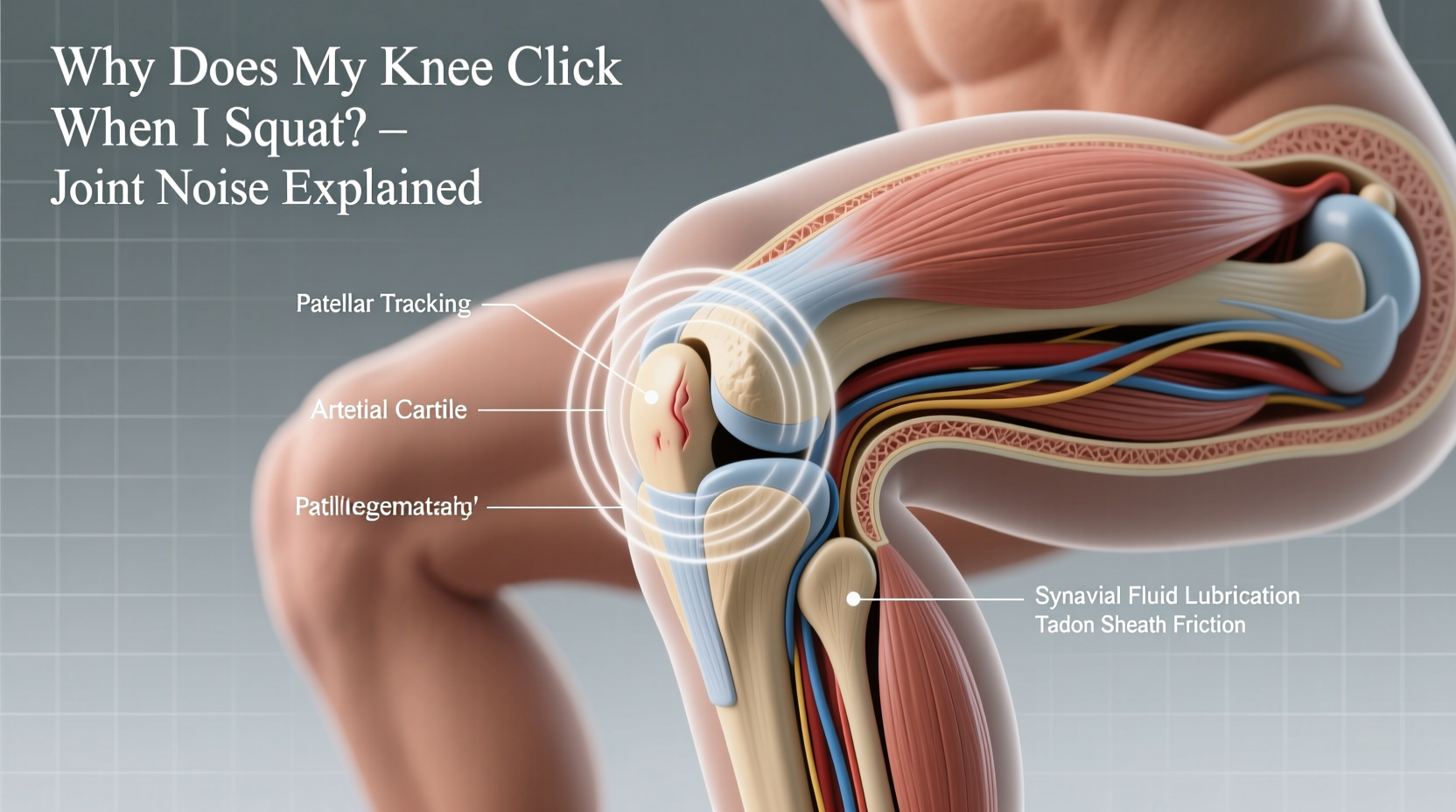
Knee crepitus refers to any audible or palpable crackling, popping, or grinding sensation around the joint. It can occur during various movements, but squatting often amplifies the sound due to increased pressure and complex joint mechanics.
Several physiological mechanisms explain why knees click:
- Cavitation: The most common cause of a single, painless pop is the rapid release of gas (mainly nitrogen) from the synovial fluid within the joint capsule. When the joint stretches—such as when bending deeply into a squat—the pressure drops, causing dissolved gases to form a bubble that collapses with an audible “pop.” This is the same mechanism behind knuckle cracking and is generally harmless.
- Tendon or Ligament Snapping: As tendons and ligaments shift over bony structures during motion, they may momentarily catch and then release, producing a snapping sound. The iliotibial (IT) band or patellar tendon are frequent culprits, especially if tightness or misalignment is present.
- Cartilage Irregularities: Over time, cartilage surfaces can develop minor roughness or softening (a condition called chondromalacia patellae). As the kneecap (patella) glides over the femur, these imperfections may create a grinding or grating sensation, particularly noticeable during loaded movements like squatting.
- Meniscus Wear or Tears: The menisci act as shock absorbers between the femur and tibia. Degeneration or small tears—common with age or repetitive stress—can lead to intermittent catching or clicking, sometimes accompanied by mild swelling or stiffness.
“Joint noise alone is rarely a red flag. It’s the combination with pain, swelling, or instability that warrants further evaluation.” — Dr. Lena Torres, Sports Medicine Physician
When Is Knee Clicking Normal—and When Should You Worry?
Not all joint noise indicates injury. In fact, studies show that up to 90% of asymptomatic individuals experience some degree of knee crepitus. The key lies in context: frequency, associated symptoms, and functional impact.
Here’s how to differentiate benign joint sounds from potentially problematic ones:
| Benign Clicking | Potentially Concerning Signs |
|---|---|
| Single, isolated pop with no recurrence | Repetitive or worsening clicks during every squat |
| No pain before, during, or after movement | Pain localized to the knee joint |
| No swelling or warmth | Swelling, redness, or heat around the joint |
| Full range of motion maintained | Feeling of locking, catching, or giving way |
| No history of trauma or overuse | Recent injury or sharp onset after activity |
Real-World Example: A Case Study in Benign vs. Pathological Crepitus
Consider Marcus, a 32-year-old strength trainer who began noticing a faint clicking in his right knee during back squats. He reported no pain, full mobility, and no prior injuries. His coach observed proper form, and MRI scans showed intact ligaments and healthy cartilage. The verdict? Harmless crepitus caused by slight tendon glide over the lateral femoral condyle—likely exacerbated by tightness in his IT band.
In contrast, Sarah, a 45-year-old runner, experienced a new clicking sensation after twisting her knee on a trail. The sound recurred with each squat, accompanied by swelling and a feeling that her knee might “buckle.” An MRI revealed a degenerative tear in her medial meniscus. Her clicking was a symptom of structural compromise requiring physical therapy and activity modification.
These cases illustrate a crucial point: the presence of noise matters less than the presence of dysfunction.
How to Reduce Knee Clicking: A Step-by-Step Guide
If knee noise concerns you—or if you want to prevent future issues—follow this proactive plan to support joint health and improve movement quality.
- Assess Your Movement Pattern
Record yourself squatting from the side and front. Look for:- Knee valgus (knees caving inward)
- Excessive forward lean
- Heels lifting off the ground
- Improve Ankle and Hip Mobility
Restricted dorsiflexion (ankle bend) or tight hip flexors can alter squat mechanics, forcing the knee to compensate. Perform:- Calf stretches (3 sets of 30 seconds per leg)
- Frog stretch for hip internal rotation (2 minutes daily)
- 90/90 hip transitions for joint articulation
- Strengthen Supporting Muscles
Weak glutes and underactive vastus medialis obliquus (VMO) can lead to poor patellar tracking. Add:- Clamshells with resistance band (3x15 per side)
- Terminal knee extensions with band (3x12)
- Bulgarian split squats (bodyweight first, then progress)
- Optimize Squat Technique
Use a box squat or wall touch to control depth and ensure even weight distribution. Focus on:- Driving through the heels and midfoot
- Engaging glutes at the bottom
- Maintaining neutral spine
- Monitor Load and Volume
Sudden increases in training intensity can irritate joint structures. Follow the 10% rule: don’t increase weekly squat volume or weight by more than 10% at a time.
Common Myths About Joint Popping Debunked
Despite widespread curiosity, misconceptions about joint noise persist. Let’s clarify a few:
- Myth: Cracking your joints causes arthritis.
Reality: No scientific evidence links habitual joint cracking to osteoarthritis. A famous self-experiment by Dr. Donald Unger—who cracked the knuckles on one hand for 60 years—found no difference in arthritis development between hands. - Myth: All knee sounds mean cartilage damage.
Reality: While advanced cartilage wear can produce grinding, many pain-free clicks stem from soft tissue dynamics, not structural breakdown. - Myth: You should stop squatting if your knee clicks.
Reality: Unless pain or dysfunction is present, continuing to squat—with attention to form—supports joint nutrition and muscle balance.
Checklist: Knee Health Maintenance Routine
Stay ahead of joint issues with this weekly maintenance checklist:
- ✅ Perform ankle mobility drills (5 minutes, 3x/week)
- ✅ Foam roll quads, hamstrings, and IT bands (2 minutes per side)
- ✅ Activate glutes with banded walks (3 sets of 20 steps)
- ✅ Do bodyweight squats with perfect form (3x10, focusing on control)
- ✅ Evaluate footwear: Replace worn-out shoes that lack support
- ✅ Hydrate well: Synovial fluid production depends on adequate water intake
- ✅ Track symptoms: Note any new pain, swelling, or changes in movement
Frequently Asked Questions
Is it bad if my knee clicks every time I squat?
Not necessarily. If there’s no pain, swelling, or loss of function, regular clicking is likely due to normal joint mechanics. However, if it starts suddenly after an injury or worsens over time, consult a healthcare provider.
Can strengthening exercises eliminate knee clicking?
They can reduce or eliminate it in many cases—especially when the cause is muscular imbalance or poor tracking of the kneecap. Targeted strengthening improves joint stability and alignment, decreasing abnormal stresses that contribute to noise.
Should I get an MRI if my knee clicks?
Only if you have additional symptoms such as persistent pain, swelling, locking, or instability. Imaging is not recommended for asymptomatic joint noise, as findings like minor meniscal wear are common even in pain-free individuals.
Conclusion: Listen to Your Body, Not Just the Sounds
The occasional knee click during a squat is far more common than concerning. Joints are dynamic structures, and noise is often just a byproduct of movement. What matters most is how your knee feels—not just what it sounds like.
By understanding the root causes of joint noise, improving your biomechanics, and staying proactive with mobility and strength, you can squat confidently for years to come. Don’t let a harmless pop deter you from building strength and maintaining functional fitness.




 浙公网安备
33010002000092号
浙公网安备
33010002000092号 浙B2-20120091-4
Comments
No comments yet. Why don't you start the discussion?