
Many people hear a popping or cracking sound in their knees during everyday movements like squatting. While occasional noise without pain is usually harmless, persistent or painful popping can signal underlying issues. Understanding the mechanics behind knee sounds—and how to address them—is essential for maintaining joint health, especially if you're active, lift weights, or spend long hours on your feet.
The knee is one of the most complex joints in the body, bearing significant load with every movement. When it starts making noise, it’s often the body’s way of signaling imbalances, weakness, or improper mechanics. The good news: most causes of knee popping are manageable with targeted strengthening, mobility work, and lifestyle adjustments.
What Causes Knee Popping During Squats?
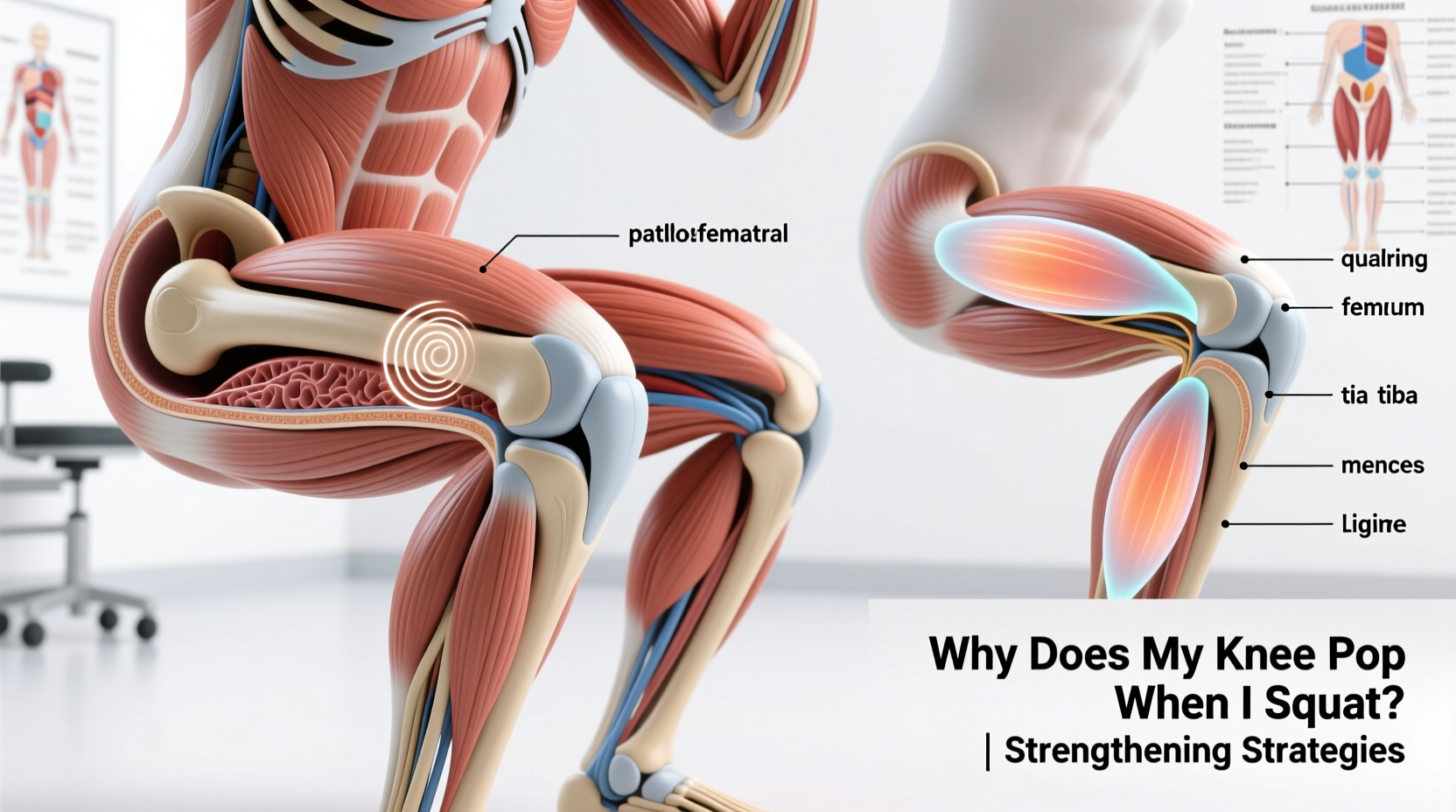
Knee popping—also known as crepitus—is the sensation or sound of grinding, snapping, or clicking within the joint. Several mechanisms can produce these noises:
- Cavitation: The most common cause. Tiny gas bubbles form in the synovial fluid (lubricant inside the joint) and collapse when pressure changes during movement, creating a pop. This is typically painless and benign.
- Tendon or ligament snapping: Tendons like the patellar tendon or iliotibial (IT) band may shift slightly over bony prominences as you move, producing a snap or pop.
- Cartilage wear or damage: In conditions like chondromalacia patella (softening of cartilage under the kneecap), roughened surfaces grind together, causing grinding sensations and noise, often accompanied by pain.
- Meniscus tears: A torn meniscus can create catching, locking, or popping, especially during deep squats.
- Poor tracking of the patella: If the kneecap doesn’t glide smoothly in its groove due to muscle imbalances, it can cause intermittent popping and discomfort.
Not all knee pops are dangerous. The key differentiator is pain. If the pop is isolated, infrequent, and not associated with swelling, instability, or pain, it’s likely innocuous. But if it happens regularly, worsens with activity, or is painful, it warrants attention.
How Muscle Imbalances Contribute to Knee Noise
The knee doesn’t operate in isolation. It's influenced heavily by the muscles of the hips, thighs, and calves. Weakness or tightness in surrounding musculature can alter joint mechanics, leading to abnormal forces and, ultimately, popping.
Two major contributors are:
- Weak glutes and hip abductors: When the gluteus medius and minimus are underactive, the femur rotates inward during squatting. This pulls the kneecap off its ideal track, increasing friction and potential for popping.
- Quadriceps dominance: Over-reliance on the quadriceps, particularly the vastus lateralis, can overpower the weaker vastus medialis obliquus (VMO), leading to lateral pull on the patella.
Additionally, tight structures such as the IT band, hamstrings, or calf muscles restrict normal motion, forcing compensatory movements that increase joint strain.
“Knee pain and popping are rarely about the knee itself. More often, they stem from proximal control deficits at the hip or ankle mobility restrictions.” — Dr. Sarah Nguyen, Physical Therapist & Sports Rehab Specialist
Effective Exercises to Strengthen the Knee and Reduce Popping
Strengthening isn't just about building bigger muscles—it's about restoring balance, improving neuromuscular control, and enhancing joint stability. Below are evidence-based exercises targeting the key areas that support healthy knee function.
1. Clamshells (Glute Medius Activation)
Lie on your side with knees bent at 90 degrees and feet together. Keeping your hips stacked, lift the top knee while keeping feet touching. Perform 3 sets of 15 reps per side.
2. Straight Leg Raises (VMO Engagement)
Lie on your back, one leg bent with foot flat, the other straight. Tighten the quad of the straight leg and lift it to the height of the opposite knee. Lower slowly. Do 3 sets of 12–15 reps.
3. Terminal Knee Extensions (TKEs) with Band
Anchor a resistance band behind you and loop it around your front knee. Slightly bend the knee and then extend fully, focusing on the last 15 degrees of motion. This isolates the VMO. 3 sets of 12 reps.
4. Box Squats (Controlled Loading)
Use a box or bench set so your hips lightly touch at parallel. Focus on sitting back, chest up, and knees aligned over toes. This reduces shear force and builds strength safely. Start with bodyweight, progress to light load. 3 sets of 10.
5. Step-Ups (Unilateral Stability)
Step onto a low platform (6–8 inches), driving through the heel. Control both the up and down phase. Keep the torso upright and avoid letting the knee drift inward. 3 sets of 8 per leg.
6. Calf Raises (Ankle Mobility Support)
Strong calves improve ankle dorsiflexion, reducing forward lean in squats that can stress the knees. Perform double- and single-leg raises, slow and controlled. 3 sets of 15–20.
Do’s and Don’ts for Knee Health During Squatting
| Do | Don’t |
|---|---|
| Keep knees aligned over second toe during squats | Allow knees to cave inward (valgus collapse) |
| Engage glutes before initiating descent | Rely solely on quads to stand up |
| Progress depth gradually based on comfort | Force deep squats with poor form |
| Include unilateral (single-leg) exercises weekly | Neglect single-leg stability work |
| Stretch hip flexors and calves daily | Ignore tightness that limits squat posture |
Real Example: Resolving Knee Pops in a Home Workout Routine
Mark, a 34-year-old office worker, began a home fitness program focused on bodyweight squats and lunges. After two weeks, he noticed a consistent pop in his right knee during each rep—painless at first, but soon followed by a dull ache.
He consulted a physical therapist who observed weak glute activation and limited ankle dorsiflexion. His squat form showed early knee valgus and excessive forward lean.
The therapist prescribed a four-week corrective plan:
- Daily foam rolling of quads, IT band, and calves
- Clamshells and banded walks for glute activation
- Terminal knee extensions to target VMO
- Box squats with emphasis on hip hinge mechanics
- Ankle mobility drills using wall stretches
After four weeks, Mark’s knee pop disappeared during squats, and his overall strength improved. He now includes glute activation drills as part of his warm-up before any lower-body session.
Step-by-Step Plan to Strengthen Your Knees in 6 Weeks
If you’re experiencing knee popping during squats, follow this progressive plan to build resilience and correct imbalances:
- Week 1–2: Assess and Activate
Focus on identifying weaknesses. Perform bodyweight squats in front of a mirror. Note knee alignment. Begin glute and VMO activation exercises (clamshells, straight leg raises, TKEs). Do 3x/week. - Week 3–4: Build Control
Introduce box squats and step-ups with slow tempos. Add ankle mobility work. Continue activation drills as warm-ups. Begin tracking symptoms in a journal. - Week 5–6: Load and Stabilize
Progress to goblet squats or light barbell squats with perfect form. Include single-leg Romanian deadlifts for hip-knee coordination. Aim for 3–4 sessions weekly, prioritizing quality over quantity.
This phased approach ensures gradual adaptation, minimizing risk while building functional strength.
Frequently Asked Questions
Is knee popping dangerous if it doesn’t hurt?
Occasional, pain-free popping is generally not harmful. It’s often due to cavitation or soft tissue movement. However, if it becomes frequent or starts causing discomfort, it’s wise to evaluate your movement patterns and strength balance.
Can squatting damage my knees?
Properly performed squats do not damage healthy knees. In fact, they strengthen the surrounding musculature and improve joint stability. The risk comes from poor technique, rapid progression, or pre-existing injury. Train smart, prioritize form, and listen to your body.
How long does it take to strengthen knees and stop popping?
With consistent effort, many people notice improvement in 4–6 weeks. Full correction may take 8–12 weeks, depending on initial imbalances and adherence to corrective exercises. Patience and consistency are key.
Final Recommendations and Prevention Checklist
To maintain long-term knee health and eliminate unwanted popping, integrate these habits into your routine:
- ✅ Warm up before lower-body workouts (5–10 minutes of dynamic movement)
- ✅ Perform glute activation drills 3x/week
- ✅ Stretch hip flexors, quads, and calves daily
- ✅ Record your squat form monthly to monitor alignment
- ✅ Avoid sudden increases in training volume or intensity
- ✅ Wear supportive footwear during exercise
- ✅ Address asymmetries (e.g., one knee pops more than the other) early
“Prehabilitation is just as important as rehabilitation. Strengthening the knee proactively prevents future injuries.” — Dr. James Carter, Orthopedic Sports Medicine Consultant
Take Action for Stronger, Quieter Knees
Your knees carry you through life—one step, lunge, and squat at a time. Popping sounds don’t have to be a permanent feature of your movement. With proper understanding, targeted strengthening, and mindful technique, you can resolve the root causes and build resilient joints.
Start today: perform a bodyweight squat in front of a mirror. Observe your knee path. Then, do three sets of clamshells and terminal knee extensions. Small actions compound into lasting results.




 浙公网安备
33010002000092号
浙公网安备
33010002000092号 浙B2-20120091-4
Comments
No comments yet. Why don't you start the discussion?