
Kombucha’s tangy, effervescent profile has made it a favorite among health enthusiasts and home fermenters alike. But when that tartness crosses into sharp, vinegar-like territory, enjoyment fades fast. A strong vinegary flavor isn’t necessarily a sign of failure—it’s usually a signal from your SCOBY (Symbiotic Culture Of Bacteria and Yeast) about the conditions in your brew. Understanding the science behind this sour shift empowers you to take control of fermentation and consistently produce kombucha that’s crisp, balanced, and refreshing.
The key lies in recognizing that kombucha is a living product shaped by time, temperature, sugar levels, and microbial activity. Vinegar taste primarily comes from acetic acid, one of several organic acids produced during fermentation. While some acetic acid contributes to kombucha’s signature zing, excess amounts overpower other flavors and indicate over-fermentation. The good news: with a few adjustments, you can fine-tune your process and achieve your ideal balance.
What Causes Kombucha to Taste Like Vinegar?
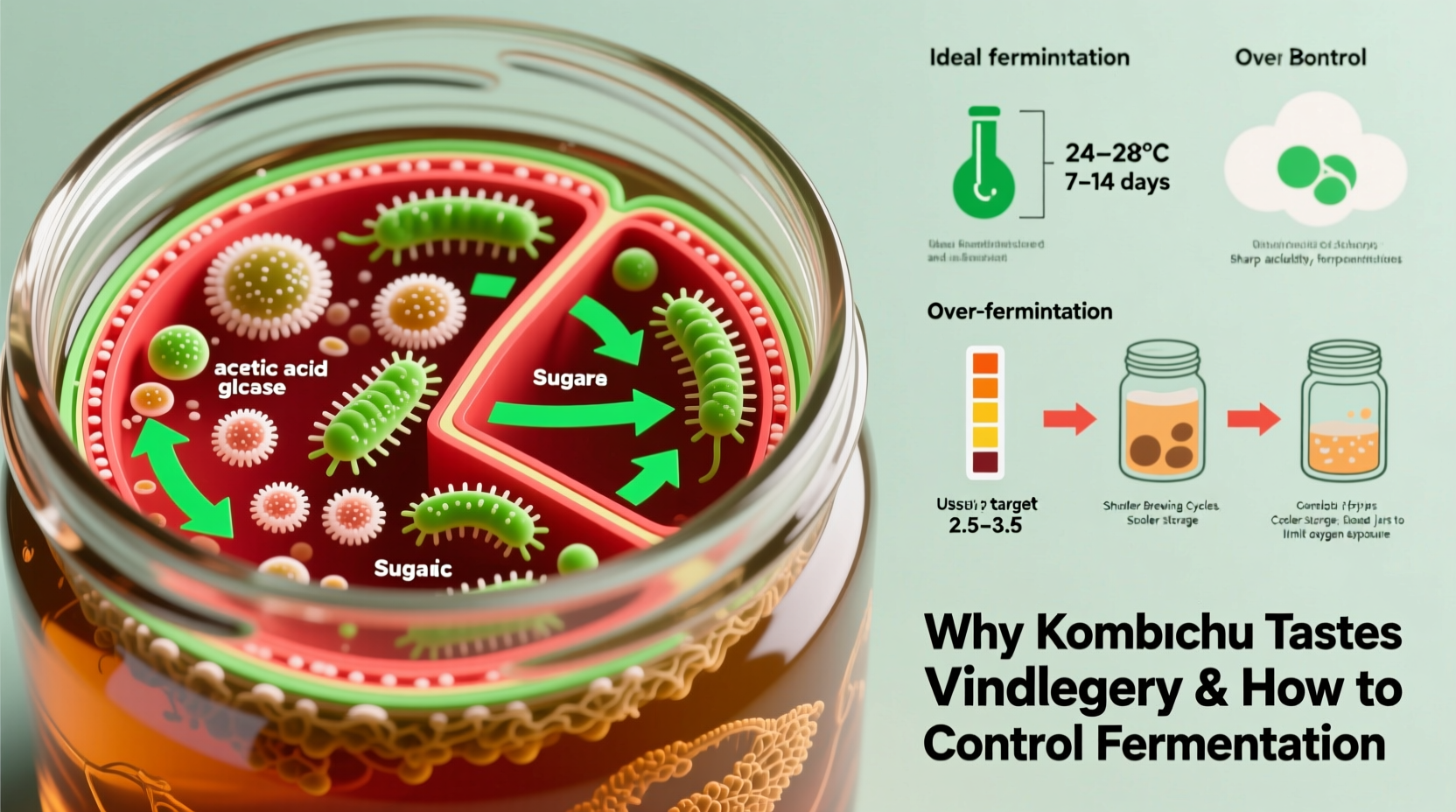
The dominant vinegar flavor in kombucha stems from acetic acid, which develops as the bacteria in your SCOBY—mainly Acetobacter species—convert alcohol (produced by yeast) into acid. This is a natural part of fermentation, but certain conditions accelerate this process, leading to excessive acidity.
- Extended fermentation time: The longer kombucha ferments, the more sugar is consumed and converted into acids. Beyond 10–14 days, depending on conditions, acidity often spikes.
- High ambient temperatures: Warm environments speed up microbial metabolism. At temperatures above 80°F (27°C), both yeast and bacteria become hyperactive, increasing acid production.
- Large or mature SCOBY: A thick, well-established SCOBY contains a dense population of bacteria, which can dominate the fermentation and lead to faster acidification.
- Low sugar concentration in later stages: As sugar depletes, the flavor balance shifts toward acidity since there’s less sweetness to counteract the sour notes.
- Inadequate flavor balancing: Skipping second fermentation or flavor additions like fruit juice or herbs means missing opportunities to round out the taste.
How Fermentation Works: The Science Behind the Sour
Fermentation is a two-phase biological process driven by symbiosis between yeast and bacteria in the SCOBY. In the first stage, yeast consumes sugar and produces ethanol (alcohol) and carbon dioxide. Then, acetic acid bacteria use that alcohol to generate acetic acid—the same compound found in household vinegar.
This transformation is essential for kombucha’s preservation and probiotic qualities, but it must be carefully managed. The ratio of lactic acid, gluconic acid, and acetic acid determines the final flavor profile. Acetic acid should complement, not dominate.
“Fermentation is not just chemistry—it’s ecology. Every variable from temperature to vessel shape influences the microbial balance.” — Dr. Lena Torres, Microbiologist & Fermentation Scientist
Environmental factors play a crucial role. For example, at cooler temperatures (68–74°F / 20–23°C), fermentation slows, allowing for a more gradual acid development and better flavor complexity. Conversely, hot environments push the culture toward rapid acid production, often at the expense of nuanced taste.
Step-by-Step Guide to Controlling Fermentation
Producing balanced kombucha requires intentional control over each phase of brewing. Follow this timeline to prevent excessive sourness and maintain consistency across batches.
- Brew sweet tea: Use 1 cup of white sugar per gallon of water and 4–6 tea bags (black, green, or a blend). Avoid herbal teas without caffeine, as they may harm the SCOBY.
- Cool the tea: Let it reach room temperature (ideally 68–75°F) before adding the SCOBY. Hot tea can kill the culture.
- Add starter liquid: Include 1–2 cups of unflavored, raw kombucha from a previous batch (or store-bought raw variety) to lower pH and inhibit mold.
- Begin primary fermentation: Place the SCOBY and tea mixture in a glass jar covered with a breathable cloth (e.g., coffee filter or paper towel) secured with a rubber band.
- Monitor daily after day 5: Start tasting with a clean straw every 2–3 days. Look for a balance between sweetness and tartness.
- Stop fermentation at the right time: When the kombucha reaches your preferred tartness (usually 7–10 days), remove the SCOBY and reserve 1–2 cups as starter for the next batch.
- Proceed to second fermentation (optional): Add fruit, juice, or herbs to bottles and ferment 2–5 days at room temperature to build carbonation and mellow acidity.
- Refrigerate: Cold halts fermentation and preserves flavor. Always refrigerate before drinking.
Do’s and Don’ts for Balanced Kombucha Flavor
| Do’s | Don’ts |
|---|---|
| Maintain a consistent brewing temperature (68–75°F) | Place your jar near heat sources like ovens or radiators |
| Use proper ratios: 1 cup sugar per gallon, 4–6 tea bags | Reduce sugar too much—yeast needs fuel for balanced fermentation |
| Taste frequently during fermentation | Leave kombucha fermenting for weeks without checking |
| Store finished kombucha in the fridge promptly | Keep bottled kombucha at room temperature indefinitely—pressure can build and cause explosions |
| Use glass containers only—avoid metal or plastic | Clean your SCOBY with tap water; chlorine can damage it. Use filtered or dechlorinated water. |
Real Example: Adjusting Fermentation After a Summer Batch Gone Sour
Sarah, a home brewer in Austin, Texas, noticed her summer kombucha batches were consistently too acidic. Despite using the same recipe, her kombucha tasted more like apple cider vinegar than a refreshing drink. She kept her brewing jar in the kitchen, where afternoon sun raised temperatures above 85°F.
After tracking her brew times and ambient temps, she realized fermentation was completing in just 6 days—two days earlier than in winter. By moving the jar to a cooler pantry and starting taste tests on day 4, she began bottling at peak balance. She also reduced her primary fermentation window to 5–7 days during hot months. The result? A smoother, more palatable kombucha with just the right tang.
Sarah now adjusts her schedule seasonally and uses a small thermometer near her jar. Her experience highlights how environment directly impacts fermentation speed and flavor.
Checklist: Prevent Overly Sour Kombucha
- ✅ Measure and maintain room temperature (use a thermometer if needed)
- ✅ Begin tasting kombucha on day 5 of fermentation
- ✅ Limit primary fermentation to 7–10 days (shorter in warm climates)
- ✅ Use fresh, high-quality tea and unrefined cane sugar
- ✅ Reserve 1–2 cups of starter liquid for each new batch
- ✅ Refrigerate finished kombucha to halt acid development
- ✅ Experiment with second fermentation using sweet fruits (e.g., mango, peach, berries) to offset sourness
- ✅ Rotate or thin large SCOBYs if fermentation becomes too rapid
Can You Fix Kombucha That’s Already Too Sour?
If you’ve opened a bottle only to wince at the vinegar punch, don’t pour it out. Overly sour kombucha still has value and can be salvaged.
- Dilute it: Mix 1 part sour kombucha with 1–2 parts water or unsweetened tea for a lighter, drinkable version.
- Blend into smoothies: Its tang complements fruits and greens. Try combining with banana, spinach, and pineapple.
- Use as a salad dressing base: Whisk with olive oil, mustard, honey, and herbs for a probiotic-rich vinaigrette.
- Repurpose as starter liquid: Extra-sour kombucha makes excellent starter due to its low pH and high acid content.
- Start a new batch: Use it as 100% starter liquid in your next brew to jumpstart fermentation with robust acidity control.
“Over-fermented kombucha isn’t wasted—it’s a resource. I use mine for cleaning surfaces or watering acid-loving plants.” — Marcus Reed, Home Fermentation Educator
FAQ: Common Questions About Kombucha Sourness
Is vinegary kombucha safe to drink?
Yes, kombucha that tastes like vinegar is generally safe if there are no signs of mold, off smells (like rot or sulfur), or improper storage. High acidity actually helps preserve the beverage. However, if you have acid sensitivity or digestive concerns, consume it in moderation.
Can I reduce sourness by adding sugar after fermentation?
Adding sugar post-fermentation won’t reduce sourness and may restart fermentation in sealed bottles, creating dangerous pressure. Instead, blend sour kombucha with sweeter liquids (juice, herbal tea) when serving, or use it in recipes where sweetness is added separately.
Why does my kombucha get sourer even in the fridge?
Fermentation slows dramatically in cold temperatures but doesn’t stop entirely. Trace microbial activity can continue, especially if bottles aren’t fully sealed or contain residual sugars. For best flavor stability, consume refrigerated kombucha within 1–2 months.
Master Your Brew: Take Control of Flavor and Fermentation
Kombucha is both an art and a science—one that rewards observation, patience, and small adjustments. The vinegary taste many home brewers encounter isn’t a flaw, but feedback. It tells you the bacteria are active, the environment is warm, or the timing ran long. By tuning into these signals, you gain deeper insight into your culture and greater control over your results.
Every batch teaches you something: how temperature shifts alter timelines, how SCOBY size affects speed, how flavor pairing can transform even an over-fermented jar into something enjoyable. Consistency comes not from rigid rules, but from responsive care.




 浙公网安备
33010002000092号
浙公网安备
33010002000092号 浙B2-20120091-4
Comments
No comments yet. Why don't you start the discussion?