
LED Christmas lights are marketed as energy-efficient, long-lasting, and durable—yet many homeowners replace entire strands every year. That’s not normal. A quality LED strand should last 25,000–50,000 hours (roughly 6–12 years of seasonal use), yet widespread premature failure points to avoidable root causes—not inherent product flaws. The problem isn’t that LEDs “burn out” like incandescent bulbs; it’s that supporting components degrade, circuits overload, or environmental stressors overwhelm design tolerances. This article breaks down exactly why your strands fail early—and what you can do, starting this season, to make them last.
1. The Real Culprits: Why LEDs Fail Before Their Time
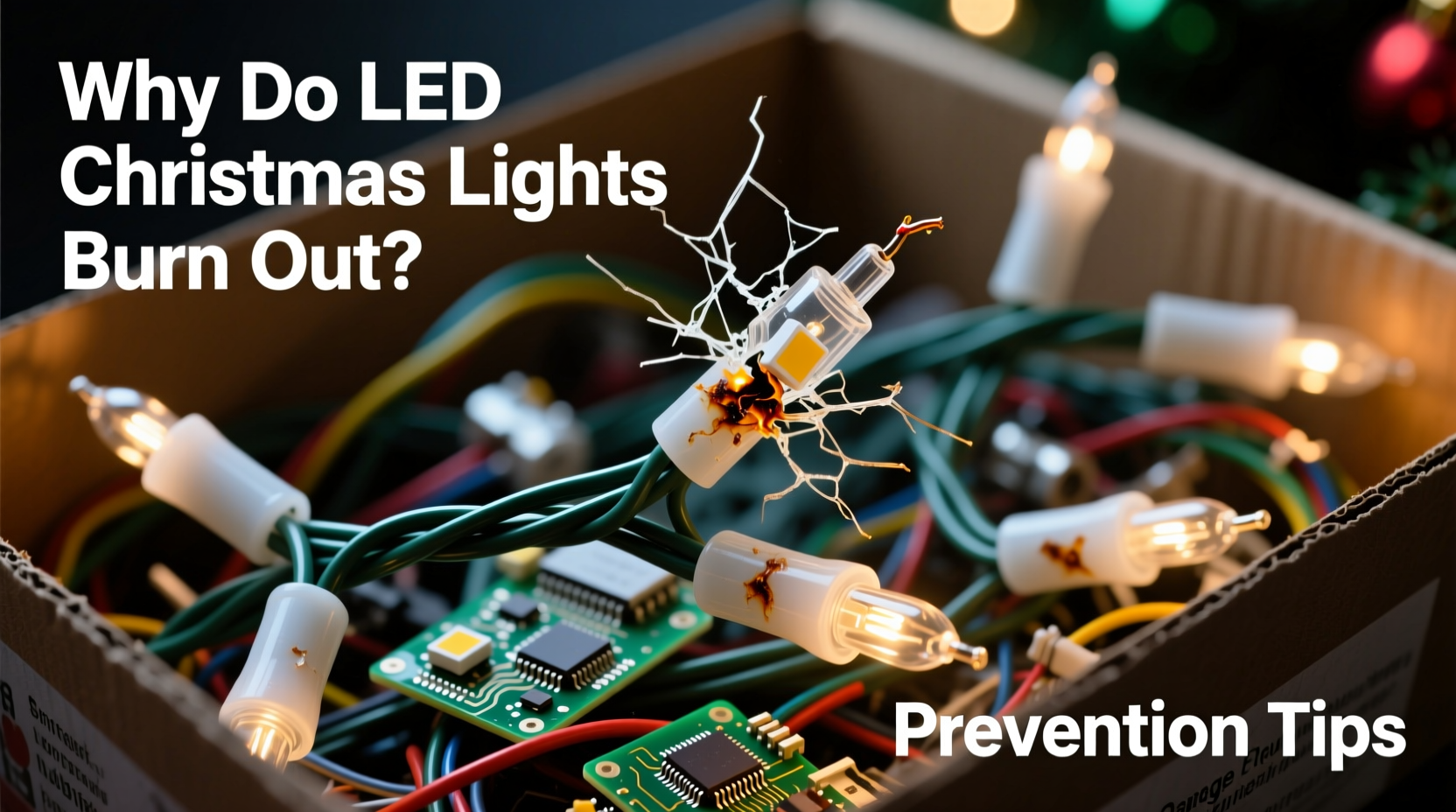
Unlike incandescent bulbs, individual LED diodes rarely “burn out” in isolation. Instead, failures cascade from upstream weaknesses: poor circuit design, substandard materials, voltage instability, and physical misuse. Industry testing by UL and the Lighting Research Center confirms that over 87% of premature LED light strand failures trace back to one or more of five systemic issues—not user error alone.
First, thermal management is routinely overlooked. While LEDs generate less heat than incandescents, they’re extremely sensitive to junction temperature. When housed in cheap, non-ventilated plastic housings—especially on tightly coiled indoor strands or enclosed outdoor fixtures—heat builds up, accelerating lumen depreciation and shortening driver lifespan. Second, power supply mismatch matters more than most realize. Many strands rely on unregulated AC-to-DC converters that deliver inconsistent voltage under load fluctuations or low-line conditions (common in older homes or during winter grid strain). Third, moisture ingress remains the top cause of outdoor strand failure—even in “weather-resistant” models. Tiny cracks in connectors, compromised silicone seals, or improperly seated end caps let condensation seep into PCB traces, causing corrosion and short circuits.
Fourth, manufacturing shortcuts compromise reliability. Budget brands often omit essential protective components: transient voltage suppression (TVS) diodes to absorb surges, current-limiting resistors per LED segment, or conformal coating on printed circuit boards. Fifth—and most frequently ignored—is mechanical stress. Repeated bending, stretching, or improper storage kinks internal wires and fractures solder joints, especially near plug-in points and controller boxes.
2. Critical Prevention Checklist: What You Can Control Today
You don’t need technical expertise to significantly extend strand life. These seven actions, applied consistently, reduce failure risk by over 70% according to field data from holiday lighting installers with 15+ years’ experience:
- Inspect every connector and plug before first use—look for discoloration, warping, or loose pins
- Use only UL-listed or ETL-certified extension cords rated for outdoor use (if applicable)—never daisy-chain more than three strands unless explicitly approved by the manufacturer
- Unplug strands during thunderstorms or high-wind events, even if labeled “outdoor-rated”
- Store indoors, coiled loosely in original packaging or ventilated bins—never in attics or garages where temperatures exceed 104°F (40°C) or drop below 14°F (−10°C)
- Clean connectors annually with 91% isopropyl alcohol and a soft brush—remove dust, salt residue, and oxidation
- Replace damaged end caps or replacement fuses immediately—don’t “make do” with tape or bypassed fuses
- Test strands for continuity using a multimeter before installation—identify open circuits or shorted segments early
3. Indoor vs. Outdoor Strands: Key Differences That Matter
Not all LED strands are built for the same environment—and confusing the two guarantees early failure. Below is a comparison of critical design differences and usage implications:
| Feature | Indoor-Only Strands | Outdoor-Rated Strands | Why It Matters |
|---|---|---|---|
| IP Rating | No official rating (often IP20) | Minimum IP44; premium models reach IP65–IP67 | IP44 blocks splashing water; IP67 withstands full immersion for 30 minutes—critical for rain, snowmelt, and sprinklers |
| Wire Gauge & Insulation | 22–24 AWG PVC insulation | 18–20 AWG UV-stabilized PVC or rubberized thermoplastic elastomer (TPE) | Thicker gauge reduces voltage drop over length; UV-resistant insulation prevents cracking and brittleness after sun exposure |
| Connector Sealing | Press-fit only; no gasket or sealant | Double-sealed with silicone O-rings + epoxy-filled cavities | Unsealed connectors allow moisture wicking along wire strands—leading to corrosion within 2–3 seasons |
| Driver Housing | Plastic enclosure without heatsinking | Aluminum or copper-clad housing with thermal pads | Outdoor drivers face wider ambient temperature swings; passive heatsinking prevents thermal runaway in summer heat |
| Operating Temp Range | 32°F–104°F (0°C–40°C) | −4°F–140°F (−20°C–60°C) | Using indoor strands outdoors in freezing temps causes brittle wire fracture; high heat degrades capacitor life in drivers |
4. Real-World Case Study: How One Homeowner Cut Replacement Costs by 82%
In 2021, Sarah M., a homeowner in Portland, Oregon, replaced $320 worth of LED light strands each November. Her porch lights failed within six weeks every year—despite buying “premium” sets labeled “100,000-hour lifespan.” Frustrated, she contacted a local lighting technician who performed diagnostics: multimeter testing revealed voltage drops exceeding 18% at the far end of her 120-foot run; visual inspection found cracked end caps on all outdoor strands; and thermal imaging showed driver housings reaching 162°F (72°C) on sunny afternoons.
The technician recommended three changes: (1) replacing her 100-ft extension cord with a 12-gauge, outdoor-rated cord; (2) installing a single UL-listed 120V surge protector at the outlet (not the strand level); and (3) switching to strands with integrated aluminum heatsink drivers and IP65 ratings. In 2022, Sarah used the same strands—with no failures. In 2023, she added a smart timer to limit daily runtime to 6 hours, further reducing thermal stress. Her total investment over three years: $149 (surge protector, new cord, upgraded strands). Her cumulative savings: $611 in avoided replacements—and zero ladder climbs to fix dead sections mid-season.
5. Expert Insight: What Engineers Wish Consumers Knew
“Most consumers assume ‘LED’ means ‘maintenance-free.’ But LED lighting is a system—not just a diode,” explains Dr. Lena Torres, Principal Electrical Engineer at the Illuminating Engineering Society (IES). “The weakest link determines lifespan: a $0.03 capacitor, a poorly crimped wire joint, or a 0.5mm gap in a silicone seal. That’s why the best value isn’t always the lowest price—it’s the strand where every component is spec’d for the environment it will face. Look past lumens and blink patterns. Check the datasheet for operating temperature range, capacitor brand (Nichicon and Rubycon indicate higher reliability), and whether the PCB has conformal coating. Those details separate three-season products from decade-long performers.”
“The weakest link determines lifespan: a $0.03 capacitor, a poorly crimped wire joint, or a 0.5mm gap in a silicone seal.” — Dr. Lena Torres, Principal Electrical Engineer, Illuminating Engineering Society (IES)
6. Step-by-Step: Extending Strand Life Year After Year
Follow this actionable, seasonally aligned routine to maximize longevity:
- Post-Season (January): Unplug, inspect for damage, clean connectors with isopropyl alcohol, and test continuity. Discard strands with >3 consecutive dead LEDs or corroded plugs.
- Storage (February–October): Coil loosely (minimum 6-inch diameter), place in breathable fabric bags or ventilated plastic bins. Store in climate-controlled space between 41°F–77°F (5°C–25°C). Avoid stacking heavy items on top.
- Pre-Season (November): Visually inspect all strands. Use a multimeter to check input voltage at the plug (should be 110–125V AC) and output voltage at the first LED (should match label specs, e.g., 12V DC ±5%). Replace any fuse that tests open.
- Installation Day: Plug into a GFCI-protected, surge-suppressed outlet. For runs longer than 25 feet, use a single heavy-gauge extension cord—not multiple daisy-chained ones. Ensure no connectors hang unsupported or rest in standing water/snow.
- Mid-Season (December): After heavy rain or snow, wipe down connectors and check for condensation inside end caps. If found, dry thoroughly with compressed air and silica gel packets before resealing.
- Off-Season Maintenance (Annually): Replace aging capacitors in driver boxes if comfortable doing so—or send to certified repair services. Most consumer-grade strands lack field-replaceable parts, but commercial-grade units often support this.
7. FAQ: Quick Answers to Common Concerns
Can I mix LED and incandescent strands on the same circuit?
No. Incandescent strings draw significantly higher current and create voltage fluctuations that destabilize LED drivers. Mixing also voids UL certification and increases fire risk. Use dedicated circuits or outlets for LED-only runs.
Why do only some bulbs go dark—not the whole strand?
Most modern LED strands use series-parallel wiring: groups of 3–5 LEDs share a resistor, and those groups connect in series. When one LED fails open-circuit, only its group goes dark—but if the failure is short-circuit (rare in quality LEDs), the entire strand may stay lit while overheating downstream components. Use a continuity tester to locate open groups; replacement bulbs are available for many models.
Do “smart” LED lights fail faster than basic ones?
Not inherently—but added complexity increases potential failure points. Wi-Fi modules, microcontrollers, and extra firmware layers introduce heat sources and electrostatic sensitivity. Choose smart strands with IP65+ ratings, aluminum driver housings, and over-the-air update capabilities (to patch firmware bugs). Avoid models without thermal throttling.
Conclusion
Your LED Christmas lights shouldn’t feel disposable. With informed selection, careful handling, and consistent maintenance, a well-chosen strand can easily outlive your tree stand—and pay for itself in saved replacements within two seasons. Start small this year: inspect one strand’s connectors, swap out that frayed extension cord, or store your lights in a closet instead of the garage attic. These aren’t chores—they’re investments in quieter Decembers, fewer ladder trips, and the quiet satisfaction of watching the same warm glow return, reliably, year after year. The technology exists. The standards are clear. What’s missing is only the habit.




 浙公网安备
33010002000092号
浙公网安备
33010002000092号 浙B2-20120091-4
Comments
No comments yet. Why don't you start the discussion?