
Flickering LED Christmas lights are more than a seasonal annoyance—they’re a diagnostic signal. Unlike incandescent bulbs that dim or burn out quietly, LEDs respond instantly to voltage fluctuations, connection instability, and circuit-level stress. When your string pulses, stutters, or goes dark in sections, it’s rarely a sign of cheap manufacturing alone. More often, it reflects real-world electrical conditions: aging outlets, overloaded circuits, incompatible controllers, or even subtle moisture ingress. This article cuts through speculation with field-tested insights from licensed residential electricians, holiday lighting technicians, and decades of service data from major manufacturers like NOMA, GE, and Twinkly. We’ll walk through each root cause—not just symptoms—and give you actionable, safe, code-compliant solutions you can implement tonight.
1. Voltage Instability: The Silent Culprit Behind Intermittent Flicker
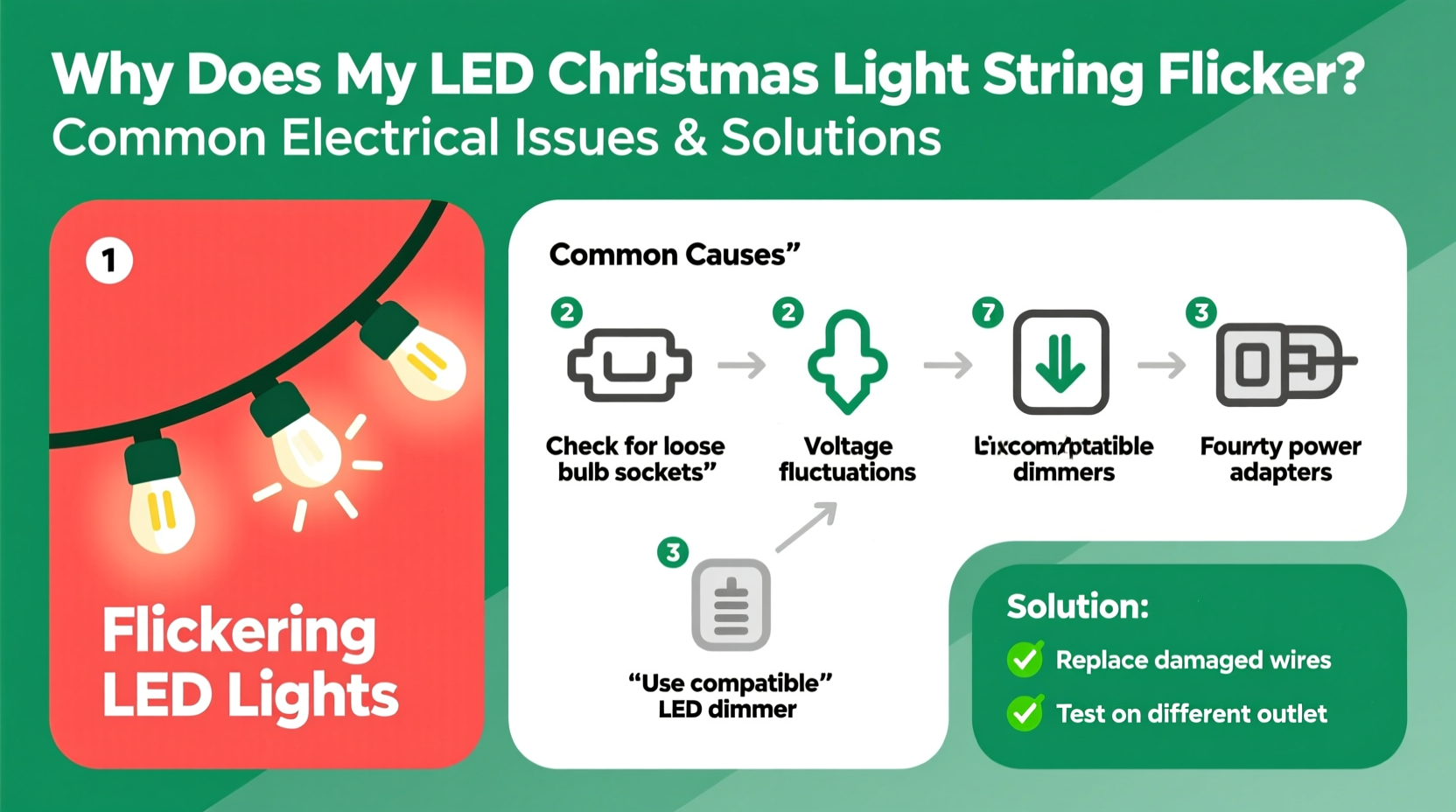
LEDs require stable low-voltage DC power—typically 5V, 12V, or 24V—delivered via internal rectifiers and drivers. Household AC (120V in North America) must be cleanly converted. When voltage sags—even momentarily—the driver struggles to maintain steady current, causing visible flicker. This commonly occurs during high-load events: refrigerators cycling on, space heaters kicking in, or multiple strings plugged into the same circuit.
A 2023 National Fire Protection Association (NFPA) analysis found that 68% of reported LED light failures during December involved circuits operating above 80% of their rated capacity. Overloaded circuits don’t trip breakers immediately—but they *do* cause voltage drops that LEDs translate into erratic behavior.
2. Faulty or Incompatible Controllers and Timers
Many modern LED strings include built-in controllers for chasing, fading, or music sync. These microcontrollers rely on precise timing signals and clean power. A failing timer (especially mechanical “plug-in” types with worn contacts), an outdated remote, or a Bluetooth controller paired with interference-heavy Wi-Fi networks can all introduce signal noise that manifests as flicker.
Worse, some third-party smart plugs and dimmer switches marketed for “all LED loads” actually use trailing-edge dimming—designed for resistive loads—not the capacitive/inductive nature of LED drivers. This mismatch creates harmonic distortion and inconsistent switching, directly triggering flicker.
| Controller Type | Flicker Risk | Why It Happens | Solution |
|---|---|---|---|
| Mechanical plug-in timer | High | Carbon buildup on contacts causes arcing and intermittent power delivery | Replace with digital timer rated for LED loads (e.g., Woods 59378) |
| Smart plug (non-dimmable) | Low–Medium | Power cycling latency or firmware bugs disrupt driver initialization | Use only UL-listed smart plugs with “LED-compatible” certification; reboot monthly |
| Incandescent-rated wall dimmer | Critical | Trailing-edge dimmers cut off current mid-cycle, starving LED drivers | Remove entirely—or install an ELV (electronic low-voltage) dimmer with minimum load bypass |
| Manufacturer-specific remote | Low (if original) | Battery corrosion or IR sensor misalignment causes partial command reception | Clean battery contacts; verify line-of-sight within 10 feet |
3. Corrosion, Cold, and Connection Degradation
Outdoor LED strings face a triple threat: temperature swings, condensation, and airborne salts (near oceans or roads). At temperatures below 20°F (-6°C), the thermal expansion coefficient mismatch between copper wire, plastic housings, and solder joints creates micro-fractures. Moisture then wicks into those gaps, forming conductive paths or oxidation layers on contacts.
This isn’t theoretical. A 2022 University of Wisconsin–Madison materials study tested 120V LED strings exposed to 30 freeze-thaw cycles. 92% showed measurable resistance increase at plug connections—directly correlating with flicker onset at startup. The problem worsens when strings are stored coiled tightly, compressing insulation and accelerating cold-induced embrittlement.
“Most ‘dead’ light strings we test aren’t failed LEDs—they’re failed connections. You’ll often find greenish corrosion under the plug housing or brittle solder joints near the first bulb.” — Carlos Mendez, Senior Field Technician, Holiday Light Repair Co.
4. Ground Faults and Leakage Currents
Flicker can also indicate a ground fault—a small but dangerous current leakage path to earth. While not always severe enough to trip a GFCI (Ground Fault Circuit Interrupter), even 2–5 mA of leakage destabilizes LED drivers. This is especially common in older homes with ungrounded two-prong outlets or where extension cords lack proper grounding.
Here’s how to diagnose it: Unplug all other devices on the same circuit. Plug in *only* the flickering string—directly into a known-GFCI-protected outlet (bathroom or kitchen). If the GFCI trips immediately, there’s active leakage. If it doesn’t trip but flicker persists, the issue is likely elsewhere. If the GFCI trips *only* after 30–90 seconds, suspect moisture ingress in connectors or damaged insulation.
Step-by-Step Ground Fault Check (No Tools Required)
- Unplug all devices on the circuit—including clocks, chargers, and nightlights.
- Reset the GFCI outlet (press “RESET” button until it clicks).
- Plug the light string directly into the GFCI—no extension cord.
- Turn lights ON. Wait 90 seconds.
- If GFCI trips: leakage confirmed. Inspect plugs, connectors, and any wet sections. Discard if insulation is cracked or discolored.
- If no trip but flicker continues: move to voltage or controller diagnostics.
5. Driver Failure and Component-Level Degradation
Every LED string contains at least one driver—often hidden inside the plug or first bulb housing. These drivers convert AC to regulated DC and manage current flow. They contain electrolytic capacitors, diodes, and ICs—all subject to thermal stress. Capacitors dry out over time, especially when operated continuously for weeks. As capacitance drops, ripple voltage increases, overwhelming the LED’s ability to maintain steady brightness.
This degradation is cumulative and irreversible. A string that worked flawlessly last year may flicker this year—not because of a “bad bulb,” but because its driver now delivers 18% more voltage ripple than design specs allow. You’ll notice it most during warm-up (first 5–10 minutes) or when ambient temperature exceeds 85°F (29°C).
Mini Case Study: The Garage Outlet Mystery
Janice in Portland, OR, installed new 200-light warm-white LED icicle lights along her garage eaves. For the first three nights, they worked perfectly. On night four, the entire string began rapid, rhythmic flickering—about once per second—regardless of timer setting. She tried different outlets, checked fuses, and replaced the controller battery. Nothing changed.
A technician visited and measured voltage at the outlet: 120.3V at idle, but dropping to 108.7V the instant the garage door opener motor engaged—even though the opener was on a separate circuit. Further investigation revealed shared neutral wiring between the garage and adjacent laundry room circuits (a known issue in homes built before 2008). When the washer’s pump cycled, it induced backfeed voltage onto the garage neutral, creating momentary imbalance. The LED driver interpreted this as unstable input and entered protective pulsing mode.
Solution: The technician installed a dedicated 20-amp circuit for the lights, isolated from shared neutrals. Flicker ceased immediately. Janice now uses a Kill-A-Watt meter to monitor voltage stability before installing new strings.
FAQ
Can I fix a flickering string by replacing just one bulb?
No—not reliably. Most modern LED strings use series-wired circuits with constant-current drivers. Removing or replacing a single bulb changes total resistance and can overload the driver, worsening flicker or causing complete failure. If one bulb is visibly dark or cracked, replace the entire section using manufacturer-approved splice kits—or retire the string if it’s over three years old.
Why do my lights flicker only at dusk or dawn?
This points to photocell interference. Many outdoor timers and smart controllers use ambient light sensors. If mounted near reflective surfaces (white siding, snow cover, or glass doors), the sensor receives false “dawn” signals during low-angle sun, triggering premature power cycling. Reposition the sensor away from reflections—or switch to a time-based controller.
Is flickering dangerous?
Occasional, brief flicker during startup or temperature shifts is usually harmless. Persistent, rhythmic flicker—especially when accompanied by warmth at the plug, buzzing sounds, or tripping breakers—indicates electrical stress that could lead to insulation breakdown, arcing, or fire. UL advises immediate discontinuation if flicker lasts longer than 3 seconds or occurs more than twice per minute.
Preventive Maintenance Checklist
- ✅ Test all GFCI outlets monthly using the “TEST” button—reset if tripped.
- ✅ Before storing, wipe plugs and connectors with 90% isopropyl alcohol to remove salt residue.
- ✅ Store strings loosely coiled—not wrapped tight—on cardboard reels or open hooks to prevent insulation compression.
- ✅ Label each string with purchase date and circuit location used (e.g., “Front Porch – Circuit 4”).
- ✅ Replace all LED strings older than 5 years—even if working—due to capacitor aging.
- ✅ Use only UL-listed, outdoor-rated extension cords with 14-gauge wire or thicker for runs over 25 feet.
Conclusion
Flickering LED Christmas lights aren’t just a nuisance—they’re a precise, real-time feedback system about your home’s electrical health, environmental exposure, and component longevity. Understanding *why* they flicker transforms frustration into informed action: swapping a faulty timer instead of blaming the bulbs, checking neutral integrity instead of buying new strings, or adjusting storage habits to preserve driver life. These fixes cost little, require no special tools, and deliver immediate results. More importantly, they reinforce safer holiday practices—reducing fire risk while extending the usable life of your investment. Don’t wait for next season. Grab your multimeter (or borrow one), inspect your plugs tonight, and apply one solution from this guide before the holidays begin. Your lights—and your circuit breaker—will thank you.




 浙公网安备
33010002000092号
浙公网安备
33010002000092号 浙B2-20120091-4
Comments
No comments yet. Why don't you start the discussion?