
When you unbox a new set of LED Christmas lights—or dig out last year’s strand from the attic—you might notice something unexpected: a thin, insulated green wire running alongside the familiar white (or black/red) conductors. It doesn’t plug into your outlet. It doesn’t connect to any bulb socket. And yet, it’s there—deliberate, consistent, and often unexplained on the packaging. This isn’t a manufacturing flaw or a leftover from an older design. That green wire is a critical, code-compliant safety component with a precise electrical function—one that many consumers overlook until their lights flicker, go dark, or fail a safety inspection. Understanding its role isn’t just technical trivia; it’s essential for safe installation, accurate troubleshooting, and responsible disposal.
The Green Wire Is the Grounding Conductor—Not a “Third Live” Wire
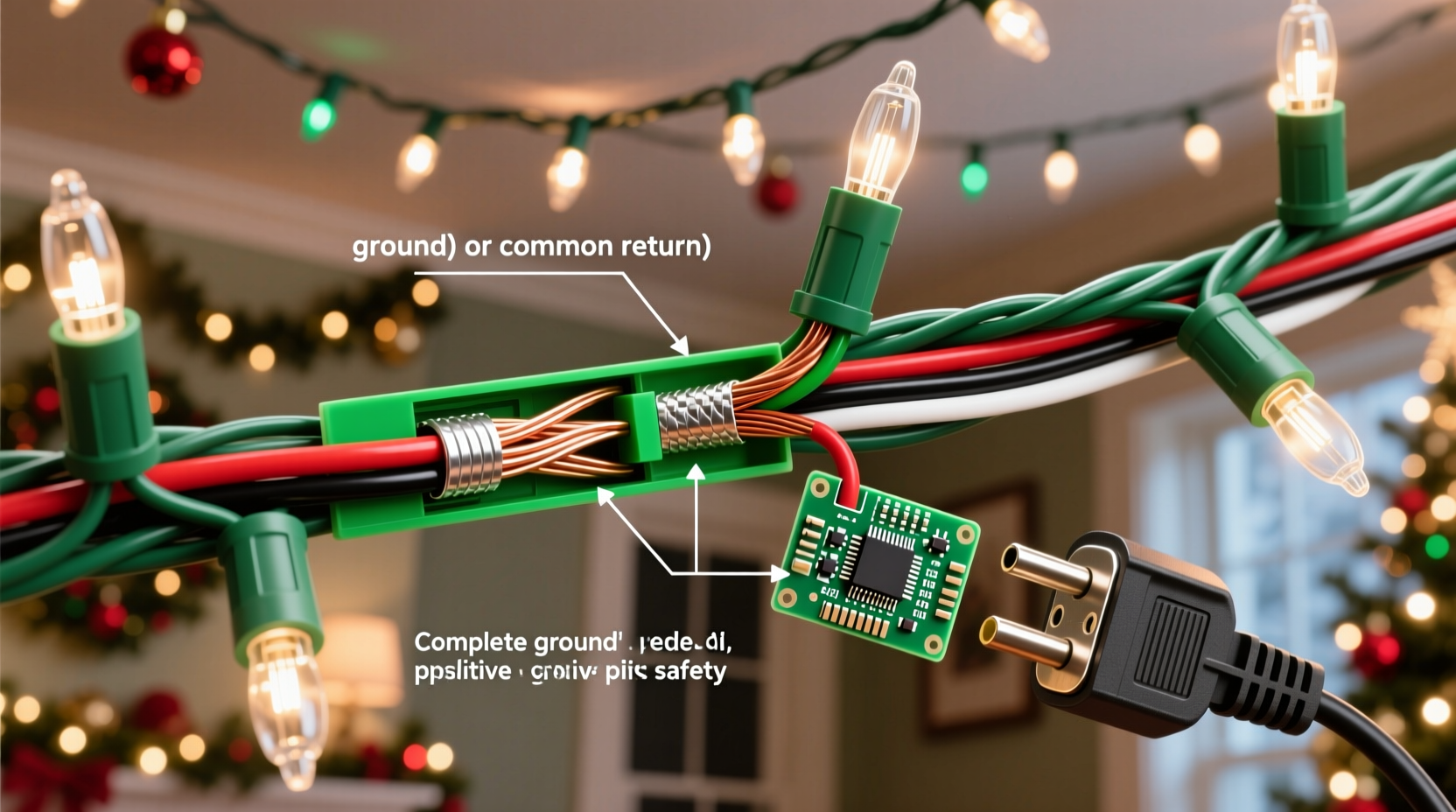
In North American residential electrical systems (governed by the National Electrical Code, or NEC), the green wire serves one non-negotiable purpose: equipment grounding. Unlike the black (hot) and white (neutral) wires that carry operating current, the green wire carries *no current* during normal operation. Its sole job is to provide a low-resistance path back to the electrical panel—and ultimately to earth—in the event of an internal fault, such as a loose connection shorting to the light string’s metal housing, transformer casing, or even a conductive outer jacket.
This distinction matters deeply for LED light strings because they almost always contain a step-down transformer or switching power supply housed inside the plug or inline controller. These components convert 120V AC household current to safer, lower-voltage DC (typically 5V, 12V, or 24V) for the LEDs. While the output side is low-voltage and inherently less hazardous, the input side remains connected directly to line voltage. If insulation fails inside the plug or cord, or if moisture breaches the housing, the metal parts of the assembly could become energized at full 120V. Without a proper ground path, that voltage stays trapped—posing a shock hazard to anyone touching the string while standing on a damp porch, ladder, or wet grass.
“The presence of a green grounding conductor in outdoor-rated LED light strings isn’t optional—it’s a NEC-mandated safeguard against electrocution, especially in wet or conductive environments. Removing or ignoring it compromises the entire safety architecture.” — James R. Loomis, P.E., Senior Electrical Safety Engineer, UL Solutions
How Grounding Works in Practice: A Real-World Scenario
Consider this realistic case: Sarah installed her new 300-light LED icicle string along her aluminum gutters. She used standard plastic clips and plugged it into an outdoor GFCI outlet—everything seemed correct. On the third night of display, her husband touched the string while adjusting a sagging section and felt a distinct, sharp tingle. He immediately unplugged it. An electrician later discovered that a tiny puncture in the cord’s outer jacket—caused by friction against a rough gutter edge—had exposed the hot conductor. That conductor had contacted the bare aluminum mounting bracket, which was bonded to the home’s gutter system. Because the light string’s green ground wire was properly connected to the outlet’s grounding terminal, the fault current tripped the circuit breaker within milliseconds. The tingle Sarah’s husband felt was residual voltage before the trip—not a sustained shock. Had the green wire been cut, disconnected, or absent entirely, the entire gutter system could have remained energized indefinitely, creating a lethal hazard.
This scenario underscores why the green wire isn’t decorative or redundant. It’s the silent guardian that turns a potentially fatal fault into a nuisance outage.
What the Green Wire Looks Like—and What It Doesn’t Look Like
Visually, the green wire in modern LED light strings is typically 18–22 AWG, insulated with green PVC or thermoplastic, and runs continuously from the male plug’s grounding pin (the round U-shaped prong) through the entire length of the cord, terminating at the female end’s grounding contact. It may be bundled tightly with the hot and neutral conductors or run separately under a protective sheath. Crucially, it is *never* connected to any LED, resistor, or control chip along the string—it bypasses all lighting electronics entirely.
It is also not to be confused with:
- Green-colored insulation on a hot or neutral conductor (rare, but possible in non-UL-listed imports—always verify wire function with a multimeter)
- A “data” or “signal” wire in smart RGB light strings (those are usually white, yellow, or blue—and carry digital commands, not safety grounding)
- A spare or unused conductor left over from multi-circuit designs (true spares are capped, not terminated at both ends)
- A bonding wire for EMI/RFI suppression (those are typically bare copper braid, not insulated green)
Grounding Requirements: Indoor vs. Outdoor, Plug Types, and Certification
Not all LED light strings include a green ground wire—and that’s intentional and code-permitted, depending on construction and rating. Here’s how standards determine its presence:
| Light String Type | Green Ground Required? | Rationale & Key Standards |
|---|---|---|
| UL 588-listed outdoor strings with metal housings or exposed conductive parts | ✅ Yes | Mandatory per NEC Article 410.136 and UL 588 Section 27. Grounding prevents shock when moisture bridges insulation. |
| UL 588-listed indoor-only strings with fully double-insulated plastic housings | ❌ No | Permitted under UL 588 Section 26. Relies on reinforced insulation instead of grounding—often uses only two-conductor cords (no green wire). |
| Cord-and-plug-connected strings rated for “damp locations” (e.g., covered porches) | ✅ Yes | NEC 400.4(A)(1) requires grounding for all cord-connected equipment in damp or wet locations, regardless of voltage. |
| Low-voltage (≤30V) sets powered by external Class 2 power supplies | ⚠️ Context-dependent | The *power supply* must be grounded if metal-housed and line-powered; the low-voltage output side does not require grounding—but the input cord to the supply does. |
Crucially, the presence of a green wire alone doesn’t guarantee safety. It must be part of a complete, unbroken grounding path—including a properly grounded outlet (verified with an outlet tester), intact plug pins, and no internal breaks. Many DIYers unknowingly defeat grounding by using cheater plugs, extension cords without ground pins, or daisy-chaining more than three strings (which can overload ground-fault protection).
Troubleshooting Guide: When the Green Wire Signals a Problem
The green wire itself rarely fails—but its condition reveals critical information about the string’s integrity. Follow this step-by-step diagnostic process if your lights behave erratically or fail safety checks:
- Visual Inspection: Examine the entire cord length for cuts, abrasions, melted spots, or discoloration near the plug. Pay special attention where the cord enters the plug housing—this is a common failure point.
- Continuity Test: Set a multimeter to continuity (beep) mode. Touch one probe to the round grounding pin on the male plug. Touch the other probe to the corresponding ground contact inside the female receptacle. A clear beep confirms an unbroken path. No beep means a break—likely near the plug or at a splice.
- Insulation Resistance Check (Advanced): Using a megohmmeter (if available), test between the green wire and the hot conductor at 500V DC. Reading should exceed 1 MΩ. Lower values indicate compromised insulation—replace the string.
- GFCI Behavior: Plug the string into a known-good GFCI outlet. If it trips immediately—even with no load—it suggests a ground-fault condition (e.g., hot-to-ground short). Do not reset and reuse.
- Outlet Verification: Use a $10 outlet tester on the receptacle. If it shows “Open Ground,” no amount of green wire in the string will help—fix the outlet first.
Frequently Asked Questions
Can I safely cut off or ignore the green wire to make the string fit a non-grounded outlet?
No. Removing or disconnecting the green wire eliminates the primary shock-protection mechanism. Even if the lights appear to work, you’ve converted a safety-certified product into an unlisted, potentially hazardous device. Instead, install a properly grounded outlet or use only indoor-rated, two-conductor strings in ungrounded locations.
My old incandescent string didn’t have a green wire—why do new LED ones include it?
Incandescent strings often used simpler, non-transformer-based wiring (e.g., series-wired 120V bulbs) and were frequently certified under older standards with different grounding allowances. Modern LED strings almost universally incorporate electronic drivers that introduce new fault modes—especially with compact, heat-sensitive components packed into small housings. UL updated its requirements (UL 588-2022 edition) to mandate grounding for most outdoor LED products precisely because field data showed higher rates of insulation breakdown and moisture intrusion in these denser, cooler-running designs.
If the green wire is intact but my lights still flicker, is the ground faulty?
Unlikely. Flickering is almost always caused by issues unrelated to grounding: failing capacitors in the driver, corroded bulb contacts, voltage drop across long daisy chains, or incompatible controllers. A faulty ground would typically cause either no operation (if GFCI trips) or a safety hazard—not intermittent illumination. Focus diagnostics on power delivery and connections first.
Safe Handling, Storage, and End-of-Life Practices
Preserving the integrity of the green wire starts the moment you unpack the lights and continues through storage and eventual retirement. Here’s how to maintain its reliability:
- During Installation: Avoid stretching, kinking, or stapling the cord. Never nail or screw through the cord—even if you miss the green wire, you risk damaging insulation on hot/neutral conductors, creating a future ground-fault condition.
- During Storage: Coil loosely—not tightly—and store in a cool, dry place. Avoid plastic bins with poor ventilation; condensation can corrode the green wire’s copper strands over time, increasing resistance and reducing fault-clearing effectiveness.
- Before Reuse: Every season, perform the continuity test described above. Also inspect the plug for cracks, discoloration, or bent pins—especially the ground pin, which is most vulnerable to bending during insertion.
- At End-of-Life: Do not discard in regular trash. LED strings contain circuit boards, rare-earth phosphors, and sometimes lead solder. Recycle through e-waste programs (e.g., Call2Recycle or municipal hazardous waste collection). Cutting the green wire before recycling is unnecessary—and risks exposing yourself to sharp copper strands.




 浙公网安备
33010002000092号
浙公网安备
33010002000092号 浙B2-20120091-4
Comments
No comments yet. Why don't you start the discussion?