
Flickering LED Christmas lights can turn a joyful holiday display into a frustrating experience. Unlike traditional incandescent bulbs, LEDs are energy-efficient and long-lasting—but they’re also more sensitive to electrical inconsistencies and physical damage. When your string of lights starts blinking erratically or dimming without warning, it’s not just annoying; it could indicate an underlying issue that, if left unaddressed, might shorten the lifespan of your entire setup.
The good news is that most flickering problems have straightforward explanations and equally simple solutions. Whether you're dealing with indoor décor or outdoor displays, understanding the root causes—ranging from loose connections to incompatible dimmer switches—can save time, money, and seasonal stress. This guide breaks down the most frequent reasons for LED light flickering, offers actionable troubleshooting steps, and shares expert-backed strategies to ensure your holiday lighting stays bright and stable all season long.
Understanding How LED Lights Work
LED (Light Emitting Diode) technology operates differently than older bulb types. Instead of heating a filament to produce light, LEDs use semiconductors that emit photons when an electric current passes through them. This makes them far more efficient, but also more dependent on consistent voltage and proper circuitry.
Each LED requires a specific forward voltage to turn on. In a string of lights, multiple LEDs are connected in series or parallel configurations. If one component fails or receives inconsistent power, it can disrupt the flow to others, causing visible flickering. Additionally, many LED strings include built-in resistors or rectifiers to convert AC (alternating current) to DC (direct current), which further increases their sensitivity to power fluctuations.
This precision means even minor issues—like a slightly bent pin in a socket or a frayed wire—can lead to intermittent performance. That’s why diagnosing the problem often involves checking both physical connections and electrical compatibility.
Common Causes of Flickering LED Christmas Lights
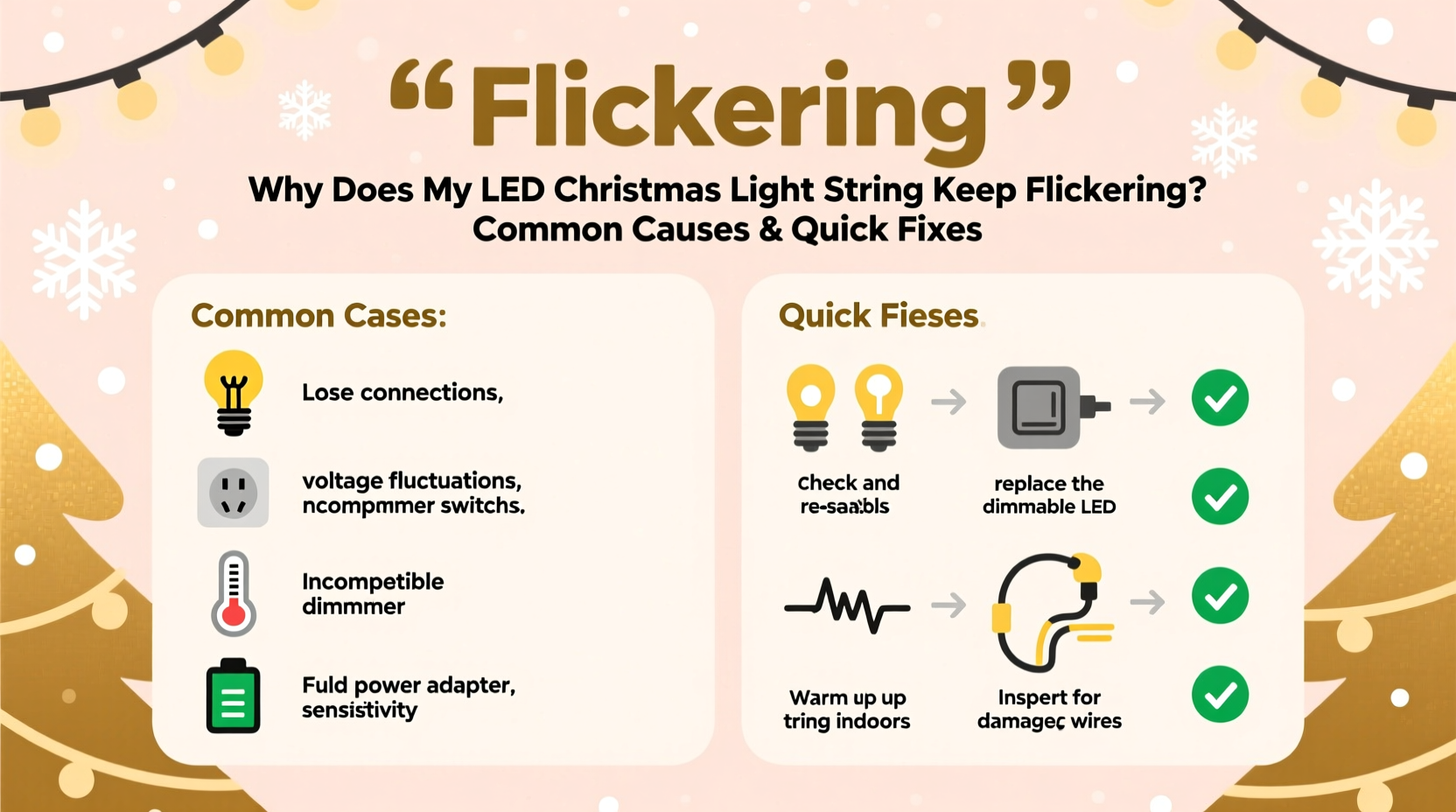
Flickering isn’t random—it usually stems from identifiable sources. Below are the six most common culprits behind unstable LED lighting during the holidays.
- Loose or faulty bulb connections: Even one poorly seated LED can break the circuit, causing sections of the string to blink or go dark.
- Damaged wires or insulation: Cuts, kinks, or rodent-chewed sections expose conductors, leading to short circuits or intermittent contact.
- Incompatible power sources: Using non-recommended extension cords, adapters, or dimmer switches can cause voltage drops.
- Overloaded circuits: Plugging too many strings into a single outlet may exceed its capacity, resulting in fluctuating power delivery.
- Moisture exposure: Outdoor lights exposed to rain, snow, or condensation inside sockets can create conductivity issues.
- End-of-string signal loss: Some LED strings rely on data signals (especially in RGB or programmable sets); signal degradation over long runs leads to flicker or color shifts.
“LEDs are designed for stability, so any flickering is a red flag. It’s rarely normal operation—it’s almost always a symptom.” — Marcus Tran, Electrical Systems Technician with 15 years in residential lighting
Step-by-Step Guide to Fixing Flickering Lights
Before replacing your entire set, follow this systematic approach to identify and resolve the issue efficiently.
- Unplug the light string immediately. Safety first. Never inspect or handle electrical components while powered.
- Inspect each bulb visually. Look for darkened casings, cracked lenses, or loose positioning. Gently press each bulb to ensure it's fully seated.
- Check the wiring path. Run your fingers along the entire length of the cord, feeling for cuts, swelling, or brittle insulation. Pay special attention to areas near plugs and connectors.
- Examine the plug and socket ends. Corrosion, bent prongs, or debris in the female end can interrupt current flow. Clean contacts with a dry cloth or isopropyl alcohol.
- Test with a different outlet. Plug the string into a known-working outlet on a separate circuit to rule out household electrical issues.
- Try a different power source. Replace any extension cords or power strips with heavy-duty, outdoor-rated versions rated for at least 13A.
- Divide long runs. If using multiple connected strings, do not exceed the manufacturer’s recommended number. Use individual circuits instead of daisy-chaining beyond limits.
- Use a multimeter (optional). For advanced users, test continuity across suspect bulbs and check voltage output at various points in the string.
When to Replace vs. Repair
Some LED strings are not user-serviceable. Sealed designs, especially in newer models, make individual bulb replacement impossible. In such cases, attempting repairs may void warranties or create safety hazards. Consider repair only if:
- The set uses replaceable screw-in or push-fit LEDs.
- You have access to exact replacement bulbs.
- The damage is isolated and accessible.
If the flickering persists after basic troubleshooting and the string is under warranty, contact the manufacturer. Many brands offer free replacements within the first two seasons.
Troubleshooting Table: Flicker Type vs. Likely Cause & Solution
| Flicker Pattern | Possible Cause | Recommended Fix |
|---|---|---|
| All lights pulse slowly in unison | Incompatible dimmer switch or transformer | Plug directly into wall outlet; avoid dimmers unless labeled LED-compatible |
| Only part of the string flickers | Loose bulb or broken connection in section | Reseat all bulbs; inspect for damaged wires in affected zone |
| Lights blink rapidly or strobe | Short circuit or moisture ingress | Disconnect and dry thoroughly; inspect for water damage |
| Flickering begins after connecting additional strings | Circuit overload or exceeding max load | Reduce number of daisy-chained units; split across outlets |
| Random blinking, especially outdoors | Weather-related expansion/contraction in connections | Seal connections with waterproof tape; elevate off ground |
Preventative Maintenance Checklist
To minimize future flickering and extend the life of your LED Christmas lights, adopt these habits before, during, and after each holiday season.
- ✅ Store lights on reels or cardboard spools to prevent tangling and wire stress.
- ✅ Label each string by location (e.g., “front porch,” “tree top”) for easier setup next year.
- ✅ Inspect all strings for damage before installation every season.
- ✅ Use only UL-listed extension cords rated for outdoor use when needed.
- ✅ Avoid placing cords under rugs, doors, or where foot traffic can wear them down.
- ✅ Keep connections elevated and angled downward to shed water if used outside.
- ✅ Unplug lights when not in use or during storms to reduce wear and risk of surge damage.
Real Example: A Homeowner’s Flicker Fix
Sarah M., a homeowner in Vermont, noticed her rooftop icicle lights were flickering violently during windy nights. During the day, they worked fine. She tried replacing bulbs and switching outlets, but the issue returned.
After reading about environmental factors, she inspected the string during a gusty evening and discovered the middle section was flapping against a gutter, causing micro-fractures in the insulation. The movement created intermittent contact, leading to erratic behavior. She re-routed the lights using plastic clips to keep them secure and sealed the damaged area with self-fusing silicone tape. The flickering stopped immediately and didn’t return—even in high winds.
Her case highlights how environmental movement combined with minor physical damage can manifest as electrical issues. Simple anchoring prevented what could have become a fire hazard.
Frequently Asked Questions
Is it safe to leave flickering LED Christmas lights plugged in?
No. While occasional flickering due to loose bulbs may not be dangerous, persistent or rapid flashing can indicate overheating, short circuits, or insulation failure. These pose fire risks, especially in dry environments like trees or garlands. Unplug and inspect immediately.
Can I mix LED and incandescent Christmas lights on the same circuit?
Technically yes, but it's not recommended. Incandescent bulbs draw significantly more current and can overload circuits intended for low-wattage LEDs. More importantly, mixing types on daisy-chained strings often causes voltage imbalances that lead to flickering or premature failure in LEDs.
Why do my new LED lights flicker even when they’re brand new?
New lights can flicker due to manufacturing defects, static discharge during shipping, or packaging pressure causing misaligned bulbs. It’s also possible the outlet has dirty power or is shared with large appliances (like refrigerators) that cause brief surges. Test the lights on a different circuit before assuming defect.
Expert Insight: Matching Technology with Application
“The biggest mistake people make is treating all LED strings the same. Indoor decorative strands aren’t built for freezing temperatures or constant UV exposure. Using the wrong type outdoors leads to early failure and flickering. Always check the IP (Ingress Protection) rating and temperature tolerance.” — Lena Pruitt, Lighting Design Consultant, Northern Lightworks Co.
For example, an IP44 rating means protection against solid objects larger than 1mm and splashing water from any direction—suitable for covered porches. For fully exposed locations, aim for IP65 or higher. Ignoring these ratings exposes delicate electronics to conditions they weren't engineered to withstand.
Conclusion: Restore Your Glow with Confidence
Flickering LED Christmas lights don’t have to ruin your holiday spirit. With a methodical approach, most issues can be diagnosed and resolved in under an hour. Start with the basics—bulb seating, cord inspection, and proper power sources—then escalate to circuit checks and environmental fixes as needed.
Remember, consistent maintenance and correct usage are just as important as the initial fix. By storing your lights properly, using compatible accessories, and respecting load limits, you’ll enjoy reliable, radiant displays year after year.




 浙公网安备
33010002000092号
浙公网安备
33010002000092号 浙B2-20120091-4
Comments
No comments yet. Why don't you start the discussion?