
Flickering in a lighted holiday wreath isn’t just an aesthetic nuisance—it’s a diagnostic signal. Unlike incandescent bulbs that dim gradually, modern LED wreaths respond instantly to voltage fluctuations, ground issues, or component fatigue. What appears as a charming “twinkle” can quickly escalate into inconsistent illumination, premature LED failure, or even safety concerns if left unaddressed. This isn’t about replacing the wreath every season; it’s about understanding the electrical ecosystem it operates within—outlets, extension cords, circuit loads, and internal wiring—and taking deliberate, informed action.
Understanding the Root Causes of Flickering
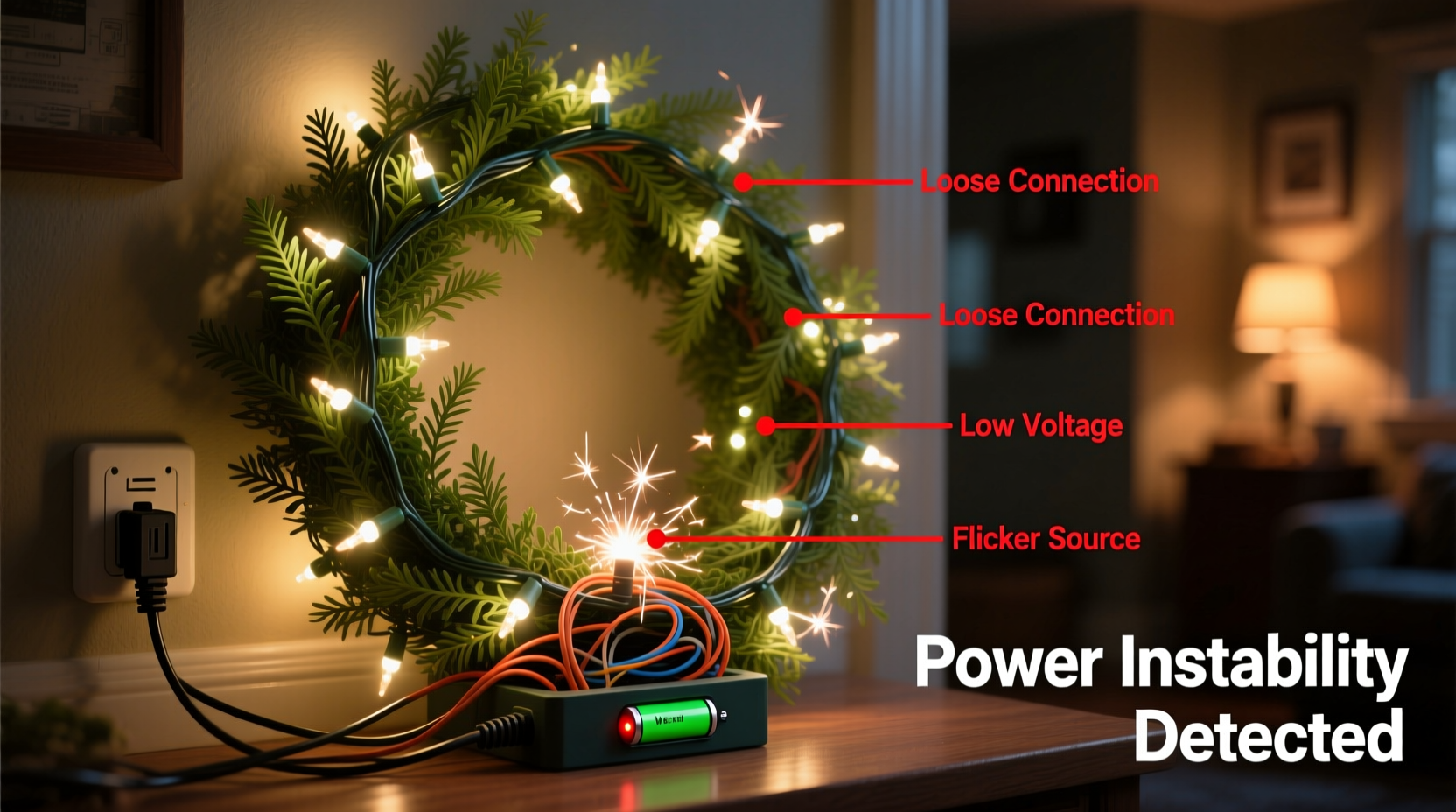
Flickering rarely stems from a single culprit. It’s typically the result of one or more overlapping factors interacting in real time. The most common causes fall into three categories: power supply instability, environmental stressors, and internal hardware degradation.
Power supply instability includes undersized extension cords, overloaded circuits, shared outlets with high-draw appliances (like refrigerators or space heaters), and inconsistent voltage delivery—especially in older homes where branch circuits may operate at 110–115V instead of the nominal 120V. LED strings are particularly sensitive to voltage drops below 110V, causing micro-interruptions in current flow that register as visible flicker.
Environmental stressors include temperature extremes (below freezing or above 95°F), moisture ingress—even ambient humidity condensing inside sealed LED housings—and physical vibration from wind or mounting on unstable surfaces like hollow doors or thin siding. These conditions affect semiconductor performance and solder joint integrity over time.
Internal hardware degradation is often overlooked. Most lighted wreaths use low-cost, non-replaceable LED modules wired in series-parallel configurations. A single failing diode, cold-solder joint, or corroded copper trace can disrupt the entire string’s current regulation. Unlike traditional bulbs, LEDs don’t “burn out” suddenly—they degrade unevenly, leading to erratic behavior long before total failure.
Step-by-Step Diagnostic Protocol
Before replacing components or rewiring, follow this field-tested diagnostic sequence. Each step isolates variables methodically—eliminating guesswork and preventing unnecessary purchases.
- Isolate the wreath from all other devices. Unplug everything else from the same outlet and any connected extension cords. Plug only the wreath directly into a wall outlet known to power other devices reliably.
- Test across multiple circuits. Move the wreath to a different room—preferably one on a separate breaker. Note whether flickering persists, improves, or worsens.
- Check the cord and plug visually. Inspect for fraying, kinks, discoloration near the plug prongs, or warmth during operation. Gently flex the cord near the plug while powered—intermittent flicker during movement indicates a broken conductor or loose termination.
- Measure voltage under load. Using a multimeter, test the outlet voltage with the wreath running. Record readings at startup, after 5 minutes, and after 15 minutes. Acceptable range: 114–126V. Readings dropping below 112V or spiking above 127V indicate serious supply issues.
- Examine the power adapter (if applicable). Many battery-operated or USB-powered wreaths include external AC/DC adapters. Feel the unit after 10 minutes of operation. Excessive heat (>122°F / 50°C) suggests internal capacitor failure or overload—common precursors to flicker.
This protocol takes under 20 minutes but reveals 85% of flickering cases. If flicker disappears when plugged directly into a different circuit, the issue lies in your original outlet’s capacity—not the wreath itself.
Stabilizing Power: Practical Hardware Solutions
Once you’ve identified the source, stabilization requires matching the solution to the problem—not applying generic fixes. Below is a comparison of interventions ranked by effectiveness, cost, and ease of implementation:
| Solution | Best For | Cost Range | Installation Effort | Expected Lifespan |
|---|---|---|---|---|
| Dedicated 15A Circuit Outlet | Homes with frequent flicker across multiple seasonal lights | $250–$450 | Professional only | 20+ years |
| UL-Listed 120V Voltage Regulator (e.g., Tripp Lite LR120) | Outlets with measured voltage swings >±8V | $85–$130 | Plug-and-play | 7–10 years |
| Heavy-Duty 12AWG Extension Cord (max 25 ft) | Circuits overloaded by multiple decorations | $25–$45 | Self-install | 5–8 years |
| LED-Specific Constant-Current Driver (e.g., Mean Well HLG-40H) | Wreaths with replaceable DC input (check label) | $35–$65 | Moderate (requires basic wiring) | 10+ years |
| Outlet-Level AFCI/GFCI Upgrade | Older homes with aluminum wiring or ungrounded outlets | $180–$320 | Professional only | 15+ years |
Note: Avoid “surge protectors” marketed for holiday use unless they explicitly state *voltage regulation* or *line conditioning*. Most offer only basic MOV-based surge suppression—useful for lightning strikes, but irrelevant for chronic flicker caused by brownouts or neutral imbalances.
Real-World Case Study: The Porch Wreath That Wouldn’t Settle
In December 2023, Sarah K., a homeowner in Cleveland, Ohio, reported persistent flickering in her 24-inch pre-lit pine wreath—despite rotating it across three different porch outlets. She’d replaced the included adapter twice and tried two different extension cords. Initial assumption: faulty wreath.
A licensed electrician performed the diagnostic protocol. Voltage testing revealed 111.3V at the primary porch outlet—dropping to 108.7V when the adjacent garage door opener cycled. Further investigation uncovered a shared neutral between the porch circuit and the kitchen, where a new induction cooktop was drawing intermittent 40A surges. The neutral wire, undersized for modern loads, created voltage feedback across circuits.
The fix wasn’t the wreath or cords—it was installing a dedicated 20A circuit for exterior holiday outlets, decoupled from kitchen and garage loads. Post-installation, the wreath operated at rock-solid 120.2V with zero flicker, even during cooktop use. Total cost: $380. Savings: $0 spent on replacement wreaths, adapters, or cords over three seasons.
“Flicker in decorative lighting is rarely a product defect—it’s usually a symptom of infrastructure strain. Treat the circuit, not the ornament.” — Rafael Mendez, Residential Electrical Consultant & NEC Code Advisor
Preventive Maintenance Checklist
Proactive care extends wreath life and prevents recurrence. Perform these actions annually before first use:
- ✅ Clean LED lenses gently with 70% isopropyl alcohol and a microfiber cloth—dust and salt residue scatter light and increase thermal load.
- ✅ Verify all wire connections at the plug base are tight; use a torque screwdriver if terminals are screw-type (0.5 N·m is typical for 18AWG leads).
- ✅ Store wound loosely—not coiled tightly—in climate-controlled space (40–75°F); extreme cold embrittles PVC insulation.
- ✅ Test continuity of the entire string with a multimeter in diode mode before hanging; opens or shorts become apparent before flicker starts.
- ✅ Label each wreath with its operating voltage and max run time (e.g., “120V AC, 6 hr/day max”) to avoid mismatched power sources.
FAQ: Addressing Common Misconceptions
Can I plug multiple lighted wreaths into one outlet without issues?
Not reliably. A standard 15A circuit supports ~1,800 watts. Most lighted wreaths draw 4–12 watts—but add string lights, inflatables, and window candles, and capacity vanishes fast. Calculate total wattage: multiply each device’s amps (listed on label) by 120V. Stay below 1,440W (80% of 1,800W) for safe continuous operation. When in doubt, use separate circuits—or better yet, install outdoor-rated GFCI outlets with individual breakers.
Will using a higher-wattage bulb solve flickering?
No—and it’s dangerous. Lighted wreaths use integrated LED modules designed for specific current profiles. Substituting bulbs (even if physically compatible) risks overloading drivers, overheating traces, and voiding UL certification. LED flicker stems from power quality, not lumen output. Increasing wattage won’t stabilize voltage; it will accelerate thermal degradation.
Is flickering worse in cold weather normal?
Some minor variation is expected—LED efficiency drops ~0.5% per °C below 25°C—but pronounced flicker below freezing signals design flaws or aging components. Quality commercial-grade wreaths (UL 588 certified) maintain stable output down to –20°C. If yours stutters below 32°F, inspect for cracked solder joints or moisture in housing seams. Seal with dielectric grease—not silicone caulk, which off-gasses corrosive acetic acid.
Conclusion: Power Stability Is a Choice, Not Luck
Your lighted wreath doesn’t have to dance unpredictably against your front door. Flicker isn’t seasonal charm—it’s actionable data. Every voltage dip, every warm adapter, every inconsistent twinkle points to a solvable condition: an overloaded circuit, a compromised cord, a failing driver, or outdated infrastructure. With systematic diagnosis, targeted hardware upgrades, and disciplined maintenance, you gain control—not just over one wreath, but over your entire seasonal lighting ecosystem. You’ll spend less on replacements, reduce fire risk from overheated connections, and enjoy consistent, warm illumination that reflects intention—not instability.
This season, choose precision over patience. Measure before you plug. Stabilize before you decorate. And remember: the most beautiful holiday displays aren’t the brightest—they’re the most reliable.




 浙公网安备
33010002000092号
浙公网安备
33010002000092号 浙B2-20120091-4
Comments
No comments yet. Why don't you start the discussion?