
Sitting for prolonged periods has become a hallmark of modern work life. Whether at a desk, in front of a screen, or commuting, many people spend eight or more hours each day seated. While convenient, this sedentary behavior places significant strain on the lower back. Over time, poor posture, weakened muscles, and tight connective tissues contribute to chronic discomfort. The good news is that most cases of lower back pain from sitting are preventable and reversible with targeted movement and awareness.
This article explores the biomechanics behind why your lower back hurts after long sitting sessions and provides practical, science-backed stretches you can do daily—even at your desk—to restore mobility, reduce tension, and support spinal health.
The Science Behind Sitting and Lower Back Pain
When you sit, especially in a slouched or unsupported position, your pelvis tilts backward. This posterior pelvic tilt flattens the natural curve of your lumbar spine—the inward arch that helps distribute weight evenly. Without this curve, pressure concentrates on the discs and joints in the lower back, leading to irritation and inflammation over time.
Additionally, sitting shortens the hip flexors—muscles at the front of your hips that connect your thighs to your lower spine. When these muscles tighten, they pull the pelvis forward into an anterior tilt, exaggerating the lumbar curve and compressing vertebrae. This imbalance often leads to muscle spasms, disc issues, and nerve irritation.
At the same time, the glutes and core muscles weaken from disuse. These stabilizing muscles normally support upright posture and absorb shock during movement. When inactive, other structures—including ligaments and spinal discs—bear loads they aren’t designed to handle.
“Prolonged sitting alters spinal mechanics and neuromuscular control. It’s not just about comfort—it’s about long-term musculoskeletal integrity.” — Dr. Lena Patel, Physical Therapist and Spine Health Specialist
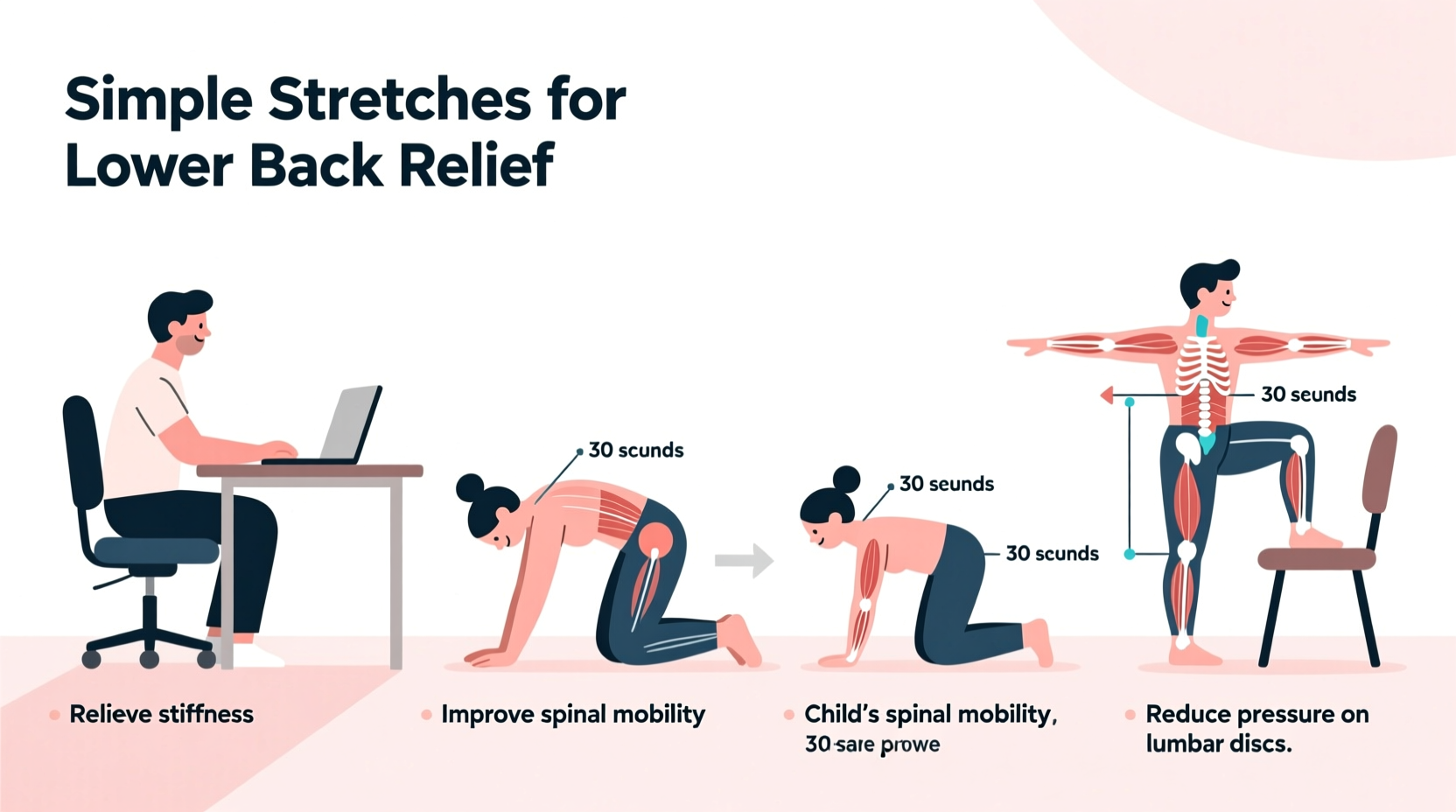
Simple Stretches That Help Relieve Lower Back Tension
Stretching isn’t just for athletes. For desk workers, regular stretching breaks reset muscle length, improve circulation, and retrain posture. Below are five foundational stretches proven to counteract the effects of prolonged sitting.
1. Seated Forward Bend (Paschimottanasana)
A gentle stretch targeting the entire back line of the body, including the hamstrings and lower back.
- Sit on the floor with legs extended straight in front.
- Inhale and lengthen your spine.
- Exhale and hinge at the hips, reaching hands toward your toes.
- Keep your back straight; avoid rounding excessively.
- Hold for 30 seconds, breathing deeply.
Repeat 2–3 times. If you can't reach your toes, use a strap or towel around your feet.
2. Cat-Cow Stretch (Marjaryasana-Bitilasana)
Dynamically mobilizes the spine and improves segmental movement.
- Kneel on the floor, hands under shoulders, knees under hips.
- Inhale: Arch your back (cow), lifting your tailbone and gaze upward.
- Exhale: Round your spine (cat), tucking your chin and pelvis.
- Move slowly and fluidly between positions for 1 minute.
This sequence warms up stiff spinal joints and reduces stiffness after long sitting spells.
3. Knees-to-Chest Stretch (Apanasana)
Relieves compression in the lumbar spine by gently decompressing the discs.
- Lie on your back with knees bent and feet flat.
- Bring both knees toward your chest, hugging them with your arms.
- Press your lower back into the floor and hold for 20–30 seconds.
- Release slowly and repeat 3 times.
For deeper release, try one knee at a time while keeping the opposite leg extended.
4. Piriformis Stretch (Figure-Four Stretch)
Tight piriformis muscles—deep in the buttocks—can irritate the sciatic nerve and mimic lower back pain.
- Lie on your back, knees bent.
- Cross your right ankle over your left thigh, forming a “4” shape.
- Grab behind your left thigh and gently pull it toward your chest.
- Feel the stretch in your right buttock. Hold for 30 seconds.
- Switch sides.
Perform this stretch once daily, especially if you experience radiating pain down the leg.
5. Child’s Pose (Balasana)
A restorative pose that elongates the lower back and encourages relaxation.
- Kneel on the floor, big toes touching, knees wide.
- Sit your hips back toward your heels.
- Extend your arms forward and lower your chest toward the ground.
- Breathe deeply for 1–2 minutes.
This pose gently reverses spinal compression caused by sitting and calms the nervous system.
Posture Habits That Prevent Lower Back Ache
Stretching alone won’t fix the root cause if your daily habits remain unchanged. Sustainable relief comes from integrating better posture and movement patterns throughout the day.
- Sit with support: Use a lumbar roll or small pillow to maintain the natural curve of your lower back.
- Adjust your workstation: Ensure your monitor is at eye level and your elbows form a 90-degree angle when typing.
- Stand every 30–60 minutes: Set a timer to stand, walk, or stretch briefly.
- Engage your core: Gently draw your navel toward your spine during sitting to activate deep abdominal muscles.
- Avoid crossing your legs: This creates pelvic asymmetry and increases lower back strain.
Mini Case Study: Sarah’s Recovery from Chronic Desk Pain
Sarah, a 34-year-old graphic designer, experienced persistent lower back pain after transitioning to full-time remote work. She sat for up to 10 hours daily, often leaning forward to view her second monitor. Within three months, she developed sharp pain near her sacrum, especially after lunchtime.
After consulting a physical therapist, Sarah implemented two changes: she added a lumbar cushion to her chair and began doing five minutes of cat-cow and knees-to-chest stretches every morning and before bed. She also set a phone reminder to stand and walk for two minutes every hour.
Within four weeks, her pain decreased by 70%. By week six, she no longer needed over-the-counter pain relievers. Her case highlights how minor, consistent adjustments can yield major improvements without invasive treatment.
Do’s and Don’ts of Managing Lower Back Pain from Sitting
| Do | Don’t |
|---|---|
| Take micro-breaks every hour to stand or stretch | Sit for more than 90 minutes without moving |
| Use a supportive chair with lumbar padding | Slouch or lean on one hip |
| Strengthen core muscles with planks or bridges | Rely solely on painkillers without addressing cause |
| Practice diaphragmatic breathing to relax tense back muscles | Stretch aggressively through sharp pain |
| Stay hydrated to maintain disc elasticity | Ignore numbness or tingling in legs |
Your Daily Action Checklist
To make lasting progress, consistency matters more than intensity. Use this checklist to build sustainable habits:
- ✅ Sit with proper lumbar support
- ✅ Stand or walk for 2 minutes every hour
- ✅ Perform 3–5 minutes of stretching upon waking
- ✅ Do 2–3 seated or floor stretches during work breaks
- ✅ Practice 5 deep belly breaths before starting work
- ✅ End your day with child’s pose or knees-to-chest stretch
- ✅ Assess your workspace ergonomics monthly
Frequently Asked Questions
How long does it take for lower back pain from sitting to go away?
Mild to moderate discomfort often improves within 2–6 weeks when you consistently apply corrective stretches, improve posture, and increase movement. Chronic pain lasting more than three months may require professional evaluation, but most cases respond well to lifestyle adjustments.
Can stretching make lower back pain worse?
Yes—if done incorrectly. Avoid bouncing or forcing a stretch, especially if you feel sharp pain. Stretching should produce mild tension, not agony. If pain increases, stop and consult a healthcare provider. People with herniated discs or spinal stenosis may need modified routines.
Is walking enough to prevent lower back pain?
Walking is excellent for circulation and joint lubrication, but it doesn’t replace targeted stretching or core strengthening. Combine walking with flexibility and stability exercises for optimal results. Aim for 30 minutes of brisk walking daily, plus 10 minutes of stretching.
Conclusion: Move More, Hurt Less
Lower back pain after sitting isn’t inevitable—it’s a signal from your body that movement is overdue. The spine thrives on variety: bending, twisting, extending, and resting in balanced alignment. By incorporating simple, effective stretches into your routine and adjusting how you sit, you reclaim control over your comfort and long-term health.
You don’t need a gym membership or hours of free time. Five minutes of intentional movement can interrupt the cycle of stiffness and pain. Start today. Your future self will move with greater ease, strength, and confidence.




 浙公网安备
33010002000092号
浙公网安备
33010002000092号 浙B2-20120091-4
Comments
No comments yet. Why don't you start the discussion?