
If you’ve ever applied foundation with care, only to notice within hours that your makeup is cracking, sliding, or forming unsightly patches—especially on your nose—you’re not alone. The nose is one of the most common areas where makeup separation occurs, and while oil production and skin texture play roles, the real culprit often lies in how (and whether) you're using primer. Many people apply primer without understanding its purpose or making subtle but critical mistakes that sabotage their entire base. This article breaks down exactly why your makeup separates on your nose, highlights the most overlooked primer errors, and delivers actionable solutions backed by skincare and makeup professionals.
The Science Behind Makeup Separation on the Nose
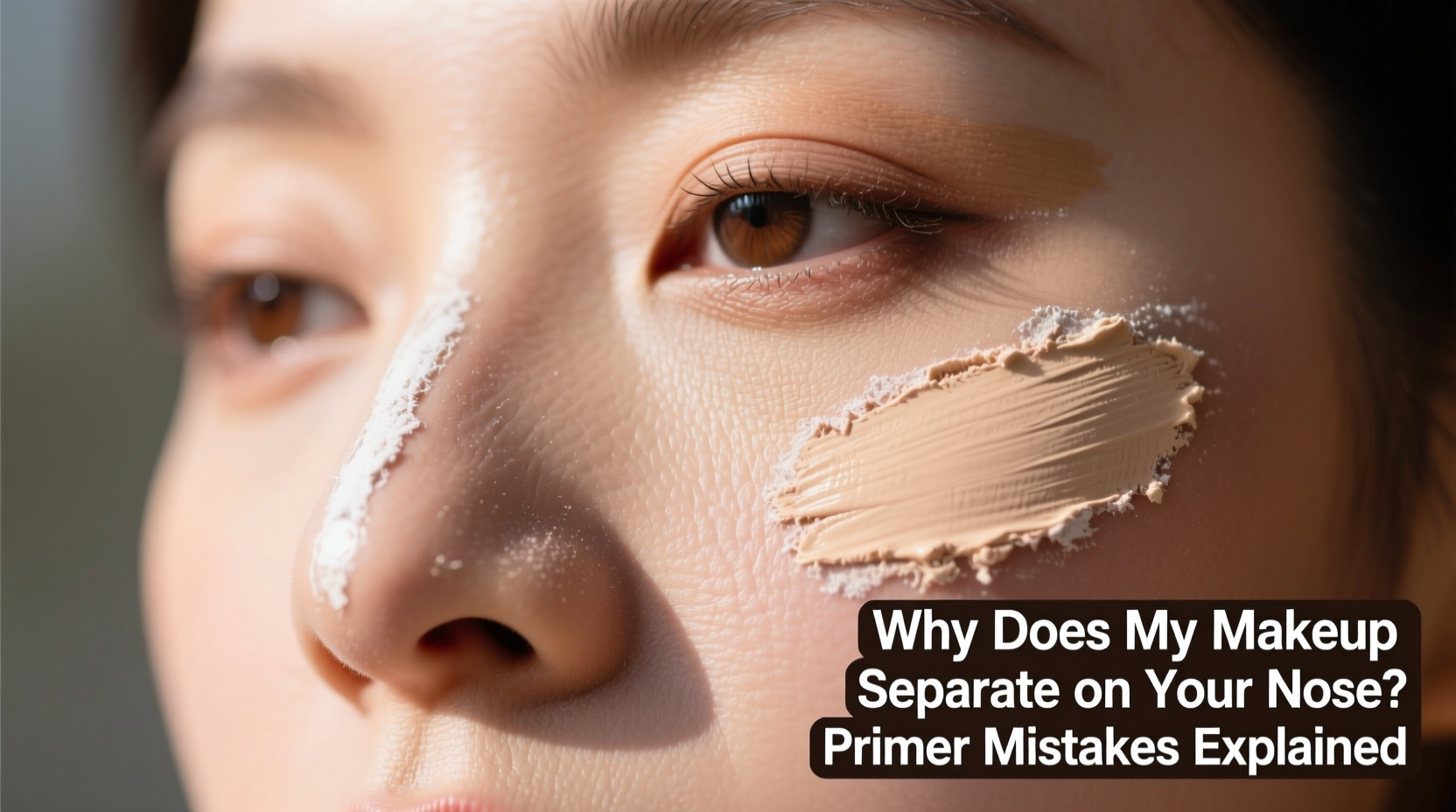
The nose occupies a unique zone on the face—both anatomically and dermatologically. It sits at the center of the T-zone, an area rich in sebaceous (oil-producing) glands. These glands are naturally more active here than on other parts of the face, which means increased oil secretion throughout the day. When oil rises to the surface, it disrupts the bond between your skin and makeup, leading to breakdown, pilling, and separation.
Beyond oil, the nose has a distinct topography. It’s convex, often textured with visible pores, blackheads, or slight bumps. Foundation and primers can pool in these micro-imperfections or slide off the curved surface if not properly prepped. Additionally, frequent touching—adjusting glasses, wiping sweat, or subconscious rubbing—adds physical friction that accelerates product wear.
But even with oily skin and high-touch habits, well-applied primer should create a stable canvas. When it doesn’t, the issue usually isn’t your skin—it’s your technique.
5 Common Primer Mistakes That Cause Nose Separation
Primer is meant to extend wear, smooth texture, and control oil—but when used incorrectly, it can do the opposite. Below are the most frequent missteps that lead to makeup failure on the nose.
1. Applying Primer to Damp or Incompletely Absorbed Skincare
One of the biggest mistakes is layering primer over moisturizer or serum that hasn’t fully soaked into the skin. When products don’t absorb completely, they create a slippery base. As you apply primer, it mixes with residual moisture or oils, forming a barrier that repels foundation instead of bonding with it. On the nose, where product buildup is already likely, this causes immediate pilling.
“Allow each skincare layer to absorb for at least 60 seconds before moving to the next. Rushing leads to emulsion breakdown.” — Dr. Lena Torres, Cosmetic Dermatologist
2. Using the Wrong Type of Primer for Your Skin
Not all primers are created equal. Silicone-based primers work well for minimizing large pores but can trap oil underneath if overapplied. Water-based primers suit dry skin but may slip on oily complexions. Using a hydrating primer on oily skin is like pouring water on grease—it increases slippage.
3. Overapplying Primer
More is not better. A pea-sized amount should cover the entire face. On the nose, excess primer gathers in crevices and mixes with sebum, creating a greasy film that pushes foundation apart. Over time, this leads to caking at the sides and separation across the bridge.
4. Skipping Pore Preparation
If your pores are clogged or filled with debris, primer sits on top rather than smoothing over them. This creates a bumpy surface where makeup catches and cracks. Regular exfoliation and deep cleansing are essential prep steps often ignored.
5. Mixing Incompatible Formulations
Combining silicone-heavy primers with water-based foundations—or vice versa—can cause repellency. The ingredients literally resist blending, leading to pilling and patchiness. This reaction is amplified on textured zones like the nose.
Do’s and Don’ts of Nose Primer Application
| Do’s | Don’ts |
|---|---|
| Use a lightweight, mattifying primer formulated for oily zones | Apply heavy amounts directly onto the nose |
| Let moisturizer absorb fully (wait 1–2 minutes) | Layer products while skin still feels damp |
| Focus application on the sides of the nose, not just the bridge | Ignore the nasolabial folds and inner corners |
| Use fingertips for warmth and better adhesion | Use stiff brushes that don’t press product into skin |
| Set primer lightly with translucent powder before foundation | Apply foundation immediately over slick primer |
Step-by-Step Guide to Prevent Nose Makeup Separation
Follow this routine to build a long-lasting, seamless base that stays intact—even on your nose.
- Cleanse Thoroughly: Use a gentle foaming cleanser to remove excess oil and impurities, especially around the nose. Rinse with lukewarm water.
- Exfoliate 2–3 Times Weekly: Use a chemical exfoliant with salicylic acid (0.5%–2%) to unclog pores and smooth texture. Avoid harsh scrubs that irritate the skin.
- Hydrate with a Lightweight Moisturizer: Choose an oil-free, non-comedogenic formula. Apply evenly and wait two minutes for full absorption.
- Select the Right Primer: Opt for a mattifying or pore-filling primer with silica or clay. Avoid heavy silicones if you’re prone to pilling.
- Apply Sparingly: Take a rice-grain-sized amount and warm it between your fingers. Gently press—don’t rub—onto the nose, focusing on areas with visible pores.
- Wait Before Foundation: Allow primer to set for 60 seconds. You should feel a slight velvety drag, not slipperiness.
- Prime Strategically: If your T-zone is oily but cheeks are dry, only prime the nose, forehead, and chin.
- Set Lightly: Dust a translucent setting powder just on the nose using a small puff or sponge for maximum adherence.
- Apply Foundation with Precision: Use a damp beauty sponge or stippling brush to press product into the skin rather than dragging it.
- Finish with Setting Spray: Lock everything in with a matte or hybrid finishing spray to prevent midday breakdown.
Real-Life Case Study: Sarah’s Nose Makeup Fix
Sarah, a 32-year-old marketing executive, struggled daily with her foundation separating on her nose by 11 a.m., despite using high-end products. She washed her face twice daily, applied a hydrating serum, moisturizer, sunscreen, primer, and foundation—yet still experienced flaking and oiliness.
After consulting a makeup artist, she discovered three key issues: she was using a silicone-heavy primer over a creamy moisturizer without waiting for absorption, applying too much product on her nose, and using a water-based foundation incompatible with her primer.
Her revised routine: switched to a gel moisturizer, waited two minutes after application, used a mattifying primer with clay, applied a tiny amount only to problem areas, and switched to a silicone-compatible foundation. She also began using a weekly salicylic acid treatment.
Result: Her makeup now lasts eight hours without separation, and touch-ups are minimal. “I didn’t realize I was working against my own products,” she said. “Fixing the order and compatibility made all the difference.”
Expert Tips for Long-Lasting Nose Coverage
- Double-Prime Method: Some artists recommend a hybrid approach—first a hydrating primer on dry areas, then a targeted mattifying primer just on the nose. Let each layer set before adding the next.
- Blurring Primers Are Not Always Better: While popular for their Instagram-ready finish, blurring primers often contain high levels of dimethicone that can pill when layered improperly.
- Temperature Matters: Cold fingers help calm oil production during application. Try storing your primer in the fridge during summer months.
- Reevaluate Seasonally: Your winter primer may be too heavy for humid summers. Rotate formulas based on climate and skin needs.
“The nose is the litmus test for a good makeup application. If it fails there first, the issue is almost always preparation.” — Jamal Reeves, Celebrity Makeup Artist
Checklist: Prevent Nose Makeup Separation
Use this checklist every morning to ensure your base stays intact:
- ✅ Cleanse and exfoliate (2–3x/week)
- ✅ Apply lightweight, oil-free moisturizer
- ✅ Wait 2 minutes for absorption
- ✅ Use a pea-sized amount of appropriate primer
- ✅ Focus on nose sides and bridge with gentle pressing motion
- ✅ Wait 60 seconds before foundation
- ✅ Set with translucent powder
- ✅ Use compatible foundation formula
- ✅ Finish with setting spray
- ✅ Carry blotting papers for midday touch-ups
Frequently Asked Questions
Can I skip primer on my nose if I have oily skin?
No—skipping primer often worsens the problem. Oily skin benefits from mattifying primers that absorb sebum and create a grip for foundation. Just choose a lightweight, non-comedogenic option and apply sparingly.
Why does my makeup pill only on my nose and not elsewhere?
The nose has higher oil production, more frequent touch contact, and concentrated pores. Combined with improper primer use, these factors make it a hotspot for separation. Other areas may stay intact simply because they’re less active and textured.
Is there a way to fix separated makeup without starting over?
Yes. Gently blot excess oil with a tissue or blotting paper. Avoid wiping, which spreads the mess. Then, lightly press a small amount of setting powder onto the affected area. Spritz setting spray and let it dry naturally—this can meld the separated layers back together.
Conclusion: Master Your Base, Starting with the Nose
Your makeup shouldn’t fail within hours, especially not in such a prominent area. The root cause of nose-specific separation often traces back to primer misuse—wrong type, wrong amount, wrong timing. By refining your prep routine, choosing compatible products, and applying with precision, you can achieve a smooth, lasting finish that holds up through meetings, commutes, and celebrations.
It’s not about buying more products; it’s about using what you have more intelligently. Start tonight by auditing your current primer and comparing it to your skin type and foundation. Tomorrow, try the step-by-step method outlined here. Small changes yield dramatic results.




 浙公网安备
33010002000092号
浙公网安备
33010002000092号 浙B2-20120091-4
Comments
No comments yet. Why don't you start the discussion?